.jpg)
.jpg)
I’m sure by now you know ISO 14001 is basically the gold standard for setting up a solid environmental plan at your company.
But to put it in everyday terms, it is the difference between a business hoping they aren't breaking any environmental laws, and a business that knows their exact process of how they dump their waste and much more. It puts being eco-friendly right into your daily operations.
And choosing to go for ISO 14001 certification makes a lot of sense. According to resources shared by the U.S. Environmental Protection Agency (EPA), businesses that use an environmental management system report fewer incidents, much faster response times, and a highly aware workforce making eco-friendly decisions every day.
But even when leaders know how great this system is, they usually hesitate to make that move. They wait because they just don’t know what the actual cost of ISO 14001 is.
So, let's clear the air and look at the real numbers.
In this blog, we are going to break down exactly what getting certified costs in 2026. We will walk through the total cost breakdown depending on how big your business is, look at the sneaky hidden costs that can catch you off guard, and talk about the real return on your investment.
Let’s dive right in and look at the actual numbers.
%20(5).png)
I will keep it simple. For most businesses in 2026, the total cost for certification usually falls between $10,000 USD and $50,000+ USD.
The starting cost can even reach $100,000 USD for just one location. This happens because the more complicated your work is, the more time an auditor needs to spend checking your systems. If your business deals with risky materials or massive factory lines, the process naturally takes much longer.
That is why businesses nowadays prefer ISO 14001 compliance software. It keeps all your paperwork organized in one digital spot before the auditor even shows up. This stops audit hours and bills from spinning out of control.
Of course, there are always exceptions to the rule. In some rare cases, a very small business with simple operations and minimal outside help might get certified closer to $8,000 USD.
But for most businesses, especially if you want to set things up properly from the start, the investment usually goes higher than that.
I’ll walk you through where every dollar goes.
%20(4).png)
Now, let’s break this down so you can clearly see what you are actually paying for. This is not a single fee; the total cost comes from several parts, and each one matters. Each of these steps is a core requirement of the overall ISO 14001 certification process.
How a business allocates resources across these phases plays a key role in long-term technical efficiency. This is especially true for documentation and auditing.
Here is where those investments go:
This is where everything starts. You pay a basic fee to the certification body to begin the process and plan your audit.
It is a small part of the total cost, but it officially starts your certification journey.
Think of this as a first check.
The auditor looks at your documents and systems to see if you are ready. They are not judging everything yet. They are just finding gaps.
You do pay for this audit, usually less than the main audit, and it counts toward your overall 3-year cost.
If something is missing, you get time to fix it before moving ahead.
This is the main audit.
The auditor checks how your business actually runs. They look at your processes, your records, and how your team follows the system.
This is not just about documents. It is about what you actually do every day.
Stage 2 is usually the biggest chunk of your total certification cost.
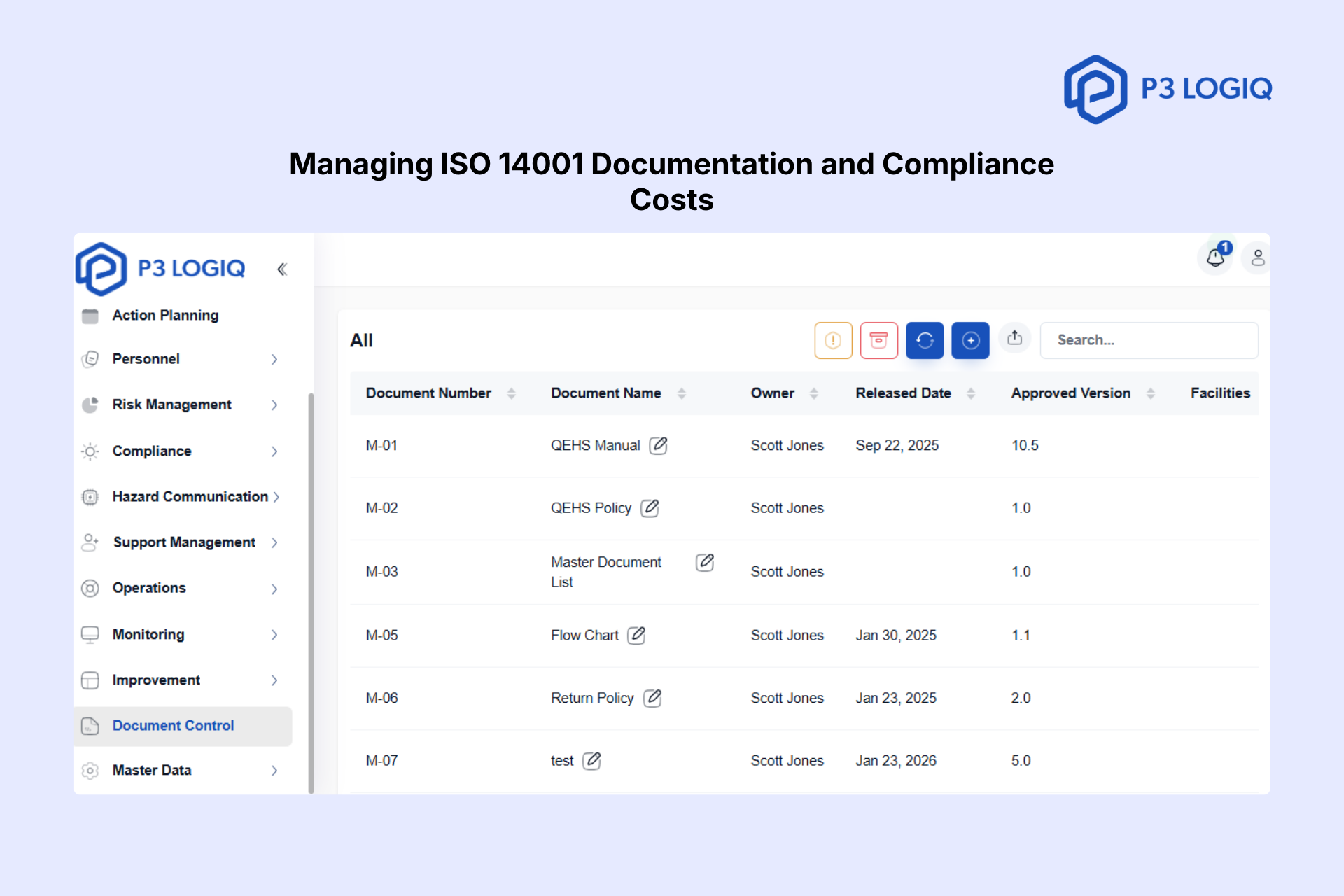
This is where many businesses spend more than they expect.
You need clear policies, procedures, and records to show how your system works.
If you already have a system, this cost is lower. Starting from scratch can become a major part of your total cost, especially if you hire outside help. This is where choosing the best ISO 14001 software solutions can simplify documentation and reduce manual effort.
Your team needs to understand the system.
That means basic training and internal checks. Even if you are not paying someone directly, the time you spend adds to your overall cost. It helps you find and fix problems before the final audit.
Getting certified is not the end. You have to maintain it.
Smaller audits happen every year to ensure you are following the system. These paid audits continue over the 3-year cycle and are part of your total cost.
These are the small things that quietly add up.
Auditor travel, hotel stays, and your team’s time spent fixing issues all contribute to your total budget. Many people forget these when planning, but they can make a noticeable difference.
When people ask about the cost, they usually think it is a one-time fee.
However, it is spread across different stages of the certification process over a 3-year cycle.
The cost covers setup, the main audit, and ongoing work to maintain the system.
For most businesses in the US, the total cost is $10,000 USD and $50,000+ USD.
Smaller businesses with simple operations may spend around $8,000 to $12,000 USD, while costs increase for businesses operating from multiple locations and with more complex operations.
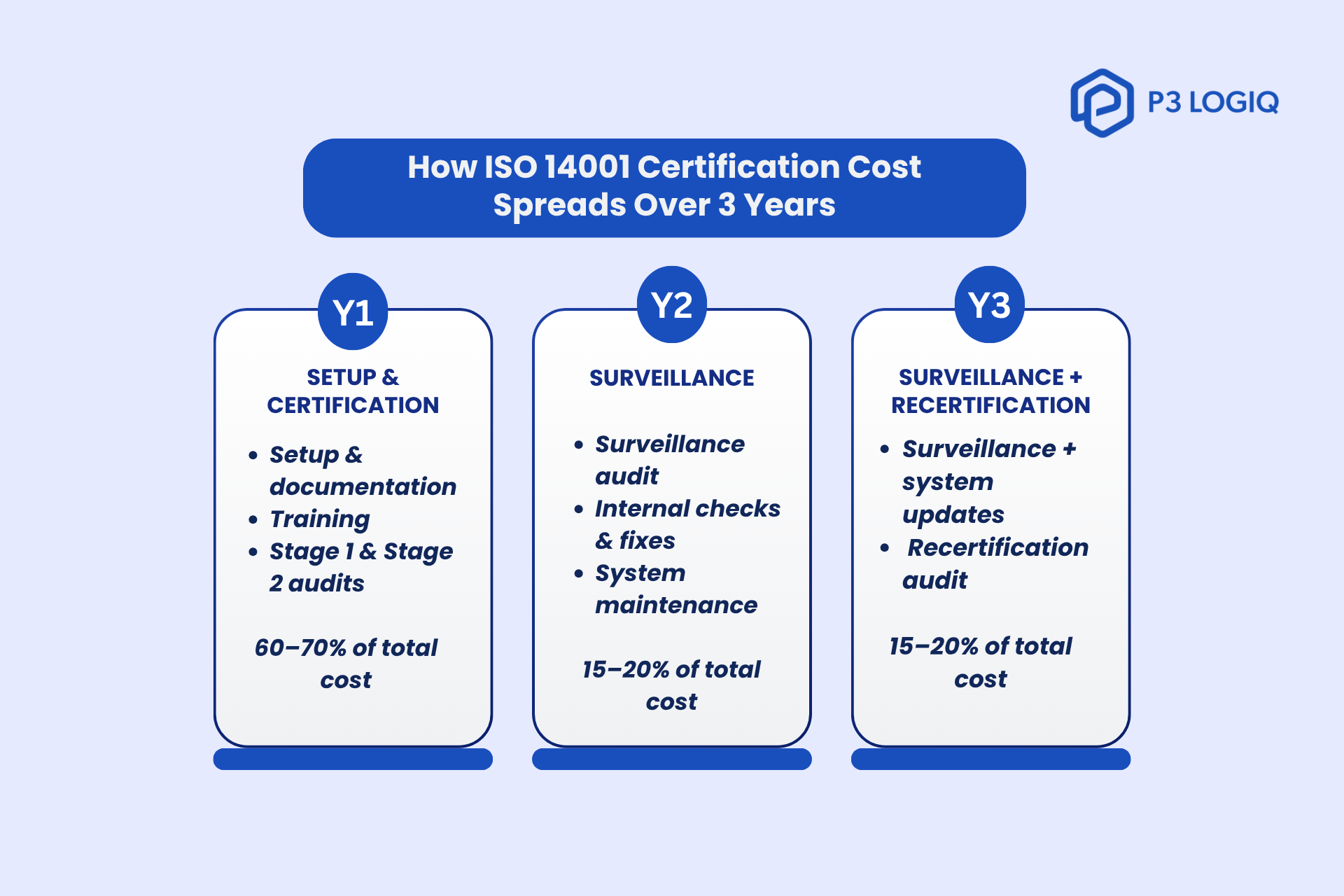
You do not pay everything at once. It usually breaks down like this:
Small business: single location, minimal outside help: $8,000 USD to $15,000 USD over 3 years.
Mid-sized: moderate complexity, some external support: $15,000 USD to $35,000 USD.
Large/complex: multiple locations, higher-risk operations: $35,000 USD to $50,000+ USD.
No two businesses operate the same way.
Your price depends on locations, complexity, and existing systems. Two companies in the same industry can still pay very different amounts.
Many businesses think that paying the auditor is the only cost. They assume once the audit is finished, the work is done.
But in reality, the cost includes a few key elements that support the full process. Such as:
Setting up your system and training your team often costs more than the audit itself. The US EPA notes that significant time and money are spent on preparation. If you do not plan for this internal work, the final bill can come as a big surprise
You only get the real benefit if you keep the system running. The American Society for Quality (ASQ) says ISO 14001 can help businesses cut waste and save energy. But these savings only happen if you do your yearly check-ups. If you let the system "sit idle" after the first year, all the money you spent building it goes to waste. Following the system for the full three years is the only way to get your money’s worth.
.png)
Every company is different, so the price is never the same. These are the main things that change your final bill.
The bigger your company, the higher the cost. More offices, factories, or warehouses mean more audits and more travel for auditors. In 2026, travel costs are a major factor for US businesses with multiple sites.
If your work has a big environmental impact, like manufacturing or chemical processes, the certification costs more. Simple, low-risk operations are cheaper because there is less to check and document. The auditor has to spend more time on risky jobs, which increases the price.
If you already have some environmental policies and records, your cost will be lower. Starting from scratch takes more time, effort, and sometimes outside help. This increases your total cost because you have to build everything from zero.
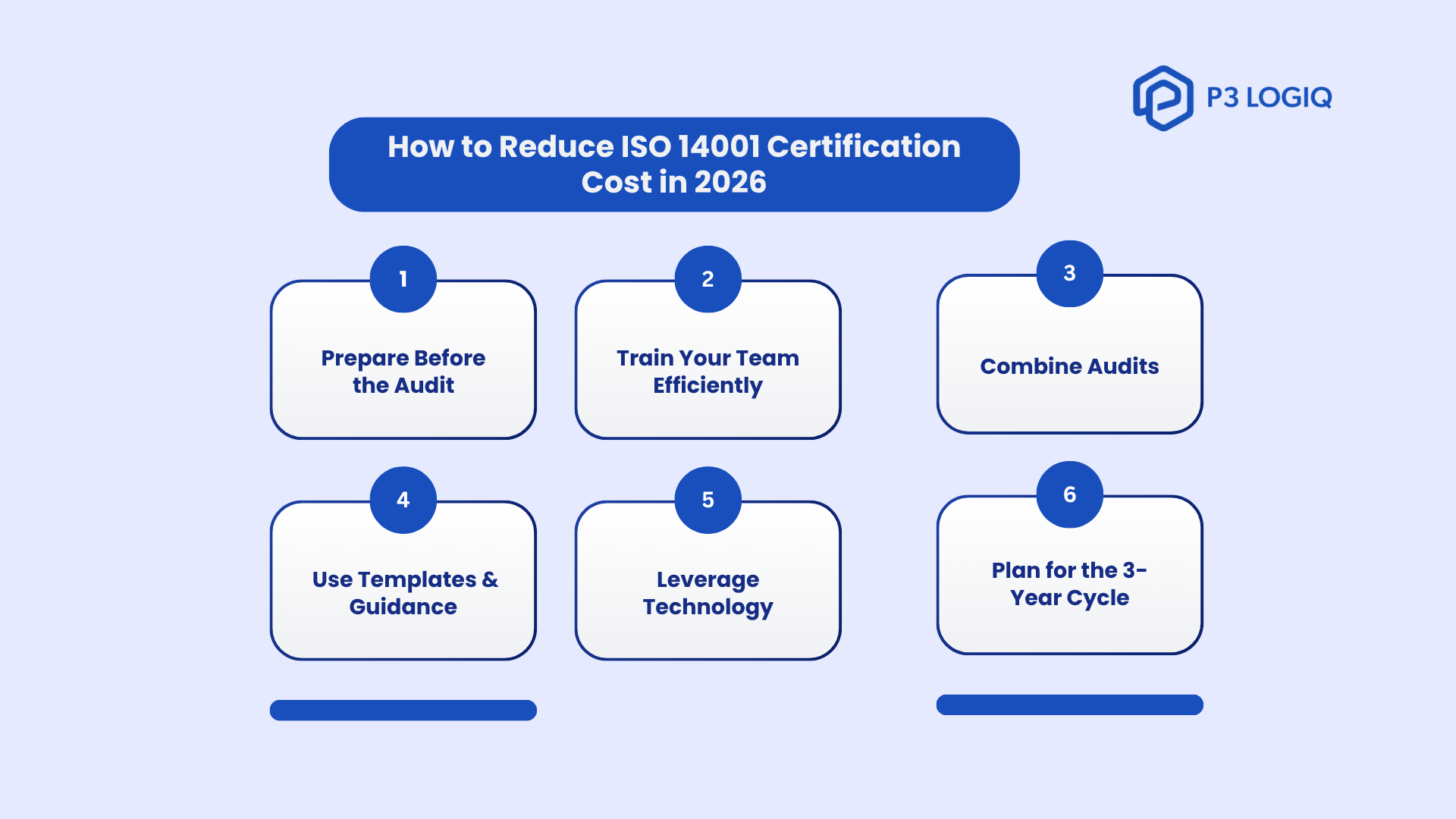
Reducing the cost does not mean cutting corners. It means planning smart and using your resources wisely. Here is what businesses can do:
The more ready you are, the faster the auditor can work. Make sure your documents and records are organized. Digital tools save time and help you avoid mistakes. A well-prepared system can lower the cost for both Stage 1 and Stage 2 audits.
Your team needs to understand the rules. If everyone knows what to do, you won’t waste time fixing errors. Short and focused training sessions usually work better than long meetings.
If you have more than one office, schedule audits together. This saves money on auditor travel and hotel costs.
Experts offer ready-made templates for forms and procedures. You can use them correctly, cut setup time, and reduce the need for expensive outside help.
Software can help you track waste and energy, making audits faster and easier. For example, P3 LogiQ’s 14001 compliance software provides tools specifically for ISO 14001. It help you organize documents and monitor progress. This lowers staff time costs and keeps your budget in check.
Don’t just focus on the first audit. Keep the system running every year. Avoid mistakes now, and you won’t pay for costly “emergency fixes” later.
.png)
Spending on ISO 14001 certification can vary depending on the business, but market trends show that more companies continue to invest in it. According to the 2025 ISO Market Report, the demand for these standards is growing fast.
Here is how the investment pays off for you:
You can bid on high-paying projects that were out of reach before. The above report also shows that 95% of major multinational companies now require their suppliers to have an ISO certification. Without it, you are simply left out of the race.
You will finally see where your business is wasting energy and supplies. In fact, as per the above report, industries that used ISO 14001 reported an average 30% reduction in waste in 2025.
Government fines can be much higher than the cost of an audit. Environmental rules are getting stricter in 2026. ISO 14001 certificate helps you follow the law so you can avoid costly penalties and lawsuits.
People today want to buy from brands that care about the planet. Showing the ISO 14001 badge proves that your business is responsible. It makes people feel confident about spending their money with you instead of someone else.
.jpg)
Getting a price for your certificate is not guesswork. Auditors follow a strict international rulebook called the IAF MD5 guidelines. This document sets the "audit days" based on how big and how risky your company is.
To get the most accurate price, have these four details ready:
It’s better to choose the right compliance partner for ISO 14001 to simplify your certification process.
Managing every step of certification can feel overwhelming. From audits and documentation to training and compliance, there is a lot to handle.
You do not have to do it alone. With our ISO 14001 compliance software, we help you stay organized, track your progress, and handle the whole process smoothly.
Think of our software as an investment in your company’s future. Having everything in one place helps you avoid expensive mistakes, repeated work, and extra hassles. We make sure your data is always ready so you can focus on your business while we handle the technical details.
.png)
P3 LogiQ provides all the tools you need to manage ISO 14001 in one easy-to-use platform. Our system keeps your paperwork organized and 'audit-ready' so you don't have to worry about unexpected costs. If you're planning to get certified, scheduling a quick call can help you determine a budget that fits your business.
Get in touch to learn how we can simplify achieving and maintaining ISO 14001 certification, or book a demo to see how P3 LogiQ makes your ISO 14001 journey easier and more manageable.
No, the official certification quote usually covers only the auditor’s time and the audit process itself. If you choose to work with a consultant for documentation, training, or system setup, that is a separate cost. Many businesses plan for this additional support to ensure smoother implementation and audit readiness.
Audit days are determined by IAF MD5 guidelines and are based on factors like your staff size and operational complexity. These cannot be reduced randomly. However, having well-organized processes or a digital management system can make audits more efficient and help avoid additional time-related costs.
Yes. After the initial certification, businesses are required to undergo surveillance audits in the second and third years to maintain their certification. These audits are typically shorter and more cost-effective than the initial audit, but they are essential to ensure continued compliance and system effectiveness.
Your industry plays a key role in determining certification costs. High-risk industries, such as chemical manufacturing or heavy engineering, require more detailed audits and specialized auditors. In contrast, low-risk environments like offices usually involve simpler audits, which can result in lower overall certification costs.
Not necessarily double, but having multiple locations does increase the overall cost. Auditors need to review or sample different sites to ensure consistency across operations. This adds more audit time and may also include travel-related expenses, depending on the number and location of your facilities.


Businesses need document management systems (DMS) to ensure ISO and R2 compliance, improve efficiency, and stay audit-ready. The article highlights key features like version control, security, and automation while reviewing the top 5 DMS solutions. P3 LogiQ stands out for its compliance-focused automation and secure document tracking
Read More
Recycling businesses gain efficiency, compliance, and sustainability with RIOS certification. It streamlines quality management, environmental responsibility, and worker safety, helping companies avoid legal risks and boost credibility. P3 LogiQ simplifies the certification process with automation, document control, and compliance tracking, making operations smarter and safer.
Read More
Audit Management Software (AMS) automates compliance tracking, streamlines workflows, and reduces audit risks. Key features include automated scheduling, compliance checklists, CAPA tracking, vendor risk management, and integrations.
Read More
Learn how audit management systems simplify ISO and R2 compliance by automating audits, managing documentation, and minimizing compliance risks efficiently.
Read More
In 2025, many businesses still face challenges in compliance management due to outdated methods like spreadsheets and fragmented software. This inefficiency leads to missed deadlines, increased risk, and regulatory penalties. The blog emphasizes the importance of modern compliance tools that automate workflows, enhance risk management, and streamline regulatory processes to meet ISO and R2 standards.
Read More
The rise in e-waste and environmental concerns makes responsible electronics recycling essential. The R2 Certification sets a global standard for safe, sustainable, and data-secure recycling practices. Developed by Sustainable Electronics Recycling International (SERI), R2 helps businesses manage environmental risks, data security, worker safety, and legal compliance.
Read More
Businesses face increasing challenges in managing complex regulatory compliance. Manual methods such as spreadsheets and paperwork can lead to missed deadlines, inefficiencies, and costly penalties. Compliance management software offers a streamlined solution to reduce risks, automate processes, and improve operational efficiency.
Read More
Maintaining R2 Certification is crucial for businesses in the e-waste recycling industry, ensuring regulatory compliance, sustainability, and strong stakeholder trust. This guide outlines 10 best practices to help businesses simplify operations, reduce risks, and stay compliant.
Read More
Unlock the value of ISO risk management certification. Explore its impact on compliance, risk mitigation, and business expansion.
Read More
Explore the top 5 ISO risk management software tools for 2025, including document management solutions for streamlined compliance and increased efficiency.
Read More
Find the ideal document management software (DMS) for your business. Learn how to choose with expert tips, key features, and insightful guidance
Read More
Unlock the power of a Document Management System (DMS). Learn how it can revolutionize your business operations.
Read More






.png)


.png)



.jpg)



.jpg)
.jpg)








.png)

.png)
.png)


.png)

