

Let's be real for a second.
Environmental regulations in the US are not getting lighter. They're getting heavier plus faster.
At the same time, your customers are asking harder questions. Your investors want ESG (environmental, social, and governance) reports. Your big name clients want to see your environmental credentials before they sign a contract.
And if you are a manufacturer, a logistics company, a construction firm, or anyone in between, you can already feel this pressure building.
So what do smart businesses do?
They do not wait for problems. They get certified.
ISO 14001 certification is how businesses prove they are managing their environmental impact properly, not just claiming it.
It is not just about compliance. It is about credibility, trust, and staying competitive in a market where environmental responsibility is being closely evaluated.
In this blog, you will understand exactly what ISO 14001 certification is, what it requires, what it delivers, and why 2026 might be the year your business cannot afford to ignore it anymore.
Let's get into it.

ISO 14001 is an internationally recognized standard that tells you how to build, implement, and continuously improve an Environmental Management System, or EMS, within your organization.
It was developed by the International Organization for Standardization, which is ISO.
ISO is not a government body. It is an independent international organization made up of representatives from 167 national standards bodies that develop internationally recognized ISO standards used by businesses worldwide. When ISO sets a standard, the global business community takes it seriously.
Now, what does ISO 14001 actually do for you?
It gives your business a structured framework for identifying your environmental impact, including waste, emissions, energy use, and pollution risk, and then managing that impact in a systematic way.
Think of it like this.
Every business affects the environment in some way. For example
Your factory uses water.
Your fleet burns fuel.
Your facility generates waste.
Your operations may release emissions.
Without a system, all of that is just happening. No one is measuring it. No one is improving it. No one even knows where the biggest problems are.
ISO 14001 changes that by giving your organization a structured system for managing environmental responsibilities and building a path toward ISO 14001 certification and compliance.
It pushes organizations to examine their environmental footprint, set real objectives, track performance, and improve over time.
And when you do all of that correctly and get audited by a certified body, you earn your ISO 14001 certificate.
That certificate tells the world this company takes environmental management seriously. It is not just words on a website. It is a verified, structured system.
Let’s break it down quickly, because people ask about this all the time.
ISO stands for International Organization for Standardization. The name might seem backward since it could look like it should be IOS, but ISO comes from the Greek word “isos,” meaning equal. It was chosen deliberately so the abbreviation remains the same in every language.
14001 is simply the number assigned to this specific standard within ISO’s catalogue.
The 14000 series is dedicated entirely to environmental management. ISO 14001 is the most important standard in that series because it contains the actual requirements an organization must meet to build a functioning EMS.
So when someone says “ISO 14001 certification” or “ISO 14001 standard,” they are referring to the specific international benchmark for environmental management systems.
Simple as that.
Many people also confuse ISO 14001 with ISO 9001. While both are international ISO standards, they serve different purposes. ISO 9001 focuses on quality management systems, while ISO 14001 focuses on environmental management. Organizations often implement both standards together to improve quality, compliance, and operational performance.
.png)
An EMS, or Environmental Management System, is the backbone of ISO 14001.
It is the internal system your organization builds to manage its environmental responsibilities, not just today, but on an ongoing basis.
Think of it the way you think about a financial management system. A good company does not just collect money and hope for the best. It tracks inflows, manages outflows, sets budgets, monitors variances, and continuously improves its financial health.
An EMS does the same thing, but for your environmental performance.
.png)
In this, a clear documented commitment from leadership gets prepared that shows how your company approaches its environmental responsibilities. This is not a poster on the wall. It is a living document that guides decisions and must be properly stored, controlled, and updated using a structured document management system so teams always work with the latest approved policies and procedures.
Specific and measurable environmental goals. Not vague promises. Real targets such as reducing water usage by 15 percent by Q3 or cutting hazardous waste generation by 20 percent within a year.
Identifying where your operations create environmental risks, such as spills, emissions, or waste, and understanding the legal obligations your business has under US federal and state environmental regulations.
Tracking environmental performance using real data. Metrics, performance reports, and trend analysis help you understand whether your initiatives are actually working.
Making sure your business meets all applicable environmental laws and regulations, including EPA requirements, OSHA standards, and state-level mandates, while maintaining a system that keeps you updated as regulations change. Here, a centralized compliance management platform helps organizations track regulatory obligations, manage documentation, and stay audit-ready as requirements evolve.
Reviewing results, correcting gaps, and improving environmental performance over time through regular audits, reviews, and updates.
That is what the EMS ISO 14001 requires organizations to build.
And it is important to understand one key point. ISO does not dictate the exact environmental performance level your company must reach. Instead, it requires you to implement a structured system for managing and continuously improving your environmental impact.
That distinction matters.
ISO 14001 focuses on building the right system for environmental management, rather than forcing every organization to meet a single predefined environmental score.
.png)
If you've done any research on this topic, you've probably seen “ISO 14001:2015” mentioned many times.
So what does 2015 refer to?
ISO standards are reviewed and updated periodically to stay relevant as industries, technologies, and regulatory expectations evolve. ISO 14001 was last revised in 2015, replacing the earlier 2004 version.
The 2015 update introduced several important changes.
One of the most significant was the introduction of the High Level Structure, or HLS. This is a common framework that all modern ISO management system standards now follow. Because of this structure, standards such as ISO 9001 and ISO 14001 share the same 10-clause framework, making it much easier for organizations to integrate quality management and environmental management systems.
This alignment is especially helpful for businesses that already hold ISO 9001 for quality management or ISO 45001 for occupational health and safety. Since the structure is similar, companies can integrate these systems without duplicating processes or documentation.
Another major change in ISO 14001:2015 was a stronger focus on leadership responsibility. The standard emphasizes that environmental management is not just the responsibility of the EHS team. It is a leadership-level commitment that requires involvement from top management.
ISO 14001:2015 is organized into 10 major clauses:
.png)
Clause 1: Scope - Defines the boundaries and applicability of the ISO 14001 standard.
Clause 2: Normative references - Lists other standards or documents that are referenced within ISO 14001.
Clause 3: Terms and definitions - Provides key terminology used throughout the standard.
Clause 4: Context of the organization - Understanding your business environment, stakeholders, and environmental conditions that affect your operations.
Clause 5: Leadership - Defines top management’s role in establishing environmental policies, responsibilities, and accountability.
Clause 6: Planning - Covers environmental risk assessment, environmental aspects, legal compliance obligations, and environmental objectives.
Clause 7: Support - Focuses on resources, employee competence, training, awareness, communication, and documentation.
Clause 8: Operation - Ensures the organization controls the environmental risks identified during planning.
Clause 9: Performance evaluation - Includes internal audits, environmental monitoring, measurement, and management review.
Clause 10: Improvement - Addresses nonconformities, corrective actions, and continual improvement of the environment using structured improvement management tools.
ISO 14001:2015 is the current active version of the standard. If your organization is pursuing ISO 14001 certification today, this is the version your Environmental Management System will be audited against.
.png)
ISO 14001 environmental management covers a wide range of environmental concerns, depending on your industry.
But at its core, below are what the standard deals with:
Solid waste, hazardous waste, electronic waste. How your business generates it, how it's stored, how it's disposed of, and how you are working to reduce it.
Air emissions, wastewater discharges, and soil contamination. ISO 14001 asks you to identify pollution risks before they become problems, not after you get a violation notice.
Energy consumption, water use, and raw material usage. Efficient resource use is both an environmental benefit and a direct cost saving. Most companies that implement ISO EMS find this part particularly rewarding.
Federal regulations from the EPA. State level environmental laws. Industry specific requirements. ISO 14001 builds a framework to make sure you're always on the right side of compliance and that you catch changes in the law before they catch you.
A broader commitment to reducing your environmental footprint over time, not just meeting minimum legal thresholds.
That’s all about what ISO 14001 deals with. Now let’s look at what ISO 14001 does not deal with.
It is not a product standard. It does not certify that your products are green or eco-friendly.
Instead, it certifies that your organization’s management system for environmental responsibility is structured, reliable, and systematic.
That is the key distinction.
.png)
A lot of companies see ISO 14001 certification as a compliance exercise. Something they have to do to check a box. A cost center.
That is the wrong way to look at it.
The businesses that get the most out of ISO 14001 certification treat it as a strategic investment, and the returns are real.
Let’s walk through the benefits that actually matter for US-based businesses in 2026.
ISO 14001 does not just help you comply with today’s regulations. It builds a system that keeps you compliant as regulations change. That is the difference between scrambling every time the EPA updates guidance and simply having it handled.
One chemical spill, one improper waste disposal incident, or one clean water violation can cost a mid size company hundreds of thousands of dollars in fines, remediation costs, and legal fees. ISO 14001 compliance means identifying those risks before they happen through proactive risk management practices that help organizations prevent incidents instead of reacting to them. That risk reduction has real financial value.
This one surprises most people. Organizations that go through the EMS process almost always find energy and resource waste they did not know they had. Reducing water use by 20 percent or cutting energy consumption by 15 percent is not just good for the environment. It directly reduces your operating costs.
Sustainability is no longer a marketing add-on. It is a purchasing factor as well. Large buyers, government agencies, and enterprise clients increasingly prefer or require vendors with verified environmental credentials. Your ISO 14001 certificate becomes proof, not just a promise.
If your investors, lenders, or board are asking for ESG data, ISO 14001 certification gives you a credible and internationally recognized foundation for environmental reporting. It strengthens every ESG narrative you present.
Federal procurement guidelines increasingly favor suppliers with sustainability credentials. The same applies to Fortune 500 supply chains. ISO 14001 certification can open doors for your business, especially in the manufacturing, construction, logistics, and energy sectors, where environmental standards matter in vendor selection.
In short, you get:
✅ Regulatory compliance you can prove
✅ Lower environmental liability and legal risk
✅ Real operational cost savings
✅ A stronger brand in front of your customers and partners
✅ Credibility for ESG and sustainability reporting
✅ Access to contracts that require certified vendors
.png)
Well, any business that has a meaningful environmental footprint can get it.
But to be more precise, ISO 14001 certification becomes especially valuable when your environmental performance affects your regulatory compliance, contracts, or competitive position.
In the US, there are some industries that see the most direct benefits from ISO 14001 certification.
Probably the biggest one. If you run a production floor, you already deal with emissions, waste, energy consumption, and resource usage. ISO 14001 helps you manage all of that in a structured way.
Construction projects naturally come with environmental risks. Site runoff, land disturbance, construction waste, and air quality issues all need proper environmental management.
Fleet emissions, warehouse energy usage, packaging waste, and transportation impacts add up quickly. Many enterprise clients now expect logistics partners to show environmental responsibility through certifications like ISO 14001.
Power generation and energy distribution companies operate under strict environmental oversight. Having a structured environmental management system helps you stay compliant and organized.
For companies handling chemicals, the regulatory exposure is significant. ISO 14001 provides a system for managing environmental risks and maintaining compliance.
Even companies responsible for handling waste need structured systems to track, process, and dispose of materials safely within EPA regulations.
Water usage, agricultural runoff, pesticide management, and packaging sustainability can all be managed more effectively through an ISO 14001 environmental management system.
And here is something important to keep in mind.
If your company bids for government contracts, works within regulated supply chains, or has public sustainability commitments, ISO 14001 certification is not just a nice thing to have. And in many cases, it is quickly becoming a business expectation.
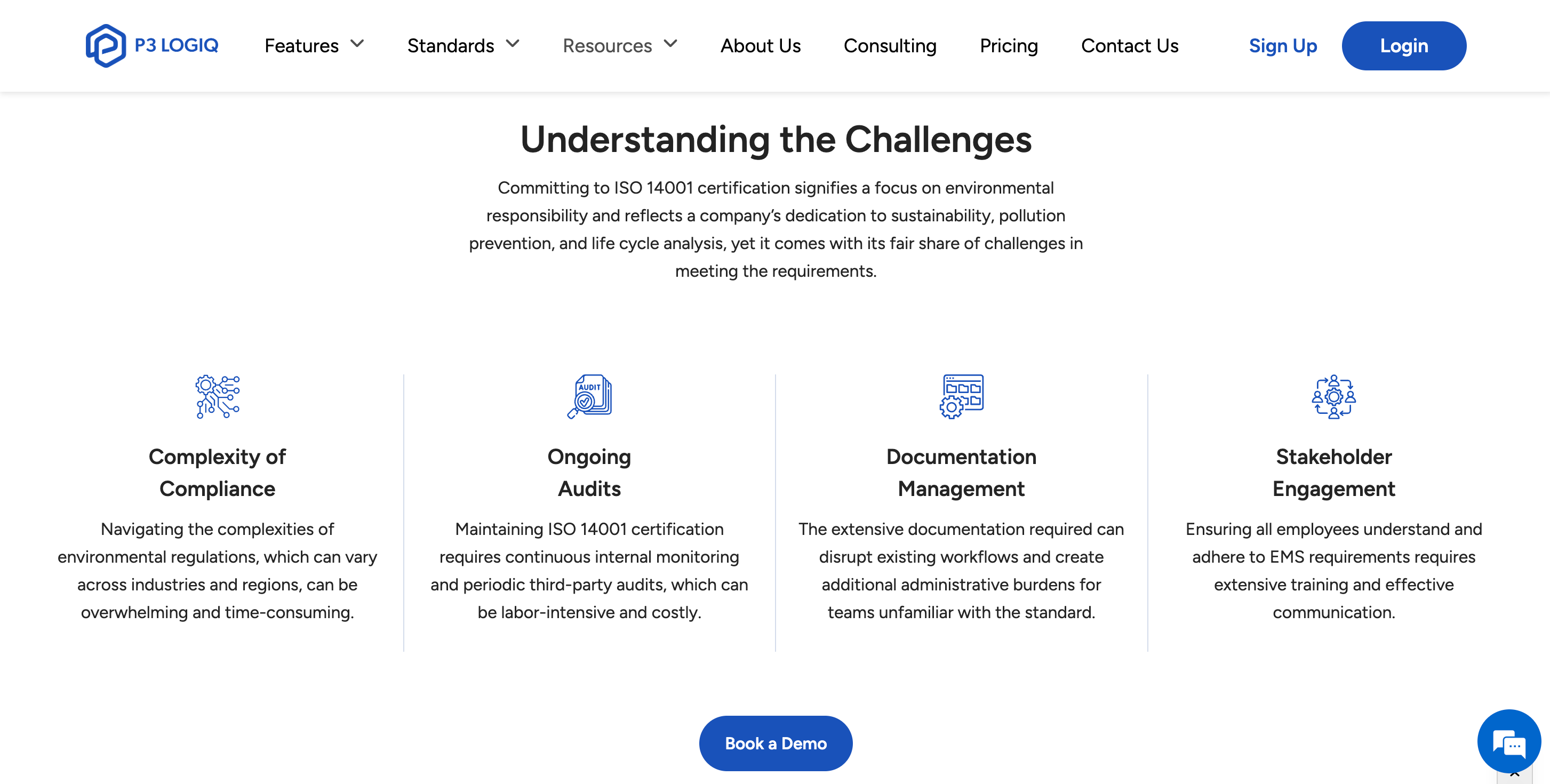
If you decide to pursue ISO 14001 certification, the process usually begins with building an Environmental Management System within your organization.
This system helps you identify your environmental impacts. It also helps you manage your legal obligations, set environmental objectives, and track your environmental performance over time.
In simple terms, your journey usually starts with a gap analysis. After that, you implement your EMS and train your team. Your organization then conducts internal audits before moving to a certification audit carried out by an accredited certification body.
At the same time, ISO 14001 compliance requires your organization to maintain proper documentation. You also need to monitor environmental metrics and review performance regularly. If nonconformities appear, your organization must address them and take corrective action through structured corrective action management processes.
The standard also expects you to continuously improve your Environmental Management System over time.
Because the certification process and the compliance requirements are closely connected, we have explained both in detail in our guide on the ISO 14001 certification process and requirements.
.png)
You might be wondering how ISO 14001 compares to other sustainability and environmental frameworks out there.
Here is the honest take.
ISO 14001 is the most globally recognized and independently audited environmental management standard in the world. That is not marketing. It is simply the reality of how widely it is adopted and how seriously certification bodies, buyers, and regulators treat it.
Frameworks like GRI (Global Reporting Initiative) or TCFD (Task Force on Climate-related Financial Disclosures) are reporting frameworks. They help organizations disclose environmental performance. They are not management system standards. They do not include the structured EMS requirements, the audit process, or the third-party verification that ISO 14001 provides.
The US EPA also runs voluntary programs such as Energy Star and the Green Power Partnership. These programs focus on specific environmental areas. ISO 14001 is broader. It is a full management system standard that covers all significant environmental aspects of your operation.
If you already have ISO 9001 for quality management or ISO 45001 for occupational health and safety, integrating ISO 14001 becomes much easier. All three standards follow the same high-level structure. This allows you to build one integrated management system that supports multiple certifications.
That integration value alone makes ISO 14001 a smart addition for many US manufacturers and industrial businesses.
.png)
Let's clear up a few things people often get wrong about ISO 14001.
Not even close. ISO 14001 certification is scalable. A 20 person manufacturing company can build an EMS just as effectively as a 20,000 person enterprise.
The scope and complexity will differ, but the framework works for organizations of any size. In fact, smaller companies often see larger benefits because they tend to have less structured environmental management to begin with.
ISO 14001 certification does not mean your company has a zero environmental footprint.
It means your organization has a credible and systematic process for managing, measuring, and improving environmental performance. The certificate reflects the strength of your management system, not the size of your environmental impact.
This is a common misunderstanding. Yes, ISO 14001 requires documentation. But the documentation is evidence of a real operational system.
Companies that treat EMS as a paperwork exercise often struggle during audits. Auditors look for proof that the system is actively followed by your organization, not just stored in a file.
ISO 14001 applies to any organization that wants to manage its environmental impact in a structured way.
Office based companies, service firms, healthcare organizations, and educational institutions all have environmental aspects worth managing. The standard is designed to work across industries.
.png)
Here is the thing about 2026 specifically.
The regulatory direction is clear. The ESG pressure is real. Supply chain sustainability requirements are also tightening fast.
In the US, the SEC's climate disclosure rules are pushing publicly traded companies to measure and report environmental data with much greater rigor than before. Those companies are now pushing their supply chains to demonstrate the same level of accountability.
If you supply to a Fortune 500 company, or want to in the future, you are probably already seeing sustainability questionnaires, supplier ESG assessments, and environmental compliance requirements in your RFP processes. That trend is only accelerating in 2026.
Many businesses that treated ISO 14001 certification as a "maybe someday" initiative are now realizing that someday is arriving sooner than expected.
There is also a talent angle that does not get discussed enough. Younger professionals, especially engineers, EHS managers, and operations specialists, increasingly prefer to work for organizations with credible sustainability programs.
Studies from ESG Today show that around 70 percent of employees consider a company’s environmental commitments when choosing where to work. For many candidates today, sustainability is part of how they evaluate employers, not just an added benefit.
ISO 14001 certification signals to your people, not just your customers, that your environmental commitments are real and supported by a structured management system.
The competitive aspect is just as important. In federal and state government contracting, procurement guidelines increasingly reward or require certified environmental management systems.
Organizations such as the Department of Defense, the General Services Administration, and various state procurement programs are already moving in this direction. If government contracts are part of your growth strategy, ISO 14001 certification is quickly becoming a baseline expectation.
2026 is not a deadline. But it is clearly a tipping point.
Companies that get ahead of this shift, build their Environmental Management System, earn certification, and integrate it into daily operations will have a clear structural advantage over businesses still managing environmental responsibilities informally.
ISO 14001 is not complicated to understand. What it really is, is a commitment.
A commitment to managing your environmental impact with the same seriousness that you manage your quality, safety, and financial performance.
By now, you know what ISO 14001 is, how an Environmental Management System works, and why more US businesses are treating ISO 14001 certification as a strategic investment rather than just a compliance exercise.
If your organization has an environmental footprint, and almost every business does, the question is no longer whether ISO 14001 certification matters. The real question is how soon you want to start.
If you are exploring certification or want to understand what the journey looks like for your business, the team at P3 LogiQ can help.
.png)
Book your free call and get practical guidance on the next steps toward ISO 14001 certification.



Businesses need document management systems (DMS) to ensure ISO and R2 compliance, improve efficiency, and stay audit-ready. The article highlights key features like version control, security, and automation while reviewing the top 5 DMS solutions. P3 LogiQ stands out for its compliance-focused automation and secure document tracking
Read More
Recycling businesses gain efficiency, compliance, and sustainability with RIOS certification. It streamlines quality management, environmental responsibility, and worker safety, helping companies avoid legal risks and boost credibility. P3 LogiQ simplifies the certification process with automation, document control, and compliance tracking, making operations smarter and safer.
Read More
Audit Management Software (AMS) automates compliance tracking, streamlines workflows, and reduces audit risks. Key features include automated scheduling, compliance checklists, CAPA tracking, vendor risk management, and integrations.
Read More
Learn how audit management systems simplify ISO and R2 compliance by automating audits, managing documentation, and minimizing compliance risks efficiently.
Read More
In 2025, many businesses still face challenges in compliance management due to outdated methods like spreadsheets and fragmented software. This inefficiency leads to missed deadlines, increased risk, and regulatory penalties. The blog emphasizes the importance of modern compliance tools that automate workflows, enhance risk management, and streamline regulatory processes to meet ISO and R2 standards.
Read More
The rise in e-waste and environmental concerns makes responsible electronics recycling essential. The R2 Certification sets a global standard for safe, sustainable, and data-secure recycling practices. Developed by Sustainable Electronics Recycling International (SERI), R2 helps businesses manage environmental risks, data security, worker safety, and legal compliance.
Read More
Businesses face increasing challenges in managing complex regulatory compliance. Manual methods such as spreadsheets and paperwork can lead to missed deadlines, inefficiencies, and costly penalties. Compliance management software offers a streamlined solution to reduce risks, automate processes, and improve operational efficiency.
Read More
Maintaining R2 Certification is crucial for businesses in the e-waste recycling industry, ensuring regulatory compliance, sustainability, and strong stakeholder trust. This guide outlines 10 best practices to help businesses simplify operations, reduce risks, and stay compliant.
Read More
Unlock the value of ISO risk management certification. Explore its impact on compliance, risk mitigation, and business expansion.
Read More
Explore the top 5 ISO risk management software tools for 2025, including document management solutions for streamlined compliance and increased efficiency.
Read More
Find the ideal document management software (DMS) for your business. Learn how to choose with expert tips, key features, and insightful guidance
Read More
Unlock the power of a Document Management System (DMS). Learn how it can revolutionize your business operations.
Read More








.png)

.png)




.jpg)



.jpg)
.jpg)









.jpg)


.png)

.png)
.png)



.png)

