
Since you’re looking to understand ISO 9001 certification cost, I believe you are also trying to achieve this certification for your own business as well, and are wondering:
"What is the cost of ISO 9001 certification?"
“Does the investment justify the return?”
It sounds impressive when you hear of businesses having ISO 9001 certification, but once you familiarize yourself with ISO standards and get to know more about the procedures regarding audits, documentation, and certification bodies, this whole cost and ROI side of things can feel overwhelming and confusing.
This blog breaks down what ISO 9001 certification costs, what the factors are that affect the price, and whether the return on investment actually makes sense for your business.
Along the way, you'll also explore how you can minimize certification costs for your company without compromising quality.

Before diving into the cost breakdown, one thing needs to be clear. It is that the circling around of one of the biggest misconceptions is that ISO 9001 has a “fixed” price for the certification.
It does not.
In fact, it is confirmed by the International Organization for Standardization in one of their certification guidelines. They do not issue certifications or charge for them. Rather, it is carried out by independent, accredited certification bodies. Due to this, the cost of getting certified varies.
When you pay for the certification, you are not just paying for a document, but you are paying for the:
ISO 9001 certification can cost somewhere around 5,000 USD - 40,000 USD. These are estimated ranges based on the external certification body, the size of the company, the audit practices, and the standards of the industry. Take a look at this cost breakdown, as it can help you predict or estimate the amount you would need to budget for the ISO 9001 certification.

This is the initial phase where you align your processes, document your Quality Management System (QMS), and prepare for audits.
It can take quite some time for the internal team to carry out gap analysis and adjust to the procedure development, document preparations, which can range somewhere between 3,000 USD to 10,000 USD. But having an automated document processing system can make it convenient as well as audit-ready.
You will also need to take the effort in training your team members to comply and follow ISO standards, which can take up time as well as money. Training costs can range somewhere between 500 USD to 1500 USD+ based on different training programs.

In most cases, companies hire external consultants to guide them and speed up their documentation process, gap analysis, and audit prep. In addition to this, you can make your life easier if you have an internal audit management system that can create a smooth workflow. Companies do this because they want to make sure every process is up to ISO standards as well as to make sure nothing is missing; otherwise, they might need to rework the whole process.
Hiring an external consultant can cost somewhere between 500 USD to 1250 USD per day. Now of course, these estimates will vary depending on how experienced the consultants are and what type of industry your business is in.

This is usually the core external cost most people think of when inquiring about ISO 9001 certification cost.
Accredited certification bodies charge based on:
These costs are widely accepted industry standards.
Below are the breakdown details of stage 1 and 2 audits:

The auditor reviews QMS documents, policies, and procedures and checks whether they are up to ISO standards. They do this to see if there is any gap or room for improvement before moving on to Stage 2. This can typically take a day or two.

In this stage, the auditor further confirms that the company is actually implementing what it says on the QMS document. This is an on-site assessment, as the auditor takes interviews of the company staff as well as observes the way they work to ensure it is following the ISO standards. This can typically take multiple days, as it is entirely based on the size of the company.
These are the typical costs, which vary based on the size of your company.
These figures represent the typical fees charged by accredited certification bodies for a full initial audit, including documentation review and on-site assessment.

Even though the validity of ISO 9001 certifications is for three years, certification bodies require annual surveillance audits and then a recertification audit at the end of the cycle. Planning this into your budget can help you avoid getting surprised by ongoing expenses.
ISO 9001 certification is valid for 3 years, but surveillance audits are done annually to retain the certificate.
This is a crucial step because If you skip surveillance, your certificate will be suspended.
Includes surveillance audits
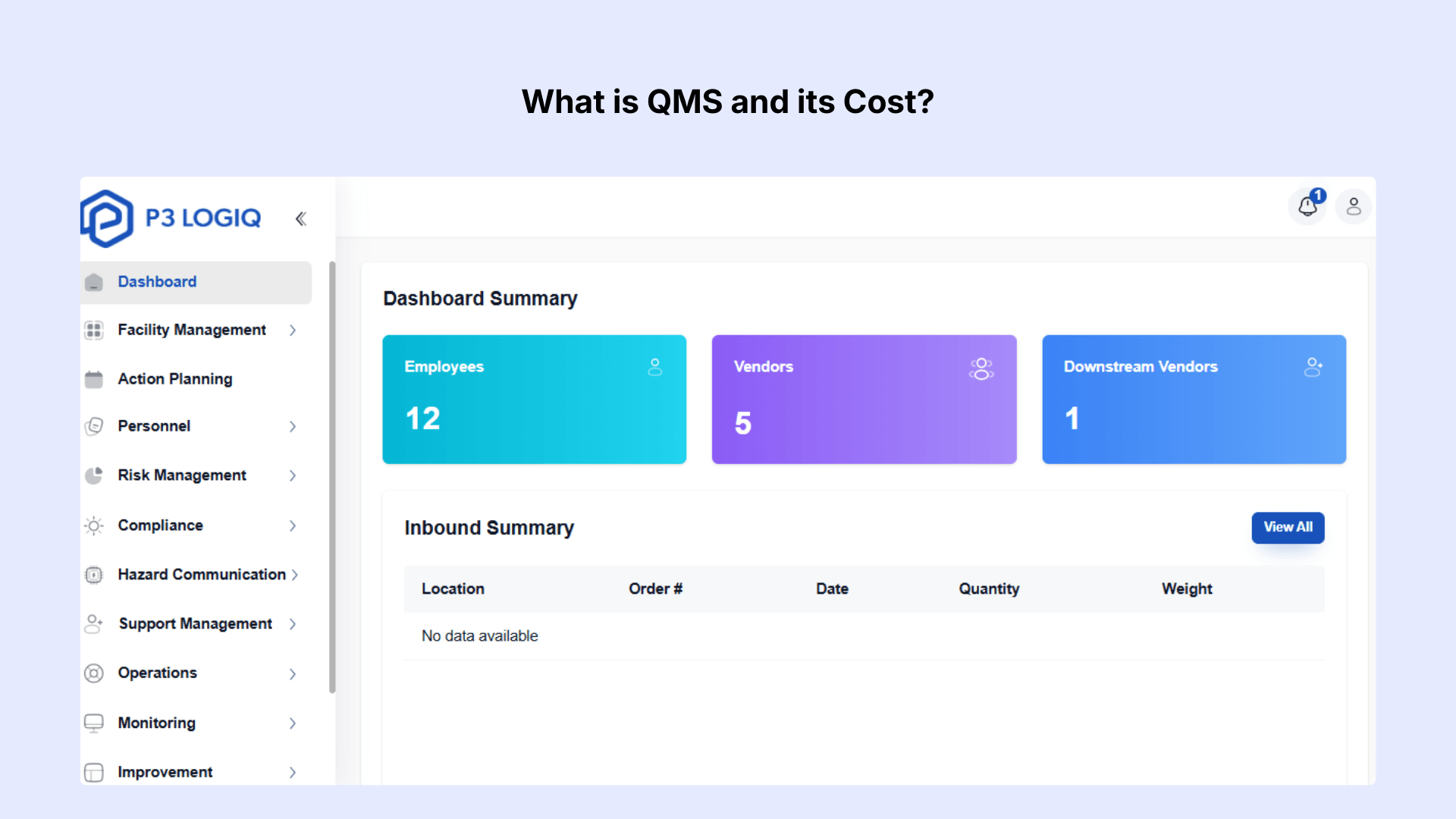
Quality Management System (QMS) software is a cloud-based digital platform that can be used for convenient automated processes such as document control, internal audits, corrective actions, risk management, and compliance tracking. Instead of relying on manual procedure, companies use QMS software to maintain audit-ready data, and support ISO 9001 requirements more efficiently.
The cost of the QMS software are as follows:
QMS products are usually priced per user, per month.

Here are some of the factors that affect the ISO 9001 certification cost for your business:
The larger your company, the higher your ISO 9001 certification cost, it is the same with having multiple locations or branches which requires audits and assessments. Having more employees means that the cost for providing comprehensive training will be greater.
The industry in which your company is matters as each type of industry has specific criterias set for it, due to this the cost can vary.
If your company has already been implemented and has a QMS structure built around ISO 9001 standards, then the cost can vary.
If your team has a deep knowledge of ISO standards, then the need for an external party won’t be necessary, which can save cost.
Certification bodies provide services and charges differently based on their accreditation, region, and travel cost.
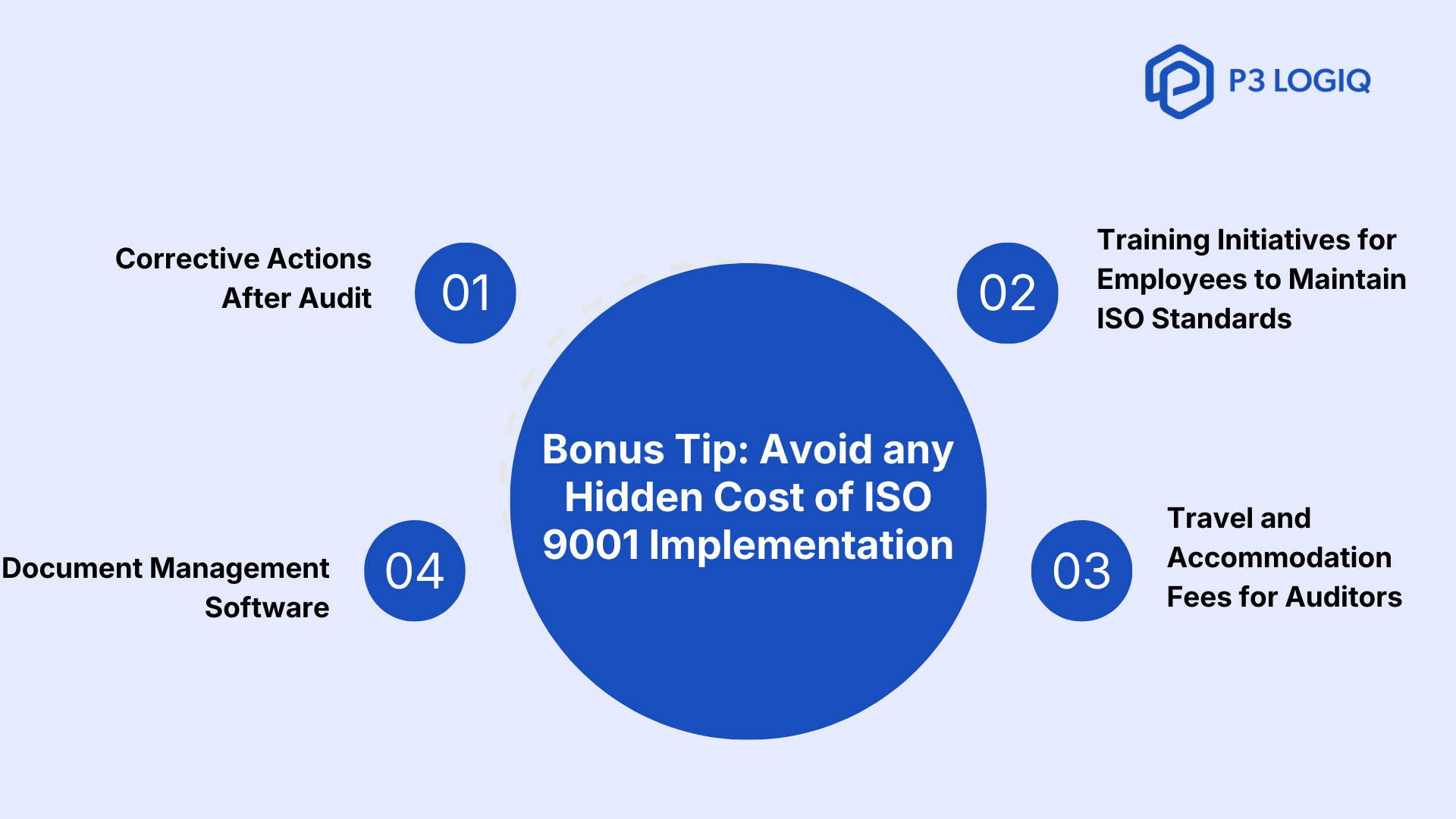
Make sure to double check the quotation when enquiring the charges from a CB. Because sometimes there is a chance of having a hidden cost which can be under these:
You’ll run into the higher chance of spending quite a hefty amount of money for the ISO Standard procedures, but that does not have to be the case if you know some of the best tips that can save you some cash as well as your valuable time.

If your company has the means, do take advantage of utilizing in-house resources to train your employees to handle ISO Standard implementation. This will cu down on relying on external consultants for the future.
Using a centralized platform such as P3 LogiQ can further support this approach. With tools for document management, training tracking, audit workflows, and compliance monitoring, internal teams can manage ISO 9001 processes more effectively while maintaining documents that are audit-ready.
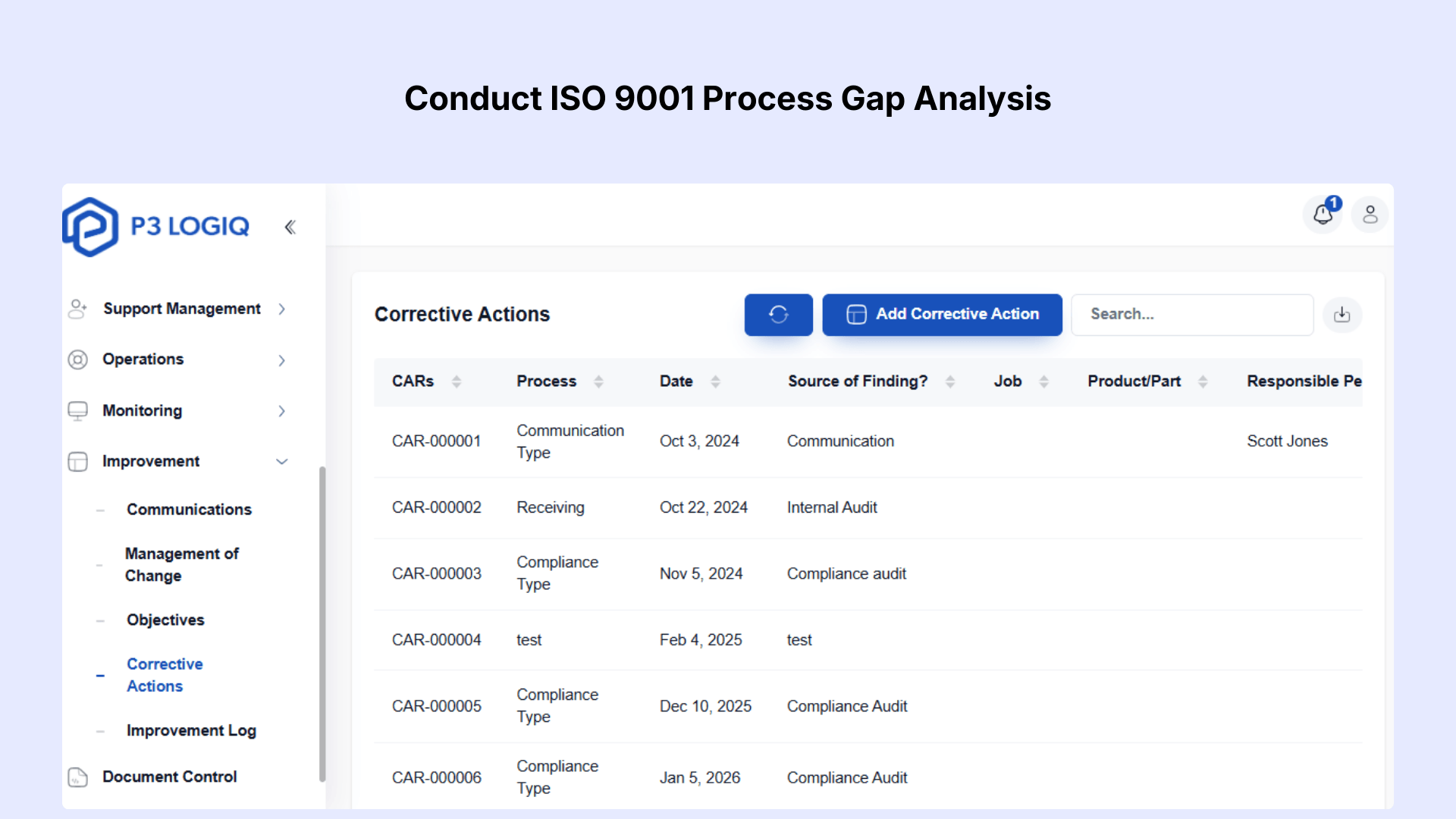
Make sure to do an internal assessment so that you can identify deviations from QMS documents. Doing this ensures the prevention of re-audits, which can be costly.

By using an ISO 9001 document template, you can drastically reduce consultant hours as well as set up QMS quickly. Pre-structured templates provide a framework for policies, procedures, and documentation aligned with ISO standards.
We provide structured document management, version control, and audit-ready templates within a centralized system. This helps internal teams manage documentation efficiently while aligning with ISO 9001 requirements.

Having your audits either remote or hybrid can help cut down the auditor’s travel and accommodation cost to an extent.

Check out certification bodies (CBs) that are not only reputable but also offer their services at a reasonable cost. You can also keep your options open by requesting the quotas of 3-4 accredited CBs. Make sure you get the full transparent cost that should typically include travel, administration, and maintenance cost for a period of 3 years.

Budget your cost over the time span of 3 years as opposed to a one-time investment to make sure you are not caught off guard with additional expenses.

Evaluating ROI alongside ISO 9001 certification cost shows how improved efficiency, customer trust, and market access can outweigh the initial investment.
Yes, the total cost of having an accredited ISO 9001 certification can look like spending a hefty amount right now, but in the long run it makes the investment and ROI worth it. The benefits of ISO 9001 that come with it are what justified the investment.
According to an ISO public user survey, 79% of companies that have ISO 9001 certification saw better internal process control, 65% reported improvements in operational performance, and 48% reported higher customer satisfaction.
Another international analysis published on ScienceDirect shows that ISO 9001 certified firms experienced an average sales increase of 48.3%, which indicates a strong market performance.
Companies with ISO 9001 certification usually have few process errors, lower rework cost, and predictable work delivery, all because of a smooth compliance process and a structured document management system. Beyond better internal work efficiency, the certification holds a strong credibility with enterprise buyers and government agencies, because ISO 9001 is often seen as a qualification rather than a stamp.
A case study from ISO was done on a Colombian company called "Gerfor." Gerfor is a PVC pipe manufacturer company that implemented ISO 9001 to gain entry for international markets.
Before implementing the ISO 9001, the company was struggling to qualify for foreign contracts. But after implementing the ISO 9001, not only did they qualify for foreign contracts and win bids, but they also had exceptional operational efficiency. The material testing time for PVC was reduced from 4 hours to just 15 minutes just by following the standardized procedures. Last but not least, they had a total sales revenue of 47% that was directly attributed to contracts that required the ISO 9001 certification.
This shows that ISO 9001 ROI compounds over time and having compliance tools can simplify audit preparation. For B2B companies in 2026, especially those operating in regulated or contract-driven markets, ISO 9001 certification is about building a scalable system that protects revenue, unlocks larger contracts, and pays for itself through sustained operational gains.
It is clear by now that ISO 9001 certification is not cheap; in fact, it is rarely the wrong investment. What is actually costing you a lot is not the auditing or the consultant fees. It is the inefficient processes, rework, and poor credibility in markets where certification is the baseline.
ISO 9001 becomes more than compliance. It turns into a structured operating system that improves efficiency, increases customer satisfaction, and supports long-term growth. The ROI doesn’t show up overnight; it compounds over time as your business scales.
P3 LogiQ helps businesses to implement ISO 9001 through a structured, audit-ready platform so that the compliance stays organized and costs stay predictable.
If you’re planning to move forward with ISO 9001, a quick free discovery call can help you understand the cost based on your business needs.
Factors like company size, scope, and readiness vary the cost of the ISO 9001 certification.
No. Maintenance and recertification costs apply over a three-year period.
Yes, ISO 9001 certification enhances career credibility, auditing expertise, and global recognition, enabling professionals to lead QMS audits and improve organizational quality practices.
Unfortunately it is not free, you will need to purchase it from accredited vendors. While the documentation itself costs money, some of the introduction training courses and educational resources can be found online.


Businesses need document management systems (DMS) to ensure ISO and R2 compliance, improve efficiency, and stay audit-ready. The article highlights key features like version control, security, and automation while reviewing the top 5 DMS solutions. P3 LogiQ stands out for its compliance-focused automation and secure document tracking
Read More
Recycling businesses gain efficiency, compliance, and sustainability with RIOS certification. It streamlines quality management, environmental responsibility, and worker safety, helping companies avoid legal risks and boost credibility. P3 LogiQ simplifies the certification process with automation, document control, and compliance tracking, making operations smarter and safer.
Read More
Audit Management Software (AMS) automates compliance tracking, streamlines workflows, and reduces audit risks. Key features include automated scheduling, compliance checklists, CAPA tracking, vendor risk management, and integrations.
Read More
Learn how audit management systems simplify ISO and R2 compliance by automating audits, managing documentation, and minimizing compliance risks efficiently.
Read More
In 2025, many businesses still face challenges in compliance management due to outdated methods like spreadsheets and fragmented software. This inefficiency leads to missed deadlines, increased risk, and regulatory penalties. The blog emphasizes the importance of modern compliance tools that automate workflows, enhance risk management, and streamline regulatory processes to meet ISO and R2 standards.
Read More
The rise in e-waste and environmental concerns makes responsible electronics recycling essential. The R2 Certification sets a global standard for safe, sustainable, and data-secure recycling practices. Developed by Sustainable Electronics Recycling International (SERI), R2 helps businesses manage environmental risks, data security, worker safety, and legal compliance.
Read More
Businesses face increasing challenges in managing complex regulatory compliance. Manual methods such as spreadsheets and paperwork can lead to missed deadlines, inefficiencies, and costly penalties. Compliance management software offers a streamlined solution to reduce risks, automate processes, and improve operational efficiency.
Read More
Maintaining R2 Certification is crucial for businesses in the e-waste recycling industry, ensuring regulatory compliance, sustainability, and strong stakeholder trust. This guide outlines 10 best practices to help businesses simplify operations, reduce risks, and stay compliant.
Read More
Unlock the value of ISO risk management certification. Explore its impact on compliance, risk mitigation, and business expansion.
Read More
Explore the top 5 ISO risk management software tools for 2025, including document management solutions for streamlined compliance and increased efficiency.
Read More
Find the ideal document management software (DMS) for your business. Learn how to choose with expert tips, key features, and insightful guidance
Read More
Unlock the power of a Document Management System (DMS). Learn how it can revolutionize your business operations.
Read More



.png)


.png)



.jpg)



.jpg)
.jpg)




.jpg)

.png)
.png)
.png)


.png)

