
Ever noticed how we’re all trying to “do better” these days?
Carrying tote bags, saying no to plastic straws, maybe even switching to metal bottles or obsessing over eco-friendly swaps that just feel right.
But when it comes to businesses, things get a bit more complicated. It’s not just about good intentions, it’s about systems that actually make a difference.
Think of it like this:
You can decide to eat healthy, but unless you plan your meals, track what you’re eating, and stay consistent, it’s just a phase.
The same goes for environmental responsibility in organizations. Without a clear structure, it quickly turns into random efforts with no real impact.
This is exactly where the right ISO 14001 software starts to make a real difference. It brings all those scattered efforts into one clear, structured system that actually works day to day, making the ISO 14001 certification process much smoother.

Hands cradling a sapling in rich soil against a sunlit, blurred forest background, symbolizing environmental stewardship and sustainable growth under ISO 14001.
According to a recent update from DNV (A leading international independent assurance and risk management provider) on the upcoming ISO 14001:2026 revision, the standard continues to focus on structured internal audits, clearer performance evaluation, and stronger environmental priorities such as climate change and resource use.
From identifying environmental risks to staying compliant with regulations, choosing the right ISO 14001 software gives businesses a clear direction instead of leaving things to guesswork.
In this blog, I will be breaking down the ISO 14001 checklist and requirements into simple, practical points you can actually use.
Whether you’re preparing for an audit or simply trying to understand how ISO 14001 certification fits into your business, it serves as a practical framework to manage your environmental impact, stay compliant with evolving regulations, and improve overall operational efficiency while building credibility with clients and stakeholders.
Having ISO 14001 certification for your business in 2026 isn’t about having a polished policy on paper. It’s about proving that what you say actually happens in your day-to-day operations.
If you’re going for certification, you need clarity on two things:
Auditors today focus on real performance, waste, energy use, and how your team follows processes on the ground.
And now, it matters more than ever. Clients don’t just appreciate it, they actively look for it before they even consider working with you. It has become a baseline expectation, not an added advantage. As businesses go through the ISO 14001 certification process, they often realize how closely it ties into client expectations around compliance and transparency. With regulations becoming increasingly stricter and more defined, businesses are under constant pressure to stay compliant, transparent, and accountable.
As a result, what was once optional is now a critical factor in building trust, securing partnerships, and staying competitive in the market.
So this isn’t a one-time task anymore. It’s a system you need to live with, and get right.
Getting ready for an ISO 14001 audit in 2026?
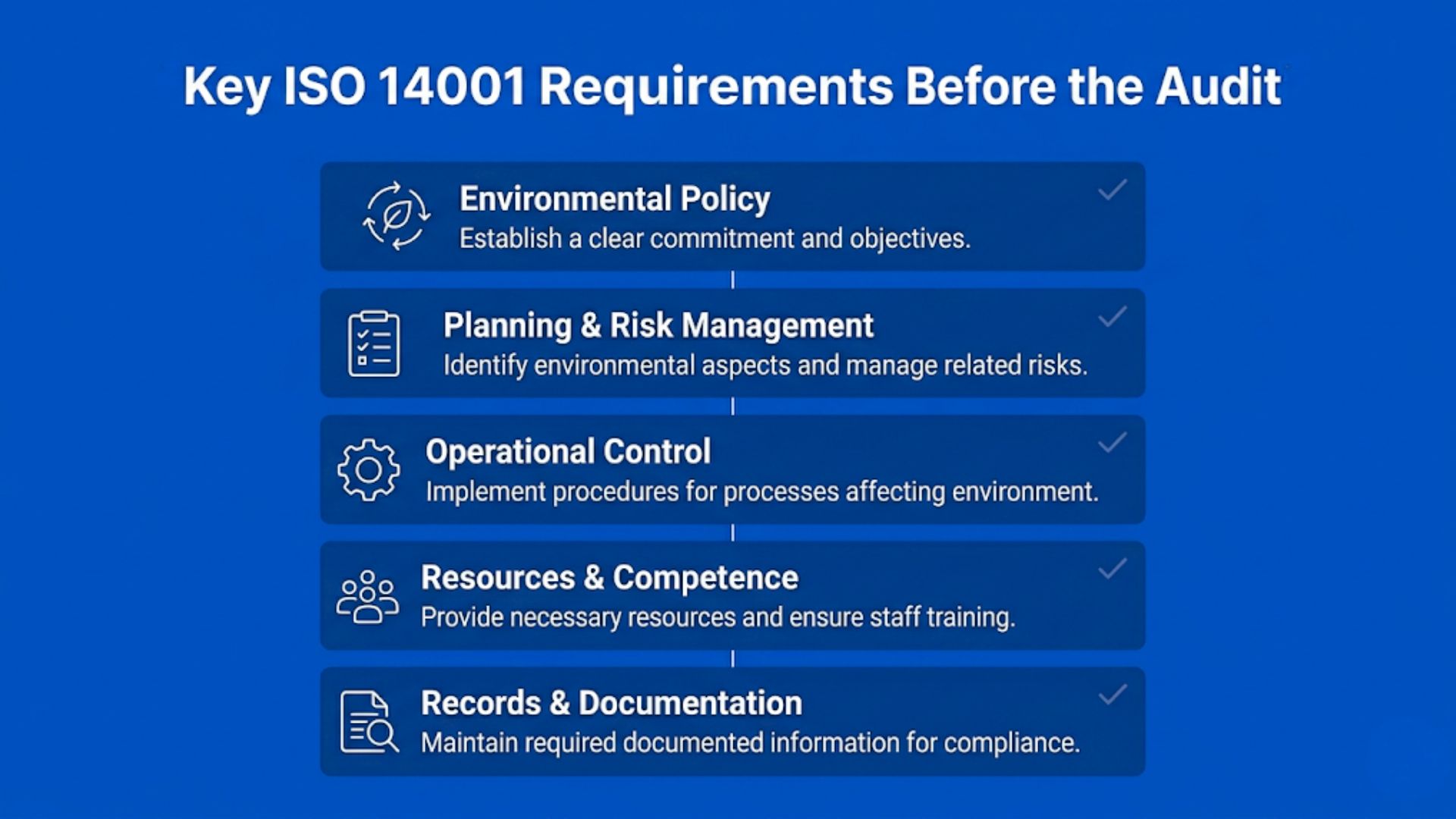
Let’s be real, auditors aren’t looking for fancy reports; they want proof that your business actually meets the requirements. So here’s what you need to focus on before they walk through the door.
First, your environmental policy. This isn’t just a statement on a wall, it should reflect what your company actually does to reduce environmental impact. Be prepared to show how this policy is communicated and followed by your team.
Next up is planning and risk management. Auditors want to see that you clearly understand your environmental risks and have structured plans in place to manage them effectively.
Using a reliable risk and document management system can simplify this process by keeping assessments, action plans, and updates organized, accessible, and audit-ready.This also includes identifying key environmental aspects such as waste, emissions, and energy use, along with setting measurable objectives and consistently monitoring performance.
Don’t forget operational control. This means documenting procedures and making sure your staff knows how to follow them consistently.
Resources and competence also matter. Auditors will check if your team has the skills, training, and tools to stick to your environmental commitments.
Finally, keep your records tidy. Internal audits, corrective actions, and performance data all need to be easily accessible.
Hit these key ISO 14001 requirements, and you’re not just audit-ready, you’re running an ISO 14001 system that actually works in real life.
If you’re walking into an ISO 14001 audit in 2026, here’s the mindset shift, you’re not being audited on paperwork, you’re being audited on proof. Auditors want to see if your environmental practices are actually working in real life.
Use this checklist as your pre-audit reality check.
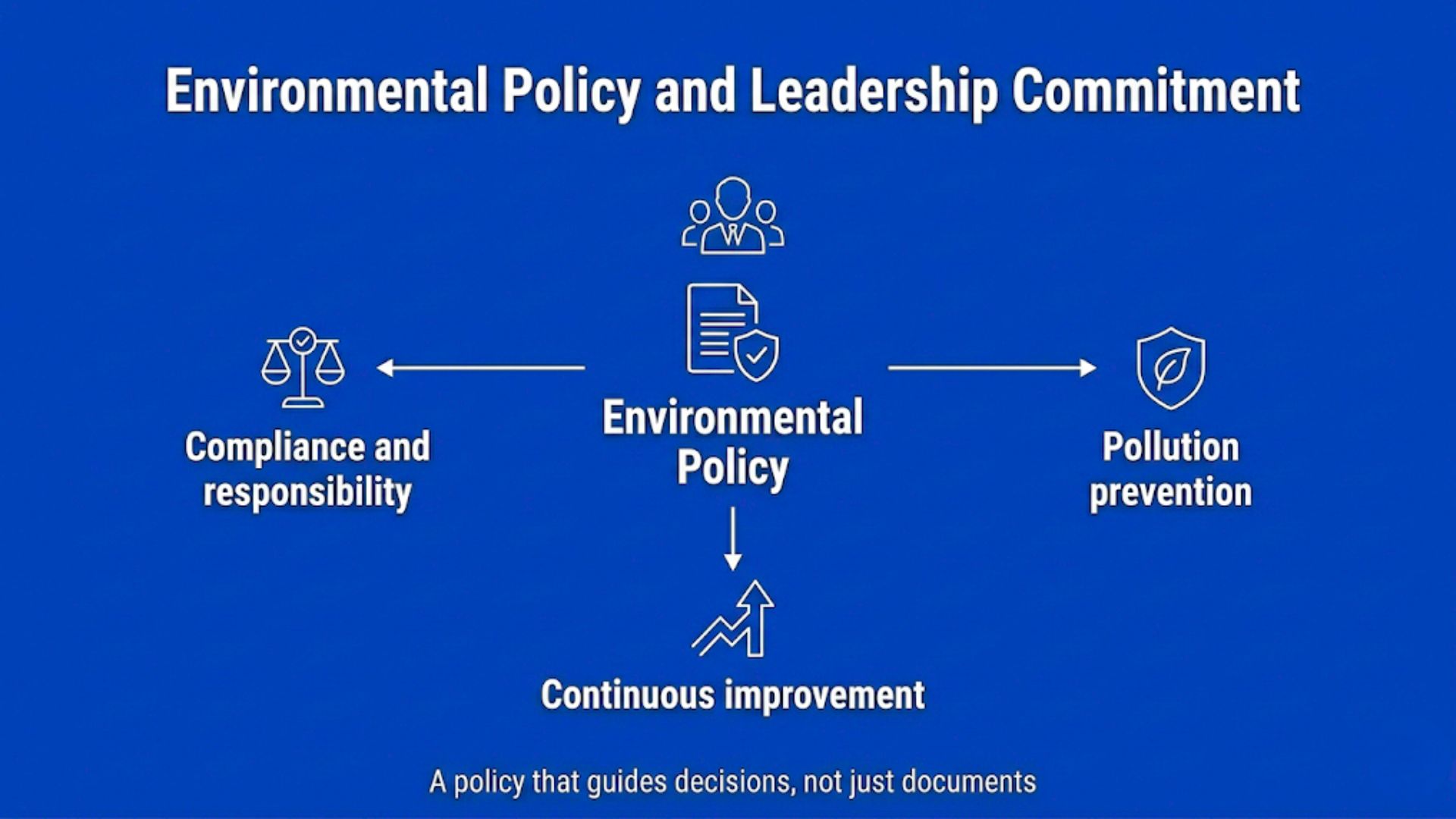
Your environmental policy sets the tone, but auditors will quickly check if it’s more than just a document. It should reflect real intent and direction from leadership, not generic statements copied from templates.
More importantly, this policy should be visible in day-to-day decisions. From leadership discussions to team actions, it should feel like a guiding principle, not just something framed on a wall.
Make sure:
If your team doesn’t recognize the policy, it signals a disconnect between management and execution.
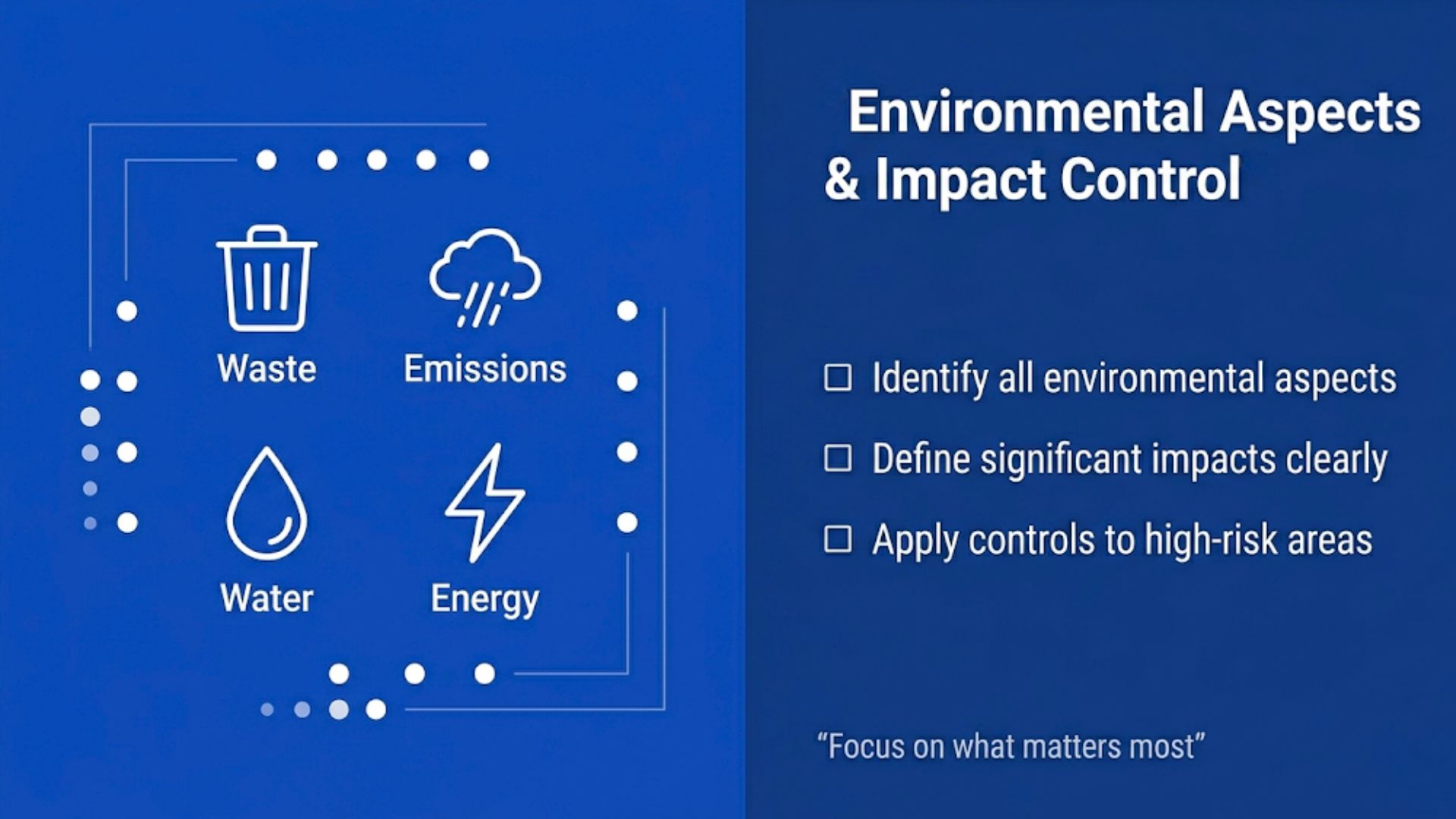
This is one of the most heavily audited areas because it shows how well you understand your environmental risks. You need to clearly identify what activities impact the environment and how you’re managing them.
It’s not just about listing impacts, it’s about prioritizing them. Auditors want to see a clear logic behind what you consider “significant” and how seriously you’re managing those risks.
Check if:
Auditors often pick one aspect and ask you to walk them through how it’s controlled, so be ready with real examples.
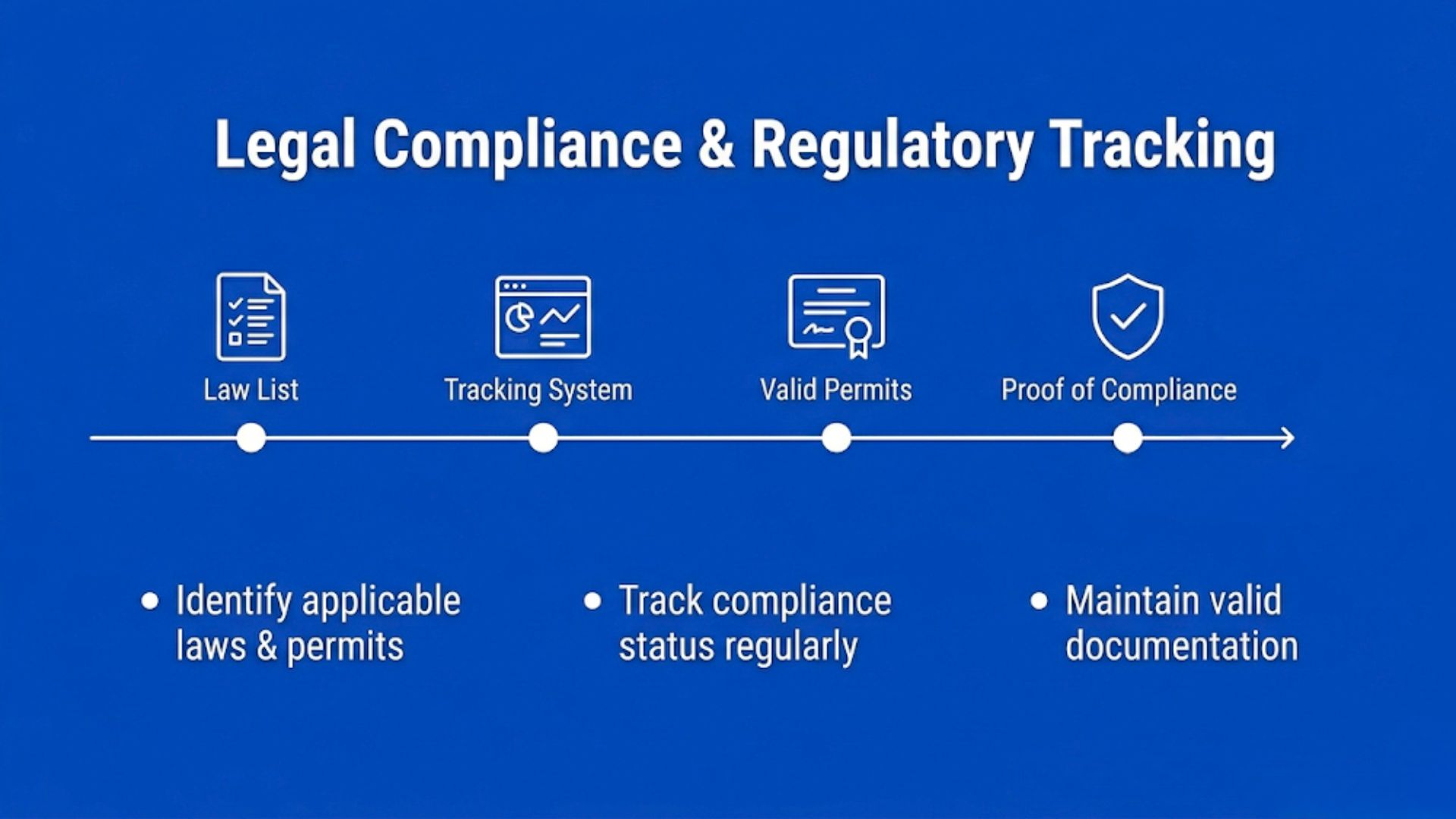
Compliance isn’t assumed, it’s proven. Auditors will expect clear evidence that you’re aware of and meeting all applicable environmental regulations.
This also means staying updated. Regulations change, and your system should reflect those updates without delays or confusion.
You should have:
If you can’t show documented proof, it’s considered a gap, even if you are technically compliant.
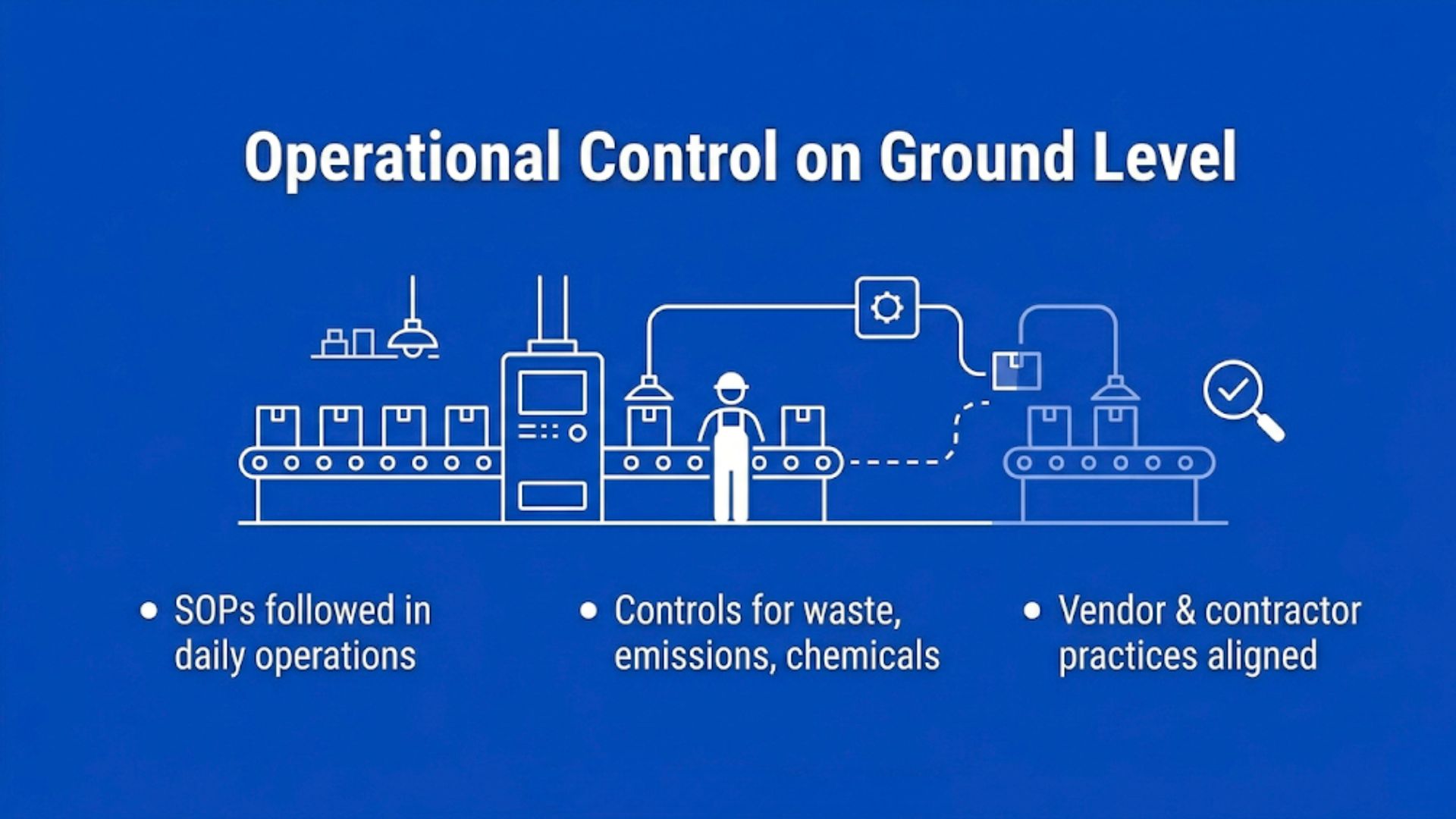
This is where auditors move beyond documents and observe your actual operations. They want to see if your processes are controlled, consistent, and aligned with your environmental goals.
In most audits, the shop floor tells the real story. If there’s a gap between what’s written and what’s happening, it becomes obvious very quickly.
Look at:
A quick walk-through of your facility often reveals more than your entire documentation set.
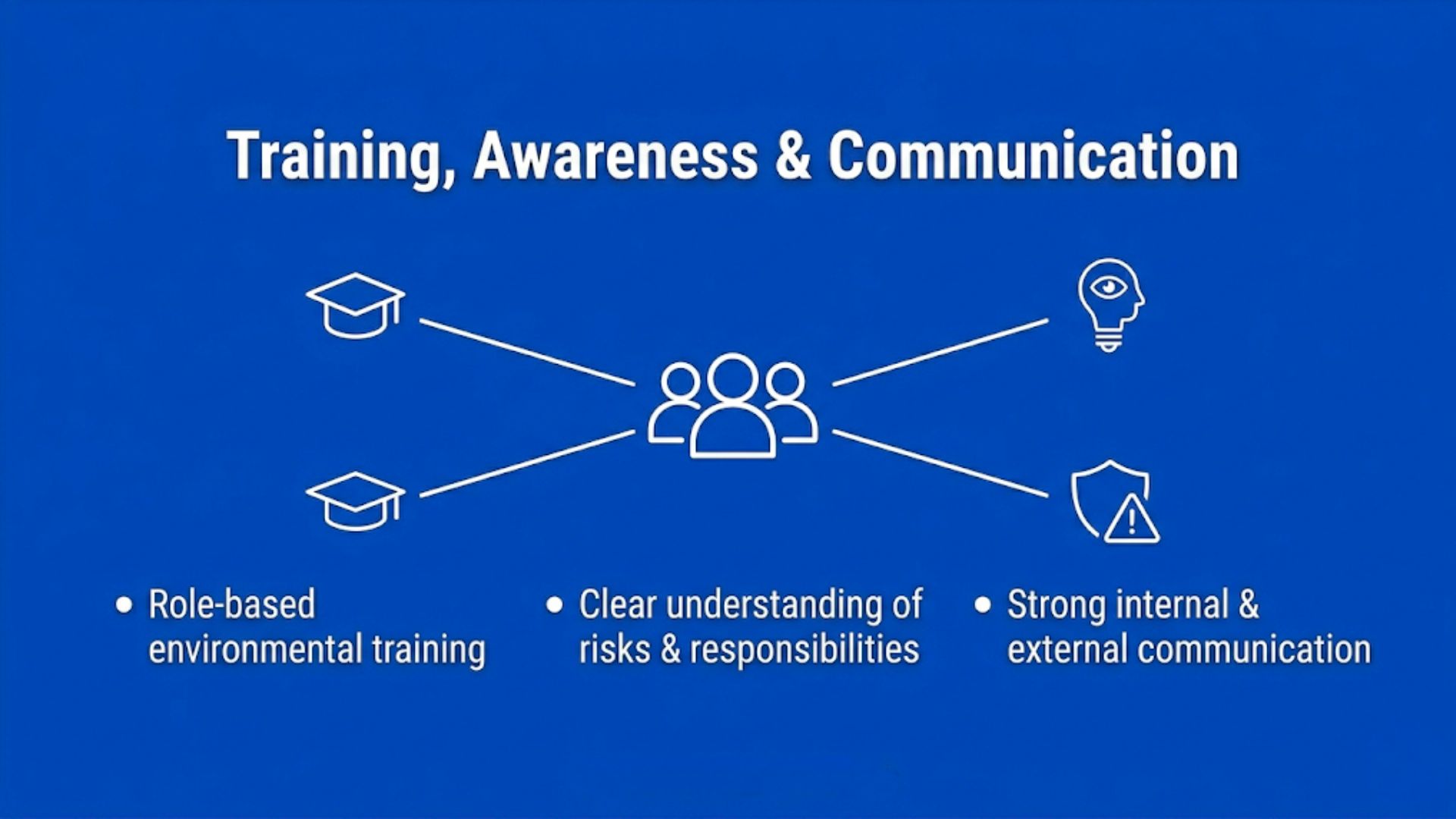
An effective EMS depends on people, not just processes. Your team should know what to do, why it matters, and how their role connects to environmental performance. When employees clearly understand the importance of ISO 14001 certification for business, it becomes much easier for them to see the value behind their daily actions and stay aligned with environmental goals.
Awareness should feel natural, not forced. Employees don’t need to know everything, but they should confidently understand their part in the system.
Make sure:
If a random employee can confidently answer basic questions, you’re in a strong position.
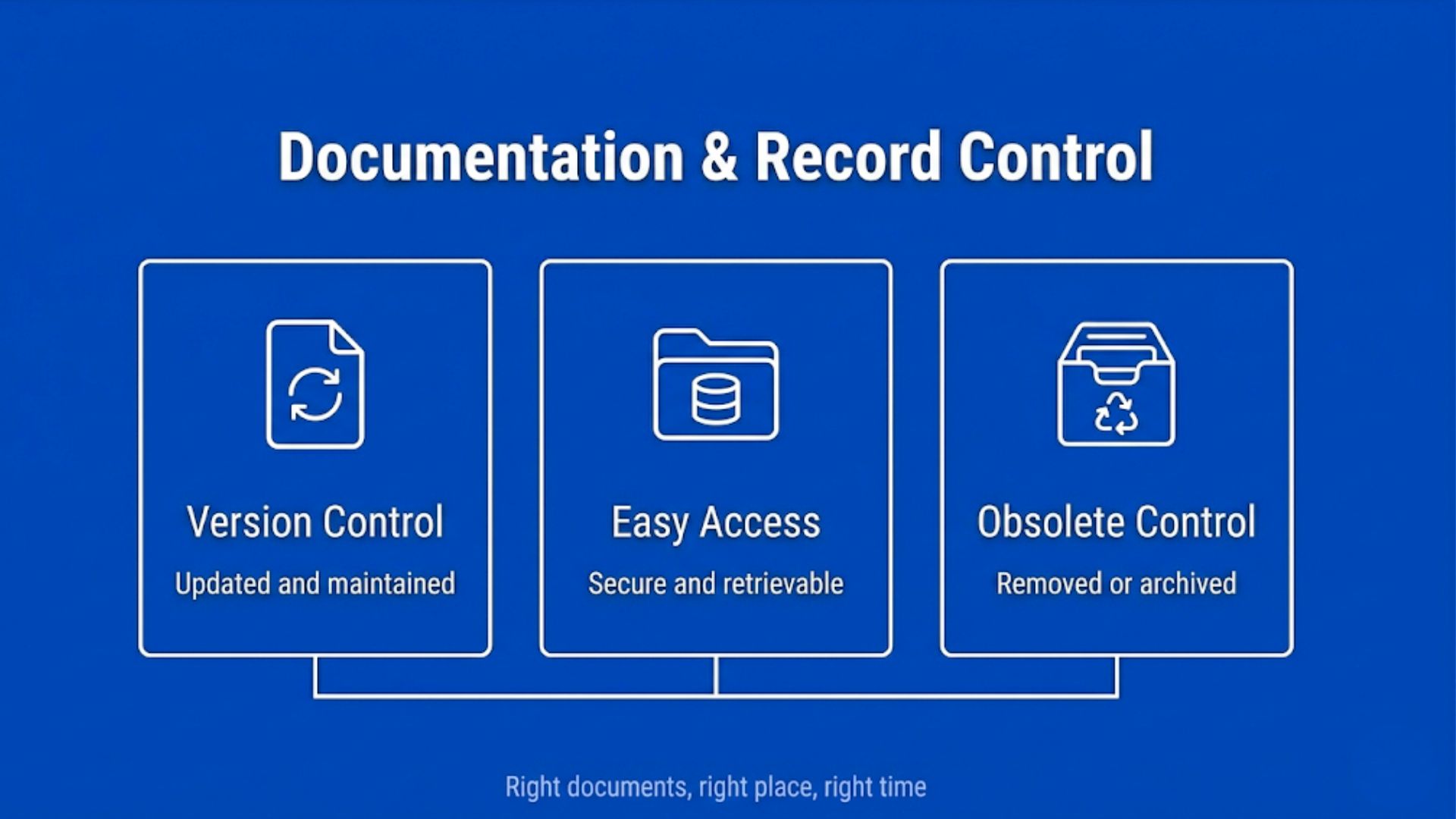
Your documentation should support your system, not slow it down. With a well-structured DMS, auditors can easily access what they need, when they need it.
It’s not about having more documents, it’s about having the right ones, in the right place, properly maintained and readily available.
Check whether:
If it takes too long to find a document during the audit, it reflects poor control.
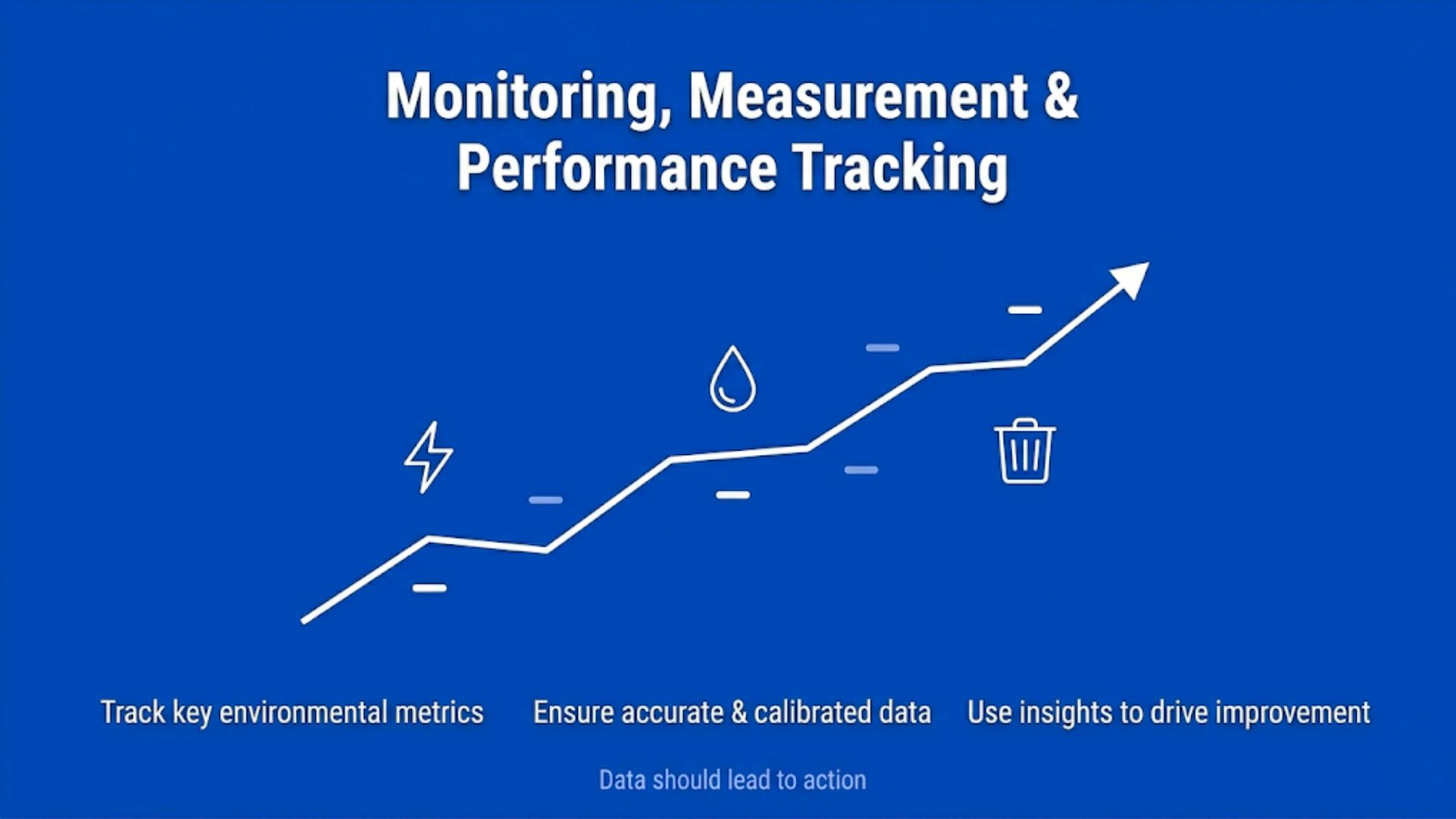
ISO 14001 isn’t just about control, it’s about improvement. That only happens when you track and analyze your environmental performance.
Good data should lead to action. If you’re measuring something, you should also be improving it.
Focus on these areas:
Raw data alone isn’t enough, auditors want to see what actions you’ve taken based on it.
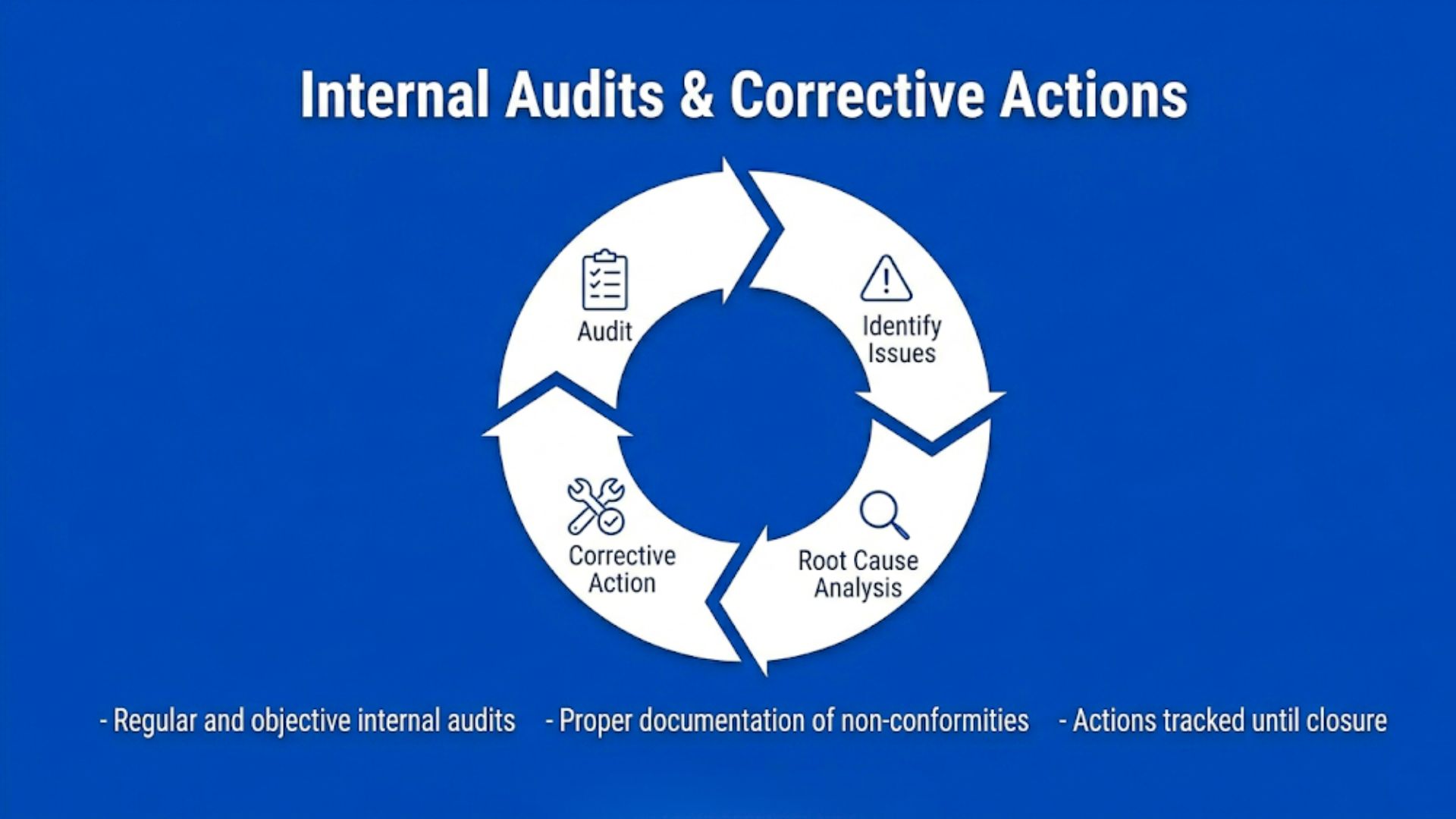
Before the external audit, your internal system should already be catching and fixing issues. This not only reflects maturity in your processes but also shows a genuine commitment to continuous improvement rather than last-minute preparation.
A strong internal audit process, especially when supported by audit management software, acts like a reliable safety net. It helps you systematically identify gaps, track nonconformities, assign corrective actions, and monitor their closure over time. Instead of reacting to audit findings, you’re proactively addressing issues early, making your system more robust, transparent, and audit-ready.
Ensure this when you go for internal audits:
A strong internal audit process often means a smoother external audit.
If there’s one thing to remember, it’s this, ISO 14001 audits are evidence-driven. It’s not about saying the right things, it’s about showing them.
If your processes are clear, your team is aware, and your records are solid, the audit becomes a validation, not a stress test.

When you hear “clause-by-clause,” it might sound like you need to memorize the entire ISO 14001 standard.
You really don’t. An auditor is not expecting textbook answers. They just want to see if your system makes sense for your business and if it’s actually being followed. As they move through Clause 4 to Clause 10, they are mentally connecting your processes to each requirement.
For example:
Clause 4 is about understanding your business context, Clause 5 checks if leadership is involved, and Clause 6 looks at how you plan for risks and opportunities. It is less about theory and more about how naturally all of this shows up in your day-to-day work.
When auditors review Clause 7 and Clause 8, they usually go a bit deeper. They will check if your team is trained, aware, and actually following the processes you have defined. This is where they often step onto the floor and observe things directly instead of just reading documents.
Here’s what they are quietly looking for across all clauses:
When they reach Clause 9 and Clause 10, the focus shifts to performance and improvement. They want to see if you are tracking results, conducting internal audits, and actually fixing issues instead of letting them slide.
This stage is often where businesses realise how important the right guidance can be, because interpreting audit findings, maintaining proper records, and turning insights into action requires a structured approach. That’s why choosing the right ISO 14001 compliance partner can make a meaningful difference, not to complicate things, but to help you stay consistent, prepared, and confident throughout the process.
You don’t need a perfect system to pass an audit. What matters is clarity and honesty. If your system is simple, understood by your team, and backed by real proof, you are already doing most things right.
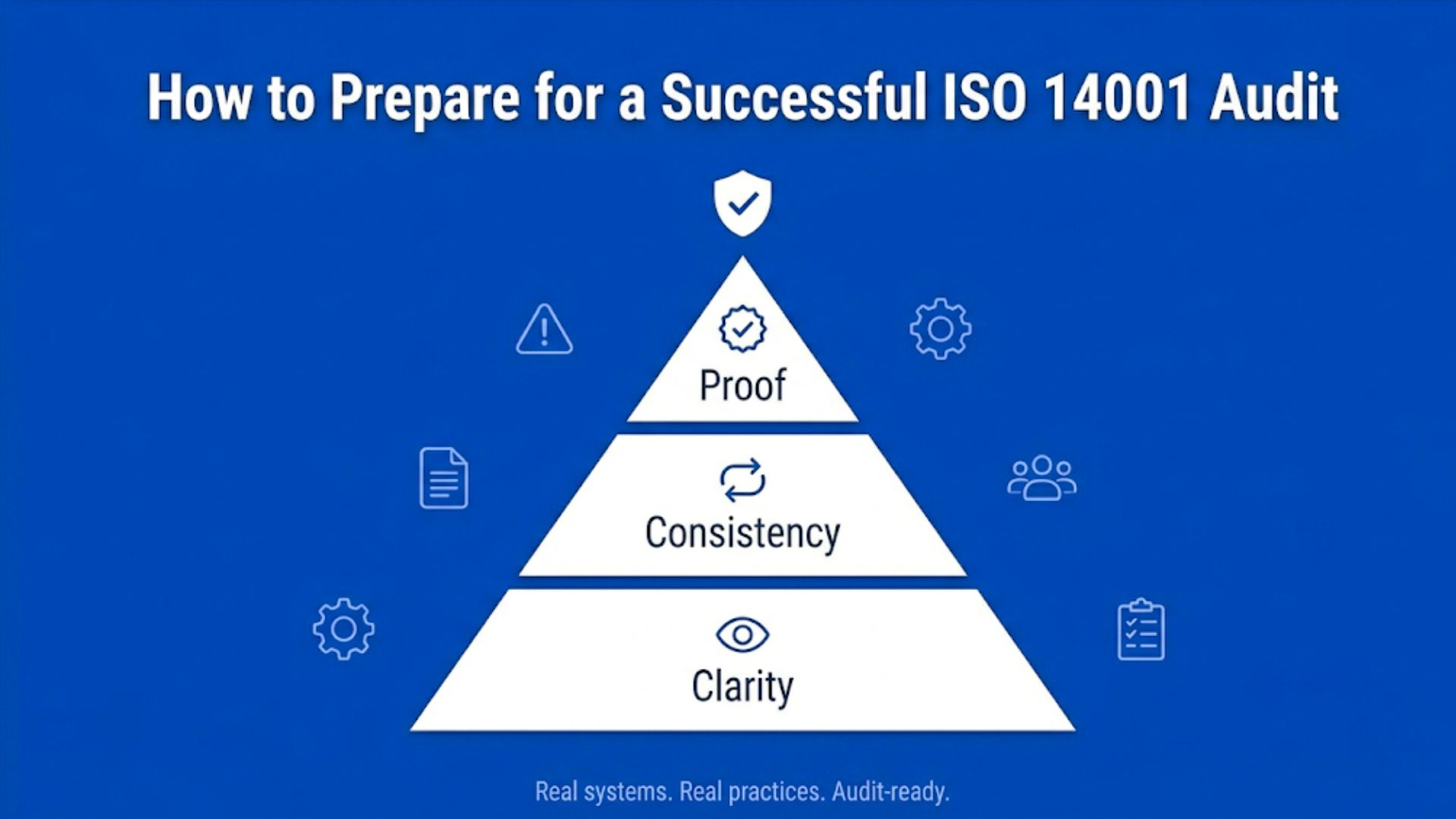
Imagine this, you’ve got an ISO 14001 audit coming up, and it’s sitting in the back of your mind like an unread notification you keep ignoring. Not scary, but definitely not chill either.
Here’s where it gets better,
This isn’t about impressing an auditor with perfect documents. It’s about proving that what you claim to do for the environment is actually happening in real life.
Before you open any templates or policies, pause.
Look at your operations as they are today and ask yourself:
Don’t try to sound technical here. Be real. Auditors can spot “over-smart answers” instantly.
This is where most people either overdo it or completely miss the point.
Think of it as your problem map:
If everything feels important, you’re not prioritizing.
If nothing feels important, you’re definitely missing something.
This is not a last-minute Google search situation.
You need clarity on:
It doesn’t have to be fancy. Even a simple system works, as long as it’s consistent and updated.
Here’s where audits usually get uncomfortable.
You probably already have things like:
But ask yourself honestly, are people actually following them?
If your documentation says one thing and your team does another, that gap will show.
Focus less on polishing documents and more on aligning real practices.
ISO 14001 audit is not a one-person job.
Your team should:
And no, awareness doesn’t mean boring training sessions. It means they actually get it.
Internal audits are your chance to catch mistakes before the real audit.
Use internal audits to:
The more honest you are here, the smoother your external audit will be.
Management review isn’t just a calendar event.
This is where you need to ask:
If something feels off, this is your moment to fix it.
A successful ISO 14001 audit doesn’t come from perfect files.
It comes down to three things when it comes to management review:
If your system reflects reality, and your team is aligned with it, you’re already ahead of most businesses walking into that audit room.
Keeping all of this aligned in real time is where things usually start to slip.
That’s where P3 LogiQ steps in and keeps everything grounded.

Instead of juggling policies, risks, compliance, and team alignment separately, it brings it all into one place.
Your environmental aspects, controls, audits, and records stay connected, so what’s documented actually reflects what’s happening on the ground. It helps you stay consistent without overthinking, keeps your team on the same page, and makes it easier to spot gaps before they turn into audit issues. No last-minute fixes, no confusion, just a system that runs the way it should.
Book a free demo call and our expert team will ensure your ISO 14001 processes stay structured, clear, and fully audit-ready, without the usual stress.

Let’s be honest, most ISO 14001 audits don’t go wrong because people don’t care.
They go wrong because people assume they’re “mostly ready.”
That small overconfidence?
That’s usually the problem.
One of the biggest mistakes is treating ISO 14001 like a documentation exercise. You might have neat policies, clean formats, and everything filed perfectly, but if your actual operations don’t match what’s written, it’s game over. Auditors don’t just read, they observe.
If your team is doing things differently on the ground, that gap becomes very obvious, and it can also quietly increase your overall ISO 14001 certification cost because fixing these gaps later usually takes more time and resources.
Another common slip is rushing compliance. You can’t just pull up environmental laws a week before the audit and expect it to work. If you’re not regularly tracking and updating your legal requirements, it shows. And this is one area auditors don’t even need to dig too deep, they can sense it quickly.
Most audits fail quietly because of things like:
Also, don’t ignore the small things thinking they won’t matter. In ISO 14001 audits, it’s often the tiny inconsistencies that build the bigger picture.
A missed record here, an unclear responsibility there, it all adds up. If you stay honest about what’s actually working and fix gaps early, the audit starts feeling less like a test and more like a validation of what you’ve already built.
At the end of the day, it’s not about avoiding mistakes perfectly. It’s about not ignoring the obvious ones.
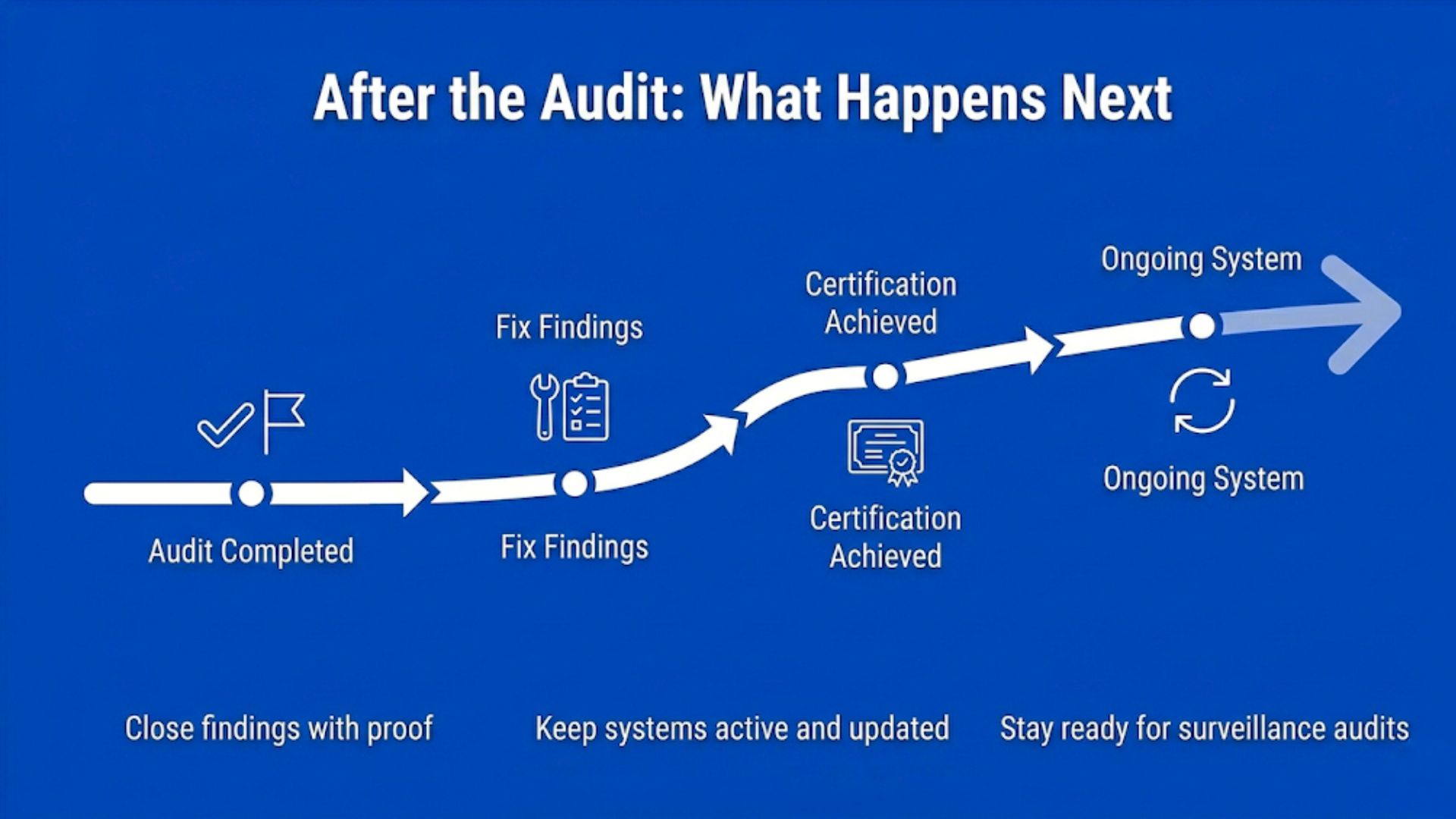
So your audit is done. First of all, take a second. That part is not easy. Now comes the part most people don’t really talk about. What happens after the auditor leaves.
You will usually get an audit report with a few findings. Some might be minor, some might need a bit more attention.
Don’t panic. This is completely normal. What matters is how you respond. You’ll be expected to fix these issues within a given time and show proof that you’ve actually resolved them.
Once that’s done, you get your certification. But here’s the honest part. Certification is not the finish line. It is more like a checkpoint.
To stay certified, you need to keep your system active and not let it fade away after the audit.
There will also be surveillance audits, usually once a year. These are shorter, but they check if you’re still following the system properly.
If you treat ISO 14001 like a one-time project, it becomes stressful every year. But if you treat it like part of your daily work, audits start to feel a lot more manageable.
Getting audit-ready doesn’t have to feel like a separate project.
With P3 LogiQ, it fits right into the way you already work.
From organizing your documentation to keeping every process aligned, everything starts to feel clearer and more in control. You’re not just preparing for an audit, you’re building a system that actually works day to day.

P3 LogiQ helps you stay consistent, track what matters, and walk into audits with confidence instead of last-minute stress.
Book a free demo call and see how our team ensures smoother processes, better clarity, and a more confident path to ISO 14001 compliance.



Businesses need document management systems (DMS) to ensure ISO and R2 compliance, improve efficiency, and stay audit-ready. The article highlights key features like version control, security, and automation while reviewing the top 5 DMS solutions. P3 LogiQ stands out for its compliance-focused automation and secure document tracking
Read More
Recycling businesses gain efficiency, compliance, and sustainability with RIOS certification. It streamlines quality management, environmental responsibility, and worker safety, helping companies avoid legal risks and boost credibility. P3 LogiQ simplifies the certification process with automation, document control, and compliance tracking, making operations smarter and safer.
Read More
Audit Management Software (AMS) automates compliance tracking, streamlines workflows, and reduces audit risks. Key features include automated scheduling, compliance checklists, CAPA tracking, vendor risk management, and integrations.
Read More
Learn how audit management systems simplify ISO and R2 compliance by automating audits, managing documentation, and minimizing compliance risks efficiently.
Read More
In 2025, many businesses still face challenges in compliance management due to outdated methods like spreadsheets and fragmented software. This inefficiency leads to missed deadlines, increased risk, and regulatory penalties. The blog emphasizes the importance of modern compliance tools that automate workflows, enhance risk management, and streamline regulatory processes to meet ISO and R2 standards.
Read More
The rise in e-waste and environmental concerns makes responsible electronics recycling essential. The R2 Certification sets a global standard for safe, sustainable, and data-secure recycling practices. Developed by Sustainable Electronics Recycling International (SERI), R2 helps businesses manage environmental risks, data security, worker safety, and legal compliance.
Read More
Businesses face increasing challenges in managing complex regulatory compliance. Manual methods such as spreadsheets and paperwork can lead to missed deadlines, inefficiencies, and costly penalties. Compliance management software offers a streamlined solution to reduce risks, automate processes, and improve operational efficiency.
Read More
Maintaining R2 Certification is crucial for businesses in the e-waste recycling industry, ensuring regulatory compliance, sustainability, and strong stakeholder trust. This guide outlines 10 best practices to help businesses simplify operations, reduce risks, and stay compliant.
Read More
Unlock the value of ISO risk management certification. Explore its impact on compliance, risk mitigation, and business expansion.
Read More
Explore the top 5 ISO risk management software tools for 2025, including document management solutions for streamlined compliance and increased efficiency.
Read More
Find the ideal document management software (DMS) for your business. Learn how to choose with expert tips, key features, and insightful guidance
Read More
Unlock the power of a Document Management System (DMS). Learn how it can revolutionize your business operations.
Read More








.png)


.png)



.jpg)



.jpg)
.jpg)







.jpg)


.png)

.png)
.png)




.png)

