.jpg)

Imagine sitting at your desk on a Tuesday morning. You have a cup of coffee in one hand and a high-priority to-do list in the other. You feel like everything is under control.
You know the major federal laws like the Clean Air Act by heart. Your key permits are in place, and your waste records are ready.
Then a notification arrives.
It is an update about a local environmental permit that was revised last month. The email had been sitting in your inbox while you were focused on other work. Moments later, a client asks for proof of a carbon reduction goal you committed to earlier.
That sense of control starts to fade.
You start digging through folders and searching for that one specific thread. Your heart sinks as you realize that while you were focusing on the "big" rules, the small, local, and voluntary ones were quietly piling up.
This is the reality for many organizations. It is not always a giant federal lawsuit that trips you up. Often, it is the dozens of tiny, moving parts you did not realize were compliance obligations.
When this information is managed through scattered files, you are one missed email away from a major violation.
This is precisely where the framework of ISO 14001 certification enters the picture.
The primary benefit of ISO 14001 is the structured safety net it provides. By moving away from manual tracking, the system keeps your environmental obligations visible and significantly easier to manage
Modern ISO 14001 compliance software makes this even stronger by automating these alerts. This means you never have to worry about a buried email again.
In this blog, we look at how that system works. From identifying obligations to evaluating them, each step plays a role in staying prepared.
It all starts with understanding what counts as a compliance obligation.

Most people think ISO 14001 compliance means getting a certificate, framing it, and hanging it in the lobby.
But that’s only part of the story.
ISO 14001 compliance is an ongoing commitment.
It means your organization has a real system to identify its environmental impact, track legal obligations, and prove you are actually following them.
The certificate gets you in the door. The compliance keeps you there.
Here’s the part that surprises many managers.
ISO 14001 does not replace the law.
Even if you are certified, you can still be audited for violations.
Your certificate does not replace the Clean Air Act or your local permits.
What it does is give you a structured way to manage all of these requirements in one place.
In many organizations, this becomes easier with ISO 14001 compliance software that tracks deadlines, permits, and regulatory updates in one system.
That’s the real value.
It’s not about the paper on the wall. It’s about having a system that helps you avoid fines and run a cleaner, more efficient business.
But this only works if you treat it as a living system, not a one-time project.
So what does that system actually look like?
It starts with understanding your compliance obligations.
And this is where things get interesting.
Under ISO 14001, there are two types that every US organization needs to know.

In simple terms, compliance obligations are just the rules your business has to follow.
But here’s where it gets interesting.
ISO 14001 does not only focus on government laws. It divides your responsibilities into two types: mandatory and voluntary. And to stay compliant, you have to treat both with the same level of importance.
This is a core part of how the ISO 14001 certification process is structured.
These are the non-negotiables.
If you operate in the United States, these are the legal requirements set by federal, state, and local authorities.
Depending on your industry, this usually includes:
Federal laws: Requirements under laws like the Clean Air Act or the Clean Water Act.
Permits: Limits on what you can release into the air or discharge into water.
Local rules: City-level requirements for noise, recycling, or waste handling.
If you ignore these, you are not just failing an ISO audit.
You are taking on legal risk that can lead to heavy fines or even a shutdown.
This is the part that catches many managers off guard.
Voluntary obligations are the rules you choose to follow. They are not laws. But once you commit to them, ISO 14001 treats them just like legal requirements.
Common examples for US companies include:
Customer agreements: If a client requires a 50 percent recycling rate, that becomes a compliance obligation.
Industry standards: Following frameworks like the R2 standard for electronics recycling.
Company goals: If leadership commits to being carbon neutral by 2030, you must track and show progress.
So why does ISO treat a choice like a law?
Because the system is built on accountability.
If you say you are going to meet a certain environmental goal, you need to prove it.
Whether it is a government regulation or a promise made to a customer, both must be tracked and managed.
If you miss either one, you are no longer in compliance.

If you want to stay compliant, you cannot just keep a mental list of rules.
ISO 14001 Clause 6.1.3 requires you to follow a structured process to identify and document every obligation that applies to your business.
Missing these rules is not just about the environment. It also puts your people at risk. For example, hazard communication was the second most cited workplace violation in the US last year. According to this OSHA enforcement report, inspectors issued 2,546 violations in Fiscal Year 2025 alone.
When rules are not tracked properly, they get missed. A clear, up-to-date compliance register keeps these requirements visible so nothing slips through the cracks.
In most organizations, this is captured in a document called a compliance obligations register.
Think of it as your master list.
It tells you what rules apply, why they apply, and how you plan to meet them.
Without this, you are essentially guessing. And that is where compliance gaps begin.
A good register is more than a list of law names. To stay audit-ready, it should clearly include:
If an auditor asks how you meet a requirement like the Clean Air Act, you should not be searching through files. You should be able to point to your register directly. Using an ISO 14001 compliance software makes this easier by keeping everything in one place.
Even experienced teams make mistakes here. One common issue is ignoring voluntary obligations.
Many organizations only track legal requirements and miss commitments made to customers or industry groups.
Another problem is letting the register go outdated. Regulations change and permits expire. If your register is not updated regularly, it stops being useful.
Modern tools help solve this by sending alerts for expiring permits and new regulations. This turns your register from a static document into a system you can actually rely on.
If you are looking for a centralized way to manage your 14001 journey, book a demo and see how P3 LogiQ automates your compliance records to keep your data live, accurate, and audit-ready.

Understanding the theory is helpful. But seeing how it works in daily operations is where the real value lies.
For an organization in the US, your compliance obligations usually fall into three categories: federal laws, local permits, and the commitments you make to your stakeholders.
These are the laws you must follow to stay in business.
If you are a manufacturer or a service provider in the US, your register likely includes:
If you ignore these, you are not just failing an ISO audit. You are taking on a serious legal risk.
These are just as important for your ISO 14001 audit.
They are the commitments you choose to follow. But once you commit to them, they are treated the same as legal requirements.
Common examples include:
These are easy to miss, but they must be tracked just like legal obligations.
ISO 14001 is placing more focus on environmental conditions. This includes areas like biodiversity and climate impact.
Because of this, your list of obligations may continue to grow. You may need to document how your operations affect local ecosystems or how you manage resources over time.
Keeping track of these changes is often the hardest part. Regulations evolve, and expectations increase.
If you are looking for a more structured way to manage this, tools like ISO 14001 compliance software can help keep your obligations updated and audit-ready.
Explore how P3 LogiQ manages these updates to keep your data live and audit-ready.

Identifying your rules is the first step.
Clause 9.1.2 is where you prove you are actually following them. This is called the evaluation of compliance.
Many teams confuse this with a standard internal audit. They are related, but they are not the same thing.
An internal audit checks if you are following your own system.
An evaluation of compliance checks if you are meeting your legal and voluntary obligations.
So what does this look like in practice?
To meet this requirement, your organization needs to:
The rule here is simple. If it is not documented, it did not happen.
ISO 14001 requires you to keep records as proof of your compliance evaluations.
This means recording the date of the check, what was reviewed, and the final result.
If an auditor asks how you are meeting a requirement like an air permit, showing a recorded result is far more reliable than a verbal answer.
Clause 9.1.2 acts as your safety net.
It helps you catch small issues early, before they turn into violations.
And that is what keeps your compliance on track and your certification secure.
Running a compliance evaluation does not have to be complicated. Once your obligations are clearly listed, the process becomes structured and repeatable.
But getting this right matters more than ever.
In the United States, enforcement is not slowing down. In Fiscal Year 2025, the EPA Enforcement and Compliance Annual Results closed over 2,100 civil enforcement cases, the highest in nearly a decade. Penalties crossed $1.2 billion. That is not a small risk. That is a real financial impact.
This is why “doing your best” is not enough. You need a clear system that checks every requirement and catches gaps early.
Here is how most organizations do it in practice.

Start with your compliance obligations register. This is your baseline. Make sure it is updated with all legal and voluntary requirements before you begin.
If your list is outdated, your evaluation will be inaccurate from the start.
Each obligation needs a clear checkpoint. For example, if you have an air permit, your check might be emission logs or monitoring reports.
The goal is simple. You should know exactly what proof shows that you are compliant.
Compliance cannot sit with one person alone. Assign each obligation to a responsible team or individual.
This ensures accountability and prevents gaps where tasks are assumed but never completed.
Now comes the actual check. Review records, inspect processes, and verify that requirements are being met.
This is where you identify gaps. If something is missing or incomplete, it needs immediate attention.
Every evaluation must be documented. Record what was checked, when it was checked, and whether it passed or failed.
Without this, you have no proof during an audit.
If you find a gap, fix it. Do not wait for the next audit cycle.
Also, document what action was taken. This shows that your system is active and responsive.
Over time, patterns will appear. Some areas may fail more often than others.
Use this data to improve your processes and reduce repeat issues.
An audit is not just a test of your paperwork. It is a test of your system in action. To stay certified, you need to show that your environmental management system is active and working.
And the expectations are only getting stricter. According to this LRQA transition report, ISO 14001 is already moving toward its next version, with a stronger focus on broader environmental risks and long-term impact.
Regulators and auditors are now looking beyond basic compliance. They want to see how well you understand your environmental risks and how consistently you manage them.
Use this checklist to verify your status before the auditor arrives.

Start by reviewing your context and leadership involvement. You should have clearly documented how environmental conditions, such as climate change or resource availability, impact your operations. At the same time, your top management must be able to explain their role in the EMS. Auditors expect more than approvals; they look for clear accountability and active involvement.
Check your compliance obligations register to ensure it is fully updated with all applicable laws, permits, and voluntary commitments. It is also important that your team can demonstrate how they stay informed about new or changing regulations. Without this, your compliance system can quickly become outdated.
Review your operational controls to confirm that your emergency procedures are current and have been tested. You should be able to show how your organization prepares for potential environmental incidents. In addition, ensure that your suppliers and contractors follow your environmental requirements, as auditors expect you to maintain control over outsourced activities.
Focus on your compliance evaluation process by checking whether you have documented proof of all compliance checks. Simply stating that you are compliant is not enough; records must support it. You should also ensure that evaluations are carried out at the planned frequency, whether monthly or annually.
Finally, assess your internal audit and improvement processes. If issues were identified earlier, there should be clear evidence that they were resolved, demonstrating a closed-loop system. Additionally, make sure training records are up to date, showing that employees understand and can manage the environmental impact of their roles.
Environmental expectations are evolving. Auditors are starting to look at broader risks like climate impact, resource use, and long-term sustainability.
This means your system cannot stay static. It needs to grow with these expectations.
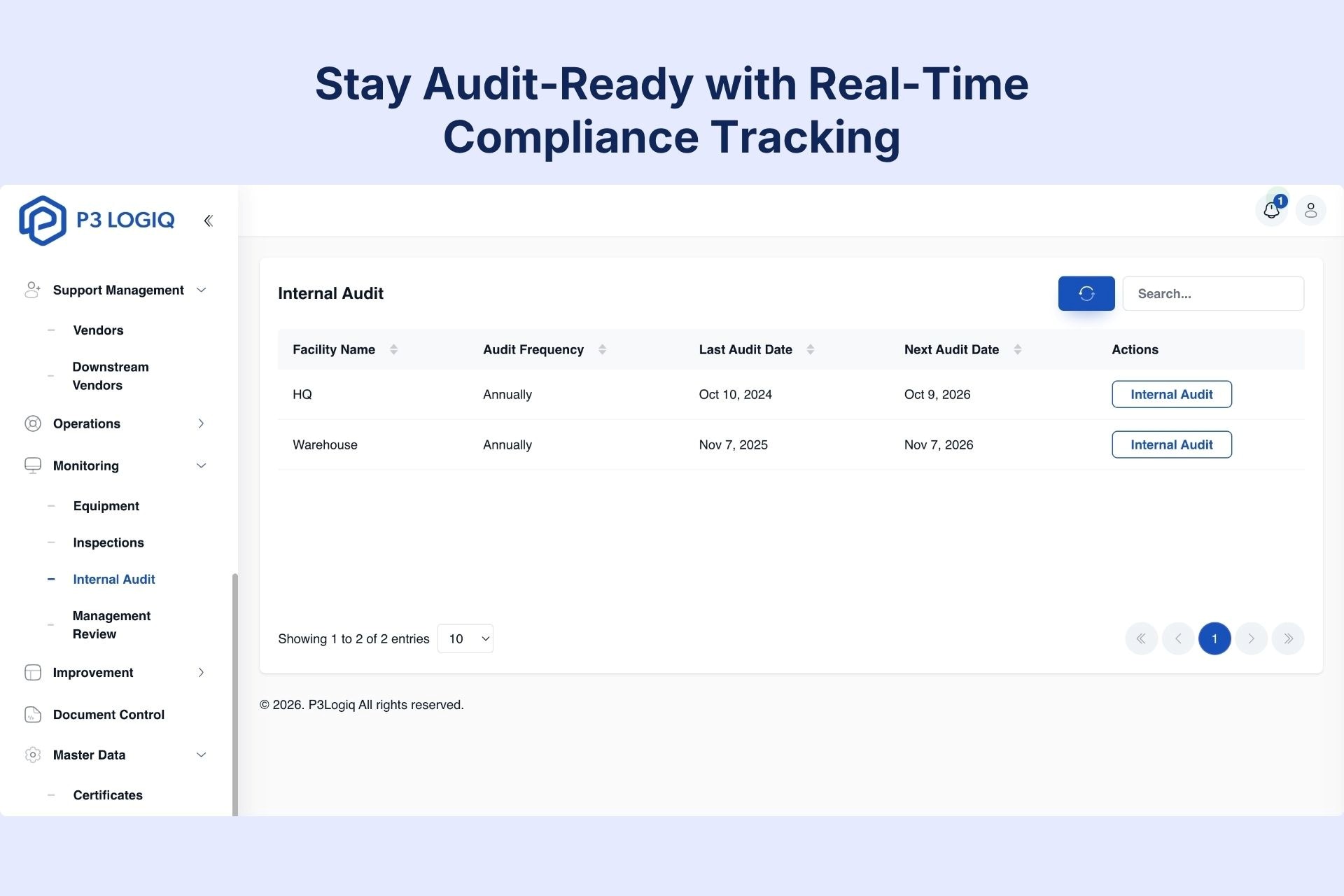
If you are still managing things manually, it is easy for gaps to go unnoticed.
P3 LogiQ brings everything into one place, tracks what matters, and keeps you audit-ready without the constant chasing. You can book a demo and see how it works in real time.

Maintaining your ISO 14001 certification is not a one-time effort. It requires consistency. Your system needs to stay active as your operations grow and change.
And the expectations are only getting higher.
Recent transition guidance from this SGS report suggests that auditors are placing more focus on how actively leadership supports the system, not just at the top level, but across teams. This means your environmental management system cannot sit with one department. It has to be part of how the entire organization works.
Once you are certified, your organization enters a three-year audit cycle. Understanding how this works helps you stay prepared.
Surveillance audits happen once a year. These are smaller reviews where auditors check selected parts of your system. The goal is to confirm that your processes are being followed consistently.
Recertification audits happen every three years. This is a full review of your system. Auditors assess all major areas before renewing your certification.
Long-term success comes from consistency, not last-minute preparation.
Empower your team: Employees should understand how their work connects to environmental impact. When people take ownership, gaps are easier to catch early.
Visible leadership: Management should be involved, not just approving reports. Regular participation in reviews and discussions shows that the system matters.
Clear communication: Share updates, issues, and progress regularly. This keeps compliance part of everyday operations, not just audit preparation.
Your business will not stay the same. Your system should not either.
When you introduce a new process, supplier, or location, you need to assess its environmental impact. If changes are made without updating your compliance obligations, gaps will appear.
A strong system adapts as your operations evolve. To see how P3 LogiQ keeps your data live and your certification secure, book a demo with our team. We help you maintain a professional, audit-ready system that grows with your organization.

ISO 14001 is not a law. It does not replace environmental regulations in the United States. Instead, it helps you manage them in a clear and organized way.
In the US, organizations must follow rules set by agencies like the EPA, along with state and local authorities. These rules cover areas such as air emissions, waste handling, and water discharge. ISO 14001 requires you to identify these obligations and keep track of them in one place.
This is where the connection becomes practical.
ISO 14001 expects you to maintain a list of your compliance obligations. This includes permits, legal requirements, and any other environmental commitments that apply to your operations. Once identified, you are also expected to review them regularly and check whether you are meeting them.
For example, if your business operates under an environmental permit, ISO 14001 requires you to monitor your activities against the limits defined in that permit. You also need records that show these checks are actually being done.
The standard also requires periodic evaluation of compliance. This means you are not only listing regulations, but actively verifying that your processes align with them over time.
In this way, US environmental regulations define what you must follow, while ISO 14001 defines how you stay organized, track your obligations, and demonstrate compliance during audits.
Together, they create a system that reduces the chance of missing requirements and helps you stay prepared for both regulators and auditors.

Even with a dedicated team, certain gaps tend to appear again and again. Identifying them early can help you avoid major non-conformities during an audit.
Many organizations review their compliance obligations only a few weeks before an audit, which often leads to missed updates, expired permits, or outdated regulatory references. To prevent this, set a recurring schedule such as monthly or quarterly reviews so compliance is maintained continuously rather than checked only at audit time.
In the US, it is common to focus only on federal regulations from agencies like the EPA or OSHA while overlooking local rules and customer-specific requirements. To prevent this, include a clear category for voluntary and local obligations in your compliance register so all applicable requirements are covered.
Some organizations create a compliance register once and rarely update it, which creates gaps when regulations change or new permits are added. To prevent this, assign ownership and review the register at regular intervals to keep it aligned with current legal requirements.
Verbal confirmation such as “we do this regularly” is not enough during an audit, as auditors expect documented proof of actions. To prevent this, maintain logs, timestamps, and records for all inspections and checks, ensuring every activity is documented at the time it is performed.
If only one person understands the system, it creates a dependency risk and makes the system vulnerable if that person is unavailable during an audit. To prevent this, cross-train multiple team members so they can access the system and explain operational controls when needed.
ISO 14001 is not something you complete once and move on from. It is a system that needs to stay active as your business, risks, and regulations continue to evolve.
In practice, long-term compliance depends on consistency. The organizations that stay audit-ready are not the ones that prepare at the last moment but the ones that treat compliance as part of their daily operations. This includes regularly reviewing compliance obligations, maintaining records, and ensuring that operational controls are actually followed on the ground.
It also depends on visibility. When environmental responsibilities are shared across teams and not limited to one person, the system becomes more stable. Everyone involved should understand their role and how their work impacts environmental performance.
Another key factor is keeping your system updated. Changes in processes, suppliers, or regulations should always be reflected in your compliance register and operational controls. Without this alignment, gaps can form quickly, and those gaps are often what auditors identify first.
ISO 14001 works best when it is supported by simple, repeatable practices. Regular checks, clear documentation, and team awareness all contribute to a system that remains reliable over time.
When these elements come together, compliance becomes less about preparing for audits and more about maintaining a system that is always ready.

Book a demo to see how P3 LogiQ keeps your compliance data live and audit-ready. Contact our team to discuss how we can help you maintain your certification long-term.
An ISO 14001 compliance evaluation helps organizations verify whether they are meeting their environmental legal requirements and voluntary commitments. It ensures that permits, operational controls, and environmental obligations are actively monitored, documented, and reviewed regularly to maintain compliance and support successful certification audits.
Compliance obligations under ISO 14001 include both mandatory legal requirements and voluntary environmental commitments. These may involve federal regulations, local permits, customer agreements, sustainability targets, or industry standards. Organizations must identify, track, and evaluate all applicable obligations as part of their environmental management system.
ISO 14001 does not specify an exact evaluation frequency, but organizations must perform compliance evaluations at planned intervals. The frequency depends on operational risks, permit conditions, and regulatory requirements. Many businesses conduct monthly, quarterly, or annual reviews to ensure ongoing compliance and audit readiness.
Auditors typically review compliance registers, permits, monitoring records, inspection logs, corrective action reports, internal audit findings, and training records. Organizations must also provide evidence that compliance evaluations are completed regularly and that identified issues are corrected and documented appropriately within the environmental management system.
Common ISO 14001 compliance failures include outdated compliance registers, poor documentation, missed permit updates, overreliance on one employee, and focusing only on federal regulations while ignoring local or voluntary obligations. These gaps often lead to audit non-conformities and increased environmental compliance risks.
ISO 14001 provides a structured framework for managing environmental responsibilities and tracking regulatory requirements. It helps organizations organize permits, monitor environmental performance, document compliance activities, and evaluate ongoing obligations, reducing the risk of missed requirements, penalties, and audit failures over time.
Maintaining ISO 14001 certification requires continuous monitoring, regular audits, updated compliance evaluations, and active leadership involvement. Environmental regulations, operational processes, and sustainability expectations evolve over time, so organizations must continuously improve their environmental management systems to remain compliant and audit-ready.
ISO 14001 certification confirms that an organization’s environmental management system meets the requirements of the ISO 14001 standard through an external audit. ISO 14001 compliance, however, is the ongoing process of following environmental obligations, maintaining records, conducting evaluations, and continuously improving environmental performance to remain audit-ready.



Businesses need document management systems (DMS) to ensure ISO and R2 compliance, improve efficiency, and stay audit-ready. The article highlights key features like version control, security, and automation while reviewing the top 5 DMS solutions. P3 LogiQ stands out for its compliance-focused automation and secure document tracking
Read More
Recycling businesses gain efficiency, compliance, and sustainability with RIOS certification. It streamlines quality management, environmental responsibility, and worker safety, helping companies avoid legal risks and boost credibility. P3 LogiQ simplifies the certification process with automation, document control, and compliance tracking, making operations smarter and safer.
Read More
Audit Management Software (AMS) automates compliance tracking, streamlines workflows, and reduces audit risks. Key features include automated scheduling, compliance checklists, CAPA tracking, vendor risk management, and integrations.
Read More
Learn how audit management systems simplify ISO and R2 compliance by automating audits, managing documentation, and minimizing compliance risks efficiently.
Read More
In 2025, many businesses still face challenges in compliance management due to outdated methods like spreadsheets and fragmented software. This inefficiency leads to missed deadlines, increased risk, and regulatory penalties. The blog emphasizes the importance of modern compliance tools that automate workflows, enhance risk management, and streamline regulatory processes to meet ISO and R2 standards.
Read More
The rise in e-waste and environmental concerns makes responsible electronics recycling essential. The R2 Certification sets a global standard for safe, sustainable, and data-secure recycling practices. Developed by Sustainable Electronics Recycling International (SERI), R2 helps businesses manage environmental risks, data security, worker safety, and legal compliance.
Read More
Businesses face increasing challenges in managing complex regulatory compliance. Manual methods such as spreadsheets and paperwork can lead to missed deadlines, inefficiencies, and costly penalties. Compliance management software offers a streamlined solution to reduce risks, automate processes, and improve operational efficiency.
Read More
Maintaining R2 Certification is crucial for businesses in the e-waste recycling industry, ensuring regulatory compliance, sustainability, and strong stakeholder trust. This guide outlines 10 best practices to help businesses simplify operations, reduce risks, and stay compliant.
Read More
Unlock the value of ISO risk management certification. Explore its impact on compliance, risk mitigation, and business expansion.
Read More
Explore the top 5 ISO risk management software tools for 2025, including document management solutions for streamlined compliance and increased efficiency.
Read More
Find the ideal document management software (DMS) for your business. Learn how to choose with expert tips, key features, and insightful guidance
Read More
Unlock the power of a Document Management System (DMS). Learn how it can revolutionize your business operations.
Read More








.png)


.png)




.jpg)



.jpg)
.jpg)










.jpg)



.png)

.png)
.png)





.png)

