
The other day, I saw a news report about an accident that happened in the workplace, and to be honest, that could have been prevented.
An employee working there lost their life because the company was not following a proper safety protocol.
And the sad reality is, this happens every single year.
And this isn’t rare either. The study from the International Labour Organization reports that nearly 2.93 million workers die every year from work-related accidents and diseases. This is truly heartbreaking.
Now, it’s not like most companies ignore the safety protocol intentionally, of course, but sometimes they overlook the processes, or maybe their documentation is not up-to-date or something along those lines.
And this is why problems like deaths or injuries happen.
You don’t notice the gaps… until something goes wrong.
This is exactly why standards like ISO 45001 software. Not just to be certified, but to protect your fellow team members. According to the ISO.org on 45001:2018, ISO 45001 provides a framework to proactively improve workplace safety and reduce risks.
Implementing this will make sure you follow a structured system that makes your workplace safer for the workers to work in, and at the same time, they will follow processes that are being monitored and improved on a consistent basis. Also, the benefits of 45001 after you implement them are way beyond what is mentioned here.
Because in the end, safety isn’t about policies.
It’s about whether your system actually works when it matters.
To understand how this actually helps in real operations, let’s break down what ISO 45001 certification is.
ISO 45001 is focused on Occupational Health and Safety (OHS) management systems. This ISO standard was developed by the International Organization for Standardization (ISO) in 2018.
When your company implements ISO 45001, you are basically making sure that your workplace is safe, preventing chances of any fatal injuries and following safety protocols. At the same time, you get a framework where you identify any hazards, risks, and such while making sure to follow legal requirements. This makes sure you are having a habit of being proactive so that you can predict any risks or hazards in the future.
The ISO 45001 certification is versatile in the sense that companies of any size, no matter a startup or an enterprise-level one, can implement it.
Apart from what I have mentioned earlier in the Introduction, I’ll mention some more things for you.
Right now with the ISO 45001 out there, the rules and frameworks from different industries are only getting stricter from here. If you are not compliant or face any hazards or injury-related issues, you will have to pay hefty fines, face legal consequences, or worse, shut down your business.
Did I also mention that you would lose the opportunity to international markets and tenders without ISO 45001?
Yeah, that matters too, FYI.
So, to avoid all these risks, ISO 45001 certification can be seen as more of a necessity than an option at this point.
While the focus is more towards worker safety, it is also about avoiding the headache and the piled-up costs for not aligning your company with ISO 45001 standards.
But the main change is how your company operates.
For example, let’s say when a hazardous incident happens, not only does it affect your workers. It disrupts your flow of work, such as production and delayed deliveries, and hurts your customers' trust.

So, what do you really get out of implementing ISO 45001?
After checking out these benefits, you’ll be more convinced to get ISO 45001 certified.
I don’t know if you noticed, but the incidents in most workplaces don’t happen because the risks are completely unknown. It usually happens when risks are either ignored, not tracked properly, or handled inconsistently across teams.
The approach or the “mentality” you could say about ISO 45001 is that it is not just you identifying the hazards once and forgetting them. You are actively making sure to review, update, and control them as part of your daily operations. Think of this as second nature, if you will.
What happens over time with this approach is that, in the future, this is going to reduce the chances of injuries, near misses, and unsafe conditions that were overlooked initially.
According to the European Agency for Safety and Health at Work, around 3,300 workers die each year in the EU due to workplace accidents.
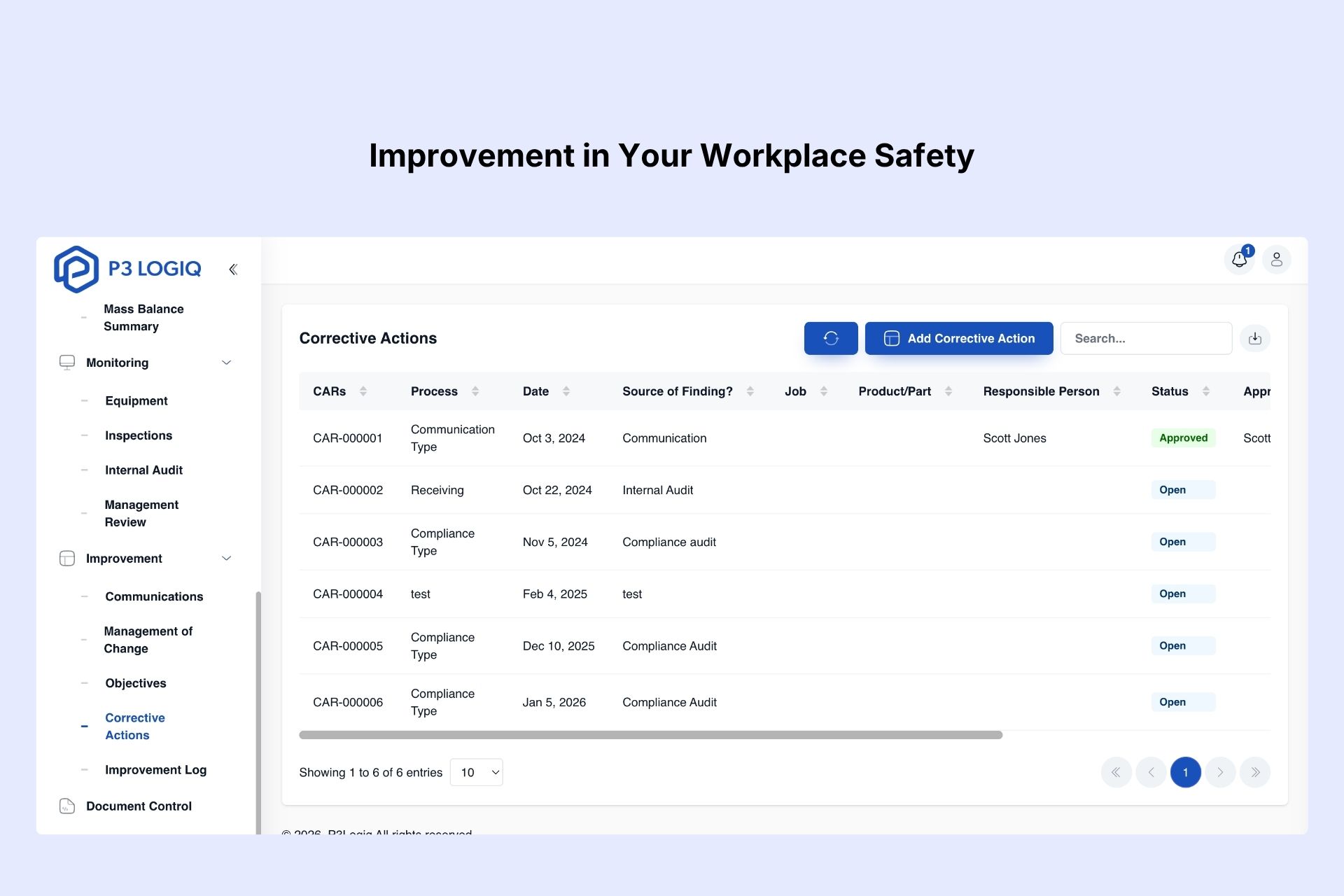
This is where a structured ISO 45001 risk management system makes a difference. You track hazards, assign controls, and review them consistently instead of reacting after incidents.
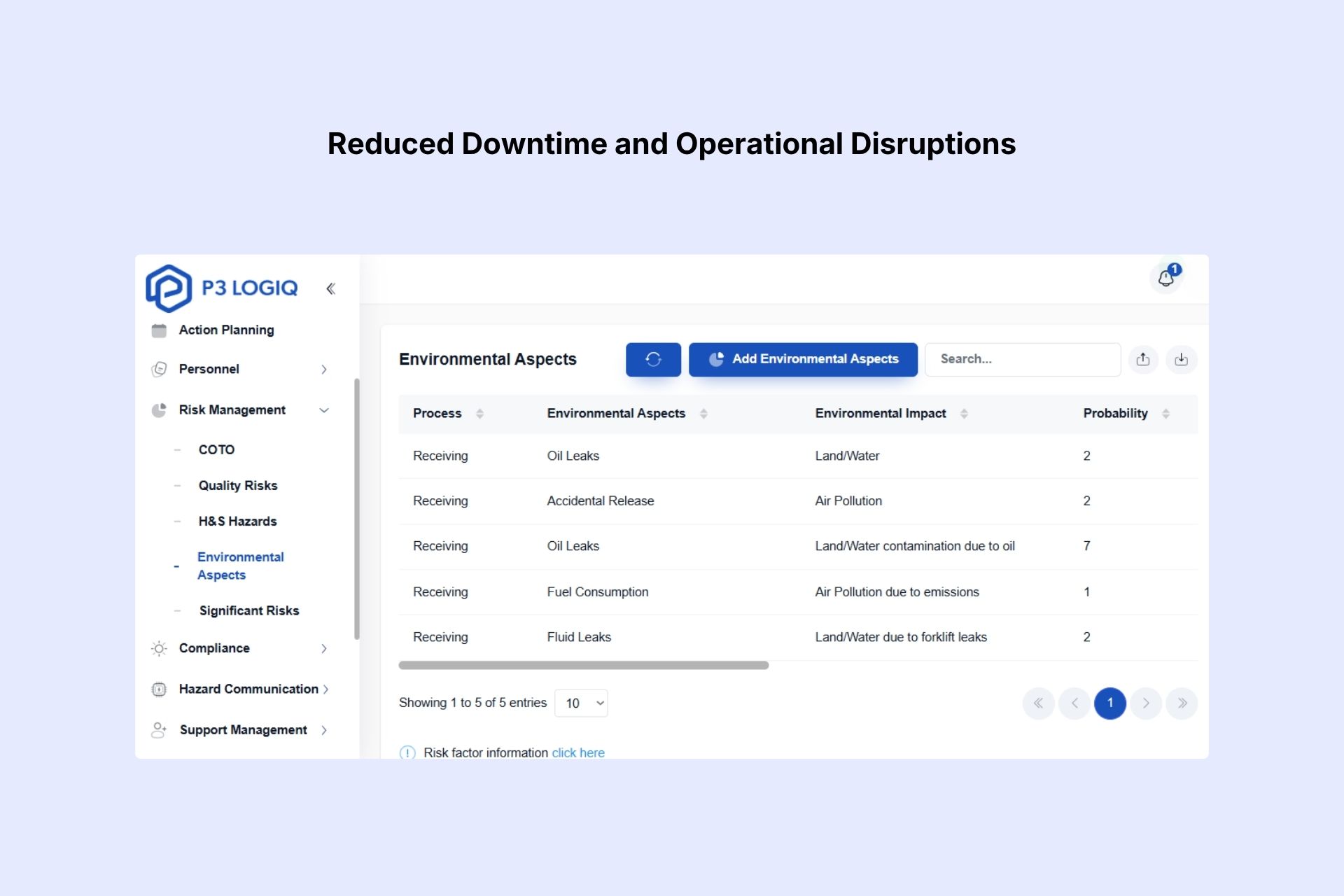
Think of not getting ISO 45001 as a ripple effect.
How, you might ask?
God forbid, but let's say your worker did get injured because of no safety protocol.
Your operation stops or pauses, which causes disruption among your team.
Deadlines get nearer as each day passes by.
And it takes days to get back on track.
See the downward spiral?
ISO 45001 can reverse it for you, helping you eliminate this negative ripple effect. It reduces the possibility of dealing with hazardous risks earlier and does not escalate into a bigger issue. It keeps your workflow steady, with no disruptions whatsoever.
There is something you need to know, workplace injuries are expensive. Very expensive.
Because the U.S. National Safety Council states that the average cost of a medically consulted workplace injury is $42,000.
This cost means you lose productivity, gain medical expenses.
When a safety protocol is strict and consistent, I can guarantee you that your teams will know what to expect and will know what to do, and issues are handled at a much faster pace. Which means smooth operations and fewer interruptions.
This will help you cut your downtime, and it will be noticeable.

Imagine this for a moment.
It is that time of year when you need to get your company audited, but wait…
You noticed something off; in a hurry, you seemed to notice all your documents were scattered all around you.
Documents are not up-to-date; your operations records are either incomplete or missing.
According to ISO.org ISO 45001 requires documented information, internal audits, and management reviews as core system elements.
I got one word for you…
Structure!
You see, ISO 45001 changes the game. It is a part of the ISO requirements that you maintain proper documentation, conduct regular audits to make sure everything is in alignment, and conduct performance reviews. Like I mentioned, rules are becoming tighter across industries, and you need to stay in the ISO game. Also, this gives you this confidence, showing that your system is A-okay and good to go for external audit.
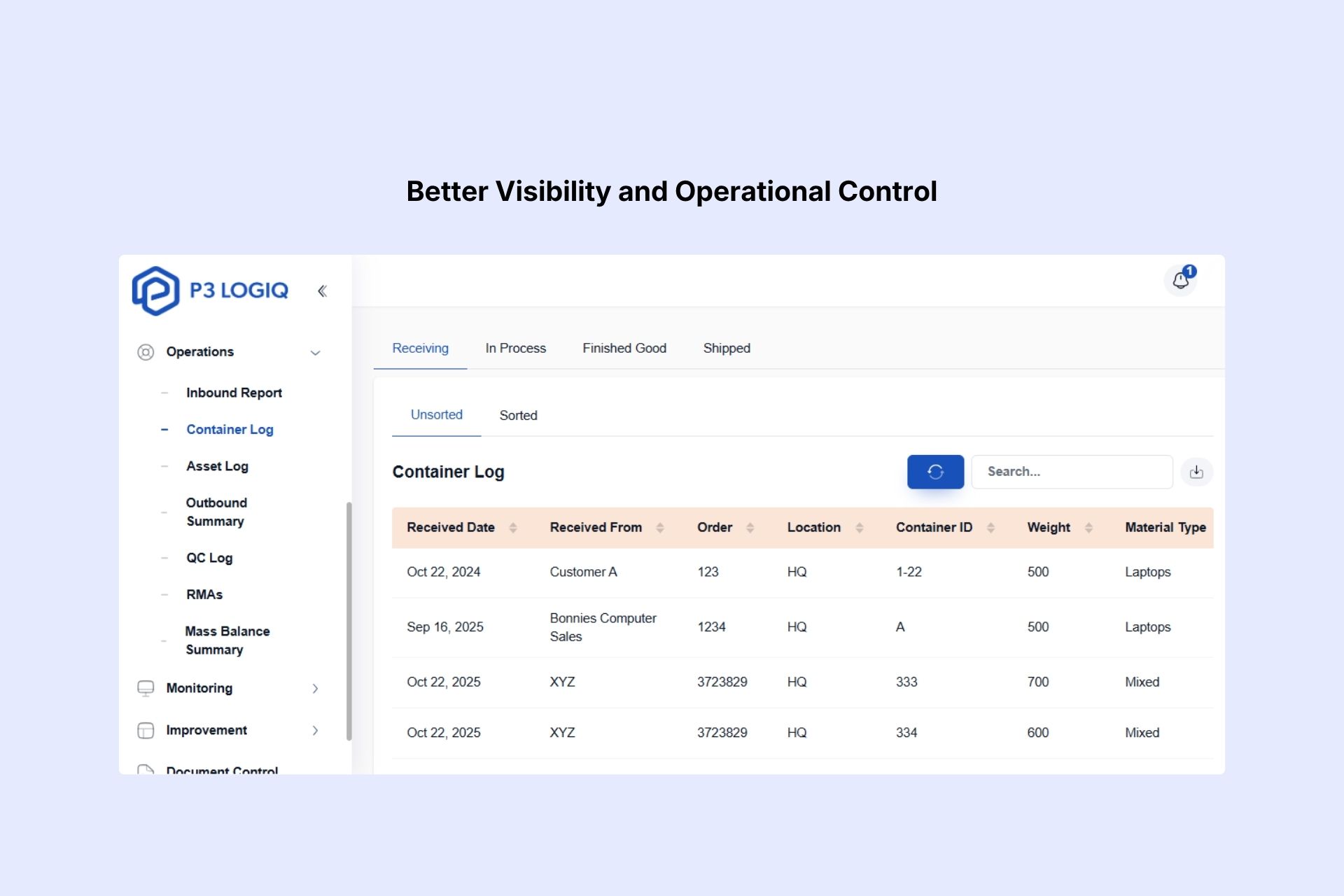
One of the biggest problems in safety management is not knowing what’s actually going on. Risks exist, and incidents happen, but the information is either delayed, incomplete, or scattered across different systems.
ISO 45001 introduces structured monitoring and reporting, which makes a big difference over time. You start getting a clearer view of where risks are increasing, which areas need to be prioritized, and how well your processes are working. No more assumptions and guessing from your side; that means the visibility allows faster decision-making.
Instead of reacting late, you get to act earlier and prevent issues from growing.
“Prevention is better than the cure," as they say.
Over time, this improves overall control across operations and reduces uncertainty in how safety is being managed.
More companies need ISO 45001 than you'd probably expect.
The obvious ones are manufacturing, construction, logistics, and energy. Physical environments where a small lapse can turn into a serious incident fast. But the need doesn't stop there.
Warehouses deal with equipment and movement. Healthcare has patient and staff safety to manage. Even an office has fire safety, ergonomics, and compliance requirements to stay on top of.
The risk just looks different depending on where you are operating from.
ISO 45001 works for all of it. Small businesses, large ones, public authorities, corporate offices. And it doesn't have to sit in isolation either. It follows the same standardized framework as ISO 9001 certification, ISO 14001 certification, and ISO 45001 certification and so on, which means if you're already certified in any of those, you're not starting from scratch.
Talk about compatibility, right?
Your management reviews cover all systems. Internal audits can be combined. Instead of running separate compliance tracks, everything fits together. Quality issues often have safety implications. Environmental risks frequently involve worker exposure. Energy projects can affect workplace conditions. An integrated system catches all of that in one place.
For growing businesses especially, ISO 45001 stops being just a safety measure. Clients expect it. Tenders require it. It becomes part of how you qualify for bigger opportunities and keep operations from breaking as you scale.
Risk exists in every business. Having an ISO 45001 software just gives you a structured way to handle it.

The ISO 45001 clause isn't just a checklist you run through once and forget. The requirements are built to keep your workplace genuinely safe over time and to keep pushing for improvement, not just maintain the status quo.
The standard holds ten clauses in total. The first three clauses are mostly introductory, covering the basics of what the standard is and how it works. It is more like a theoretical sense to get an understanding of how the clauses work, you could say.
The real practical work starts at Clause 4, where the health and safety-specific requirements kick in and you actually begin building your management system.
Clause 4 is where you begin to figure out the context of your organization. That means looking at what internal and external factors actually affect your workplace safety, who your stakeholders are, and what the scope of your system needs to cover.
Clause 5 is about leadership. And this isn't just signing off on a policy document. Top management has to be visibly and actively involved; they are going to set the direction, assign responsibilities, and bring workers into the decision-making process. For this to work, ISO 45001 puts more weight on worker participation than most standards do.
Clause 6 gets into planning. You identify hazards, assess the risks they carry, check your legal requirements, and set objectives that are actually measurable. This is where the real groundwork happens.
Clause 7 covers support. Resources, training, awareness, communication, documentation. Everything the people inside your organization need to actually run the system properly.
Clause 8 is where plans turn into action. You control operational risks, apply the hierarchy of controls to eliminate or reduce hazards, manage contractors, and make sure emergency preparedness is in place.
Clause 9 is your check-in point. You monitor performance, run internal audits, and conduct management reviews to see how the system is actually holding up against your objectives.
Clause 10 closes the loop. When incidents happen or something falls short, you investigate, fix it, and use it to keep improving. The goal isn't just compliance. It's a system that genuinely gets better over time.

Getting ISO 45001 certified is a structured process. It is very important that I note that all of this depends on your organization's size and how mature your current safety practices already are; you should expect it to take anywhere from 6 to 18 months.
Here's how it actually breaks down.
Estimated duration: 1 to 2 months

This is where everything starts. Before you touch a single procedure or policy, you need to understand what you're working with.
Get a copy of ISO 45001:2018 and go through it with your key people. The whole standard runs on the
So understanding this logic early makes every step after this one easier.
I want you to compare what you're doing now against what ISO 45001 actually requires, I mean, clause by clause. Because this tells you what you are already implementing, what's missing and needs to be implemented, and how much work you're realistically looking at.
This can't be delegated down. Top management needs to be genuinely involved, not just sign-off-involved. Budget, time, personnel... All of that flows from leadership buy-in.
Start by deciding what your system actually covers.
Which departments, which locations, and which processes?
Once that's clear, draft a policy that genuinely reflects where your business stands on safety, not just something that sounds good on paper. It needs to address risk reduction and legal compliance in a way that's specific to your operation.
Estimated duration: 2 to 4 months

Here is where the action starts!
Now you build and roll out the system.
Go through every one of your current operation processes, emergencies, and non-routine tasks and identify the hazards. Assess the risks, assign controls, and prioritize what needs fixing first.
Create everything the standard requires. Your OHSMS scope, policies, objectives, hazard records, legal obligations register, emergency procedures, training records, and incident logs. You need to get all of this documented properly from the very start.
Whatever your risk findings are, turn them into actual procedures. SOPs, permit-to-work systems, PPE requirements, maintenance schedules. This is where plans stop being plans and start being practice. It should turn out to be a habit to follow here on out.
Everyone in the organization needs to know how the system works and what their role in it is. Not just managers. Everyone. Training here isn't something you tick off a list and move on. It's an ongoing requirement, and you need to be able to show it was done, who completed it, and when.
After all, you need your people to know what to expect and what to do when a hazardous situation arises, right?
Estimated duration: 1 to 2 months

Before any external auditor shows up at your company, you need to stress-test the system yourself to confirm whatever you have implemented is actually aligning with the ISO standards and that there are no flaws whatsoever.
This is crucial for you, so please keep this in mind. Trust me, it can save you time, headache, and money.
Run a full internal audit against all ISO 45001 requirements. Treat it like a mock certification audit. Find the flaws before the external auditor does, and fix them. Your internal auditors need to be competent and independent from the areas they're reviewing.
Leadership sits down with the internal audit results, incident trends, objective progress, and any changes in the business or legal landscape. This is the final check before you go for the external audit.
Estimated duration: 1 to 3 months
Buckle up!
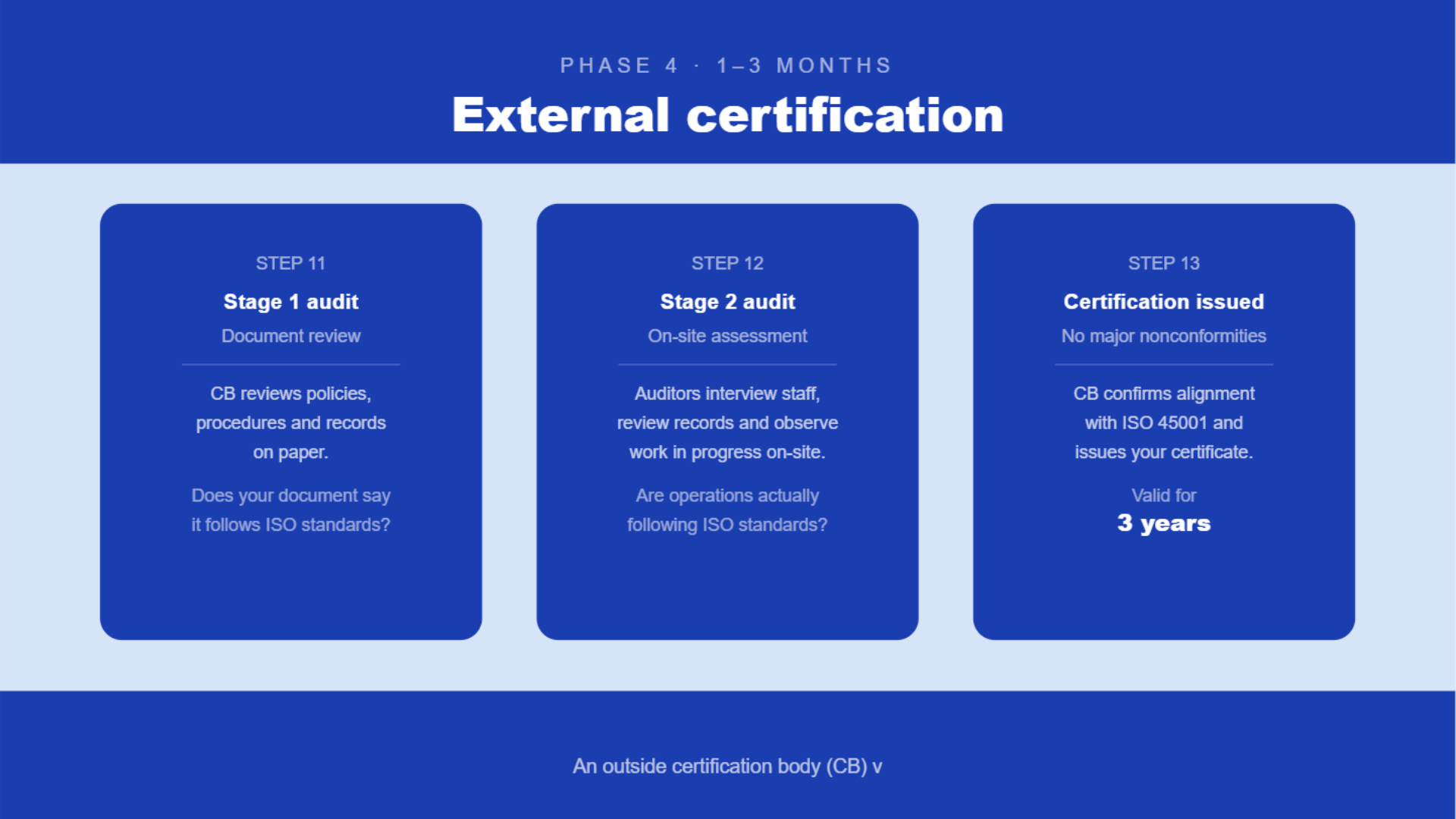
Because this is the official part, where an outside certification body (CB) comes in to verify everything you've built.
Stage 1 starts with a document review. The CB goes through your policies, procedures, and records to check that everything meets ISO 45001 requirements on paper.
Keyword: paper, meaning it’s more in a theoretical sense.
If anything's missing or unclear, they'll flag it before the on-site visit so you have a chance to sort it out.
Stage 1 is more towards if your document says it follows ISO standards.
Auditors come to your site. They interview people at all levels, review records, observe work in progress, and check whether the system is actually being followed on the ground, not just on paper.
Stage 2 is more towards the CB confirming if your operations (practicality) are implemented as per the ISO standards.
Assuming that you have followed, made changes, and implemented ISO standards to the T.
Most probably you won’t have any major nonconformities, which the CB confirms that you have aligned your company with the ISO standard, and the certificate gets issued to you.
FYI, it's valid for three years.
Ongoing, across a 3-year cycle.
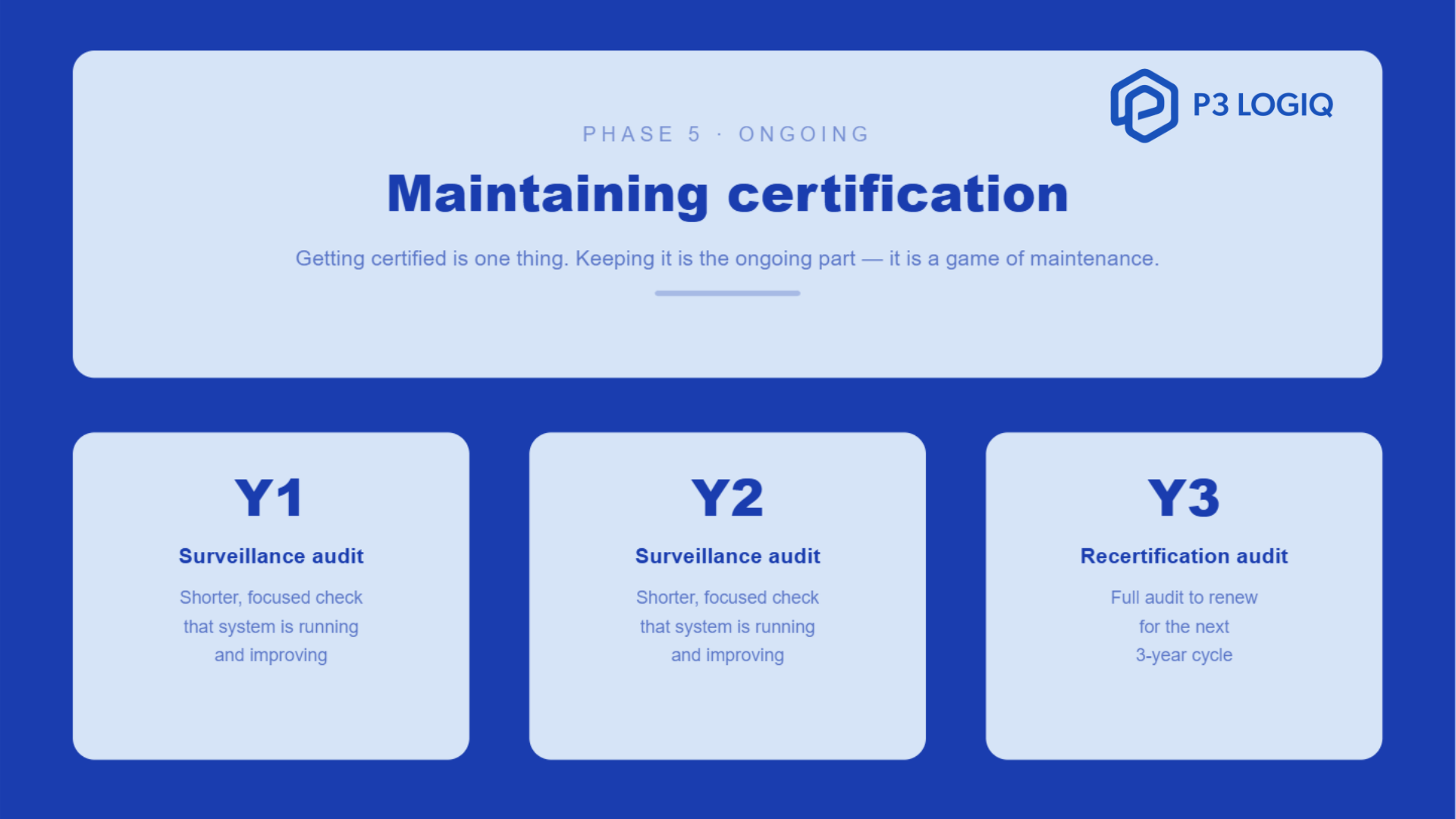
Getting certified is one thing. Keeping it is the ongoing part.
It is a game of maintenance.
Having followed the ISO 45001 checklist will give you an idea of how your business can take to get certified.
Yes, the certificate lasts three years, but that doesn't mean you're done after year one. Annual surveillance audits happen in years one and two. They're shorter and more focused than the full audit, but they're there to confirm you're still running the system properly and improving over time. Then in year three, you go through a full recertification audit to renew for the next cycle. You get the gist.

While getting ISO 45001 certified is a great choice for you, it may not always be a smooth ride. There might be few bumps here and there. Here are the challenges most businesses run into and what you can do about it.
This excuse comes up a lot, especially for smaller business owners.
Consultant fees, audit costs, employee time, system upgrades... it adds up and it's hard to justify when you're already watching the budget.
But here's the thing. I want you to look at a much larger picture.
Accidents are way more expensive than those costs. Lost time, insurance claims, legal exposure, staff turnover after safety incidents. If you know the costs of these accidents and legal consequences that come after, I am sure that you will change your mind in a heartbeat.
I say this because most businesses that go through the numbers find that certification pays for itself fairly quickly when you factor all of that in.
If the budget is genuinely tight, phase it out. You don't have to do everything at once. Start with the most critical and essential gaps and build from there.

As you know, ISO 45001 does require documentation.
Policies, procedures, training records, audit reports... It can feel like a lot. But the newer version of the standard is actually lighter on paperwork than its predecessor. The focus now is on having systems that work, not just filing cabinets full of paper. Basically, it is more towards practicality, is what I am saying.
Document what's necessary and nothing more. Using templates and cloud-based tools helps a lot here. And remember, good documentation isn't busywork. It's what keeps things consistent when people leave or processes change.

Workers have seen plenty of "safety initiatives" come and go. A new program with a lot of management enthusiasm behind it doesn't automatically mean people on the floor are going to take it seriously.
The fix is simple in theory and harder in practice. You need to actively involve people early on. Let them participate in hazard assessments. Ask for their input on procedures and actually use it.
When employees see that their perspective genuinely shapes the system, the resistance drops. And when you can show a real example where a new procedure prevented something going wrong, share it. Make that benefit visible to your team. In time, your team will actively want to get involved with you.
This is leadership 101 for you.
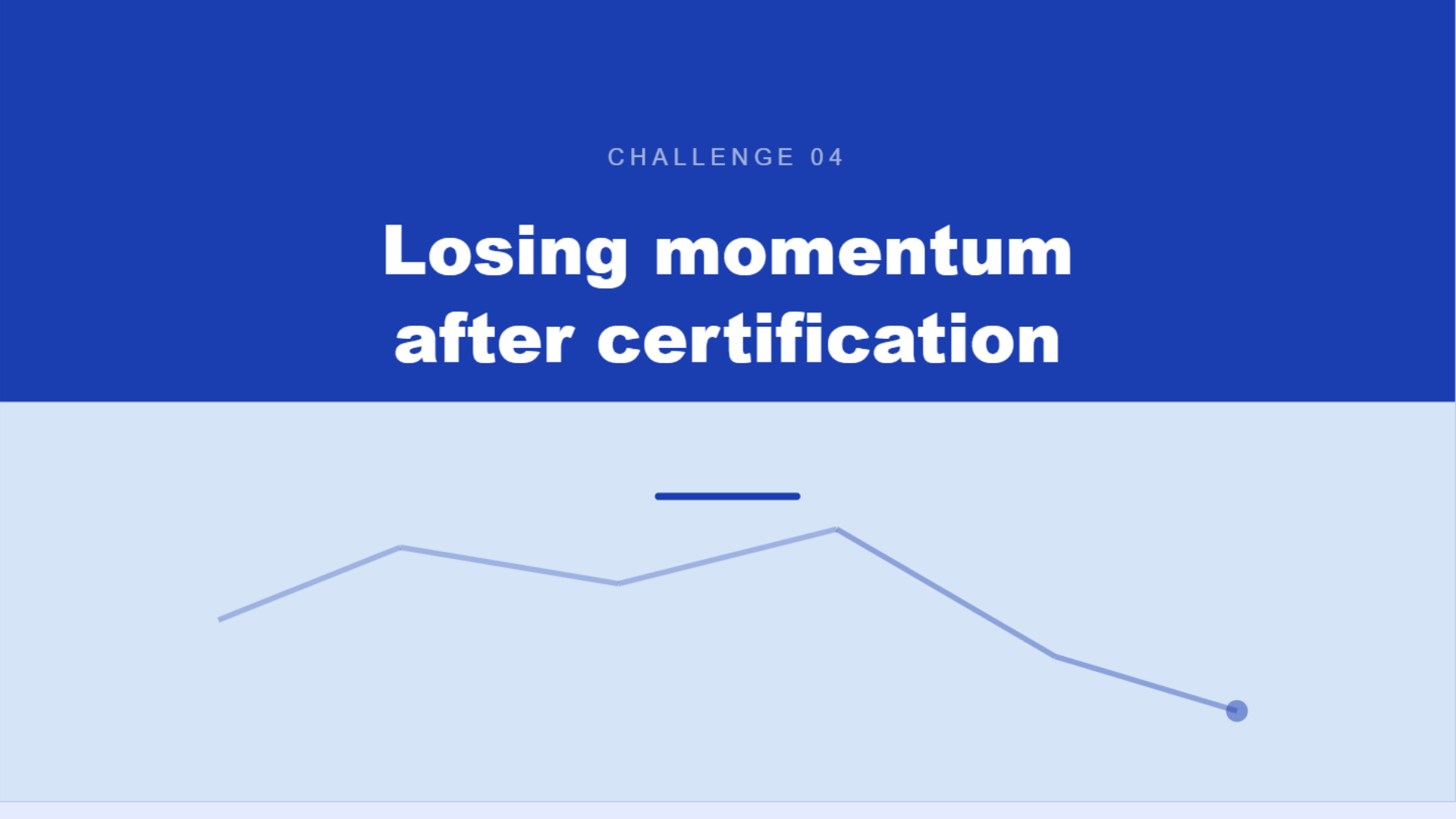
This is probably the most common long-term challenge.
The certificate goes up on the wall, and slowly the system starts to drift.
Audits become more like a chore for you rather than a check-in. Safety reviews get pushed down the agenda.
The certificate isn't the finish line. The improvement it drives is the whole point. Build safety into your regular business rhythm so it doesn't depend on individual enthusiasm to keep going.
Following the ISO 45001 compliance will help you make sure you do not make any single mistakes and helps you stay on track.
Treat surveillance audits as a habit's outside perspective, not a threat. And when you hit milestones, a clean recertification, a year without lost-time injuries, a new control measure that actually works... acknowledge it. All of it. It keeps the momentum real and ongoing.

The cost of ISO 45001 certification in the USA typically ranges from $5,000 USD to over $50,000 USD.
Now that's a wide range, and it exists for good reason.
You see, factors based on your company's size, how complex your work operations are, how many sites you're certifying, and whether you bring in external consultants all play a role in where you land.

These are some of the fees that you need to pay in order to get your ISO 45001 certification.
Consulting fees are usually the biggest line item. If you bring in an external expert (CB) to guide your implementation, daily rates typically run between $800 USD and $2,500 USD. You’ll have to take into account their travel expenses, hotel stay, accommodation, and all as an additional cost.
For full implementation support, total consulting costs can land anywhere between $5,000 USD and $50,000 USD depending on how much help you need.
Certification body audit fees cover the Stage 1 document review and the Stage 2 on-site assessment. For small to mid-sized companies, initial audit fees generally run between $1,000 USD and $8,000 USD.
Surveillance audits are a necessity, and they have to be done every year to keep your certificate valid. The budget for this comes to around $1,000 USD to $7,500 USD per visit depending on your certifying body and company size.
Training costs depend on who you're putting through what. Internal auditor training typically runs $500 to $1,500 per person. Lead auditor training, which is essential for whoever is managing the system, generally costs between $1,000 and $3,000. Online implementation courses can be found for as low as $249 per person.
There's also the hidden cost most people don't factor in upfront, which is your own employees' time. Documentation, training sessions, internal audits... that's real hours pulled from real work.

If by chance you already hold ISO 9001 or ISO 14001, you're in a better position than most.
Why?
Because the standards share overlapping processes, implementation costs can drop by 30% to 50% when you integrate rather than build from scratch.
Multiple sites push costs up. Each additional location adds audit time and travel expenses for the certifying auditors.
The type of the industry your business is in matters a lot too. High-risk environments like construction or chemical manufacturing are going to need more intensive audits than a standard office setup, and that is reflected in the final price.
At the end of the day, ISO 45001 isn't just a certificate you frame and forget about.
It is the difference between a workplace that reacts to problems and one that prevents them. It is the difference between scrambling during an audit and walking into one with confidence. And more than anything, it is the difference between your workers going home safe every single day or not.
Does the process take time?
Yes.
Does it cost money?
Absolutely.
But when you weigh that against the cost of incidents, legal consequences, lost productivity, and damaged trust... the math isn't that complicated. Everything becomes clear to you.
Whether you are a small business just getting started or a larger operation looking to tighten things up, the right time to build a proper safety system is before something goes wrong. Not after.
If you are serious about getting ISO 45001 certified and want to do it without the confusion,

P3 LogiQ helps businesses implement, manage, and maintain their ISO systems the right way from day one.
Book a free demo call with us today and let's map out your path to ISO 45001 certification together.
ISO 45001 fully replaced OHSAS 18001, and the differences between the two are worth knowing.
OHSAS 18001 was procedure-based, meaning it focused on following set steps. ISO 45001 is process-based, built on the same Annex SL framework used across modern ISO standards like ISO 9001 and ISO 14001. That shift alone makes it easier to implement and integrate with systems you may already have.
Beyond structure, the approach changed too. ISO 45001 requires workers to actively participate in hazard identification and risk assessment, not just be consulted. Top management has to personally lead the system, not hand it off. The organization's context and the needs of all relevant stakeholders have to be formally considered. And while OHSAS 18001 only dealt with risk, ISO 45001 looks at both risks and opportunities, which is a more complete way of managing safety.
Not legally, no. Most regions don't require it by law. But I would highly suggest you use this certification to your advantage because in high-risk industries like construction or manufacturing, it's often expected. A lot of clients and larger organizations also require their partners and suppliers to be ISO 45001 certified before working with them. So while it isn't forced on you, not having it can close doors.
Only an accredited third-party certification body can issue the certificate. That body needs to be accredited by a recognized national accreditation body, like ANAB or A2LA in the USA, UKAS in the UK, or DAkkS in Germany, all of which are members of the International Accreditation Forum. You cannot self-certify or certify internally. It has to come from an independent, accredited source.



Businesses need document management systems (DMS) to ensure ISO and R2 compliance, improve efficiency, and stay audit-ready. The article highlights key features like version control, security, and automation while reviewing the top 5 DMS solutions. P3 LogiQ stands out for its compliance-focused automation and secure document tracking
Read More
Recycling businesses gain efficiency, compliance, and sustainability with RIOS certification. It streamlines quality management, environmental responsibility, and worker safety, helping companies avoid legal risks and boost credibility. P3 LogiQ simplifies the certification process with automation, document control, and compliance tracking, making operations smarter and safer.
Read More
Audit Management Software (AMS) automates compliance tracking, streamlines workflows, and reduces audit risks. Key features include automated scheduling, compliance checklists, CAPA tracking, vendor risk management, and integrations.
Read More
Learn how audit management systems simplify ISO and R2 compliance by automating audits, managing documentation, and minimizing compliance risks efficiently.
Read More
In 2025, many businesses still face challenges in compliance management due to outdated methods like spreadsheets and fragmented software. This inefficiency leads to missed deadlines, increased risk, and regulatory penalties. The blog emphasizes the importance of modern compliance tools that automate workflows, enhance risk management, and streamline regulatory processes to meet ISO and R2 standards.
Read More
The rise in e-waste and environmental concerns makes responsible electronics recycling essential. The R2 Certification sets a global standard for safe, sustainable, and data-secure recycling practices. Developed by Sustainable Electronics Recycling International (SERI), R2 helps businesses manage environmental risks, data security, worker safety, and legal compliance.
Read More
Businesses face increasing challenges in managing complex regulatory compliance. Manual methods such as spreadsheets and paperwork can lead to missed deadlines, inefficiencies, and costly penalties. Compliance management software offers a streamlined solution to reduce risks, automate processes, and improve operational efficiency.
Read More
Maintaining R2 Certification is crucial for businesses in the e-waste recycling industry, ensuring regulatory compliance, sustainability, and strong stakeholder trust. This guide outlines 10 best practices to help businesses simplify operations, reduce risks, and stay compliant.
Read More
Unlock the value of ISO risk management certification. Explore its impact on compliance, risk mitigation, and business expansion.
Read More
Explore the top 5 ISO risk management software tools for 2025, including document management solutions for streamlined compliance and increased efficiency.
Read More
Find the ideal document management software (DMS) for your business. Learn how to choose with expert tips, key features, and insightful guidance
Read More
Unlock the power of a Document Management System (DMS). Learn how it can revolutionize your business operations.
Read More






.png)


.png)





.jpg)



.jpg)
.jpg)








.jpg)



.png)

.png)
.png)



.png)

