

Imagine a scenario where you are getting audited for the ISO 9001 certification, and it is just three weeks away. Your team has documented processes, trained staff, and prepared records. You’re feeling confident everything is going to be A-OK, then all of a sudden the auditor asks: "Walk me through how you identified your internal and external issues."
There is nothing but dead silence.
This is one of the most common gaps when it comes to getting audited.
Under ISO 9001 clauses, there is Clause 4.1, which requires your business to identify the internal and external issues that affect its quality management system (QMS). Yet many teams treat this clause as a box to tick rather than a real working exercise.
Clause 4.1 of ISO 9001:2015 sits at the foundation of the entire standard. According to ISO.org’s own overview of ISO 9001:2015, the standard requires your business to determine the external and internal factors that affect their ability to achieve the intended results of their quality management system. Without a clear and current picture of those factors, the rest of your QMS has no real foundation to stand on.
Having an ISO 9001 checklist will help you map your entire documentation plan with ease.
This blog explains what internal and external issues mean in ISO 9001. It gives you real examples for both categories. It also shows you how to document them correctly and use them in your QMS.
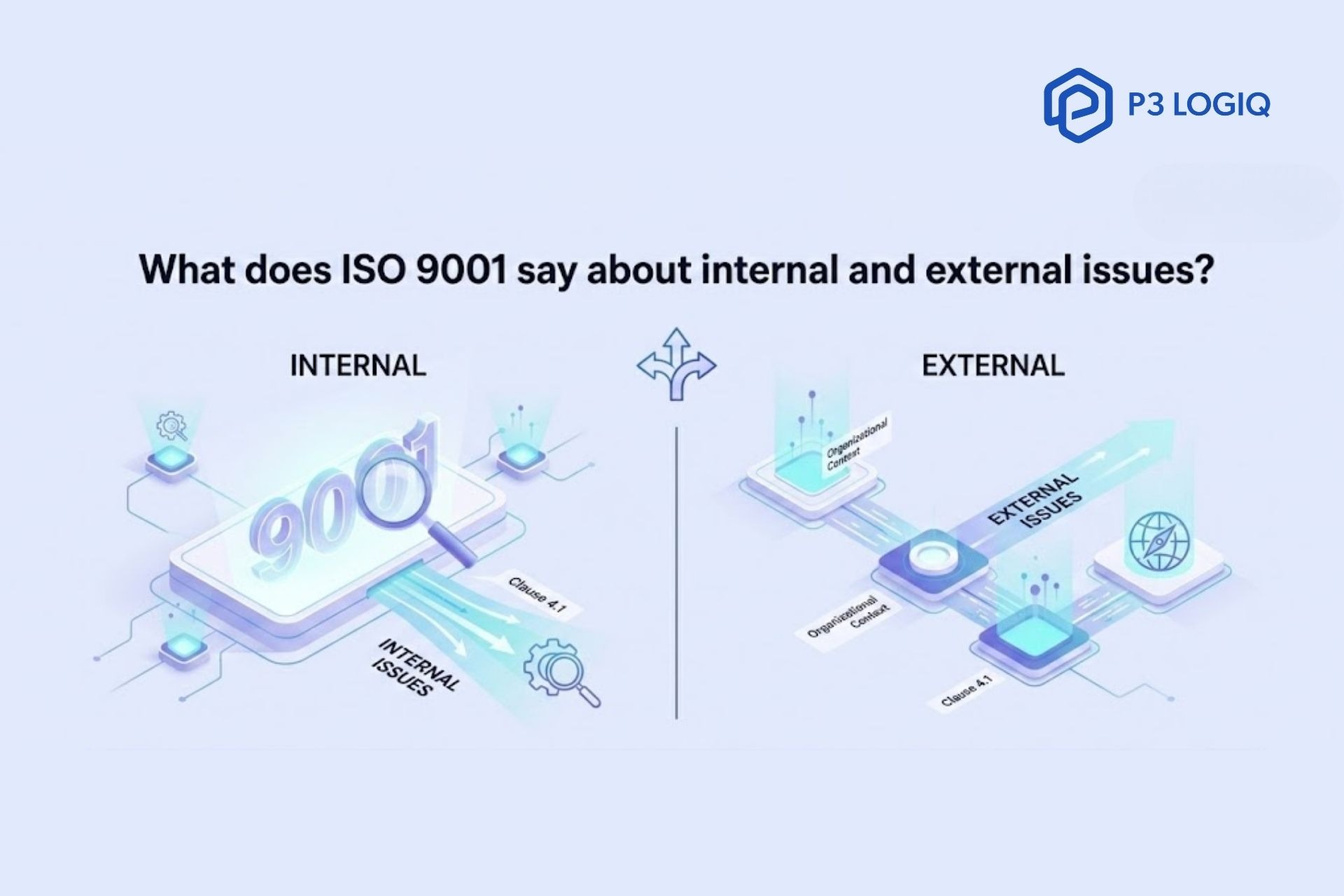
From the ISO 9001 clauses, they have Clause 4.1 which basically says that your business must identify the internal and external issues that affect your purpose and your ability to achieve the planned results of your quality management system.
This means you need to understand what is happening inside and outside your company before building or improving your QMS.
The clause does not tell you which method to use to achieve your desired results. It does not require a SWOT analysis or a risk register in a specific format.
What it requires is evidence proving that you have actively considered these factors and that your findings feed into your QMS planning.
So, why does the standard ask for this?
Because with the standard, it helps you build context for your QMS. A QMS built without context is a QMS built on guesswork. It is as simple as that.
Your processes, objectives, and risk controls need to reflect the business you work in.
Clause 4.1 helps you build that foundation.
This clause also feeds directly into Clause 6.1, which covers actions to address risks and opportunities.
You cannot do 6.1 properly without first completing 4.1.
In February 2024, ISO published Amendment 1:2024 to ISO 9001:2015.
It added one line to Clause 4.1: "The organization shall determine whether climate change is a relevant issue."
So, meaning to say, if your supply chain depends on areas that are prone to extreme weather, or if your customers have sustainability requirements, climate change is now an explicit external factor to assess.
Our guide on how to get ISO 9001 certification covers the full planning sequence, from context through to risk treatment.
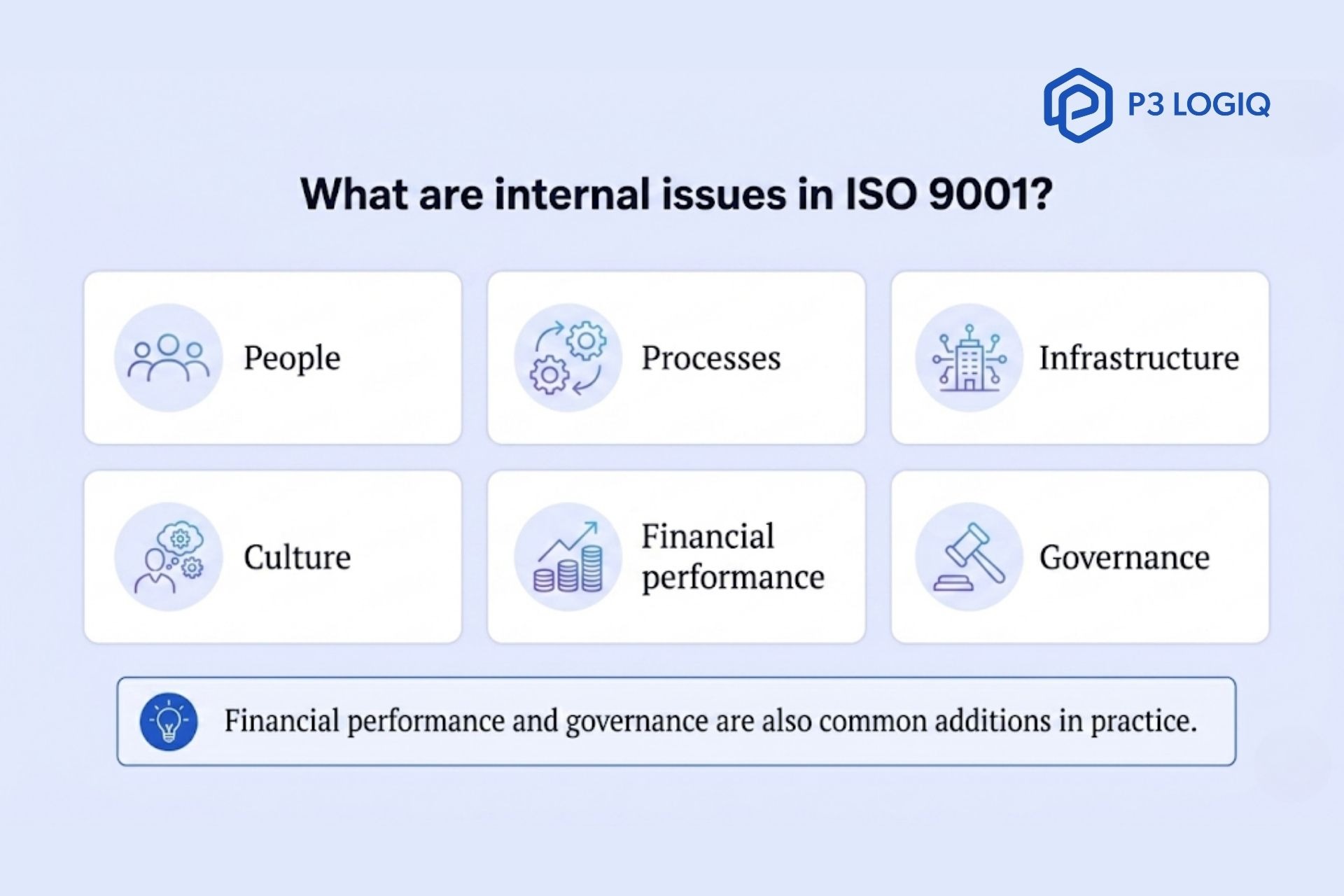
Internal issues are factors that happen inside your business, which affect your ability to meet your QMS objectives.
The good thing about this is you control these factors, or at least you are in a position to influence them better.
ISO 9001:2015 groups internal issues into four broad areas, which are:
Financial performance and governance are also common additions in practice.
How do you test to see if your business has an internal issue?
Just ask two simple questions.
Does the factor come from inside my business?
And
Does it affect quality outcomes?
If both answers are yes, it belongs in your internal issues analysis.

I have added some practical examples below by category. These are the types of issues the auditors expect to see in your Clause 4.1 analysis.
Staff-related issues are among the most common internal factors organizations overlook. High turnover in production or customer-facing roles creates inconsistency. Skills gaps grow when products change faster than training does. When too few experienced people carry the bulk of the knowledge, one resignation can disrupt an entire process.
Many organizations have processes that exist on paper but not in practice. SOPs that are missing or out of date, and workflows that were never updated after a software change, are two of the most common gaps auditors flag.
Aging equipment with no proper maintenance schedule is a direct quality risk. So is software that does not connect with current operations. Facilities that do not meet production cleanliness requirements should also be on your list.
Budget limits that prevent training or equipment upgrades affect output quality directly. Not enough staff to meet customer demand without errors is also a resource issue, not just an operations one.
Culture is often the hardest internal issue to document, but it matters. Leaders who do not visibly support the QMS set the tone for the rest of the team. A blame culture stops staff from reporting problems early, which means issues surface only when they are expensive to fix.
Your own audit history is one of the clearest sources of internal issues. Non-conformances that keep coming up in audit reports, customer complaints focused on specific product lines, and high rework or scrap rates that have not triggered any process review are all signals that belong in your Clause 4.1 analysis.
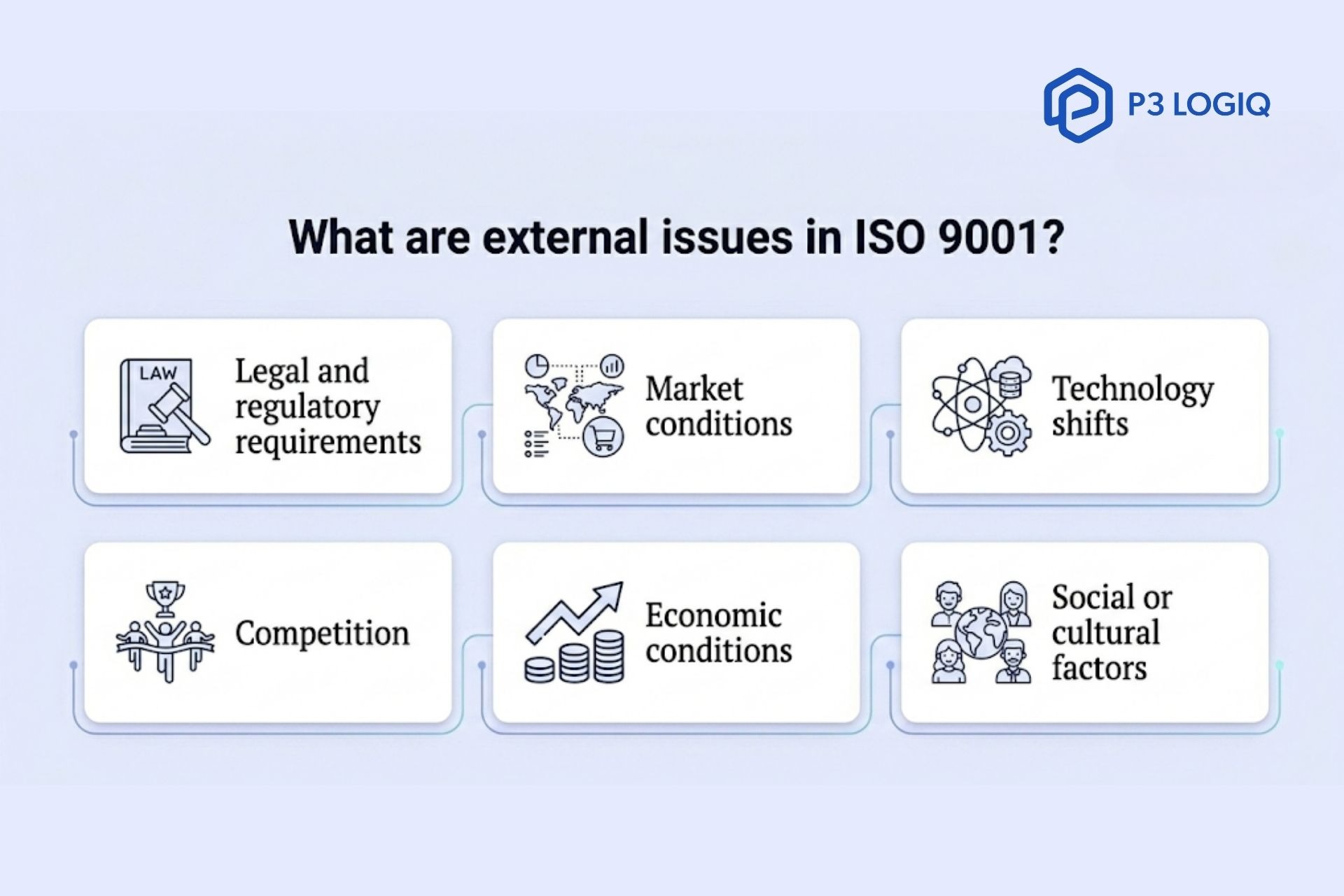
External issues are factors outside your business that affect your QMS performance or your ability to meet customer and regulatory requirements.
Unfortunately, you do not control these factors, but still you must watch them and respond to them.
ISO 9001:2015 points to several external categories:
The PESTLE framework (political, economic, social, technological, legal, and environmental) is widely used for this analysis.
According to the American Society for Quality (ASQ), it says that ISO 9001:2015 was designed to better integrate into an organization's business activities, and PESTLE is one of the tools practitioners use to structure their external context analysis. SWOT analysis is also used alongside PESTLE to help their business get a whole picture while factoring both internal and external issues.
So, is your external issue relevant to your business?
It should be relevant in a way that your business makes a negative impact in areas like quality objectives, either product or service delivery or if customer satisfaction is taking a dip.
A change in regulation that affects how you manufacture or label your product is a relevant external issue. A competitor that drives customers to expect faster delivery is also relevant.
Since February 2024, ISO requires you to explicitly decide whether climate change is a relevant external issue for your organization. Even if you decide it is not relevant, that decision must be made and should be documented.
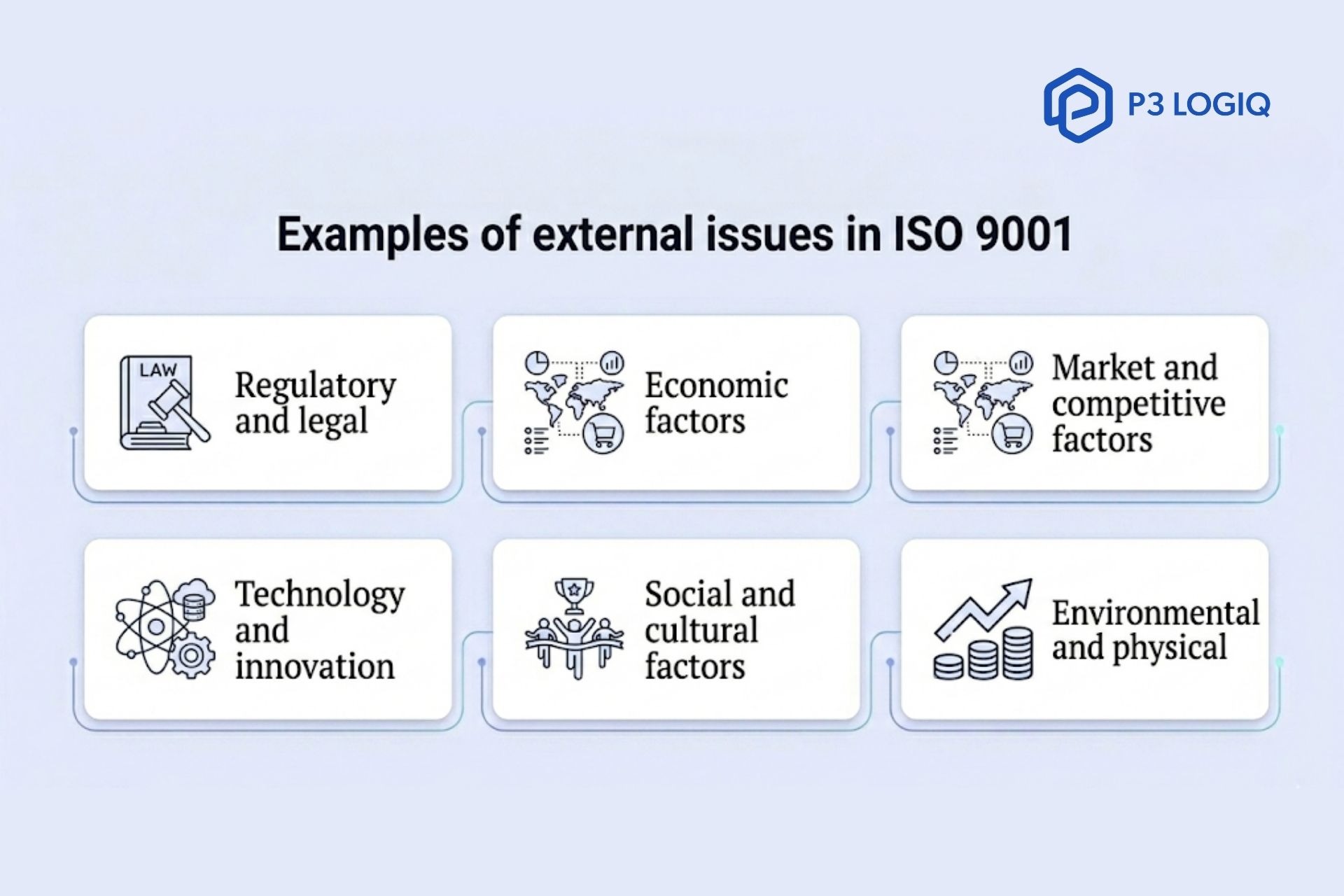
Below are some examples of external issues that can affect your business.
Regulations change, and your QMS needs to keep up.
Let's say you produce and label your products, and next thing you know, there is major news that brings changes to regulations on safety like FDA or CE marking. These can affect your products if you do not make changes as per the latest update.
Something to keep in mind as well:
If the price of raw materials does not stabilize or hits an inflation point, this is one issue; another one is if you're a business that deals in an international supply chain and major currency changes happen, that can also affect you.
When customers cut budgets or change order specifications, your processes need to flex without dropping quality standards.
When competitors introduce new technology, customer expectations shift, even for organizations that have not changed anything. Customers moving toward sustainability or products with certification is also a market factor your QMS needs to account for.
Automation is making some existing processes less competitive. Customers are increasingly requiring digital integration for order management. Cybersecurity requirements now affect how organizations store and protect quality records, which is a factor that many teams still treat as an IT issue rather than a QMS issue.
Demographic shifts affect your recruitment pool and the skills available to your team. Remote work has changed how teams communicate and stay consistent across sites and shifts.
Weather disruptions to logistics or raw material supply are now a documented Clause 4.1 consideration following the 2024 climate change amendment. Natural disasters affecting your facilities or supplier networks and geographic risks linked to key customers or suppliers round out this category.

Knowing what the issues are is only half the job. ISO 9001 requires evidence that you identified them and that your findings feed into your QMS planning.
Here is how to do it.
Do not let one person complete this exercise alone.
Bring in people from operations, HR, finance, sales, and quality. Each function sees different issues.
The combined view is more accurate and easier to defend in an audit.
The ISO 9001 Auditing Practices Group, the official ISO technical committee for quality management standards, confirms that cross-functional input is essential for identifying the full breadth of issues, since finance, HR, commercial, engineering, and design each bring expertise that a single quality manager cannot cover alone.
If your organization is small and you are unsure how much detail is enough, our ISO 9001 for small businesses guide gives a practical breakdown of how to scale Clause 4.1 to your size without overcomplicating it.
SWOT and PESTLE are the two most common tools.
SWOT covers internal strengths and weaknesses plus external opportunities and threats.
PESTLE structures your external analysis across six categories.
Either method works for auditors. What matters is that you use it regularly and update it over time.
Record your findings in a format that is version-controlled and easy to access during an audit. A simple table works: issue, category (internal or external), relevance to QMS, and planned response.
One clarification worth knowing: Clause 4.1 does not require documented information as a formal standard requirement.
This is confirmed by ISO's own technical committee FAQ, which states that Clauses 4.1 and 4.2 across ISO management system standards do not require documented information to meet the requirements, since the output of these clauses is knowledge used as input to the design of the management system.
Auditors will ask you to demonstrate compliance through interviews, SWOT outputs, or management review minutes. In practice, keeping a documented context register makes that demonstration far easier.
Each issue you find should link to a risk, an opportunity, or a QMS objective. If an issue has no connection to any of these, question whether it is truly relevant or important.
Auditors look most closely at the link between your context analysis and your risk planning.
Clause 4.1 does not set a review frequency. But that does not mean you shouldn’t.
Because most businesses review their context analysis at the annual management review, which is required under Clause 9.3.
I would highly advise you to review it straight away when something significant changes:
Maybe like a new regulation took place, a key customer shift, or a major internal restructuring.

This is where Clause 4.1 stops being a paperwork exercise and starts actually being useful.
Every issue you identify is either a potential risk or an opportunity.
A skills gap puts product quality at risk.
A new regulation puts compliance at risk.
A competitor losing ground is an opportunity to grow.
New automation technology is both a risk and an opportunity depending on who moves first and fast.
ISO 9001:2015 Clause 6.1 requires you to plan actions to address risks and opportunities. Without a thorough Clause 4.1 analysis, your risk register will have blind spots.
How do you connect the two in practice?
Map each issue to a risk or opportunity entry. Assign an owner. Agree on a response action. Set a review date. This is exactly what auditors trace through during a surveillance audit, going from your context analysis to your risk register.
During the ISO 9001:2015 certification audits, the auditors will check all of the problems mentioned in this stage.
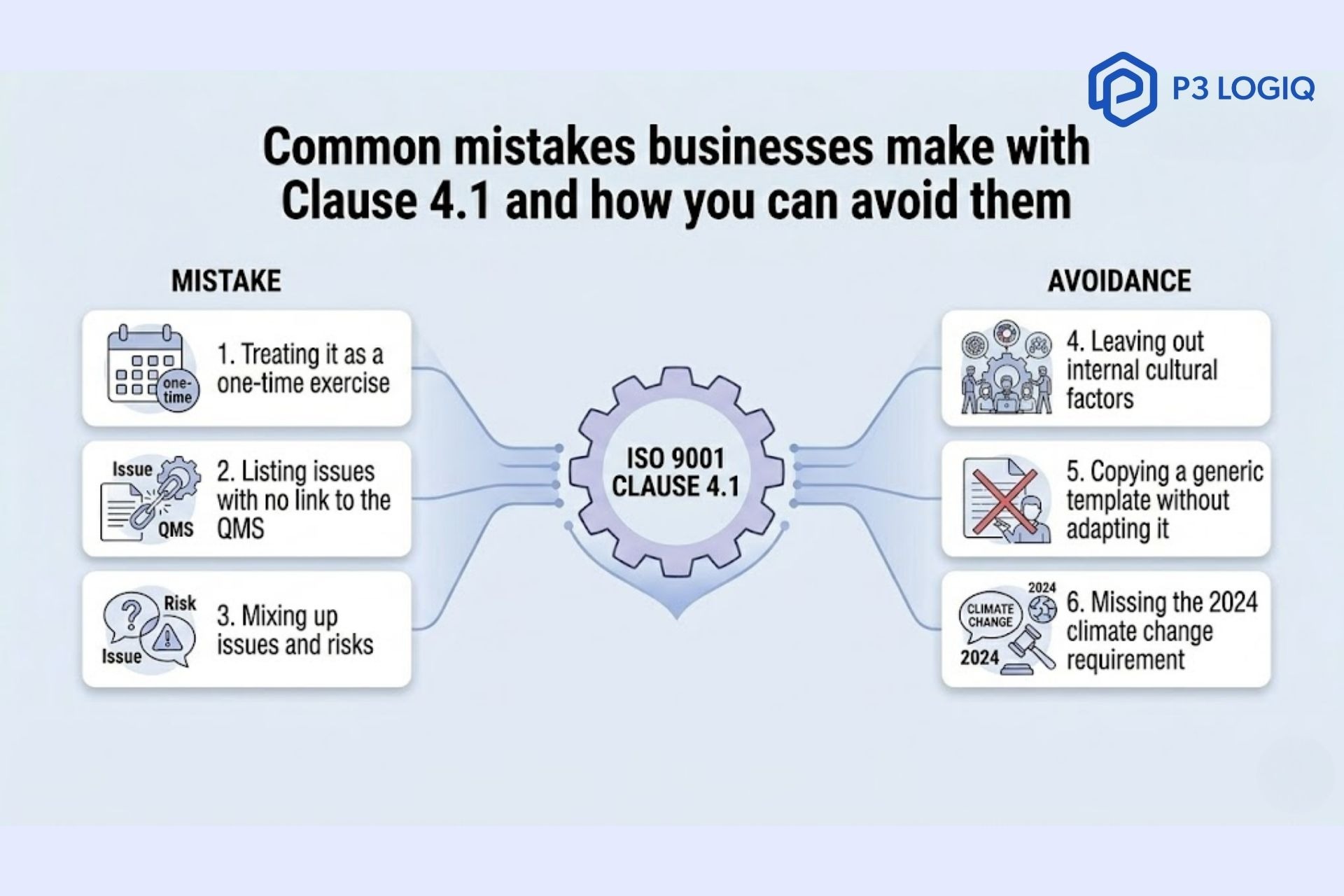
These are some of the common mistakes businesses have made while finding internal and external issues. These will help you not get a rework when you are done with auditing.
Many organizations complete the issue analysis during initial certification and never touch it again.
That is a big mistake you would be making because ISO 9001 expects this to be a living part of your QMS.
If your list has not changed in three years, auditors will question whether you are genuinely monitoring your context.
Repeated audit findings also add directly to your overall spend. ISO 9001 certification cost covers how audit findings, re-assessments, and preparation gaps affect the total cost of certification.
Never give auditors the chance to question your methods.
A list of bullet points that sits in a folder and connects to nothing fails the intent of Clause 4.1. Each issue must connect visibly to your planning, risk assessment, or objectives.
Relevancy is what matters here.
An issue is a factor in your context. A risk is the potential consequence of that issue on your QMS.
Auditors sometimes find organizations that have only documented risks in their Clause 4.1 register, with no underlying issues to support them.
Businesses often document process and infrastructure issues clearly but skip leadership alignment, staff engagement, or communication gaps.
These are real internal issues. They affect QMS outcomes directly.
The combined input from multiple functions gives you a more complete picture of your QMS context. It also means that when an auditor asks how you identified your issues, you have people across the business who were part of the process and can speak to it directly.
A template is a starting point, not a finished product.
Copying an industry-generic list without adapting it to your business is something auditors spot quickly. Based on the analysis you got for clause 4.1, it should reflect your process, such as what type of customers you have, markets, and workforce.
The long-term benefits of ISO 9001 certification come from taking this analysis seriously, not from treating it as a tick-box.
If you are still choosing your QMS tools, reviewing how the best ISO 9001 software options compare is a practical first step before your context analysis work begins.
Since Amendment 1:2024 came into effect in February 2024, organizations must explicitly decide whether climate change is a relevant issue.
If your Clause 4.1 analysis was last reviewed before February 2024 and does not address this question, it is incomplete.
Clause 4.1 is not a paperwork requirement. It is the input that makes the rest of your QMS relevant to your actual situation.
When you identify your internal and external issues accurately, your risk planning gets specific. Your objectives become grounded. Your audits become easier to defend. And your QMS becomes something your team uses every day, not a folder that only comes out when an auditor visits.
According to the ISO Survey 2024, published by the International Organization for Standardization in collaboration with the International Accreditation Forum (IAF), ISO 9001 reached 1,479,165 certificates globally as of 31 December 2024.

P3 LogiQ helps organizations manage their ISO 9001 compliance in one place. From context analysis to risk registers, corrective actions to audit prep, the platform keeps your QMS connected and current.
When you are ready to take the next step, book a free call with us, and we will walk through what your Clause 4.1 process should look like for your organization.
Internal issues come from inside your business. Internal issues are the stuff you deal with day to day like your team’s skills, gaps in processes, the condition of your equipment, how resources are managed, and even leadership style. External issues are everything happening around you, which you are not in control of. These are regulations changing, markets shifting, conditions of the economy, new technology showing up. All of this impacts how effective your quality management system is, which is why Clause 4.1 asks you to look at both.
Luckily no, because ISO 9001 does not ask you in a neat folder or format, what you need to show evidence that the analysis was done and that the outputs connect to your QMS planning. Common formats include SWOT tables, PESTLE matrices, and context registers. The format matters less than the substance and whether it traces clearly back to your risk planning and quality objectives.
Most organizations review their context analysis at the annual management review, which is required under Clause 9.3. You should also trigger a review whenever something significant changes: entering a new market, a major regulatory shift, a leadership change, or a supply chain disruption that affects quality delivery.
Yes. ISO 9001 scales to the size of your organization. A small business does not need a lengthy formal report. A one-page table listing relevant issues, their category, and their link to quality objectives is enough.
The auditor may raise a non-conformance or an observation, depending on how serious the gap is. Let’s say that if you have issues that are either incomplete or outdated, chances are this is going to show up as a small non-conformance. You should make sure to update your analysis and show it all connects and is relevant to your QMS planning. Gaps that keep appearing across multiple audits can escalate to major non-conformances.
Unaddressed issues often lead to longer audit preparation, extra consultancy fees, and re-audit costs. Organizations that actively manage their Clause 4.1 analysis tend to get through certification with fewer findings.



Businesses need document management systems (DMS) to ensure ISO and R2 compliance, improve efficiency, and stay audit-ready. The article highlights key features like version control, security, and automation while reviewing the top 5 DMS solutions. P3 LogiQ stands out for its compliance-focused automation and secure document tracking
Read More
Recycling businesses gain efficiency, compliance, and sustainability with RIOS certification. It streamlines quality management, environmental responsibility, and worker safety, helping companies avoid legal risks and boost credibility. P3 LogiQ simplifies the certification process with automation, document control, and compliance tracking, making operations smarter and safer.
Read More
Audit Management Software (AMS) automates compliance tracking, streamlines workflows, and reduces audit risks. Key features include automated scheduling, compliance checklists, CAPA tracking, vendor risk management, and integrations.
Read More
Learn how audit management systems simplify ISO and R2 compliance by automating audits, managing documentation, and minimizing compliance risks efficiently.
Read More
In 2025, many businesses still face challenges in compliance management due to outdated methods like spreadsheets and fragmented software. This inefficiency leads to missed deadlines, increased risk, and regulatory penalties. The blog emphasizes the importance of modern compliance tools that automate workflows, enhance risk management, and streamline regulatory processes to meet ISO and R2 standards.
Read More
The rise in e-waste and environmental concerns makes responsible electronics recycling essential. The R2 Certification sets a global standard for safe, sustainable, and data-secure recycling practices. Developed by Sustainable Electronics Recycling International (SERI), R2 helps businesses manage environmental risks, data security, worker safety, and legal compliance.
Read More
Businesses face increasing challenges in managing complex regulatory compliance. Manual methods such as spreadsheets and paperwork can lead to missed deadlines, inefficiencies, and costly penalties. Compliance management software offers a streamlined solution to reduce risks, automate processes, and improve operational efficiency.
Read More
Maintaining R2 Certification is crucial for businesses in the e-waste recycling industry, ensuring regulatory compliance, sustainability, and strong stakeholder trust. This guide outlines 10 best practices to help businesses simplify operations, reduce risks, and stay compliant.
Read More
Unlock the value of ISO risk management certification. Explore its impact on compliance, risk mitigation, and business expansion.
Read More
Explore the top 5 ISO risk management software tools for 2025, including document management solutions for streamlined compliance and increased efficiency.
Read More
Find the ideal document management software (DMS) for your business. Learn how to choose with expert tips, key features, and insightful guidance
Read More
Unlock the power of a Document Management System (DMS). Learn how it can revolutionize your business operations.
Read More









.png)


.png)





.jpg)




.jpg)
.jpg)












.jpg)



.png)

.png)
.png)





.png)

