.jpg)

I was once having a conversation with a friend who works as a clinical psychologist.
We were discussing workplace mental health and what she sees across her sessions.
There was a clear pattern.
Deadlines were tight. Breaks were often skipped. Many people said they stopped raising concerns because no one took them seriously. It was seen as part of the job and their level of seniority.
These expectations were not hidden. They were built into the work itself.
Over time, the effects began to show.
People complained of constant headaches. Some described mental fog. Focus dropped. Irritability increased. Mistakes became more frequent.
In many cases, the pressure came from how work was managed.
Constant comparisons. Public criticism. Long hours that stretched into weekends. Leaves were discouraged. Overtime was expected.
Most people did not see this as a safety issue.
They saw it as normal work pressure.
Some tried to manage it on their own. A few workplaces offered counseling sessions or encouraged open conversations. But these efforts were not consistent. They depended on individuals, not on a system.
The impact, however, was consistent.
The State of the Global Workplace: 2026 Report estimates that low employee engagement costs the global economy about $10 trillion each year in lost productivity. This shows how workplace conditions can have a very large impact on the economy.
Workplace stress, burnout, and poor psychosocial working conditions are some of the factors that can lead to employee disengagement.
These risks do not look like physical hazards. They build quietly, through daily pressure and repeated behavior.
In professional terms, these are called psychosocial hazards.
They include things like high workload, lack of support, long hours, and constant criticism. They are often dismissed as part of the job. But they are safety risks.
Left unchecked, even small patterns can turn dangerous.
This is where ISO 45001 becomes relevant.
One of the key things ISO 45001 does is expand workplace safety beyond physical injuries. It gives organizations a structured way to identify and manage psychosocial hazards before they affect people and performance.
This guide covers everything you need to know about ISO 45001 compliance in 2026. What it means. What it requires. How US businesses can get certified. How to build a workplace where safety goes beyond the hard hat. And how ISO 45001 software can make the process easier to manage.

ISO 45001 is the global standard for occupational health and safety management systems. Published in 2018, it replaced the older OHSAS 18001 standard.
It gives your organization a clear framework to identify hazards, assess risks, and put controls in place so workers stay safe.
The standard follows a four-step cycle: Plan, Do, Check, Act. You plan how to manage safety. You carry out those plans. You check whether they are working. Then you act to improve. The cycle then repeats.
ISO 45001 compliance means your organization has actually built and follows this system. Your safety policies match how your business actually runs. Your workers understand their role. Your leaders take an active role in safety decisions.
In 2026, auditors measure compliance differently. They are no longer satisfied with a neat folder of policies. They want to see real evidence. They look for decisions made based on safety data. They expect changes driven by leadership action. They check whether worker input has shaped how risks are controlled.
The standard applies to every type of organization, across every industry and business size. Many companies still assume ISO 45001 for small businesses is unnecessary or only meant for large corporations, but that is not the case.
As of 2024, 542,527 organizations globally hold ISO 45001 certification, as per the Global Standard ISO survey. That number has nearly tripled since 2020, which tells you how fast this standard is being adopted.
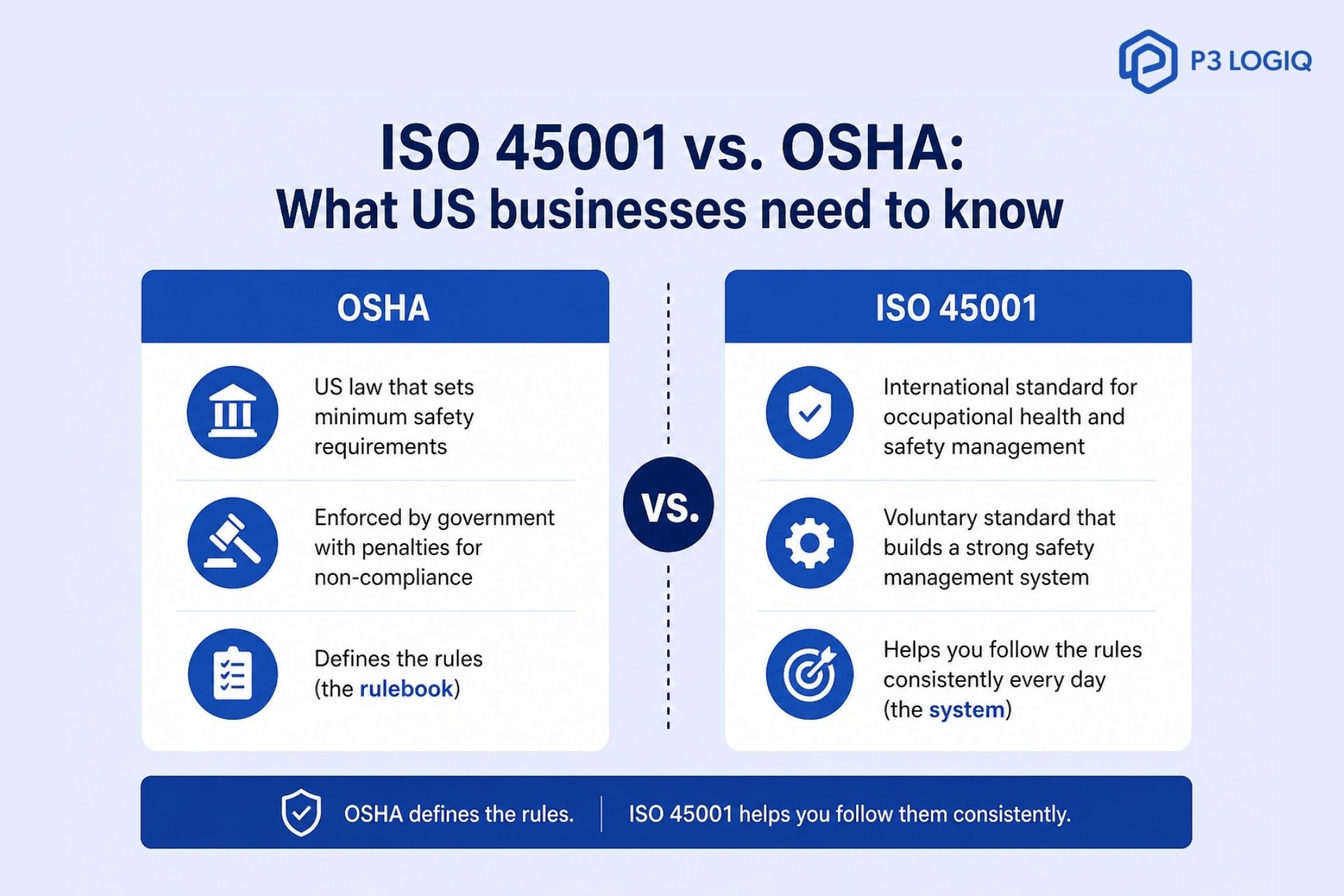
If you run a business in the US, you know OSHA is the law. It sets minimum safety requirements, and failing to meet them carries real financial consequences.
A single serious violation, as per OSHA penalties, can cost your business up to $16,550 USD per citation. A willful or repeated violation? Up to $165,514 USD.
ISO 45001 is different. It is voluntary. No federal agency requires you to get certified.
But "voluntary" does not mean it does not matter.
OSHA defines the rules. ISO 45001 helps you build a system that keeps you aligned with them every day. It works across your organization, even when no inspector is around.
Here is a useful way to think about it. OSHA is the rulebook. ISO 45001 is the system that helps you follow it consistently.
There is a practical connection between the two. Businesses with a working ISO 45001 system are far better prepared for an OSHA inspection. Their records are organized. Their procedures are written down. Their workers can clearly explain safety processes.
One part of ISO 45001 is especially useful for US businesses: Clause 6.1.3. It requires you to maintain a current list of every legal and regulatory requirement that applies to your operations.
This includes OSHA standards, state OSHA plans, EPA rules where they overlap with safety, and Department of Transportation (DOT) requirements for transport operations. All of it in one place, reviewed and updated regularly.
That alone prevents a lot of compliance surprises.
ISO 45001 does not replace OSHA. It helps you meet OSHA requirements consistently and show clear proof of compliance.
The standard has 10 clauses. The first three are introductory. Clauses 4 to 10 are the ones you need to implement.

Before building your safety system, you need to understand your environment. What industry are you in? What hazards come with it? Who has a stake in your safety performance, and what do they expect from you?
You also define the scope of your system here. What is included, what is not, and why.
This clause carries more weight in 2026 than before.
Leaders cannot hand safety off to a team and step away. The standard requires visible, active commitment from the top. That means setting safety goals, allocating a budget for risk reduction, and making decisions based on safety data.
Worker participation is required, too. Workers must be involved in spotting hazards, building controls, and reviewing incidents. There is a clear difference between being informed and being involved.
This is where you identify hazards, assess risks, and plan how to control them. You also map out your legal obligations and decide how you will meet them.
The standard also asks you to look for ways to improve safety before issues arise.
This covers the resources, training, awareness, and communication your system needs.
Workers need to be capable of doing their jobs safely, and you need to show and record that capability. Safety information must flow clearly in both directions, across teams and leadership.
This is where plans turn into action. Controls are put in place. High-risk work is managed through permits and procedures. Contractors are included in your safety requirements.
You also assess changes in your operations for safety impact before they are made.
How do you know your system is working? You measure it. Clause 9 requires ongoing safety monitoring, internal audits, legal compliance reviews, and formal leadership reviews.
These cannot be box-ticking exercises. The data has to be real, and the reviews must lead to clear decisions.
When things go wrong or gaps are found, you investigate properly. You find the root cause. You take action to fix it. Then you check that the fix worked.
Improvement is built into the system. It does not stop. The system keeps moving forward.
Managing these clauses across documents, teams, and timelines can get difficult fast. If you want to see how this can be handled in one system, you can book a demo of P3 LogiQ.
One of the most useful things ISO 45001 asks you to do is get clear on your actual compliance requirements.
Most organizations know OSHA exists. Fewer have a complete, up-to-date view of every regulation that applies to their operations, locations, and workforce. That gap is where compliance failures often occur.
Your compliance register should include relevant OSHA standards for your industry, your state’s OSHA plan if one applies, EPA rules that overlap with worker safety, DOT requirements if you operate vehicles or handle hazardous materials, and any client or contract-specific safety requirements.
This is not a task you do once. Operations change. Laws change. You need to review and update your register regularly.
Industry also matters here. A construction company, a food processing plant, and a healthcare clinic all operate under different compliance requirements. ISO 45001 does not give you a one-size-fits-all checklist. It gives you a process to build a system that fits your operations and keeps it current.
The text of ISO 45001 has not changed. But how auditors apply it has shifted. Three areas stand out.

ISO's technical guidance now expects organizations to consider climate-related factors where they affect worker safety. This does not mean every business needs a climate action plan.
It means that if your workers are exposed to extreme heat, work outdoors in severe weather, or operate in areas prone to floods or wildfires, you need to assess and address those risks. Heat stress plans, updated emergency procedures, and outdoor work policies for extreme weather are now part of many audits.
This is one of the biggest shifts in workplace safety today.
The WHO Mental Health at Work fact sheet states that depression and anxiety alone cost the global economy $1 trillion USD in lost productivity every year.
Psychosocial risks are aspects of work that affect mental health. Excessive workload. Poor management. Job insecurity. Workplace conflict. Isolation. These are real hazards. They affect worker health, which brings them within the scope of ISO 45001.
Closer to home, as per the 2025 NAMI Workplace Mental Health Poll, 1 in 4 US employees has considered quitting their job because of mental health concerns.
Most people think of hazards as broken equipment or slippery floors. ISO 45001 looks at more than that.
Under Clause 6.1.2, tight deadlines, long hours, and constant pressure are treated as psychosocial hazards. These are safety risks.
The same way you would flag a faulty machine, you are expected to flag a workload that pushes people too far. This matters for a reason.
When someone is stressed, focus drops. Attention slips. Mistakes increase.
A tired worker is more likely to miss a step or ignore a risk. That is how physical incidents happen. Mental strain and physical safety are connected, even if they are often handled separately.
ISO 45001 addresses this at the source. It does not stop at offering support after things go wrong. It expects you to fix the conditions that create the pressure in the first place.
The companion standard ISO 45003 gives organizations a way to manage these risks within their existing safety system. You do not need a separate certification. You integrate these controls into your current system.
For businesses in the US, this means your hazard identification process needs to include psychosocial risks. Burnout, isolation, harassment, and chronic stress are legitimate workplace hazards that belong in your risk register.
An auditor asking about leadership commitment in 2026 wants more than a signed policy.
They want to see meeting records where safety was discussed. Budget decisions that reflect real risk priorities. Follow-up actions taken after incidents or audit findings. Worker interviews that confirm leadership listens and takes action.
Effective ISO 45001 compliance in 2026 is proven through behavior, not paperwork.
There is also growing discussion around ISO 45001:2027, which may shape how organizations approach workplace safety in the coming years.
Certification takes time, but the path is clear. Here's how the process to get ISO 45001 certified works for your business

Start by understanding where you stand. Go through your current safety practices clause by clause against ISO 45001 requirements. What is already in place? What is missing? What exists on paper but does not work in practice? This step shows you what needs to be built and where to begin.
Get leadership involved before you build anything. Certification cannot be handed to a safety manager and forgotten. Leaders need to commit time, budget, and real attention. If leadership treats this as someone else’s job, it will show during the audit.
Build your legal and regulatory register. Go through OSHA standards for your industry. Check whether your state has its own OSHA plan. Add any other federal, state, or local requirements that apply. Keep this updated as your operations and regulations change.
Develop your OH&S policy, safety goals, risk assessment process, hazard register, procedures, and emergency plans. The documents need to reflect how your business actually runs. Documents created only for audits, but disconnected from real work, are a common failure point.
Everyone whose work affects safety needs to understand the system. They need to know the hazards in their area, their responsibilities, and how to report unsafe conditions or incidents. For certain roles, training needs to go deeper and be role-specific.
Put your hazard controls into action. Manage contractors. Set up permit systems for high-risk work. Test your emergency response procedures to confirm they work in real conditions.
Before bringing in a certification body, audit your own system. Use auditors who are not directly involved in the areas they review. Identify gaps early and fix them on your own terms.
Leadership reviews how the system is performing. They look at audit findings, incident data, compliance status, and progress on safety goals. This review should lead to clear decisions and actions.
An accredited certification body reviews your documentation and confirms you are ready for the main audit. They check that your system is structured correctly and that your scope is defined properly.
The auditor visits your site. They observe how work is done. They talk to workers at different levels. They review records. They check whether your system is active and working in practice. Any major gaps need to be resolved before the certificate is issued.
Your certificate is valid for three years. Annual surveillance audits confirm the system is being maintained. At the three-year mark, a recertification audit is required.
For most businesses in the US, the full process from gap analysis to certification takes between 3 and 12 months, depending on the size and complexity of the organization.

Training is a formal requirement under Clause 7. It is not optional, and it is not a one-time activity.
The standard requires that anyone whose work affects safety has the skills and knowledge to do it safely. This needs to be shown through their actual work, not only through a course completion record.
Awareness training applies to everyone. Workers need to understand the OH&S policy, the hazards specific to their work area, their responsibilities, and how to report unsafe conditions or near misses. This includes contractors and temporary workers working on your site.
Internal auditor training is for people who will audit your system. They need a clear understanding of ISO 45001 requirements to spot real gaps and write clear findings. This is typically a two to three days program.
Lead auditor training is for those who want a more advanced qualification, either to build stronger internal capability or as part of their professional development.
One thing that often gets missed is contractor awareness. If a subcontractor works on your site without knowing your safety procedures, it creates a clear gap. ISO 45001 requires you to extend your safety expectations into your supply chain and check that they are being followed.
Training and compliance tracking can get difficult to manage if done manually, especially as teams grow and responsibilities increase. Many businesses now use training management software to keep training records organized, track certifications, and maintain audit-ready documentation.
P3 LogiQ brings everything into one place, helping you track training, assign roles, and keep records updated without relying on scattered systems.
If you want to simplify this process, you can contact us to see how it works for your team.
An internal audit is how you verify your system is working before anyone else does. When done properly, it becomes one of the most valuable tools in your safety program.
The audit covers all seven auditable clauses of ISO 45001 (Clauses 4 through 10). A good checklist does not rely on vague questions. It focuses on specific checks:
Here is a practical approach to running your internal audit.
Review your previous audit reports, corrective action logs, and any changes to operations or legal requirements since the last audit. Focus your audit plan on higher-risk areas. Assign auditors who are independent of the areas they review.
Brief key personnel on the scope, methodology, and what you will be reviewing. Keep it short and clear.
Check that your policies, procedures, risk assessments, training records, and compliance registers are current and accurate. Look for gaps between documented processes and actual practice.
Talk to workers at all levels. Do they know the OH&S policy? Can they identify the main hazards in their area? Do they know how to report an incident? Their responses often reveal as much as your documentation.
Document every finding clearly. Separate conformities (things working as intended) from nonconformities (gaps that need corrective action). Assign responsibility and set clear timelines for each finding.
Nonconformities need root cause analysis and documented corrective actions. Follow up to confirm the actions were completed and that they addressed the root cause.
The most common failures found in ISO 45001 audits tend to repeat: incomplete hazard identification, legal compliance registers that have not been updated, training records with gaps, and leadership involvement that looks good on paper but does not hold up in interviews.
Use your internal audit as a live tool, not a one-time exercise. The businesses that get the most value from ISO 45001 are the ones that treat each audit as a real check on whether their system is protecting people.
Getting certified is a milestone. Staying compliant is where the real work begins. Compliance is not a one-time activity. It is how the system runs every day.
A lot of organizations put real effort into certification, then let things drift between surveillance audits. That is when gaps start to appear. Auditors can usually spot when a system has been inactive.
Active compliance management means your safety system runs consistently throughout the year.
To support this, many organizations use some of the best software for ISO 45001 to manage audits, track actions, and keep records up-to-date.
Your compliance register needs to be reviewed whenever regulations or operations change. You do not want to discover during an audit that a new requirement now applies to you.
Your internal audit schedule should run consistently. Many businesses audit different parts of the organization at different times of the year. That way, the full system gets reviewed annually without overloading teams.
Corrective actions from audits and incidents must be tracked through to completion and verified. Many organizations use compliance management software to assign responsibilities, monitor deadlines, and maintain proper audit records in one place.
Management reviews happen at planned times and need to lead to clear decisions and actions. A record that the meeting happened is not enough.
Worker participation needs to stay active. Hazard reporting channels should remain open and responsive. When workers stop reporting issues, it often signals that the system is no longer being heard, not that everything is fine.
For organizations that also hold ISO 9001 or ISO 14001 certification, there is a real efficiency gain. All three standards share the same high-level structure. Document control, internal audits, management reviews, and corrective actions can be managed through a single integrated system. Running one system is simpler than managing three separate ones.
ISO 45001 is not only for large organizations. In reality, ISO 45001 for small businesses works just as effectively when applied in a scaled and practical way.
The requirements are the same, but the scope scales with the size of the business. A ten-person contractor has fewer processes and less documentation to manage than a thousand-person manufacturer. The investment is smaller as a result.
For small businesses, the case for ISO 45001 is often stronger. One serious injury can take out a key team member and stop operations. One OSHA citation can create real financial pressure. One lost contract because you could not show your safety credentials can impact your revenue for the year.
The NSC workplace injury cost statistics estimate that a single medically consulted workplace injury costs businesses around $48,000 USD on average, while a workplace fatality averages approximately $1.54 million USD.
A phased approach usually works best for small businesses. Instead of trying to build a full system at once, focus first on your highest-risk areas, put practical safety controls in place, train your team, and improve the system gradually as the business grows.
If you already have a safety program, you are not starting from zero. ISO 45001 gives you a framework to organize and strengthen what you already have.
ISO 45001 certification is increasingly becoming a requirement for contracts with larger buyers and government organizations. For small businesses looking to grow into these markets, certification removes a barrier that is becoming harder to ignore.
But managing compliance alongside daily operations can get difficult when everything is handled manually.
P3 LogiQ gives you a structured way to manage tasks, documents, and audits in one place, so nothing slips through as you scale. If you want to see how this can work for your business, you can contact us to get started.
One of the top benefits of ISO 45001 is a clear reduction in workplace injuries. The system helps identify hazards early. It also helps control them before they cause harm. This leads to fewer incidents on the job.
Fewer incidents mean less disruption to work. They also mean less downtime. This reduces both human and operational costs.
ISO 45001 also reduces workers’ compensation and insurance costs. Fewer injuries lead to fewer claims. Fewer claims improve your risk profile. Over time, this can lower insurance premiums.
Research published in CSR & Environmental Management found that ISO 45001-certified companies show measurably better productivity and profitability compared to non-certified businesses in the same industries.
It also reduces OSHA risk. The system helps find gaps early. These include missing records, unsafe processes, or a lack of training. Fixing them early helps avoid penalties during inspections.
ISO 45001 can also improve business opportunities. Many large companies and government buyers prefer certified suppliers. Certification shows strong safety control. This can help win contracts.
Employee morale also improves. Workers feel safer. They trust the system more. They are more willing to report problems. This improves overall workplace behavior.
Audit and inspection readiness also improves. Records stay updated throughout the year. Responsibilities are clear. The system matches real work. Audits become easier and less stressful.
The businesses that get the most out of ISO 45001 do not treat it as a one-time certification exercise.
There is a real difference between the two. A certification exercise ends when the certificate arrives. A management system keeps running, keeps improving, and keeps protecting people whether an auditor is scheduled or not.
Compliance is not a one-time activity. It is how the system runs every day.
The standard is not complicated in principle. Identify hazards. Control them. Involve your workers. Hold leadership accountable. Check whether it is working. Improve. Repeat.
What makes it difficult is doing all of that consistently, across an entire organization, over time. Structure is what makes consistency possible. ISO 45001 provides that structure.
For US businesses in 2026, the gap between organizations that need a system like this and those that have one is still significant. That will not stay true for long. Client expectations are rising. Supply chain requirements are tightening. Regulatory pressure is growing.
The businesses that build this now will be in a stronger position than those that wait.
Getting started early makes the transition easier and more effective.
If you are looking to manage ISO 45001 compliance more effectively, P3 LogiQ can help you streamline your safety processes and keep your system active year-round.
Sign up to get started or book a demo to see how it works in practice.
No, ISO 45001 certification is voluntary for US businesses. OSHA regulations remain the legal requirement. However, many large buyers and government contractors now expect ISO 45001 certification from vendors, making it increasingly important for businesses that want to stay competitive and qualify for larger contracts.
Most US businesses complete ISO 45001 certification within three to twelve months. Smaller organizations with fewer processes usually move faster, while larger or more complex operations take longer due to broader risk assessments, documentation, training requirements, and system implementation across multiple teams or locations.
ISO 45001 compliance means your organization meets the standard’s requirements. Certification means an accredited third-party auditor has verified your system and issued a certificate. While you can operate in compliance without certification, certification provides external validation that customers, partners, and regulators can trust.
ISO 45001 certification is valid for three years. During this period, annual surveillance audits are conducted to confirm the system is maintained and effective. At the end of the three-year cycle, a full recertification audit is required to renew the certificate and continue demonstrating compliance.
No, ISO 45001 does not replace OSHA compliance. OSHA sets the legal safety requirements that businesses must follow. ISO 45001 provides a structured management system that helps organizations meet those requirements consistently, identify risks early, and maintain stronger overall safety performance across operations.
Organizations usually fail ISO 45001 audits due to incomplete hazard identification, outdated legal compliance registers, gaps in training records, weak worker participation, and a lack of visible leadership involvement. Most failures occur when systems look good on paper but do not reflect actual practices observed during interviews or site visits.
Clause 6.1.3 requires organizations to identify and maintain a register of all applicable legal and regulatory requirements. This includes OSHA standards, state plans, and other relevant laws. It matters because auditors expect this register to stay current and directly guide how safety risks are managed in practice.
ISO 45003 is a supporting standard that provides guidance on managing psychosocial risks such as stress, burnout, and workplace conflict. It works alongside ISO 45001 by helping organizations address mental health risks using the same structured approach applied to physical hazards within their existing safety management system.



Businesses need document management systems (DMS) to ensure ISO and R2 compliance, improve efficiency, and stay audit-ready. The article highlights key features like version control, security, and automation while reviewing the top 5 DMS solutions. P3 LogiQ stands out for its compliance-focused automation and secure document tracking
Read More
Recycling businesses gain efficiency, compliance, and sustainability with RIOS certification. It streamlines quality management, environmental responsibility, and worker safety, helping companies avoid legal risks and boost credibility. P3 LogiQ simplifies the certification process with automation, document control, and compliance tracking, making operations smarter and safer.
Read More
Audit Management Software (AMS) automates compliance tracking, streamlines workflows, and reduces audit risks. Key features include automated scheduling, compliance checklists, CAPA tracking, vendor risk management, and integrations.
Read More
Learn how audit management systems simplify ISO and R2 compliance by automating audits, managing documentation, and minimizing compliance risks efficiently.
Read More
In 2025, many businesses still face challenges in compliance management due to outdated methods like spreadsheets and fragmented software. This inefficiency leads to missed deadlines, increased risk, and regulatory penalties. The blog emphasizes the importance of modern compliance tools that automate workflows, enhance risk management, and streamline regulatory processes to meet ISO and R2 standards.
Read More
The rise in e-waste and environmental concerns makes responsible electronics recycling essential. The R2 Certification sets a global standard for safe, sustainable, and data-secure recycling practices. Developed by Sustainable Electronics Recycling International (SERI), R2 helps businesses manage environmental risks, data security, worker safety, and legal compliance.
Read More
Businesses face increasing challenges in managing complex regulatory compliance. Manual methods such as spreadsheets and paperwork can lead to missed deadlines, inefficiencies, and costly penalties. Compliance management software offers a streamlined solution to reduce risks, automate processes, and improve operational efficiency.
Read More
Maintaining R2 Certification is crucial for businesses in the e-waste recycling industry, ensuring regulatory compliance, sustainability, and strong stakeholder trust. This guide outlines 10 best practices to help businesses simplify operations, reduce risks, and stay compliant.
Read More
Unlock the value of ISO risk management certification. Explore its impact on compliance, risk mitigation, and business expansion.
Read More
Explore the top 5 ISO risk management software tools for 2025, including document management solutions for streamlined compliance and increased efficiency.
Read More
Find the ideal document management software (DMS) for your business. Learn how to choose with expert tips, key features, and insightful guidance
Read More
Unlock the power of a Document Management System (DMS). Learn how it can revolutionize your business operations.
Read More








.png)


.png)





.jpg)



.jpg)
.jpg)











.jpg)



.png)

.png)
.png)



.png)

