.jpg)

I once visited a construction site to pick up some paperwork. At the front gate, everything looked perfect. The guards checked my ID and gave me a hard hat. It felt like a very safe place to work.
But when I walked inside, the picture changed.
I started noticing safety gaps that people were ignoring. I saw a worker carrying heavy pipes, but his helmet was pushed back so it wouldn't actually protect his head. Some of the workers’ safety glasses were hanging around their necks instead of covering their eyes. In another corner, a large truck was backing up, but no one was standing nearby to help guide it safely.
The most worrying part? Nobody stopped them. These unsafe habits had become "normal."
In that moment, I realized the site wasn't following a real system. People were just doing what they usually did to get the job done quickly. But when you stop checking on the "small" things, you create a path for a big accident to happen.
We often ignore the small things because they feel minor. But in workplace safety, those small gaps are exactly what lead to massive problems later.
In fact, employers in the US pay over $1 billion every week for workplace injuries, according to the Occupational Safety and Health Administration.
Most business owners I talk to care about their teams. They do not avoid safety systems because they are uncaring. They hesitate because they worry about the cost or the complexity of the rules.
But let’s be honest. The cost of a habit-based system is much higher than the cost of a professional one. One accident, one government fine, or one lost contract can cost ten times more than a certification.
This is where a formal system changes everything. When you look at the benefits of ISO 45001, it becomes clear that this is not just about staying out of trouble. It is about building a proven plan that turns safety into a daily habit.
To manage this effectively, many organizations now rely on ISO 45001 software to track safety activities, maintain records, and ensure compliance without depending on manual processes.
In this blog, we are going to break down how to fix these issues. We will look at what ISO 45001 actually involves and what the certification cost looks like for businesses in the USA in 2026. Most importantly, we will show you what your business actually gets in return for making the switch.
But before we get into the costs, let’s quickly understand what ISO 45001 actually is and who it’s for.
Think of ISO 45001 as your international rulebook for workplace safety. It is a clear set of steps that helps your business find risks. It helps you stop accidents before they ever happen. When your company has this certificate, it proves to the clients that you truly care about your workers.
This standard replaced an older one called OHSAS 18001 back in 2018. Since then, the change has been huge. According to the ISO Survey, there are now over 400,000 certified sites around the globe. This is a clear signal that safety is becoming a must-have priority for all of us. It is no longer just a box to check.
That growth is not a mistake. It happens because we are seeing the real costs of safety problems. Without a good system, a company faces big fines and legal trouble. We also risk a bad reputation that can take years to fix.
So, who needs it?
To be honest, any business where people face risks every day needs it. This includes fields such as construction, factory work, shipping, healthcare, energy, and much more.
But even office-based companies are starting to get certified now.
Why? Because many clients and big contracts now demand proof of safety. They want to know a partner is reliable before they sign a deal. Using a dedicated ISO 45001 compliance management tool allows these companies to provide that proof instantly.
Workplace safety has always been a moral responsibility. In 2026, it is also one of the most measurable financial decisions a business can make.
We used to draw artificial boundaries between “work life" and "home life." We treated them like two different worlds. However, research published by Taylor & Francis on Total Worker Health and Organizational Behavior Management proves these boundaries are an illusion.
Every person lives an integrated life. The physical and psychosocial environment at work directly impacts health and well-being at home. This cycle works both ways.
When safety fails, the costs go far beyond medical bills. In the United States alone, the annual financial burden of occupational injuries and illnesses is estimated at $320 billion.
For businesses planning in 2026, the reality is clear.
You cannot manage these risks with simple habits. You need a system.
This is where ISO 45001 comes in. It provides the international framework to turn this research into a repeatable process. You can’t ignore the benefits of ISO 45001 that go beyond the balance sheet, from improved worker morale to a stronger, more reliable brand reputation.
I will give you the numbers first. That is likely why you are reading this.
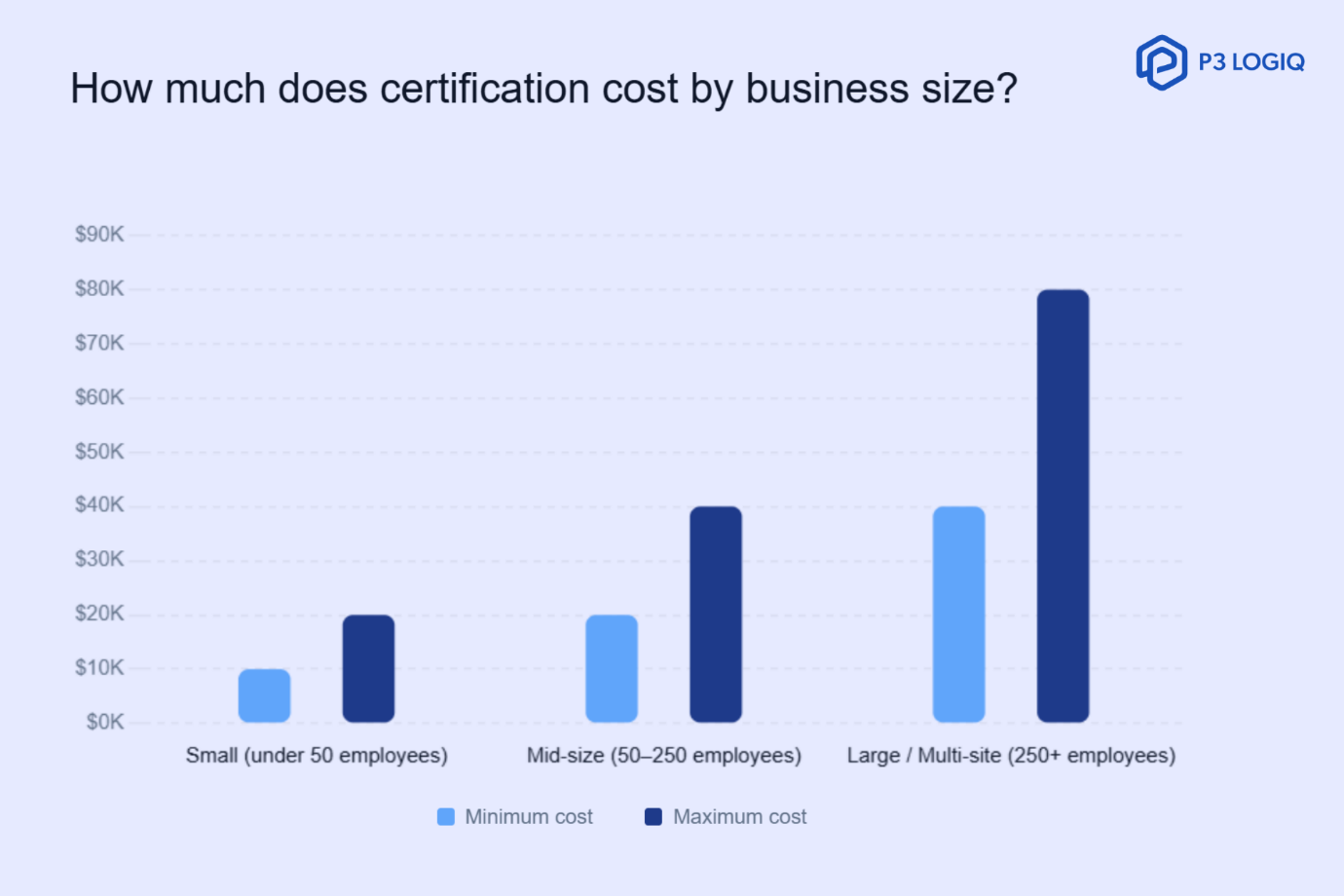
For most US businesses in 2026, the total cost for ISO 45001 usually falls between $10,000 USD and $50,000 USD over a 3-year cycle.
I know the range may seem wide. But there is a reason for this.
Every certification body in the US follows the same international rules to set its price. These rules (found in a document called IAF MD5) make sure the cost is fair. The price range changes because your audit time is based on four main things:
Because of these rules, your price is calculated specifically for your business. A large, high-risk company will always have a higher price than a small office because the auditor has more work to do.
Here is a breakdown of what to expect by business size:
The good news is that you do not pay all of this at once. The cost spreads across three years. Year 1 is the biggest investment among the total costs because it covers the setup and the main audit. Years 2 and 3 are comparatively fewer because they only involve smaller check-ups.
We will break down every part of these costs next.
Your total cost comes from several parts, and each one matters. Here is exactly where your money goes.

This is where everything starts. You pay a basic fee to the certification body to begin the process and get your audit scheduled. It is a small part of your total cost, but it officially opens the door to your certification.
Think of this as a readiness check. The auditor reviews your documents and systems to find gaps before the main assessment. You pay for this audit, and it usually costs less than Stage 2. It counts toward your overall 3-year USD budget. If the auditor finds gaps, you get time to fix them.
This is the main audit. The auditor looks at how your business actually runs. They check your processes, your records, and how your team follows the safety system every day.
This is not just paperwork. It is about what actually happens on your factory floor, in your process and operations, and on your job sites. Stage 2 is usually the single biggest cost in your entire journey.

This is where many businesses spend more than they planned. You need clear policies, safety rules, and proof that your system works. Starting from scratch takes much more time and money than building on what you already have.
But this is also where your long-term value begins.
A peer-reviewed study by the IJIRSS, covering 92 global studies, found that businesses using ISO 45001 see an average 32% reduction in workplace injuries within just two years. This means the money you spend here directly impacts your future savings.
Managing documentation manually is where most businesses lose time and money. P3 LogiQ automates this entire process, keeping everything organized and audit-ready from day one.
Your team needs to understand the system. That means safety training for all staff and special training for your internal audit team. Even if you manage this internally, the time your team spends is part of your total cost.
And it matters more than it seems. According to the National Safety Council, workplace injuries led to 103 million lost workdays in 2023. This shows how gaps in training and safety systems can directly hurt your productivity.
Getting certified is not the finish line. Smaller audits happen every year to confirm you are still following the system. These continue across the 3-year cycle and are a required part of your ongoing improvement.
These are the quiet costs that add up fast. They include auditor travel and hotels, staff time taken away from regular work, and new safety investments you might need to make. Most businesses underestimate this part.
To put this in perspective, the National Safety Council reported massive losses in 2023 alone.
These are the same types of hidden costs that grow when safety systems are not managed well. By investing in your certification now, you are protecting your business from these much larger financial hits later.
Here is the full picture, a complete cost breakdown for ISO 45001.
Managing all of these moving parts manually is where most businesses lose time and budget. Book a demo to see how P3 LogiQ keeps every component organized and audit-ready in one place.
When people ask about the cost, they usually picture a one-time payment. But as you can see, it is a commitment spread over three years.
Year 1 is always the heaviest. Your system setup, documentation, training, and both Stage 1 and Stage 2 audits all happen here. This is where the majority of your investment lands.
Year 2 is much lighter. A surveillance audit confirms your system is being maintained, and your costs drop significantly.
Year 3 is similar to Year 2, but it includes a bit more preparation for your recertification audit at the end of the cycle.
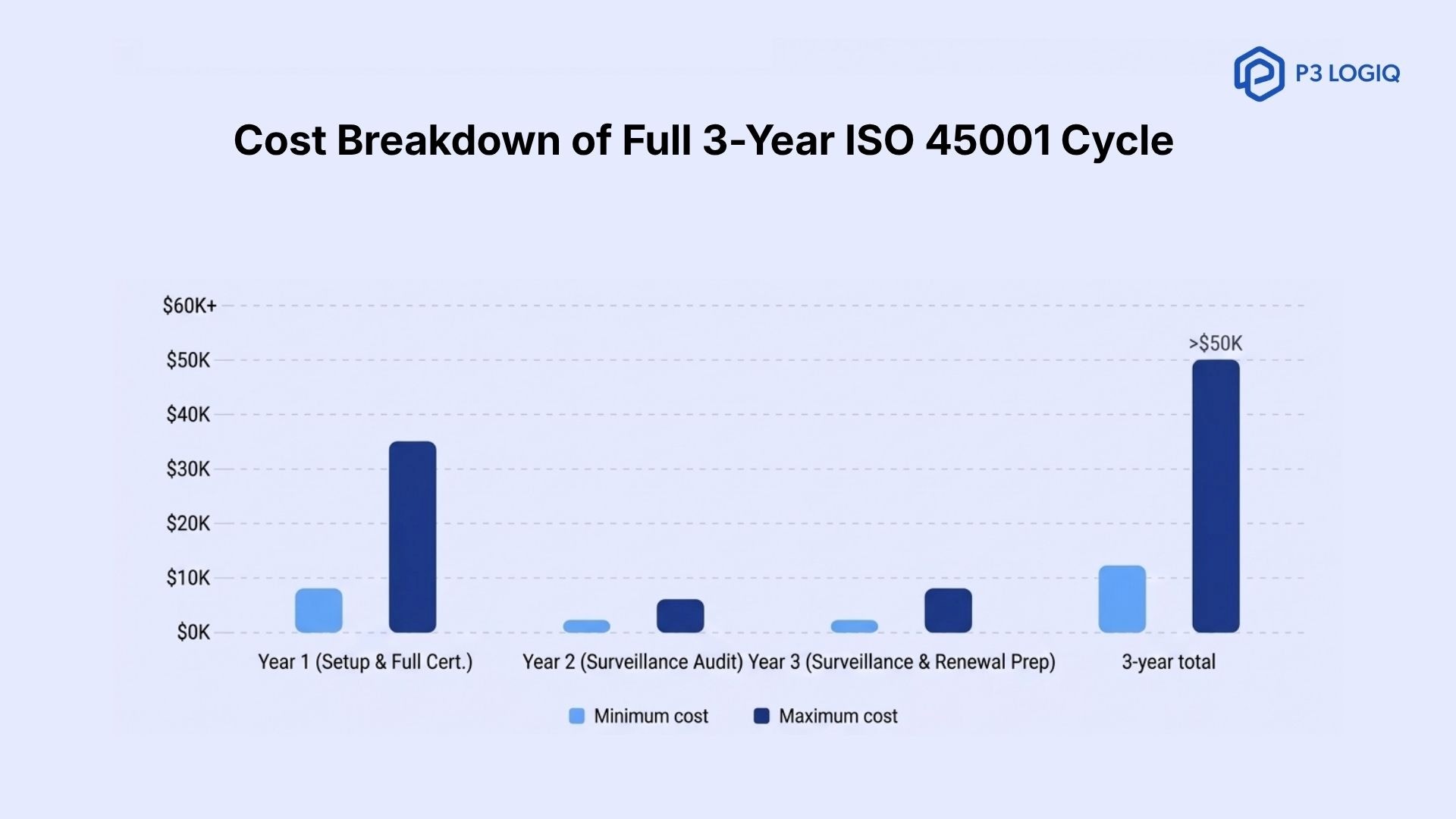
The table below shows how ISO 45001 certification costs are spread across the full three-year cycle in the USA. The first year is usually the most expensive. This is because it includes system setup, documentation, employee training, and certification audits.
The next two years are usually easier to manage. Most of the costs during this phase come from surveillance audits and maintaining compliance. This helps make sure your safety system continues to work properly.
Your total cost can still vary from business to business. Company size, number of locations, workforce size, and your current safety practices all play a role. Businesses that already have some systems in place usually spend less during the setup stage.
It is easy to think that paying the auditor is the only cost. Many people assume that once the audit is finished, the work is done. But the real value comes from staying committed for the full three years.
According to OSHA, businesses that invest in a structured safety system can see a 9.4% drop in injury claims and save an average of 26% on workers’ compensation costs.
Spreading your costs over three years allows you to build a system that actually earns those savings. If you only focus on the first year and let the system sit idle, the money you spent building it goes to waste. Following the system for the full cycle is the only way to get your money’s worth.
Every company is different. That is why the price is never the same. These are the main things that move your final number up or down.
Naturally, the larger your organization, the higher the cost of certification. More sites require more audit days and increased travel expenses for the auditor. The IAF MD 5:2023 rules are very specific about this. They require that audit time be calculated based on your total employee count and the number of locations included in your plan. A company operating five separate factories will not receive a flat rate; instead, each site adds more time and more dollars to the total bill.

High-risk industries like construction, manufacturing, and oil and gas naturally carry more danger than standard office work. This higher risk level means an auditor must spend significantly more time checking your safety steps and physical controls.
The difference in cost is not a minor detail. Recent data from the International Labour Organization shows that the global toll is staggering, with nearly 3 million workers dying every year from work-related accidents and diseases. This averages out to about 8,200 deaths every single day.
Because of this rising level of risk, high-hazard industries require deeper audits and stricter documentation. These requirements naturally increase your certification cost because the auditor must be much more thorough to ensure your people stay safe on the job.
If your business already has established safety rules and documented processes, your initial investment will be much lower.
This matters because many companies still operate without a structured safety framework. In the United States, the Bureau of Labor Statistics recently reported 2.5 million nonfatal workplace injuries in a single year. Businesses without proper systems often face much higher Year 1 costs as they work to fix gaps before an auditor can even begin the certification process.
If your business already holds a certificate like ISO 9001 or ISO 14001, you have a major head start. Most ISO standards follow the same High-Level Structure (HLS). This means you can adapt your existing management system rather than building an entirely new one from scratch. Integrating your audits in this way is one of the most effective ways to save money on consultant hours and audit preparation time.
Two common mistakes trip up business owners every time they look at the numbers. If you want to plan your budget properly, you have to look past the surface level of the quote.
.jpg)
It is a common mistake to assume that the quote from your registrar is your final bill. In reality, the audit is just one piece of the puzzle. Your real investment goes into setting up the system, organizing your documentation, and the internal hours your team spends getting everything right.
The numbers are eye-opening. According to the 2025 Workplace Safety Index, serious non-fatal workplace accidents now cost U.S. employers over $58 billion every year. That is a massive financial drain that a solid safety system helps you plug. When you plan your budget, do not just think about paying the auditor. Think about the upfront investment required to build a system that protects you from those billion-dollar risks.
I have seen many leaders treat ISO 45001 like a trophy they can just hang on the wall and forget about. But it is a three-year commitment, not a one-day photo.
The businesses that get the most value are the ones that keep their system moving every day. This is why surveillance audits are a mandatory part of the cycle. They are not just extra fees. They are the check-ups that keep your safety culture from getting rusty.
According to the American Society of Safety Professionals, the most successful organizations treat safety as a core business operating system rather than a yearly compliance chore. If you let the system sit idle between audits, you are essentially throwing away the money you spent building it.

These are the budget items that rarely appear in early conversations. While they might not be on your initial quote from an auditor, they are a real part of your total investment.
First, you must account for auditor travel and logistics. If your certification body is not local to your facility, this includes their flights, meals, and hotel costs. These are external fees that add up quickly.
Beyond these fees, you should also factor in your internal staff hours. Your team will spend significant time preparing for interviews and gathering evidence. This is a necessary part of the process that requires careful planning.
Sometimes, a gap analysis will identify specific equipment or site upgrades that you need to handle before you can pass. You might also find that investing in searching for the best ISO 45001 software tools is a smart step. Using software to track incidents and training records ensures your documentation is always ready for review.
None of these costs is avoidable. However, all of them are predictable if you plan for them early. Staying prepared is the most effective way to manage your safety budget over the long term.
It is easy to think that getting your certificate is the finish line. In reality, it is just the beginning.
To keep your certification valid, your business must stay active within the system. You don’t just set it and forget it. After your initial success, you will enter a three-year cycle that includes annual surveillance audits in Years 2 and 3.
While these audits are smaller in scope than your main Stage 2 audit, they are still formal, paid engagements. They require your team’s focus, time, and preparation.
For most businesses in the USA, annual maintenance costs typically range from $2,000 USD to $8,000 USD. This depends on your company’s size and how complex your operations are.
One of the most expensive mistakes you can make is letting your system drift between audits. When you ignore small issues, they pile up. By the time your recertification comes around, those small problems have turned into major corrective actions that cost significantly more to fix.
Staying consistent isn't just about safety or compliance. It is the most cost-effective way to manage your budget. When you maintain the system daily, you avoid the audit panic and the high costs of emergency fixes.
This is where the numbers start to work in your favor. The cost of workplace safety in the United States is a significant burden for any growing business.
A single serious injury at your facility can cost more than your entire certification investment. Beyond the immediate medical bills, you have to account for the rising cost of legal penalties.
Now, look at what ISO 45001 delivers against that risk.
According to recent insights published by EHS Today, businesses that adopt modern safety systems and digital tools can improve operational efficiency by up to 25%.
The logic here is straightforward.
When you have a structured safety program, you see a natural drop in workers' compensation claims. Your insurance premiums go down over time. You stop reacting to emergencies and start managing your operations.
The ROI of ISO 45001 is not theoretical. It shows up in lower costs, fewer lost workdays, and a safer environment. Most importantly, it gives you the operational stability you need to win higher-value contracts.
This is the question most small business owners are really asking.
Let us look at it simply. In 2026, the financial stakes for a 30-person operation are higher than ever. According to Safety By Design, a single serious OSHA violation now carries a maximum penalty of $16,550.
For a small business, that isn't just a fine. It is a major hit to your quarterly profit.
Consider this. A full ISO 45001 certification typically costs between $10,000 USD and $15,000 USD over a three-year period. Compare that to the cost of just one penalty or a single injury claim.
It is clear that one avoided incident pays more for the entire three-year investment.
Beyond avoiding costs, certification opens doors.
Let’s be honest. Large enterprises and government programs are raising their standards. They don’t just want to hear that you are safe. They want you to prove it.
In many cases, they now require a valid ISO 45001 certificate before you can even enter the bidding process.
Without it, you are left out of the conversation. With it, you prove that your team is just as reliable and professional as a global corporation. It tells your future partners that you have the structure to handle their biggest projects without the risk of a safety shutdown.
It is not just a safety standard. It is a competitive edge.
Reducing cost does not mean reducing quality. It just means planning smartly.
Here are a few ways to keep your ISO 45001 costs under control without cutting corners.

The more organized your documents and records are, the easier the audit becomes.
When your system is ready, the auditor spends less time reviewing things. This directly reduces your Stage 1 and Stage 2 audit time and cost.
Do not wait for the audit to start training.
Run short, focused sessions with your team before the audit. When people know what to do, there are fewer mistakes.
Fewer mistakes mean fewer findings. And fewer findings mean you avoid extra time and cost fixing them later.
Manual work takes time. And time is money.
Using software to manage documents, track incidents, and record training can save a lot of effort. It keeps everything in one place and makes your system easier to manage across all three years.
This is where tools like P3 LogiQ can help. You can manage documentation, track compliance, and stay audit-ready without the usual last-minute stress.
If you are working with more than one ISO standard, try to combine your audits.
Instead of running separate audits for quality, environment, and safety, you can do them together. This reduces total audit days and saves costs.
This approach is already used by many companies. A case study by LRQA shows that businesses using one combined system reduce complexity and improve efficiency.
Audit time usually follows standard rules, but pricing can still vary.
Before you choose a certification body, ask for a full breakdown. If one quote is much higher than another, ask why.
A simple question can save you a lot of money.
If you already have ISO 9001 or ISO 14001, you are not starting from zero.
You can reuse your documents, internal audits, and review process. This reduces both setup time and cost.
A single rule to remember.
The more prepared your system is, the faster your audit will be. And a faster audit usually means lower cost.
If you are ready to stop the manual chaos and start saving on your ISO 45001 investment, book a discovery call with P3 LogiQ. We will show you how to build a system that is lean, compliant, and ready for growth.
By now, you should have a clear idea of what ISO 45001 certification costs, where every dollar goes, and what you get in return.
The next step is easy. Get your own number.
Start with a gap analysis. Before you reach out to a certification body or consultant, understand where your current safety system stands. This helps you see how much work is needed. It is also the biggest factor that affects your total cost.
Once you have your baseline, you can begin the formal ISO 45001 implementation process. Get at least three quotes from accredited certification bodies. Audit time usually follows standard rules, so the numbers should be similar. If one quote is much higher or lower, ask why.
Businesses that overspend usually go in without a clear plan.
The ones that stay on budget know what to expect. They track each step, keep their documents organized, and stay ready for audits at all times.
Most US businesses spend $10,000 USD to $50,000 USD over a 3-year cycle. The final cost depends on your size, risk, locations, and system readiness. Year 1 is the most expensive. Years 2 and 3 focus on maintenance.
The difference comes down to how you manage it.
Businesses that treat ISO 45001 like a one-time task often struggle.
The ones that see real value build it into their daily operations and stay consistent over time.
That ongoing management is where most of the work really is.
This is exactly where P3 LogiQ can help.
From gap analysis and documentation to training, audits, and ongoing compliance, everything stays in one place so you always know where you stand and what comes next.
Get in touch to learn how we can simplify achieving and maintaining ISO 45001 certification, or book a demo to see how P3 LogiQ makes your ISO 45001 journey easier and more manageable.
No. The certification quote usually covers only the auditor’s time. If you hire a consultant to help with documentation, training, or implementation, that cost is separate. It is best to plan for this early, so your total budget stays clear and predictable.
Audit days are based on your employee count, number of locations, and risk level. They follow standard rules, so they cannot be reduced to lower costs. However, a well-prepared system can prevent extra audit time caused by missing records or unresolved issues.
Yes. ISO 45001 certification runs on a 3-year cycle. After the initial audit, you will have surveillance audits in Years 2 and 3. These are smaller but still paid. At the end of Year 3, a full recertification audit is required as well.
Your industry affects how much audit time is required. High-risk sectors like construction or manufacturing need more detailed checks, which increases cost. Lower-risk businesses, such as office-based companies, usually require fewer audit days and have lower overall certification costs overall.
Yes. More locations usually mean more audit time. While auditors may use sampling for multi-site businesses, additional sites still increase the total effort. As a result, certification for multiple locations will always cost more than a single-site setup in general.
You can reduce ISO 45001 certification costs by preparing your system well before the audit. This includes having clear documentation, trained staff, and completed internal audits. A well-organized system reduces audit time and avoids delays or repeat visits, which helps control overall certification costs.



Businesses need document management systems (DMS) to ensure ISO and R2 compliance, improve efficiency, and stay audit-ready. The article highlights key features like version control, security, and automation while reviewing the top 5 DMS solutions. P3 LogiQ stands out for its compliance-focused automation and secure document tracking
Read More
Recycling businesses gain efficiency, compliance, and sustainability with RIOS certification. It streamlines quality management, environmental responsibility, and worker safety, helping companies avoid legal risks and boost credibility. P3 LogiQ simplifies the certification process with automation, document control, and compliance tracking, making operations smarter and safer.
Read More
Audit Management Software (AMS) automates compliance tracking, streamlines workflows, and reduces audit risks. Key features include automated scheduling, compliance checklists, CAPA tracking, vendor risk management, and integrations.
Read More
Learn how audit management systems simplify ISO and R2 compliance by automating audits, managing documentation, and minimizing compliance risks efficiently.
Read More
In 2025, many businesses still face challenges in compliance management due to outdated methods like spreadsheets and fragmented software. This inefficiency leads to missed deadlines, increased risk, and regulatory penalties. The blog emphasizes the importance of modern compliance tools that automate workflows, enhance risk management, and streamline regulatory processes to meet ISO and R2 standards.
Read More
The rise in e-waste and environmental concerns makes responsible electronics recycling essential. The R2 Certification sets a global standard for safe, sustainable, and data-secure recycling practices. Developed by Sustainable Electronics Recycling International (SERI), R2 helps businesses manage environmental risks, data security, worker safety, and legal compliance.
Read More
Businesses face increasing challenges in managing complex regulatory compliance. Manual methods such as spreadsheets and paperwork can lead to missed deadlines, inefficiencies, and costly penalties. Compliance management software offers a streamlined solution to reduce risks, automate processes, and improve operational efficiency.
Read More
Maintaining R2 Certification is crucial for businesses in the e-waste recycling industry, ensuring regulatory compliance, sustainability, and strong stakeholder trust. This guide outlines 10 best practices to help businesses simplify operations, reduce risks, and stay compliant.
Read More
Unlock the value of ISO risk management certification. Explore its impact on compliance, risk mitigation, and business expansion.
Read More
Explore the top 5 ISO risk management software tools for 2025, including document management solutions for streamlined compliance and increased efficiency.
Read More
Find the ideal document management software (DMS) for your business. Learn how to choose with expert tips, key features, and insightful guidance
Read More
Unlock the power of a Document Management System (DMS). Learn how it can revolutionize your business operations.
Read More








.png)


.png)





.jpg)



.jpg)
.jpg)








.jpg)



.png)

.png)
.png)



.png)

