

You pulled up the ISO 14001 standard document. You go through it, but the language is hard to understand. The structure is unfamiliar, almost alien-like. And you have a certification audit coming up in three months.
What do you do?
This is where most get stuck. Not because the standard is impossible, but because nobody walks you through what each clause actually requires in plain terms.
ISO 14001:2015 has 10 clauses. Clause 4 to Clause 10 carry real requirements. Miss one, and your audit readiness falls apart. Get them right, and you build an Environmental Management System (EMS) that holds up under scrutiny and keeps improving over time.
According to International Organization for Standardization, there are now more than 500,000 ISO 14001 certifications across 180+ countries. That number keeps growing because organizations that go through this process gain a real operational advantage.
This just goes to show you the importance of ISO standards and what they do for your business.
In this guide, I will help you break down all 10 ISO 14001 clauses, what they require, and what they look like in practice. If you are working through your first certification or preparing for a surveillance audit, this is what you need.

ISO 14001 is an international standard that gives your business a framework for building, running, and improving an EMS. The current version, ISO 14001:2015, follows a High-Level Structure (HLS) shared with ISO 9001 and ISO 45001.
This means if your organization already works with one of those standards, the clause structure will feel familiar. In other words, you can implement new ISO standards without having to start from scratch, which is an advantage for you.
The clauses give a picture of a complete cycle of environmental management, from understanding your business context all the way through to continuous improvement. Each clause builds on the one before it.
Why does this matter to you?
Because auditors walk through these clauses systematically. They ask for evidence. They check whether your documentation matches your actual practice. Organizations that treat clauses as a checklist fail. Organizations that build real systems around them pass and improve.
Only clauses 1 through 3 set the context, whereas clauses 4 through 10 carry mandatory requirements.

Here is a quick reference for every clause:
Clauses 1 to 3 carry no requirements. It is more towards theory. They define the boundaries, reference documents, and terminology of the standard.
Clauses 4 to 10 are the mandatory requirements your EMS must meet. These seven clauses follow the Plan-Do-Check-Act (PDCA) cycle, which is the backbone of continuous improvement in ISO standards.
How many clauses in ISO 14001 actually require action from your team?
Seven clauses.
Because everything from building your EMS context to corrective action and improvement sits within clauses 4 through 10.
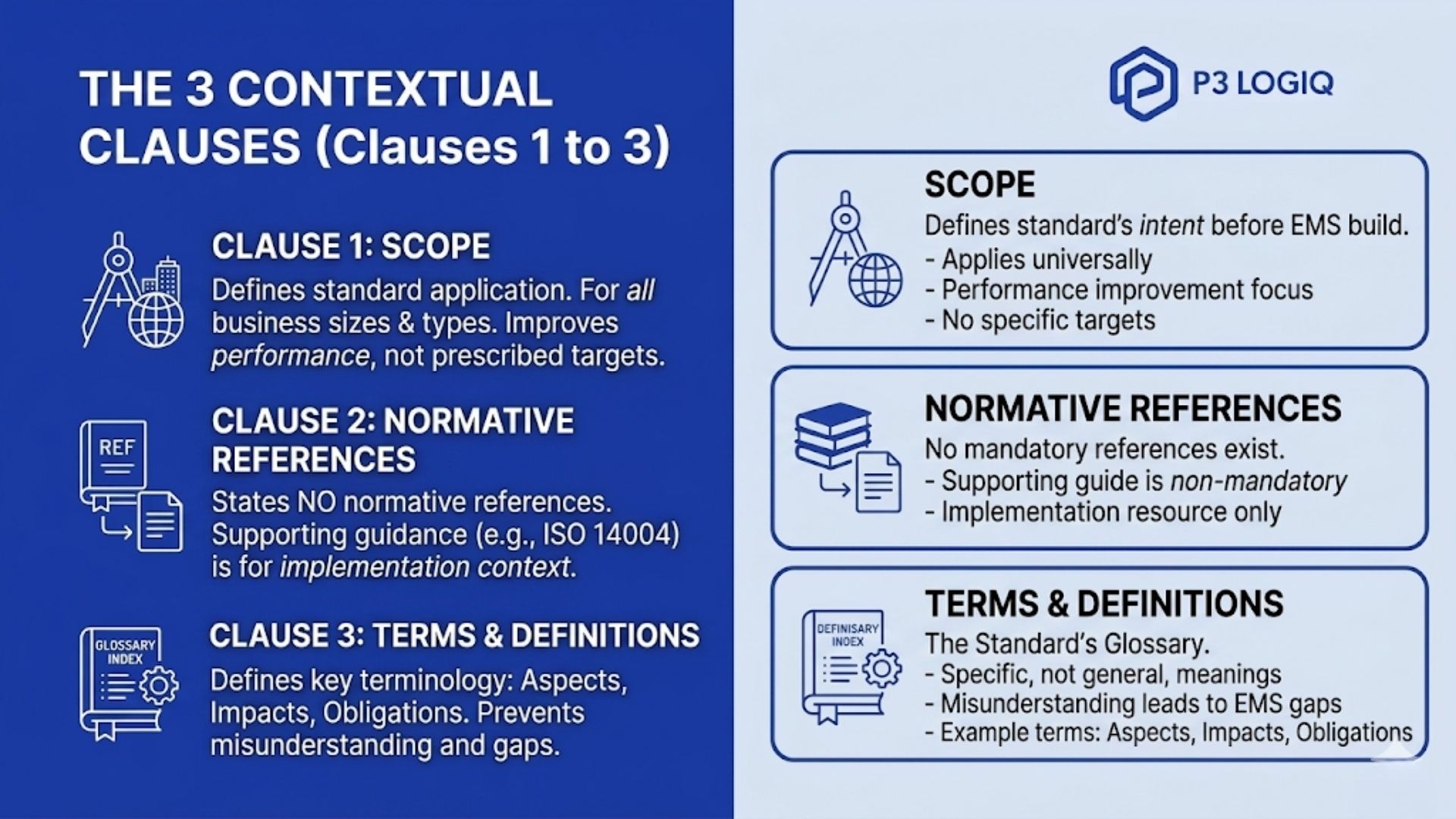
Clause 1 defines what ISO 14001 applies to. The standard is designed for any type of business, regardless of size, type, or industry. The scope confirms that ISO 14001 is about improving environmental performance, not prescribing specific environmental targets.
No requirements here. But reading it tells you the intent of the standard before you start building your EMS.
Clause 2 states that ISO 14001:2015 has no normative references. The only supporting guidance document is ISO 14004, which provides general guidelines on EMS principles and techniques.
Again, no requirements. But ISO 14004 is worth having on hand as an implementation context.
Clause 3 is more towards the terminology that is used throughout the standard. Words like "environmental aspect," "environmental impact," "interested party," and "compliance obligation" all carry specific meanings here.
Before you work through clauses 4 to 10, read clause 3. Misunderstanding a term early leads to gaps in your EMS that auditors will find later.


This is where your EMS begins. Clause 4 has four subclauses:
In 4.1, you identify internal and external factors that affect your environmental performance. Internal factors include things like your operational processes, equipment, and resources. External factors include environmental regulations, community expectations, and supply chain pressures.
In 4.2, you map out your interested parties. These include your regulators, customers, employees, local communities, and investors. You document what each group expects from your EMS.
In 4.3, you define the boundaries of your EMS.
What operations, sites, and activities does it cover? This scope gets documented and maintained.
In 4.4, you establish, implement, maintain, and continually improve your EMS based on everything identified above.
Getting clauses 4.1 and 4.2 wrong means everything downstream is built on shaky ground. Start here and get it right.
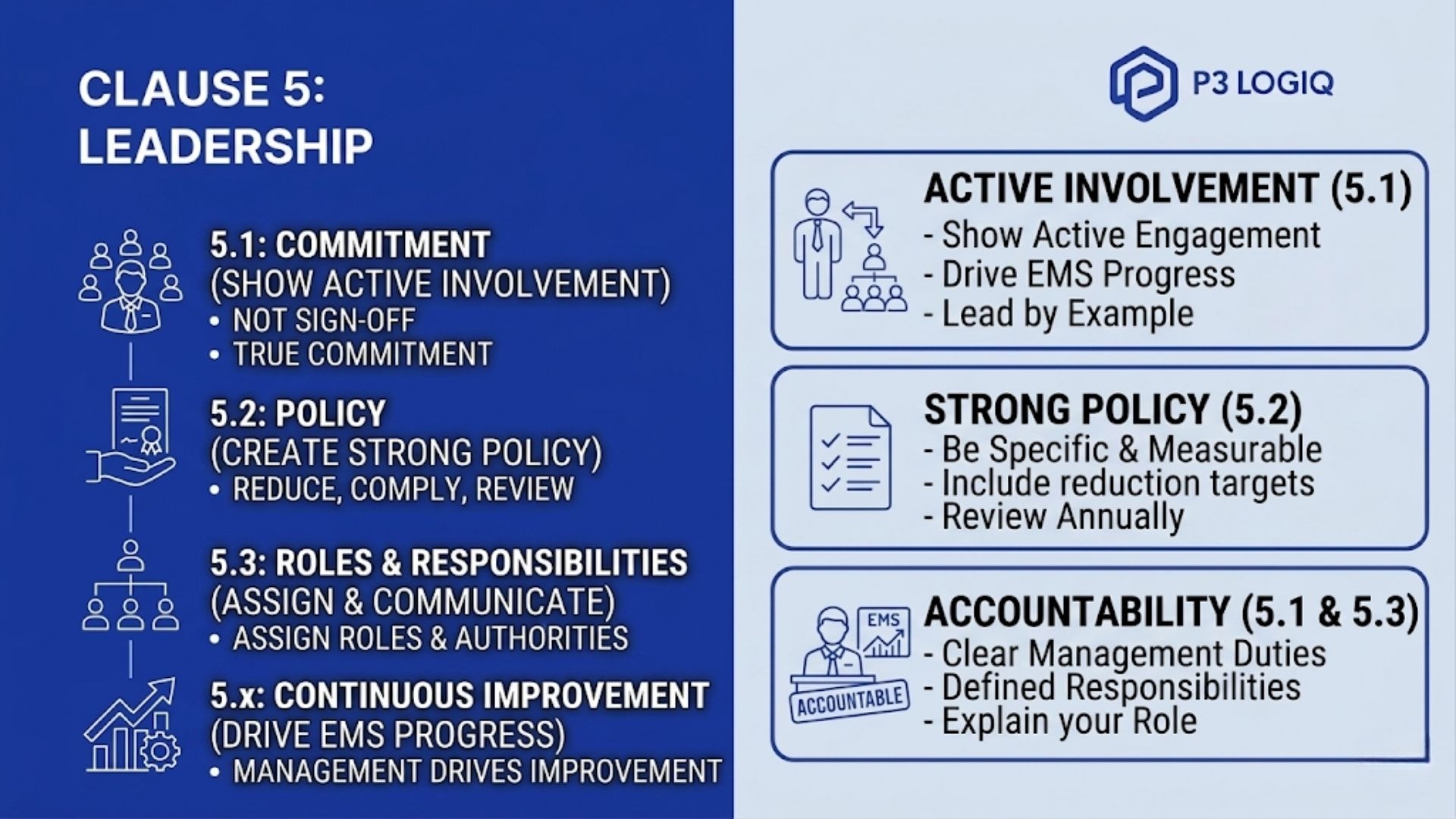
Clause 5 puts accountability on top management. Not your compliance team. Not the EHS officer. Your top management!
The clause requires your management to:
What does a real environmental policy look like versus a vague one?
A vague policy says: "We are committed to protecting the environment."
A strong ISO 14001 environmental policy says, "We commit to reducing water discharge from our production lines by 20% before Q3 2026, complying with all applicable environmental legislation, and reviewing this commitment annually at management review."
The real difference is in the specificity and accountability.
The auditor will ask, "How does your top management demonstrate active involvement?”, not just sign documents. If your CEO or plant manager cannot explain their role in the EMS, that is a finding. And a bad one.

Clause 6 basically gives you the choice where your business can either build a strong EMS or create problems you will deal with for years.
It covers:
In 6.1, you conduct an environmental aspects and impacts assessment. You identify every activity, product, or service that interacts with the environment. For each one, you assess whether the impact is significant.
A logistics company, for example, would list fuel combustion from its fleet as an environmental aspect. The associated impact is air emissions. If the impact is significant, it drives planning in clause 6.2.
In 6.1 you also document your compliance obligations, which are the legal and other requirements that apply to your environmental aspects.
In 6.2, you set environmental objectives. These must be measurable, monitored, communicated, and updated. A manufacturer is targeting a 15% reduction in packaging waste by the end of the fiscal year, and with monthly tracking, it meets this requirement.
A vague goal like "reduce waste" does not.
Basically, this clause is like a habit builder in the sense that you need to conduct proactive risk management practices.
This is also where the PDCA cycle formally starts. Plan your actions here. Execute them in clause 8, which we will cover soon.
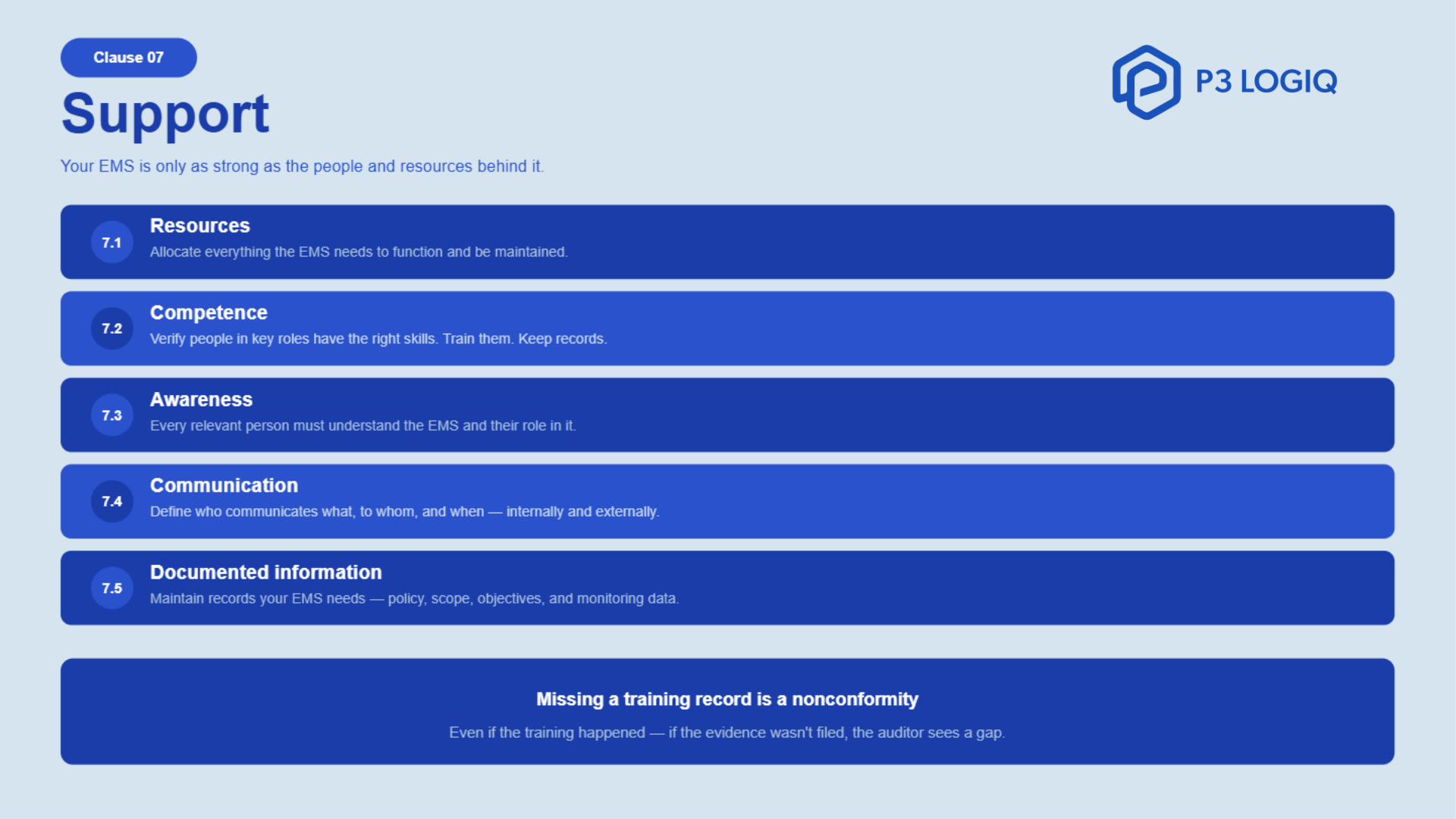
Your EMS is only as strong as the people and resources behind it. Clause 7 addresses exactly that.
It covers:
In 7.2, you identify what competencies are required for roles that affect environmental performance. Then you verify whether people in those roles actually have those competencies. If not, you train them and keep records of it.
Imagine if your business has completed all its environmental awareness training.
Records exist. Sign-off sheets are filed. But when an auditor asks to verify completion records for a recently onboarded supervisor in a role that affects environmental performance, the record is missing. The training happened. The evidence did not get filed.
Implementing all of this on training management software can ensure that you follow procedures without any loose ends.
In 7.5, documented information is not about creating paperwork for its own sake. It means maintaining the records your EMS needs to function and demonstrate compliance. This includes your environmental policy, scope, objectives, and monitoring data.
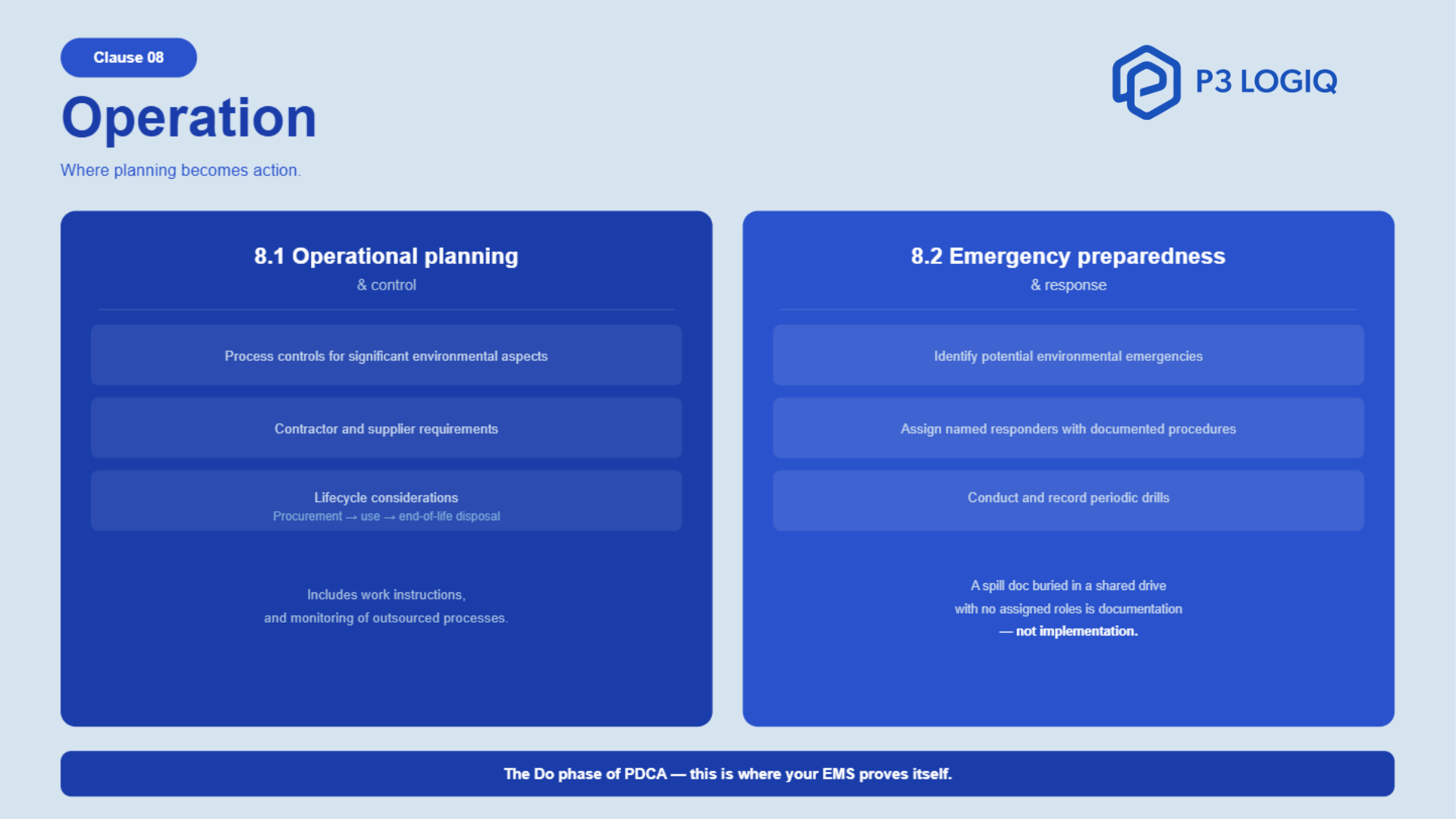
Clause 8 is where planning becomes action. It covers:
In 8.1, you implement the controls needed to manage your significant environmental aspects and meet your compliance obligations. This includes process controls, work instructions, contractor requirements, and lifecycle considerations.
The lifecycle requirement in ISO 14001:2015 is worth noting. You must consider environmental impacts not just within your own operations but also across procurement, use, and end-of-life disposal of your products and services.
In 8.2, you plan for environmental emergencies.
What happens if a chemical spill occurs at your facility?
Who responds?
What steps do they follow?
How do you notify regulators?
For example, a facility that stores industrial chemicals on site. Under clause 8.2, they are required to plan for environmental emergencies, including spill scenarios.
A company that assigns named responders, posts the procedure at the storage area, and runs periodic drills gives auditors something concrete to verify.
A company that has a spill response document buried in a shared drive folder, with no assigned roles and no evidence of drills, has documentation but not implementation.

You cannot improve what you do not measure. Clause 9 makes measurement mandatory.
It covers:
In 9.1, you define what you are measuring, how you are measuring it, and how often. You also evaluate your compliance with legal and other obligations on a defined schedule.
In 9.2, you run internal audits across the full scope of your EMS at planned intervals. Auditors must be objective and impartial. Results feed directly into management review and corrective actions.
The most common failure at surveillance audits is internal audits that check documents but do not verify implementation.
Consider a facility where the waste segregation procedure is fully documented. Every employee has signed off on training. The records look complete. But when an auditor walks the floor, bins are consistently mislabeled, and the procedure is not being followed.
The document passed. The practice did not.
In 9.3, top management reviews the EMS at defined intervals. The review must assess whether the EMS is achieving its objectives and performing as intended.
Many companies today are replacing yearly reviews with continuous performance tracking through dashboards and real-time metrics, powered by the best ISO 14001 software for environmental management.

Clause 10 closes the PDCA loop. It covers:
In 10.2, when something goes wrong, whether it is a regulatory breach, an audit finding, or an operational failure, you document the nonconformity, investigate the root cause, take corrective action, and verify the action worked.
A corrective action management system helps you with this process.
This is not about blame. It is about building a system that learns from its own failures.
In 10.3, you look for ways to improve environmental performance beyond corrective action. This includes improvements to your EMS processes, your environmental objectives, and your operational controls.
Clause 10 connects directly back to clause 4. The context you defined at the start of your EMS should evolve as your organization changes and as your EMS matures. A strong clause 10 process keeps that loop alive.

Start with clause 4 and clause 6. These two are the foundation. Get your context right in clause 4, and your aspects and impacts register properly in clause 6, before moving to anything else.
From there, work outward in this order:
Clause 5 to establish leadership accountability and your environmental policy Clause 7 to put resources, training, and documented information in place Clause 8 to execute your operational controls and emergency procedures Clause 9 to monitor performance and run your first internal audit Clause 10 to close gaps and build your improvement process
A phased approach works better than trying to implement all seven clauses at once. Give each clause a defined owner, a documented output, and a target date.
Compliance software makes this significantly more manageable. P3 LogiQ maps each ISO 14001 clause to specific workflows, tracks your compliance obligations in real time, and gives your team a single place to manage documentation, corrective actions, and audit readiness. You are not chasing spreadsheets across three departments the week before an audit.
ISO 14001 certification cost can give you clarity before you start your implementation; it helps to know what budget to set aside.
You should also work through an ISO 14001 checklist before your first audit to confirm every clause requirement is covered.
ISO 14001 is not a filing exercise. It is a live system. The organizations that maintain strong certifications year after year are the ones that treat each clause as a working part of their operations, not a box to check before an audit.
Clauses 1 through 3 give you the foundation. Clauses 4 through 10 give you the requirements. The PDCA cycle ties them together into a system that keeps improving.

P3 LogiQ is built specifically for organizations working through ISO 14001, ISO 9001, ISO 45001, and R2 compliance. It automates the tracking, documentation, and audit preparation that takes compliance teams weeks to manage manually. Your team gets real-time visibility into where every clause stands, what is overdue, and what needs attention before your next audit.
Book a free demo call with us and see how your team takes the manual work out of staying audit-ready.



Businesses need document management systems (DMS) to ensure ISO and R2 compliance, improve efficiency, and stay audit-ready. The article highlights key features like version control, security, and automation while reviewing the top 5 DMS solutions. P3 LogiQ stands out for its compliance-focused automation and secure document tracking
Read More
Recycling businesses gain efficiency, compliance, and sustainability with RIOS certification. It streamlines quality management, environmental responsibility, and worker safety, helping companies avoid legal risks and boost credibility. P3 LogiQ simplifies the certification process with automation, document control, and compliance tracking, making operations smarter and safer.
Read More
Audit Management Software (AMS) automates compliance tracking, streamlines workflows, and reduces audit risks. Key features include automated scheduling, compliance checklists, CAPA tracking, vendor risk management, and integrations.
Read More
Learn how audit management systems simplify ISO and R2 compliance by automating audits, managing documentation, and minimizing compliance risks efficiently.
Read More
In 2025, many businesses still face challenges in compliance management due to outdated methods like spreadsheets and fragmented software. This inefficiency leads to missed deadlines, increased risk, and regulatory penalties. The blog emphasizes the importance of modern compliance tools that automate workflows, enhance risk management, and streamline regulatory processes to meet ISO and R2 standards.
Read More
The rise in e-waste and environmental concerns makes responsible electronics recycling essential. The R2 Certification sets a global standard for safe, sustainable, and data-secure recycling practices. Developed by Sustainable Electronics Recycling International (SERI), R2 helps businesses manage environmental risks, data security, worker safety, and legal compliance.
Read More
Businesses face increasing challenges in managing complex regulatory compliance. Manual methods such as spreadsheets and paperwork can lead to missed deadlines, inefficiencies, and costly penalties. Compliance management software offers a streamlined solution to reduce risks, automate processes, and improve operational efficiency.
Read More
Maintaining R2 Certification is crucial for businesses in the e-waste recycling industry, ensuring regulatory compliance, sustainability, and strong stakeholder trust. This guide outlines 10 best practices to help businesses simplify operations, reduce risks, and stay compliant.
Read More
Unlock the value of ISO risk management certification. Explore its impact on compliance, risk mitigation, and business expansion.
Read More
Explore the top 5 ISO risk management software tools for 2025, including document management solutions for streamlined compliance and increased efficiency.
Read More
Find the ideal document management software (DMS) for your business. Learn how to choose with expert tips, key features, and insightful guidance
Read More
Unlock the power of a Document Management System (DMS). Learn how it can revolutionize your business operations.
Read More










.png)


.png)





.jpg)




.jpg)
.jpg)












.jpg)



.png)

.png)
.png)





.png)

