

You know what’s interesting? Most workplace accidents don’t happen because something massive breaks.
It’s usually the small stuff.
A wet floor that stayed there a little too long.
A machine that “works fine most of the time” skipping a check.
Someone pushing through a long, stressful day because the deadline can’t move.
None of it feels serious at the moment. That’s the tricky part.
Until one day… it is.
This is where ISO 45001 starts to make practical sense.
It’s not really about paperwork, at least not in the way people assume.
ISO 45001 certification process, when supported by the right ISO 45001 software, becomes much easier to manage in real time, as it helps organizations identify risks early and put the right controls in place.
And it helps you keep improving those controls over time (ISO, ISO 45001:2018 standard overview).
So instead of reacting after something goes wrong, you’re catching those small issues early. Fixing them while they still look “minor.”
Over time, that changes how safety works inside a company.
It stops being random or reactive, and starts becoming something that’s actually built into daily operations.

According to the case study by NCA Rouiba, survey of 100 employees across managerial, supervisory, and operational roles, the study looks at how safety performance changes after certification. The results show that implementing ISO 45001 leads to clear improvements in occupational health and safety, including fewer accidents and better preventive practices.
ISO 45001 certification for your business in 2026 isn’t optional anymore. Whether it’s clients, partners, or your own team, everyone expects businesses to have their safety game sorted.
And honestly, it’s way simpler than it looks from the outside.
Once you break it into steps, ISO 45001 starts to feel less like a big certification process and more like a system you can actually follow. Nothing fancy, nothing confusing.
In this blog, I’ll walk you through exactly how to get there, step by step, in a way that actually makes sense.
If you’re trying to get ISO 45001 certified, the biggest challenge is not the standard itself, it’s knowing what to do first, what to do next, and what actually matters.
Here’s a clear, practical breakdown of the entire step-by-step process of ISO 45001 certification.
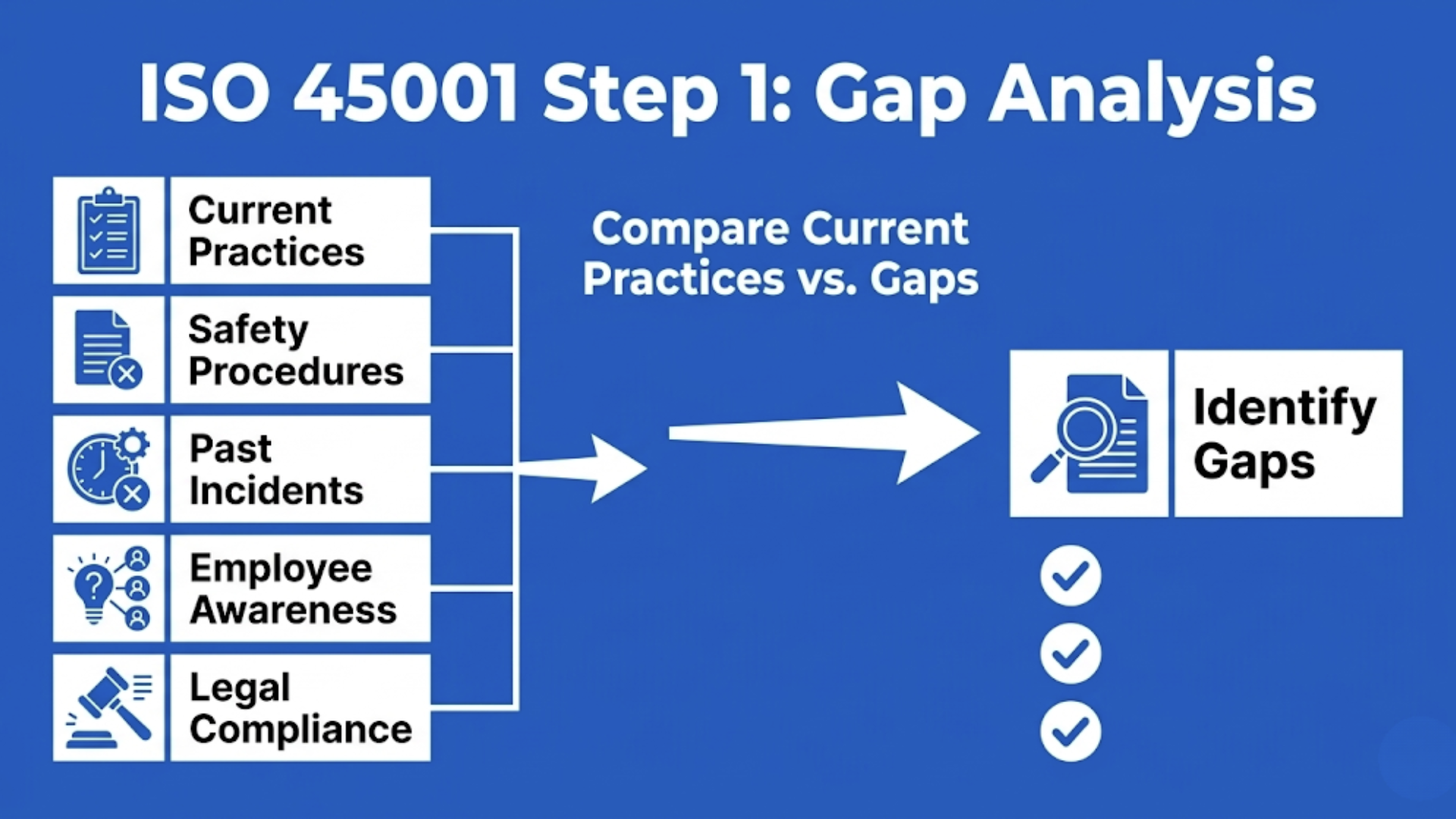
Before starting the ISO 45001 certification process, you need a clear understanding of where your organization currently stands.
Most businesses already follow some level of safety practices, even if they are not formally documented, which is why referring to an ISO 45001 certification guide at this stage can help you map your existing practices against the standard more clearly. A gap analysis helps you identify what exists and what is missing compared to ISO 45001 requirements.
Begin by reviewing your current operations, safety measures, and any past incident records. Look at how risks are handled on the ground and whether employees follow any consistent safety practices.
This step is not about perfection, it’s about clarity. So you need to focus on:
Once you map this, compare it with ISO 45001 requirements to identify gaps. This gives you a clear roadmap for implementation and prevents unnecessary work later.
Example:
A small manufacturing unit realized during gap analysis that workers were already using gloves and helmets, but there was no formal policy or tracking. Instead of starting from scratch, they documented and improved what already existed, saving both time and effort.
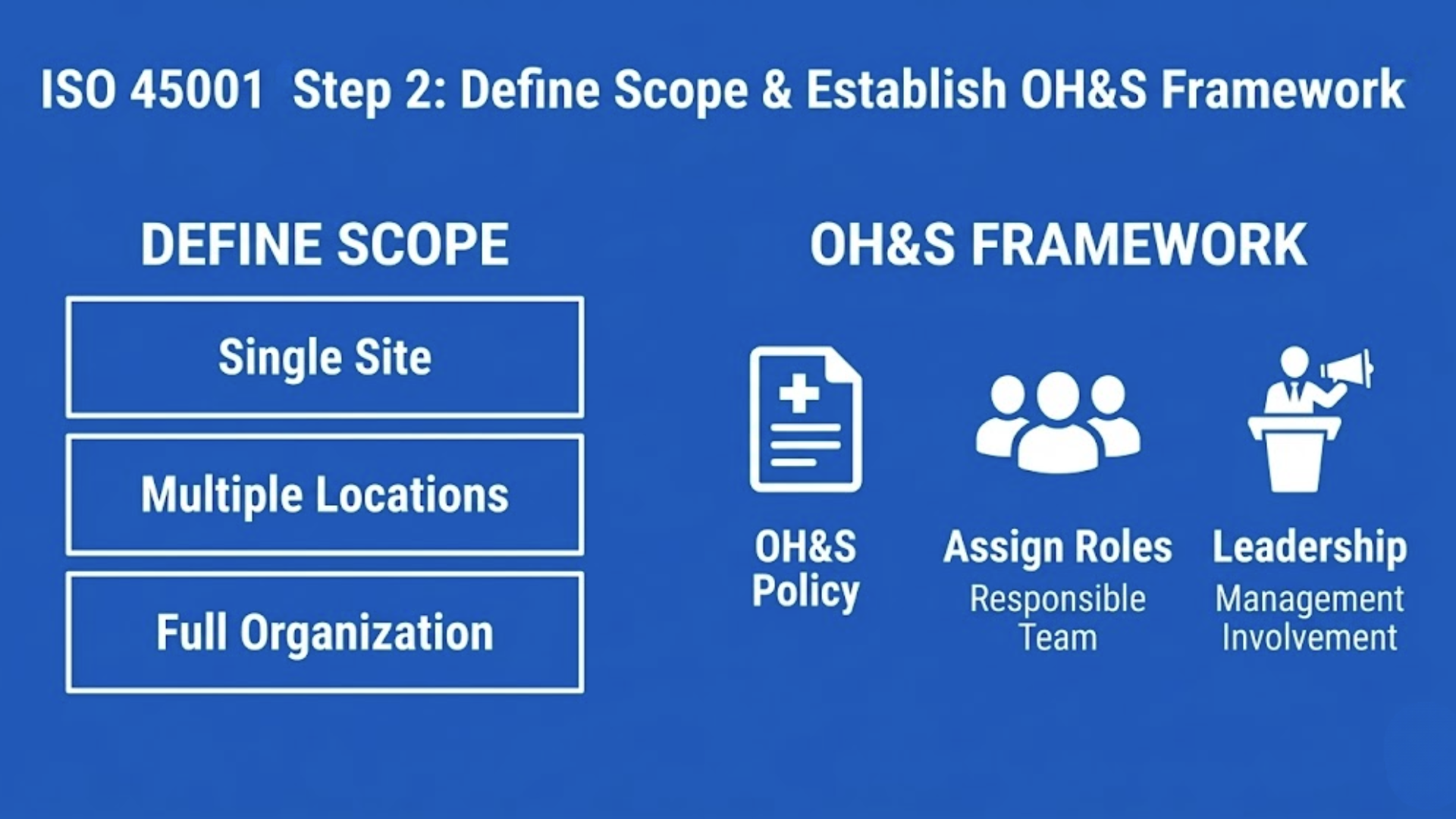
The next step is to define the scope of your ISO 45001 system. This means deciding which parts of your business will be included in the certification, whether it's a single site, multiple locations, or the entire organization.
A clearly defined scope sets expectations for both your team and the auditor. It should be realistic and aligned with your operational control. Defining the scope early also helps estimate the overall ISO 45001 certification cost, as certification bodies typically consider factors such as the number of sites, employee count, and the complexity of operations when determining audit requirements.
After this, establish your Occupational Health & Safety (OH&S) framework. Start by creating a policy that reflects your commitment to workplace safety. This should not be generic; it must connect with your actual business activities, workplace hazards, and operational risks.
A well-defined OH&S policy provides direction for your safety objectives and compliance efforts while helping ensure that the resources allocated toward implementation and certification deliver meaningful value to the organization.
Example:
A logistics company initially included all its warehouses in the scope but later reduced it to one main facility to manage implementation better. This focused approach helped them achieve certification faster and expand later.
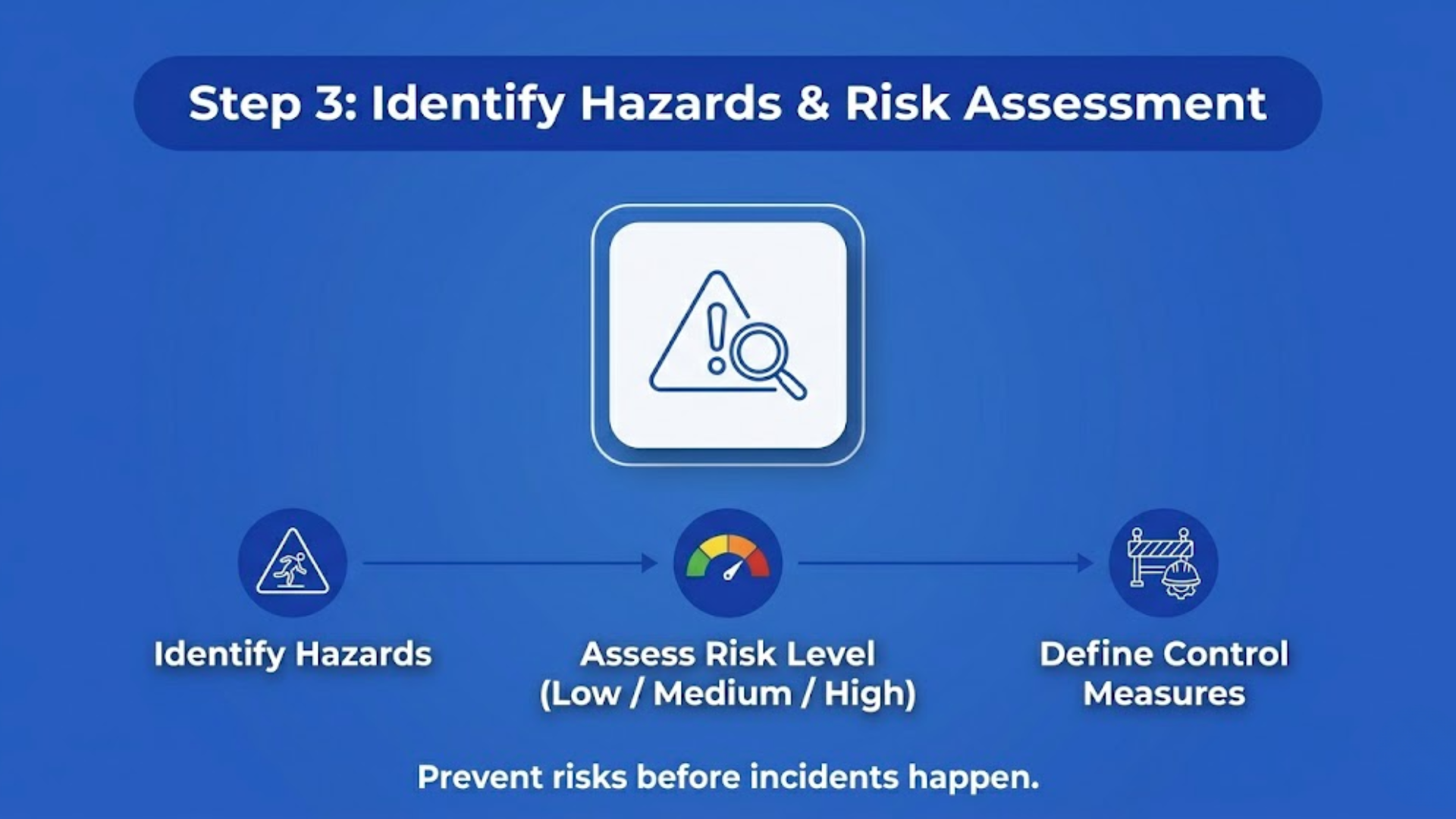
This is the core of ISO 45001. The goal is to proactively identify workplace hazards and minimize risks before incidents occur.
Start by dividing your workplace into different areas such as operations, equipment, manual tasks, and the work environment. For each area, identify potential hazards and evaluate their impact, and this is where risk management software can help you keep everything clearly documented and easy to track as your operations evolve.
Before beginning the assessment, it can be helpful to prepare an ISO 45001 checklist that covers the activities, work areas, equipment, contractors, and legal requirements relevant to your organization. Having a structured checklist ensures that important hazards are not overlooked and gives your team a consistent framework for evaluating risks across different departments.
A simple approach works best:
For example, in a manufacturing unit, machinery-related risks can be reduced through proper guarding, training, and maintenance.
Make sure your risk assessment reflects real conditions, not assumptions. Avoid copying templates, as they often miss critical, site-specific risks. Instead, use your checklist as a starting point and update it based on actual workplace observations, employee feedback, and operational changes.
A well-done risk assessment becomes the foundation for your entire ISO system and makes implementation much more practical.
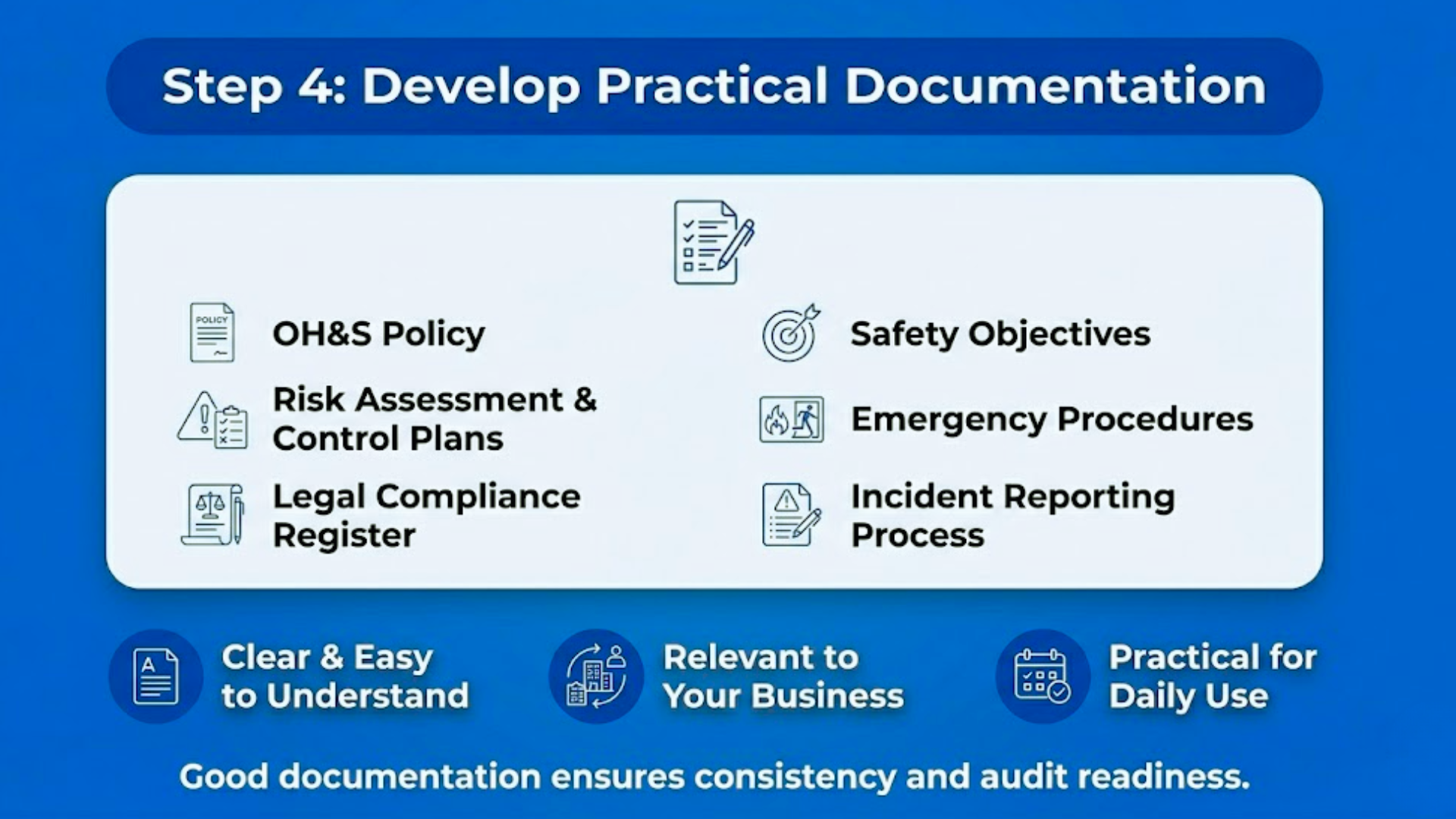
Documentation in ISO 45001 should support your processes, not complicate them. The aim is to create clear, simple documents that your team can actually follow in daily work, and using the right document management software can make it much easier to keep everything organized, updated, and accessible.
Key documents typically include:
Instead of using generic templates, focus on creating content that reflects your actual operations. If a document does not match what happens on-site, it will fail during audits.
Keep everything:
Good documentation acts as a guide for your employees and ensures consistency across processes.
Example:
A construction company initially used a generic emergency plan downloaded online. During review, they realized it didn’t include site-specific risks like scaffolding accidents. After customizing it, their team could respond more effectively during drills.
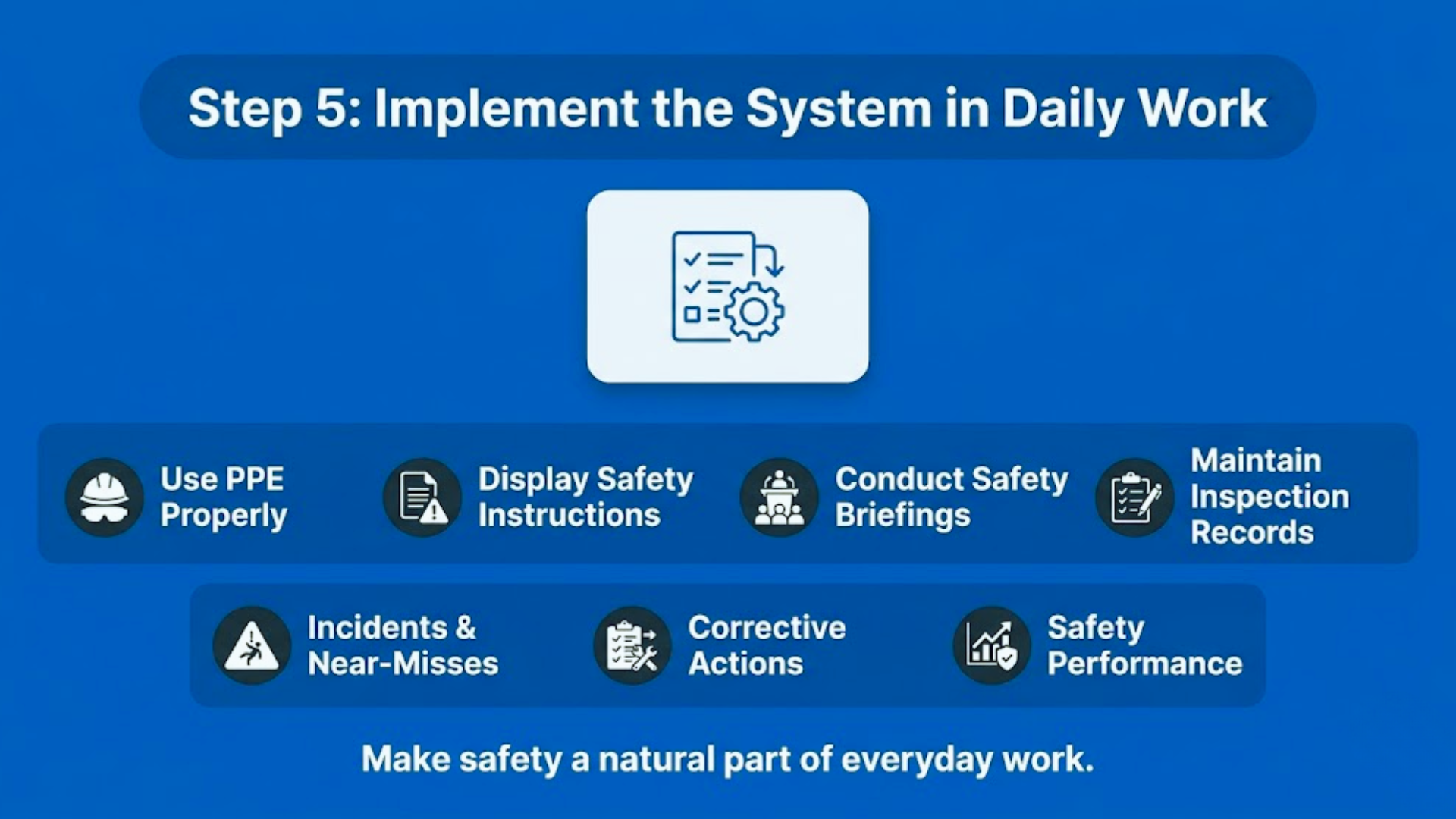
Once your system is documented, the next step is implementation. This is where many organizations struggle because they treat ISO as a paperwork exercise instead of a practical system.
Start by training employees on safety procedures and explaining their roles. Awareness is critical, employees should understand both the process and its importance.
Then integrate safety into daily operations:
You should also track:
The goal is to make safety part of routine work. If the system feels natural, it will be easier to maintain and audit.
Example:
A factory provided safety helmets to all workers, but usage was inconsistent. After introducing daily 5-minute safety briefings and supervisor checks, compliance improved significantly within weeks.
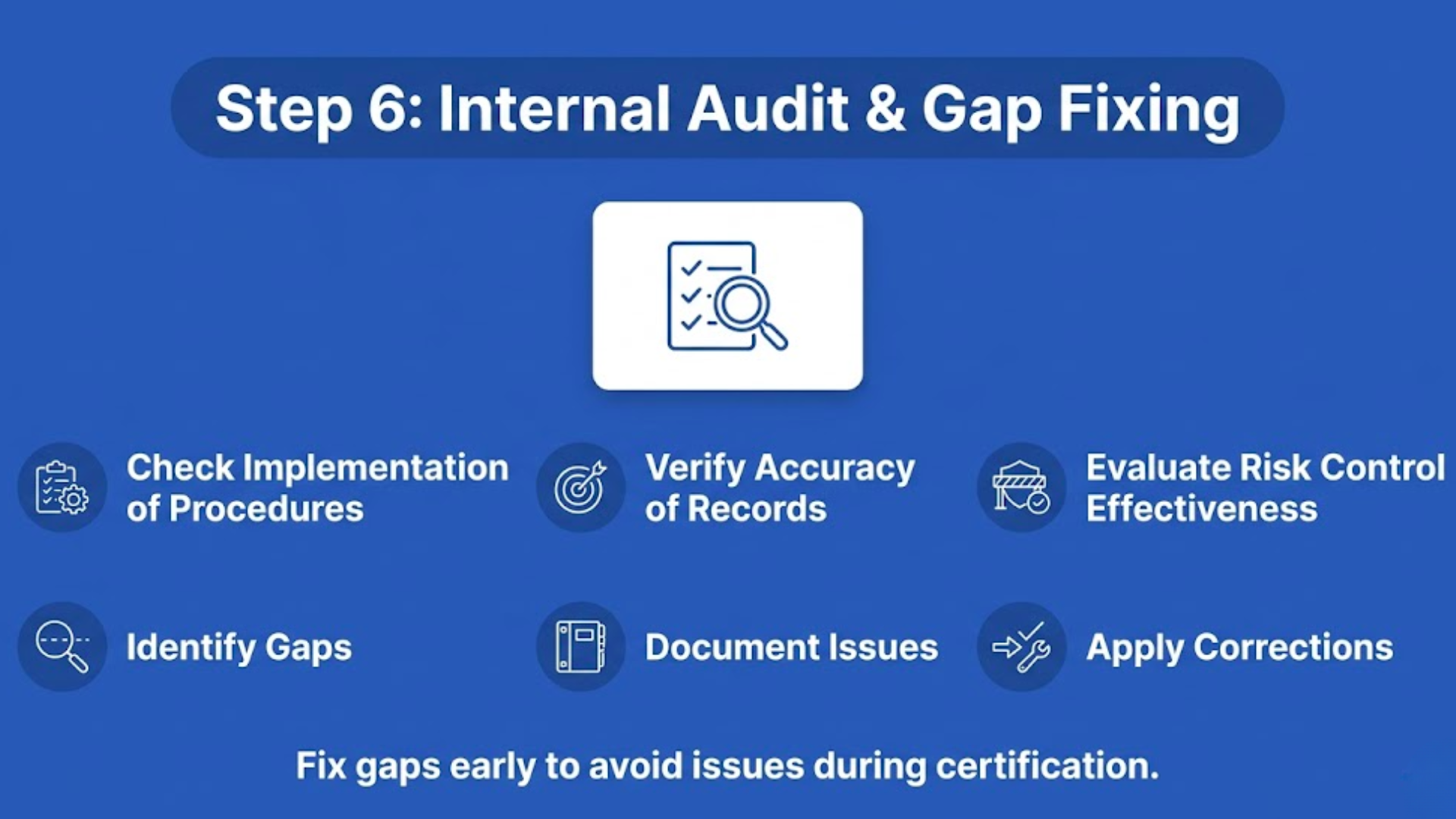
Before moving to certification, you need to test your system internally. An internal audit helps you evaluate whether your processes are actually working as planned, not just on paper but in real conditions.
At this stage, having the right audit management system will help you organize findings, track corrective actions, and keep everything properly documented without missing details. It also gives you a chance to catch small gaps early, before they turn into bigger issues during the final audit.
This step involves reviewing:
The purpose is to identify gaps, not to prove that everything is perfect. Any issues found should be documented and corrected.
Be honest during this process. A strong internal audit can prevent major problems during the certification audit.
Think of it as a final check that ensures your system is ready and aligned with ISO 45001 requirements.
Example:
During an internal audit, a company found that fire extinguishers were installed but not regularly inspected. They immediately introduced a monthly inspection checklist, which prevented a major non-conformity during the final audit.
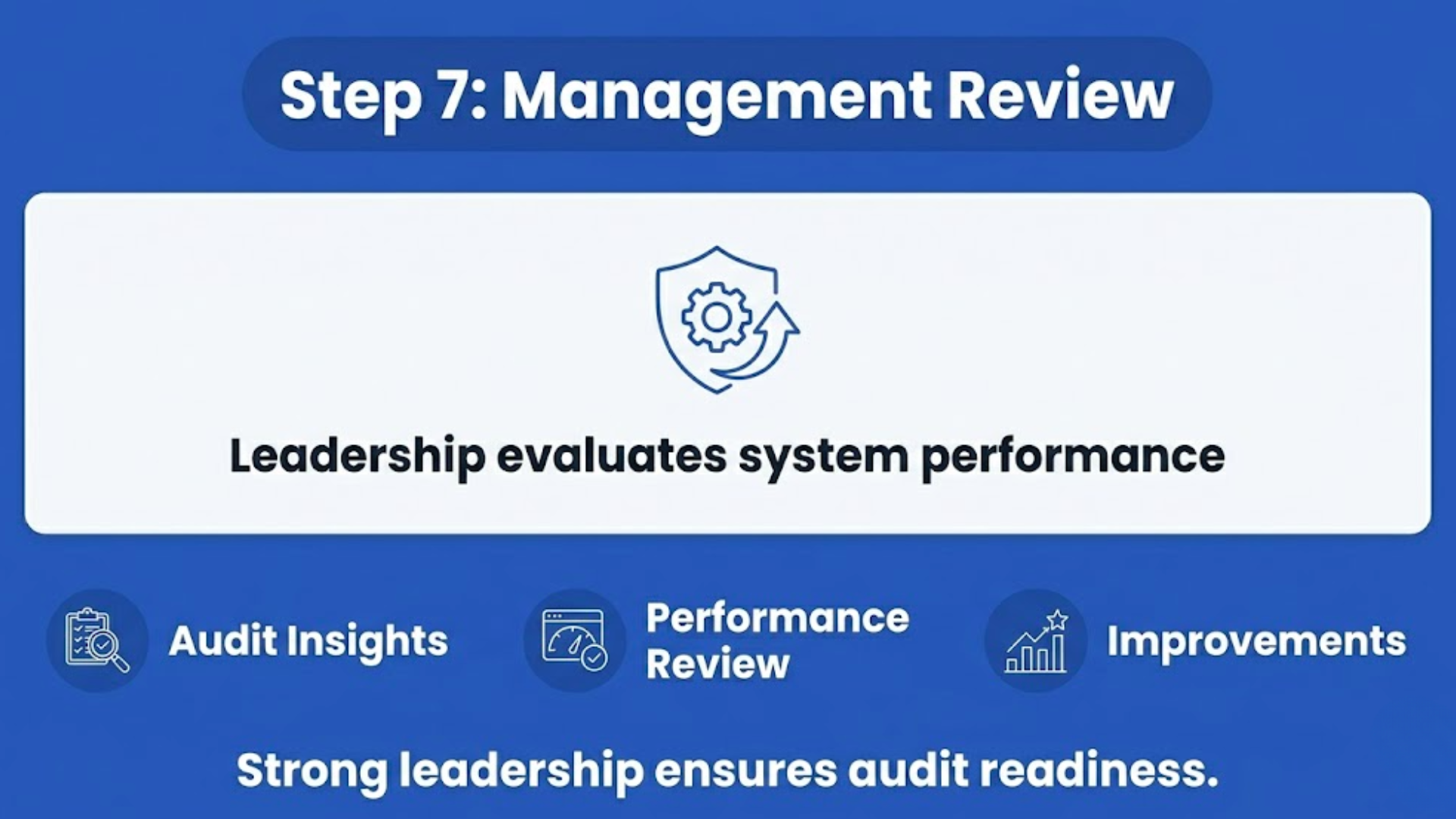
ISO 45001 requires top management to review the system before certification. This step ensures that leadership is aware of performance and actively involved in decision-making.
During the management review, key aspects are evaluated:
If any gaps are identified, management should take action by allocating resources or making improvements.
This step shows that safety is not just operational but also strategic. Auditors look for this involvement as proof of commitment.
A proper management review strengthens your system and prepares you for the final audit.
Example:
In one organization, management noticed repeated minor injuries during review meetings. They approved additional safety training and upgraded equipment, which reduced incidents over the next few months.
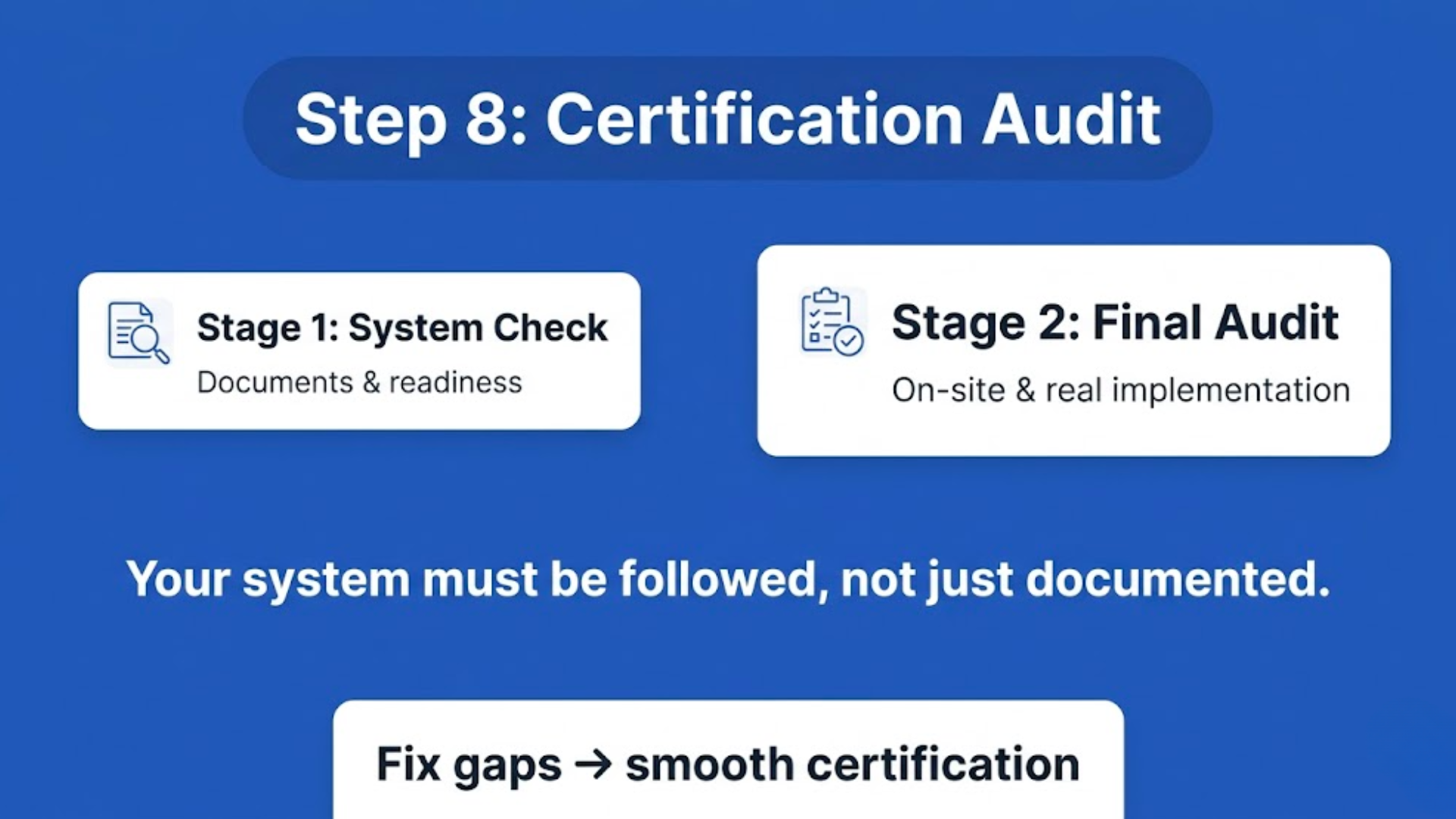
The certification process usually happens in two stages.
Stage 1 Audit focuses on:
Stage 2 Audit is the final evaluation:
The auditor’s goal is to confirm that your system is not just documented but actively followed.
If non-conformities are found, you will need to address them within a given timeframe.
Preparation and consistency are key here. If your system is genuinely implemented, the audit becomes a smooth process rather than a stressful one.
Example:
During a Stage 2 audit, an auditor asked a worker about emergency procedures. The worker confidently explained the steps and showed the nearest exit. This demonstrated proper implementation and created a positive impression.
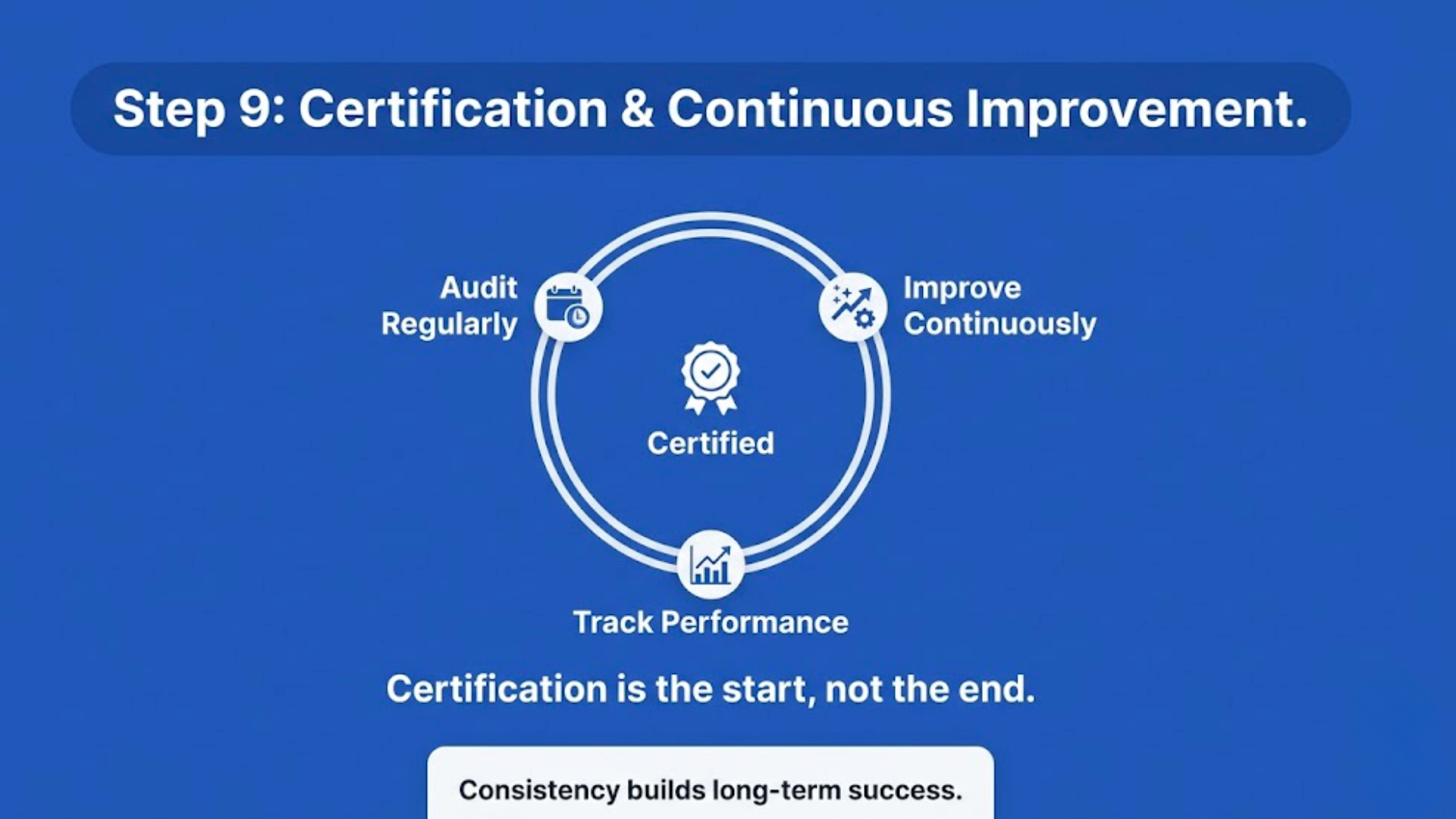
Once you successfully pass the audit, you will receive your ISO 45001 certification. However, this is not the end of the journey.
You are expected to maintain and continuously improve your system. This includes:
There will also be periodic surveillance audits to ensure ongoing compliance.
Businesses that treat ISO 45001 as a continuous system, not a one-time project, see the most value. It improves safety, builds trust, and strengthens overall operations.
In the long run, consistency matters more than speed. A well-maintained system will always deliver better results than a rushed certification.
Example:
A company that maintained regular safety reviews saw a steady decline in workplace incidents over a year. Their ISO system became a tool for improvement, not just certification.
Following every step in the certification process can start to feel overwhelming, especially when you’re trying to manage day-to-day operations at the same time.
There are multiple requirements to track, documents to maintain, and audits to prepare for, it can quickly become a lot to handle on your own.
That’s where ISO certification platforms like P3 LogiQ can really help. Instead of figuring everything out from scratch, you get a more structured and guided approach.

The platform simplifies each stage of the process, all you need to do is book a free demo call or sign up. And it will help you with the whole certification process and to stay on top of requirements, and reduces the chances of missing important steps.
In a way, it takes a lot of the pressure off your team. Rather than getting caught up in the complexities of certification, you can keep your focus where it matters most, running and growing your business. While the process becomes much more smooth, organized, and manageable.
If you’ve ever opened the ISO 45001 standard, it probably felt a bit… heavy. Clauses, sub-clauses, technical language, it’s easy to get lost.
So here’s a clear, no-fluff breakdown of each key clause, explained in a way that actually makes sense for your business.
Think of this as translating ISO language into real-world actions.

This clause focuses on understanding your environment before you build anything.
The ISO standard requires you to step back and look at:
Basically, what affects your workplace safety?
You also need to define your scope, what part of your business the ISO system will cover. This is where compliance management software can help you clearly map your processes, requirements, and boundaries in a way that reflects how your business actually operates.
At first, this exercise may feel like paperwork, but it plays a much bigger role in the success of your system. By understanding your risks, obligations, and stakeholders from the beginning, you create a stronger foundation for workplace safety and long-term compliance.
This is where the real benefits of ISO 45001 for your business start to become visible, because you're no longer reacting to problems after they occur. Instead, you're building a structured approach to identifying risks, protecting employees, and improving operational consistency.
If you run a construction company, your risks, stakeholders, and compliance needs are completely different from a digital agency. ISO expects your system to reflect your reality, not a generic template. The more accurately you understand your business context, the more relevant and effective your health and safety management system will be.
Example:
A logistics company identified delivery drivers as a key “interested party.” That changed their safety system to include driver fatigue management, something they hadn’t considered before.

ISO 45001 is very clear: safety starts at the top.
This clause requires top management to:
This is where many businesses struggle. They delegate everything to one ISO person and step away.
That doesn’t work here.
Example:
In one manufacturing unit, safety rules existed on paper, but workers ignored them. Once the plant head started attending safety meetings and enforcing rules, compliance improved almost instantly.
What ISO is really checking:
Do your leaders actively care about safety, or is this just for certification?

This is the risk-thinking engine of ISO 45001.
You need to:
It’s not just about problems, it’s also about improving conditions.
Keep it practical:
Don’t overcomplicate risk assessments. Focus on real scenarios your team faces daily.
Example:
A warehouse identified frequent slips during monsoon season. Instead of just noting the risk, they added anti-slip mats and revised cleaning schedules. That’s exactly what ISO expects, actionable planning.
Also, your safety goals should be measurable.
Not “improve safety” but something like:
“Reduce workplace incidents by 20% in 6 months.”

You can’t build a safety system without proper support.
This clause focuses on:
While planning these elements, organizations also need to evaluate the ISO 45001 certification cost in a practical way rather than viewing it as just an audit expense. The total cost is often influenced by decisions made early in the implementation process, including employee training, workplace risk assessments, documentation systems, internal audits, and the tools used to manage health and safety operations.
It simply means:
Do your people know what to do, and do they have what they need to do in order to get ISO 45001 certified?
Example:
A company had safety procedures documented but never trained workers. During an audit, employees had no idea what to do in emergencies. That’s a clear failure under this clause.
Training doesn’t have to be complex:
If your team understands the system, you’re already ahead.

This is where everything becomes real.
Clause 8 is about:
This is the execution layer.
This clause focuses on:
Are your safety plans actually being followed during day-to-day work?
Example:
A factory had machine safety guidelines documented, but guards were removed to speed up work. During the audit, this became a major non-conformity. Why? Because the implementation didn’t match the documentation.
You also need emergency preparedness:
If something goes wrong, your team should know exactly what to do, without confusion.

You can’t improve what you don’t measure.
This clause focuses on:
You need to track:
Example:
A company noticed through monthly tracking that most incidents happened during night shifts. This insight helped them improve supervision and reduce risks.
Internal audits are your checkpoint.
Management reviews are your strategy reset.
Don’t collect data just for records. Use it to make decisions.

This is where ISO 45001 becomes a long-term system, not a one-time project.
You are expected to:
Example:
If a worker gets injured due to improper lifting, fixing it is not enough. You need to ask:
Then fix the root cause, not just the symptom.
This clause ensures that your system evolves.
If you simplify everything, ISO 45001 is asking you to:
The ISO 45001 certification process might seem technical at first, but in reality, it’s about building a safer, more organized, and smarter way of running your business.
It helps you identify risks early, put the right processes in place, and create a work environment where safety becomes part of everyday operations, not just a checklist.
And when you have the right support, the process becomes much easier to manage. Cloud-based ISO certification platforms like P3 LogiQ bring structure to what can otherwise feel chaotic.

P3 LogiQ guides you through each step, keeps your documentation in one place, and helps you stay aligned with requirements without constant confusion.
You can even book a free demo call or sign up with P3 LogiQ to see how it works in practice. With the right support, your ISO 45001 certification journey becomes far more structured, predictable, and smooth from start to finish.
If your system reflects real operations, not copied templates, you won’t just pass certification.
You’ll build something that actually works.

The time required to get ISO 45001 certification in the USA typically ranges from 8 weeks to 6 months, depending on your company’s size, complexity, and current safety practices.
If you already have some safety systems in place, the process can be much faster. If you’re starting from scratch, it will naturally take longer.
Here’s how the timeline usually looks:
The certification timeline is not fixed, it depends on a few key factors:
Some companies complete certification quickly by:
For most US businesses, a 3-month timeline is a practical benchmark if the process is handled efficiently.
Trying to rush it in a few weeks often leads to weak implementation, which can create problems during audits or later.
When you actually start understanding the benefits of ISO 45001 certification in day-to-day operations, it is not just about speed, it’s about building a system that actually works.A slightly longer timeline with proper implementation is always better than a rushed certification that doesn’t hold up in real operations.

Many USA companies struggle with ISO 45001 not because it’s complex, but because of how it’s approached.
One common issue is treating ISO as just documentation. Companies create policies, but nothing changes in daily operations. The fix is simple: focus on real implementation first, then document it. If you're unsure where to start, following a structured ISO 45001 Compliance Guide can help break the process into manageable steps and keep your efforts focused on practical improvements rather than paperwork alone.
Another challenge is a lack of leadership involvement. When management is not engaged, safety becomes a low priority. Active participation from leadership makes a significant difference.
Poor risk assessment is also common. Many businesses rely on generic templates and miss actual workplace risks. A practical, on-site approach works better because it reflects what employees experience every day.
Employee resistance can slow things down. If teams don’t understand the purpose behind new processes, adoption becomes difficult. Simple training, regular communication, and involving employees in safety discussions can improve engagement considerably.
Overcomplicated documentation is another problem. Long, complex documents often create confusion instead of clarity. In practice, the most effective ISO 45001 systems are usually the ones that employees can easily understand and follow.
Some companies also rush internal audits or skip them altogether. This often leads to surprises during certification audits. A good ISO 45001 Compliance Guide typically treats internal audits as a critical checkpoint, helping organizations identify gaps before an external auditor does.
Finally, many businesses stop improving after certification. ISO 45001 is designed as a continuous improvement framework, not a one-time project that ends once the certificate is issued.
Focus on simplicity, consistency, and real action. When safety practices become part of everyday operations, certification tends to be much smoother and the system delivers far more value over time.
If you’ve made it this far, you already know ISO 45001 isn’t just about certification, it’s about building a workplace where safety actually works in real life.
The only thing left is getting started, and that part doesn’t have to be complicated.With the right support, the whole process becomes a lot more manageable.
P3 Logiq is one of the best platforms you can consider to simplify your ISO 45001 journey from day one. It’s one of the more reliable options you can consider if you want a structured, guided approach without all the confusion.
Instead of figuring everything out on your own, you get a system that keeps things clear, organized, and moving in the right direction.
You can even hop on a free demo call or sign up and see how it all works before making any moves. At the end of the day, it’s about keeping your certification journey smooth, simple, and way less stressful.
ISO 45001 certification is an internationally recognized standard for Occupational Health and Safety Management Systems (OHSMS). It helps organizations create a safer workplace by identifying risks, reducing hazards, and improving overall employee well-being.
In 2026, its importance has grown even more as businesses are under increasing pressure to comply with global safety standards, avoid legal penalties, and build trust with clients and employees.
The ISO 45001 certification process involves several structured steps that ensure your organization meets all safety and compliance requirements. I
It typically starts with a gap analysis to identify areas that need improvement, followed by developing and implementing an Occupational Health and Safety Management System. After that, internal audits and management reviews are conducted to ensure readiness.
The time required to obtain ISO 45001 certification can vary depending on the size, complexity, and current readiness of your organization.
For small businesses with basic safety systems already in place, it may take around 3 to 6 months. However, for larger organizations or those starting from scratch, the process can take 6 to 12 months or longer.
To achieve ISO 45001 certification, organizations must meet several key requirements outlined in the standard. These include establishing a clear health and safety policy, identifying workplace hazards, assessing risks, and implementing control measures.
Organizations must also ensure employee participation, provide proper training, maintain documented information, and continuously monitor and improve their safety performance.
The cost of ISO 45001 certification in 2026 depends on multiple factors, including the size of the organization, number of employees, scope of operations, and the certification body chosen.
Typically, costs include consultancy fees (if you hire experts), training expenses, documentation development, and audit fees. For small businesses, the cost may range from a few thousand dollars, while larger enterprises may spend significantly more.
Yes, ISO 45001 certification is absolutely achievable for small businesses, and in many cases, it can be a game-changer. The standard is flexible and can be adapted to organizations of any size or industry.
Small businesses often benefit the most because implementing structured safety processes can significantly reduce risks and improve efficiency.
Maintaining ISO 45001 certification requires ongoing commitment rather than a one-time effort.
Organizations must continuously monitor their health and safety performance, conduct regular internal audits, and address any non-conformities. Annual surveillance audits by the certification body ensure that the system remains compliant..
During the audit, the certification body reviews documents, workplace processes, employee awareness, risk controls, and compliance records to verify whether the organization meets ISO 45001 requirements.
Auditors may interview employees, inspect work environments, review incident handling procedures, and evaluate how effectively the safety management system is functioning in daily operations. Any nonconformities identified must usually be corrected before certification approval.
Organizations usually need documented policies, risk assessments, hazard identification records, safety objectives, operational procedures, training records, audit reports, incident records, and corrective action documentation.
The exact documentation requirements can vary depending on the organization’s structure and operational risks. However, auditors generally expect evidence that health and safety processes are properly implemented, monitored, and maintained.
ISO 45001 certification is generally voluntary and not legally mandatory in most industries. However, many organizations pursue it because clients, contractors, or industry regulations increasingly expect structured workplace safety systems.
In some sectors such as manufacturing, construction, logistics, and energy, certification may improve eligibility for contracts and strengthen business credibility during vendor evaluations or procurement processes.



Businesses need document management systems (DMS) to ensure ISO and R2 compliance, improve efficiency, and stay audit-ready. The article highlights key features like version control, security, and automation while reviewing the top 5 DMS solutions. P3 LogiQ stands out for its compliance-focused automation and secure document tracking
Read More
Recycling businesses gain efficiency, compliance, and sustainability with RIOS certification. It streamlines quality management, environmental responsibility, and worker safety, helping companies avoid legal risks and boost credibility. P3 LogiQ simplifies the certification process with automation, document control, and compliance tracking, making operations smarter and safer.
Read More
Audit Management Software (AMS) automates compliance tracking, streamlines workflows, and reduces audit risks. Key features include automated scheduling, compliance checklists, CAPA tracking, vendor risk management, and integrations.
Read More
Learn how audit management systems simplify ISO and R2 compliance by automating audits, managing documentation, and minimizing compliance risks efficiently.
Read More
In 2025, many businesses still face challenges in compliance management due to outdated methods like spreadsheets and fragmented software. This inefficiency leads to missed deadlines, increased risk, and regulatory penalties. The blog emphasizes the importance of modern compliance tools that automate workflows, enhance risk management, and streamline regulatory processes to meet ISO and R2 standards.
Read More
The rise in e-waste and environmental concerns makes responsible electronics recycling essential. The R2 Certification sets a global standard for safe, sustainable, and data-secure recycling practices. Developed by Sustainable Electronics Recycling International (SERI), R2 helps businesses manage environmental risks, data security, worker safety, and legal compliance.
Read More
Businesses face increasing challenges in managing complex regulatory compliance. Manual methods such as spreadsheets and paperwork can lead to missed deadlines, inefficiencies, and costly penalties. Compliance management software offers a streamlined solution to reduce risks, automate processes, and improve operational efficiency.
Read More
Maintaining R2 Certification is crucial for businesses in the e-waste recycling industry, ensuring regulatory compliance, sustainability, and strong stakeholder trust. This guide outlines 10 best practices to help businesses simplify operations, reduce risks, and stay compliant.
Read More
Unlock the value of ISO risk management certification. Explore its impact on compliance, risk mitigation, and business expansion.
Read More
Explore the top 5 ISO risk management software tools for 2025, including document management solutions for streamlined compliance and increased efficiency.
Read More
Find the ideal document management software (DMS) for your business. Learn how to choose with expert tips, key features, and insightful guidance
Read More
Unlock the power of a Document Management System (DMS). Learn how it can revolutionize your business operations.
Read More









.png)


.png)





.jpg)



.jpg)
.jpg)










.jpg)



.png)

.png)
.png)




.png)

