

You don’t usually notice workplace safety systems when everything is running smoothly. Your manufacturing unit hits targets, your logistics team moves goods without delays, and your employees go about their work without interruptions.
But the moment something breaks, whether it’s a safety incident, a missed protocol, or a process failure, it quickly becomes clear how much depends on structured systems working quietly in the background.
That’s often when you realize manual tracking, scattered spreadsheets, and disconnected workflows can only take you so far. As your operations grow, managing workplace safety becomes more complex, and staying on top of risks, incidents, audits, and corrective actions can start feeling overwhelming.This is where ISO 45001 software can make a real difference. It helps you bring your workplace health and safety processes into one centralized system, so you can manage policies, track risks, report incidents, and monitor corrective actions more efficiently.
When everything is organized and easy to access, you can identify issues earlier, respond faster, and build a safer workplace without adding unnecessary complexity to your day-to-day operations.
That’s exactly where standards like ISO 45001:2027 start becoming relevant. They are not just about compliance on paper, but about building systems that can handle real-world risks consistently.
The current latest version of ISO 45001 was published in 2018, and according to ISO’s official framework for occupational health and safety management systems, the standard is designed to help organizations reduce workplace risks and create safer working conditions. But like most ISO standards, it doesn’t stay static.
Over time, changes in how businesses operate, including remote work, evolving safety expectations, and tighter regulatory alignment, push these frameworks to evolve. This shift is not limited to safety alone. Standards like ISO 9001 and ISO 14001 are also evolving in parallel, reflecting how quality, environmental responsibility, and workplace safety are becoming more interconnected in real business environments.
That’s where discussions around the ISO 45001:2027 revision timeline and the ISO 45001:2027 expected publication date start gaining attention. While the final version is not published yet, businesses are already trying to understand what the next update could mean and how early they should start preparing.
For organizations already working with ISO 9001 and ISO 14001, this becomes even more relevant, as updates across standards often follow a similar high-level structure, making integration an important consideration.
If you’re running operations where safety, compliance, and consistency matter, this isn’t something to look at later. Understanding where ISO 45001:2027 is headed, alongside how ISO 9001 and ISO 14001 continue to evolve, can help you avoid rushed transitions and instead build systems that are ready for what’s coming next.
.jpg)
If you strip it down to its core, ISO 45001 is a framework that helps organizations manage workplace health and safety in a structured, repeatable way.It is designed to reduce risks and prevent incidents across different types of operations.
It also helps create safer working conditions, whether that is a factory floor, a construction site, or even an office environment.
The latest version of ISO 45001 currently in use is ISO 45001:2018. This version replaced OHSAS 18001, which many organizations relied on earlier for occupational health and safety management.
The shift wasn’t just a name change. ISO 45001:2018 introduced a more integrated approach, aligning safety with overall business processes rather than treating it as a separate compliance function.
This means organizations are expected to go beyond basic safety checklists. For example, instead of only documenting incidents after they occur, teams are encouraged to identify risks in advance, involve leadership in safety decisions, and continuously improve systems based on real data.
Understanding where things stand today is important before looking ahead. Because when people talk about ISO 45001:2027 or the ISO 45001 revision 2027, they are essentially talking about how this 2018 framework might evolve to match current workplace realities.
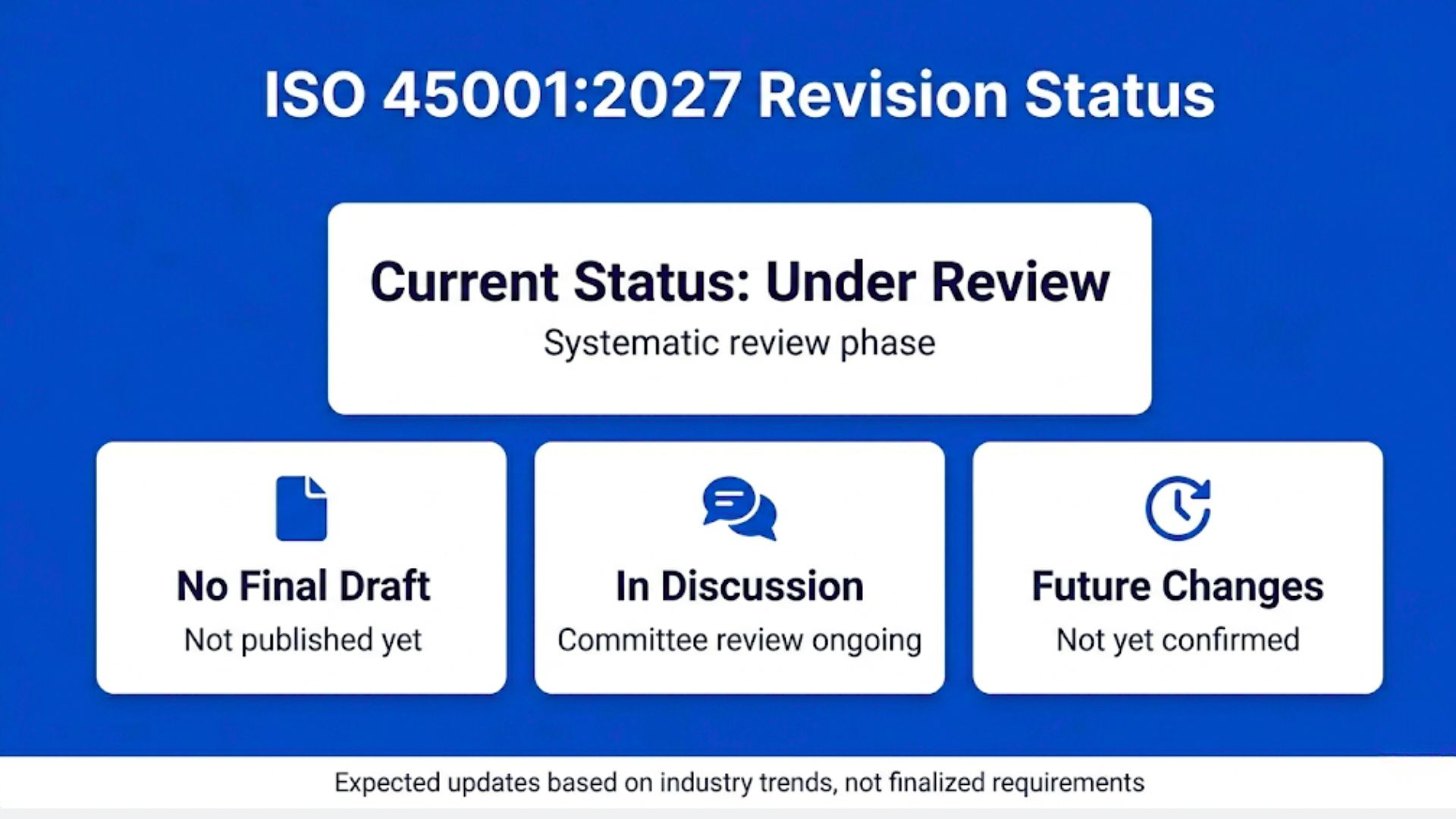
When people search for the ISO 45001:2027 revision status, they’re usually looking for a clear answer on whether the new version is already defined.
The development of ISO standards follows a structured process managed by ISO technical committees and working groups. Any revision to ISO 45001 goes through multiple stages of drafting, review, and stakeholder consultation before an updated version can be published.
Discussions around the future direction of ISO 45001 continue to focus on emerging workplace challenges, including digitalization, worker well-being, and evolving risk management practices. However, organizations should rely on official ISO publications and committee updates for confirmed requirements rather than assumptions about future revisions.
Until an updated edition is formally published by ISO, any potential changes remain subject to the standard development process and may evolve as work progresses.
This distinction matters because while early insights can help businesses prepare, they should not be treated as finalized requirements. The update, when released, will reflect real-world workplace changes rather than just incremental documentation updates.
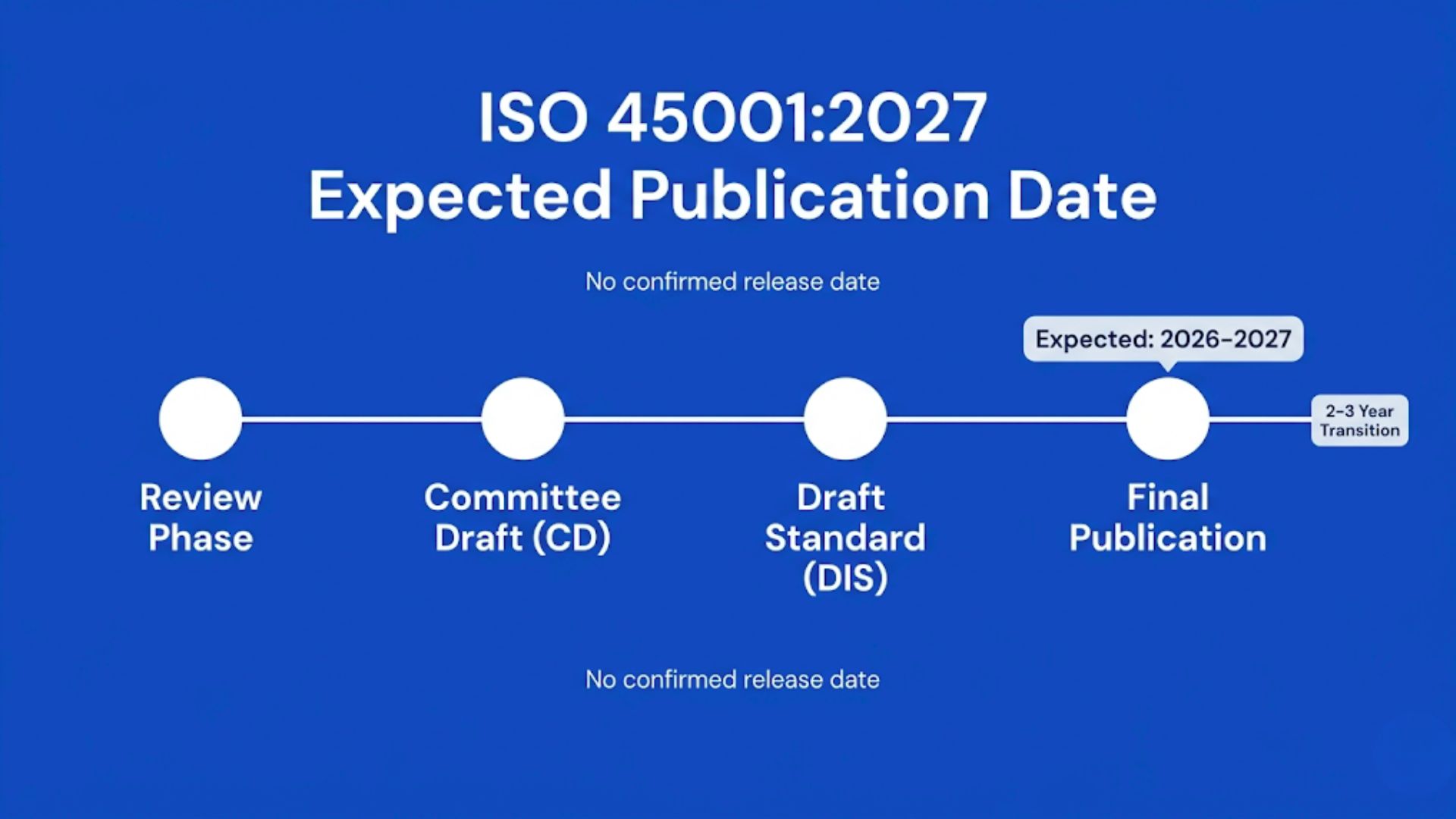
One of the most common questions right now is around the ISO 45001:2027 expected publication date. And the honest answer is that there isn’t a confirmed date published by ISO yet. What we can rely on instead is how ISO typically handles revisions and the timelines followed in previous standards.
ISO standards usually go through multiple stages before final release. This includes a review phase, followed by draft versions like the committee draft (CD) and draft international standard (DIS), before the final version is published.
Based on how long similar revisions have taken in the past, including the development of ISO 45001:2018, many industry observers expect the updated version, often referred to as ISO 45001 2027, to be released somewhere around 2026 or 2027. This, however, should be treated as an estimated window, not a fixed deadline.
At the same time, this waiting period is not just about tracking timelines. It’s also when organizations start revisiting the benefits of ISO 45001 for your business, such as improved risk control, fewer workplace incidents, better regulatory alignment, and more consistent operations, so that any transition to the updated version becomes a continuation of an already strong system rather than a reactive change.
For businesses, the exact date matters less than the direction. Waiting for the final announcement often leads to rushed implementation. Starting early, even with partial clarity, usually makes the transition smoother and more manageable.

A structured view of the ISO 45001 revision timeline, showing key phases from systematic review to final publication and transition period.
To understand how ISO 45001:2027 will actually roll out, it helps to look at the typical ISO revision lifecycle. These updates follow a structured path rather than a single release event, which is why the ISO 45001:2027 revision timeline is often discussed in phases instead of exact dates.
In simple terms, the journey from review to final publication can take a few years, depending on feedback, industry alignment, and how significant the proposed changes are.
This phased approach is why the ISO 45001 revision 2027 isn’t something that suddenly appears. It evolves over time with input from multiple industries and regulatory perspectives. For businesses, understanding this timeline makes it easier to prepare gradually instead of reacting at the last minute.
At each stage of this process, feedback plays a critical role in shaping the final standard.
For example, during the draft phases, inputs from industry experts, regulatory bodies, and businesses help identify practical gaps, whether it’s around risk assessment methods, documentation requirements, or implementation challenges. This is why no single draft should be treated as final, since multiple revisions can happen before publication.
For many organizations, this is also the stage where they revisit their internal processes against a practical ISO 45001 certification guide, using it as a reference point to understand how current systems align with evolving expectations and where gaps might exist as the standard progresses.
For businesses, this phased evolution of ISO 45001:2027 means preparation doesn’t have to wait for the final release.
By aligning current systems with the direction of these updates, organizations can prepare for the changes before they become mandatory. This may include improving risk tracking, strengthening internal audits, and adopting more structured compliance processes to support a smoother transition when the updated standard is officially introduced.
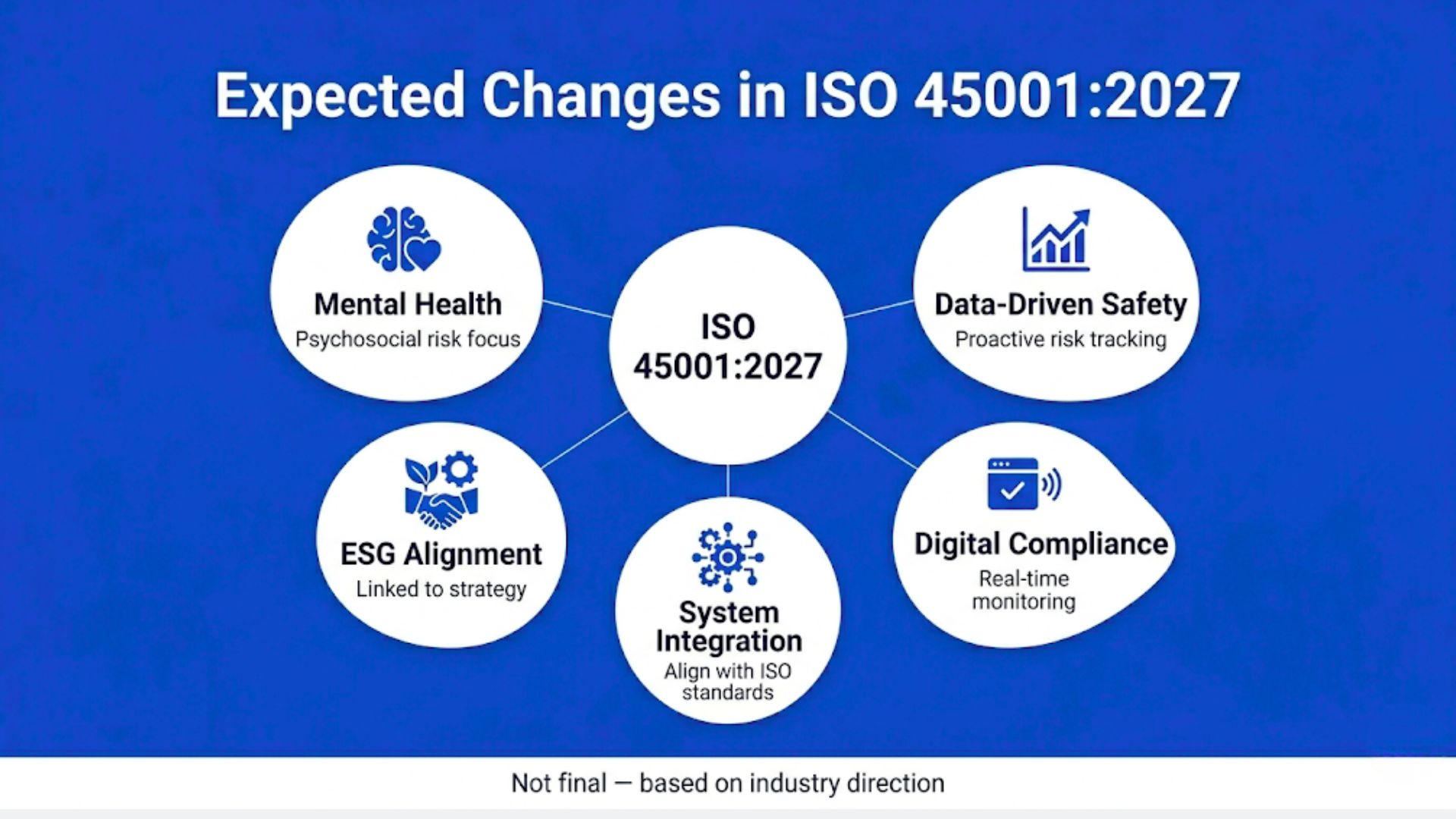
While the final version of ISO 45001:2027 is not officially published yet, there are clear directional shifts based on industry discussions, evolving workplace risks, and how other ISO standards have been updated over time.
These are not confirmed requirements, but they reflect where the ISO 45001 revision 2027 is likely heading based on current workplace realities.
One of the most noticeable shifts is the growing recognition that workplace safety extends beyond physical hazards. Issues such as stress, burnout, excessive workloads, and mental well-being are increasingly being viewed as important parts of occupational health.
As expectations around worker well-being continue to evolve, many organizations are finding that their existing safety processes were designed primarily around physical risks and may not fully address these broader concerns.This is one reason why many businesses rely on an ISO 45001 compliance guide when reviewing their occupational health and safety management systems.
It can help teams evaluate whether current risk assessment, monitoring, and improvement processes are robust enough to address both traditional workplace hazards and emerging psychosocial risks. Organizations may eventually be expected to identify psychosocial risks, assess their impact, and address them within their safety management systems while taking a more comprehensive view of worker health and well-being.
ISO 45001:2018 already encourages a risk-based approach, but future updates may push this further toward proactive and data-driven decision-making. Rather than responding after incidents occur, businesses could be expected to continuously monitor risk indicators and act early.
This might include using historical data to identify patterns, conducting regular safety audits with measurable metrics, and integrating real-time reporting into daily operations. The idea is to move from reactive compliance to predictive safety management.
Workplace safety is increasingly being linked to broader environmental, social, and governance (ESG) goals. Investors, regulators, and other stakeholders are paying closer attention to how organizations protect employee well-being and create safe working environments. As a result, businesses are beginning to view workplace safety as part of their overall responsibility and long-term performance, not just a compliance requirement.
This shift could also influence how organizations interpret and apply the ISO 45001 clauses in the years ahead. Rather than treating them as standalone health and safety requirements, businesses may increasingly use them to support wider organizational goals related to governance, accountability, and sustainability. The ISO 45001 2027 update may reflect this direction by encouraging stronger alignment between safety objectives and business strategy, with safety performance becoming part of leadership reporting, sustainability disclosures, and long-term planning.
Managing safety through manual documentation and disconnected systems is becoming difficult, especially for growing organizations. There is a clear shift toward digital-first approaches where audits, incident reports, and compliance activities are tracked in real time.
Future updates may indirectly encourage this transition by expecting better traceability, faster reporting, and more consistent documentation. For businesses, this could mean moving away from spreadsheets and adopting systems that centralize safety data and provide better visibility across teams.
Many organizations today implement multiple ISO standards together, such as ISO 9001 for quality and ISO 14001 for environmental management. To support this, ISO has been aligning its standards under a common structure.
The ISO 45001:2027 update may continue this trend, making it easier to integrate safety with other management systems. In practice, this could reduce duplication, streamline audits, and allow businesses to manage quality, environment, and safety through a more unified framework rather than separate processes.
Taken together, these expected changes suggest that ISO 45001:2027 will focus less on isolated compliance tasks and more on how safety systems operate within the larger business environment.

When you look at these expected shifts in ISO 45001:2027, the impact is less about adding new layers of compliance and more about changing how safety is managed on a day-to-day basis. Businesses will likely need to move from static systems, where safety is documented periodically, to more dynamic systems that are continuously monitored and improved.
For example, if mental health and proactive risk management become more structured parts of the standard, organizations may need to expand how they define “workplace risk.” This could mean involving more departments, collecting different types of data, and rethinking how often risks are assessed. Safety would no longer sit only with compliance teams but become part of broader operational and leadership decisions.
As companies start adapting to this shift, the conversation often moves beyond basic compliance and toward understanding how to get ISO 45001 certification in a way that actually supports continuous improvement. Instead of treating certification as a one-time milestone, businesses are beginning to see it as part of a larger system where safety performance is tracked, reviewed, and improved on an ongoing basis, aligning more closely with where the standard itself is heading.
There is also a clear shift toward integration. Instead of managing safety, quality, and environmental standards separately, businesses may find it more efficient to align them into a single system. This reduces duplication in audits, simplifies documentation, and creates better visibility across processes. However, it also requires stronger coordination and clearer ownership across teams.
At the same time, expectations around documentation and traceability are likely to increase. Whether or not it is explicitly mandated, the direction suggests that businesses will need better control over records, faster access to data, and more consistent reporting. This is where many organizations start moving toward structured systems instead of relying on manual processes that can become difficult to manage at scale.
The shift is practical. The focus is moving from “do you have a safety system in place?” to “does your safety system actually work in real conditions?” Businesses that start aligning with this mindset early will find it easier to adapt when ISO 45001:2027 is officially released.
If these changes feel like a shift from simple compliance to building systems that actually work in real operations, that’s because they are.
P3 LogiQ helps businesses translate evolving ISO 45001 expectations into structured, day-to-day processes, from risk tracking and audit readiness to system integration across teams.

Instead of reacting when ISO 45001:2027 is finalized, you can start aligning your current setup now with the right frameworks, tools, and guidance in place.
You can book a free demo call or sign up to understand where your existing system stands and how to move toward a smoother, more predictable ISO 45001 certification process without disrupting operations.
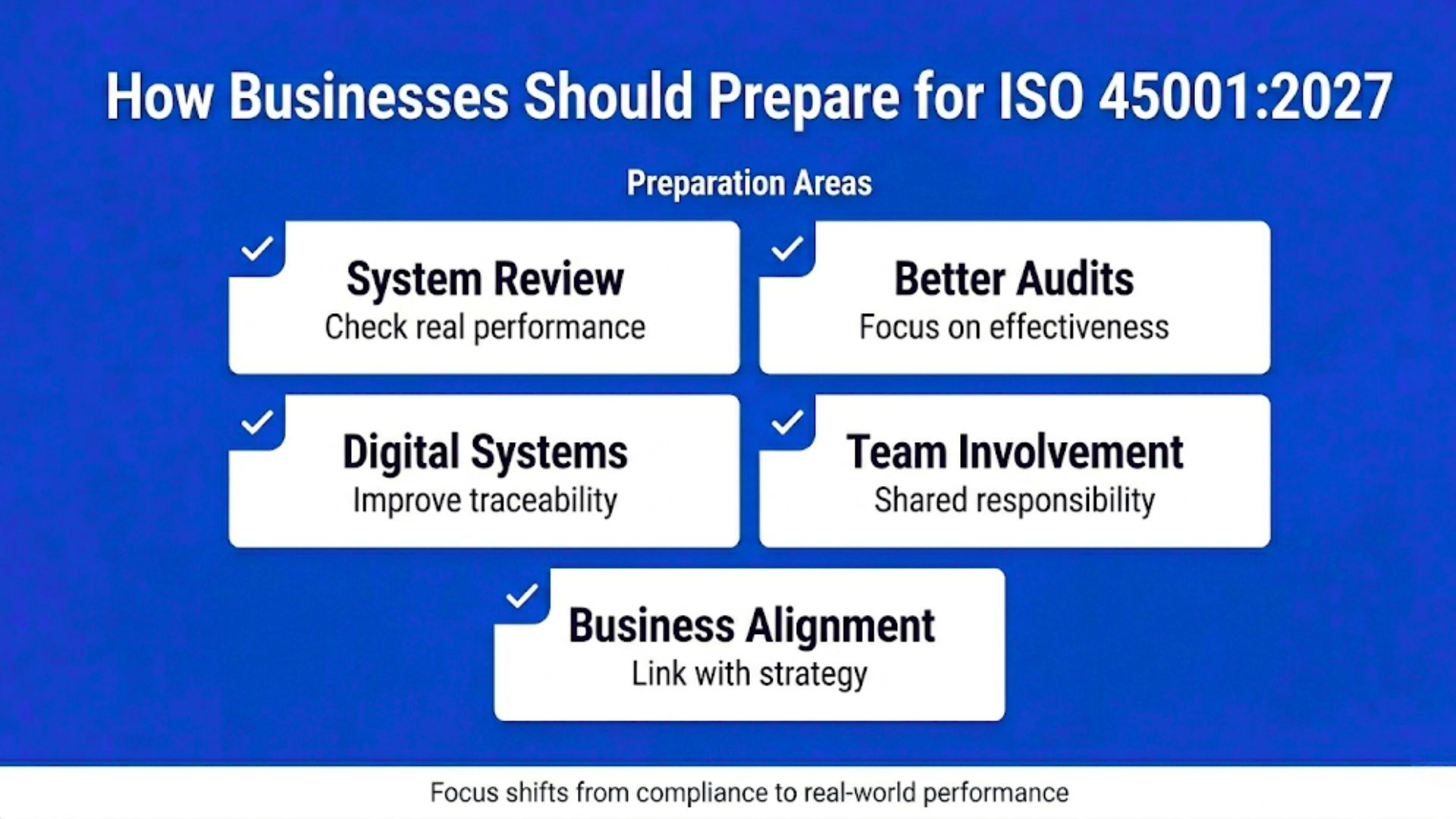
Preparing for ISO 45001:2027 is less about trying to predict every clause in advance and more about strengthening the way your current systems function in real conditions.
Since the overall direction of the update is becoming clearer, businesses that focus on improving implementation, visibility, and consistency now will find it much easier to adapt later.
Start by looking beyond documentation and assessing how your safety system actually performs on the ground. For example, procedures may be well-documented, but are they consistently followed across shifts, locations, or teams? Review how risks are identified, how incidents are reported, and how corrective actions are tracked. This kind of practical evaluation often reveals gaps that are not visible during routine audits.
Many organizations conduct internal audits as a checklist exercise, but future expectations are likely to go deeper. Instead of only verifying whether processes exist, audits should evaluate whether those processes are effective.
This could involve analyzing recurring issues, checking whether corrective actions are closed properly, and ensuring that audit findings actually lead to measurable improvements over time.
As your organization grows, managing safety through spreadsheets, emails, or disconnected tools becomes increasingly difficult. A more structured approach helps centralize documentation, maintain version control, and improve traceability during audits. It also reduces dependence on individual employees by making processes more consistent and system-driven.
This becomes especially important when you're planning for certification or evaluating factors that influence ISO 45001 certification cost. Poorly organized records, manual processes, and last-minute audit preparation can consume significant time and resources. By using automated reminders for audits, tracking corrective actions in real time, and maintaining centralized compliance records, your team can stay prepared year-round. Instead of scrambling to gather information before an audit, you already have the necessary data in place, making compliance easier to manage as your operations continue to scale.
Safety management cannot be limited to a single department. Operational teams, HR, and leadership all play a role in how effectively systems are implemented. This may involve expanding training programs to include risk identification, incident reporting, and understanding how individual actions impact overall workplace safety. The goal is to make safety part of everyday decision-making, not just a periodic requirement.
One of the clear shifts in ISO 45001:2027 is the integration of safety with overall business strategy. Instead of treating it as a separate compliance layer, organizations should start connecting safety metrics with performance indicators, operational planning, and leadership reporting.
This makes safety more visible at the decision-making level and ensures it is managed as an ongoing priority rather than a one-time certification effort.
The focus here is gradual improvement. Businesses that start aligning their systems in this direction now will be better prepared to handle the transition when the updated standard is officially released.
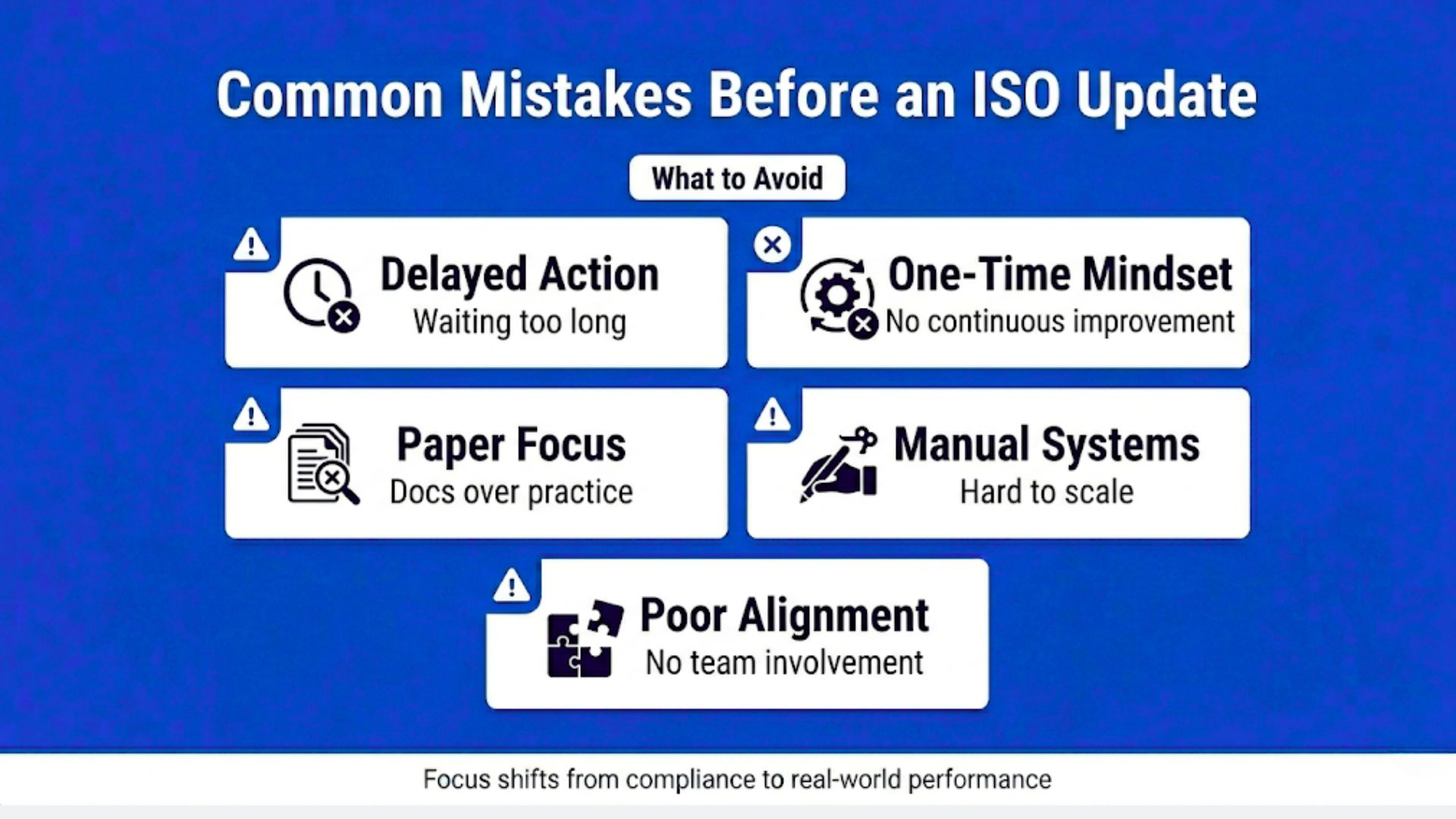
When updates like ISO 45001:2027 start gaining attention, businesses usually fall into two extremes. Some wait too long and react under pressure, while others rush into changes without clear direction. Both approaches create inefficiencies that could have been avoided with a more balanced, system-focused approach.
In practice, this is where using something as simple as an ISO 45001 checklist can help bring structure without overcomplicating the process, giving teams a clear view of what is already in place, what needs to be improved, and how closely current systems align with evolving expectations, instead of making reactive or disconnected changes.
It’s common for organizations to delay preparation until the updated standard is officially published. On the surface, this feels logical because it avoids working with incomplete information. But in reality, it compresses all the effort into the transition window.
Teams then rush to update documentation, retrain employees, and fix system gaps within a limited timeframe. This often leads to surface-level compliance rather than well-implemented processes that actually work in operations.
Many companies approach ISO certification as something to achieve rather than something to maintain. Once certified, the focus shifts away from continuous improvement, and systems gradually become outdated or inconsistently followed.
When a revision like ISO 45001 revision 2027 comes into the picture, these gaps become more visible, requiring significant rework instead of incremental updates.
Documentation is an important part of any ISO standard, but it’s only one side of the system. A common issue is having well-written procedures that are not consistently followed in daily operations.
For example, incident reporting processes may exist on paper, but employees might not actually use them in real scenarios. This disconnect creates problems during audits and becomes harder to fix when standards evolve.
In the early stages, spreadsheets and emails may be enough to manage safety and compliance activities. But as the organization grows, these methods become difficult to control and scale. Information gets scattered, version control becomes inconsistent, and audit preparation turns into a time-consuming exercise.
When updates like ISO 45001:2027 require better traceability and faster reporting, these limitations start to slow down the entire transition.
Safety and compliance are sometimes handled in isolation by specific teams, without strong involvement from leadership or other departments. This creates a gap between policy and execution.
For example, operational teams may not fully understand updated requirements, or leadership may not prioritize necessary changes. Without alignment across the organization, even well-designed systems struggle to deliver consistent results.
Avoiding these mistakes is less about doing more and more about doing things differently.
Businesses that treat safety as an integrated, continuously improving system, rather than a one-time compliance task, are generally in a much stronger position to adapt when ISO 45001:2027 is officially introduced.
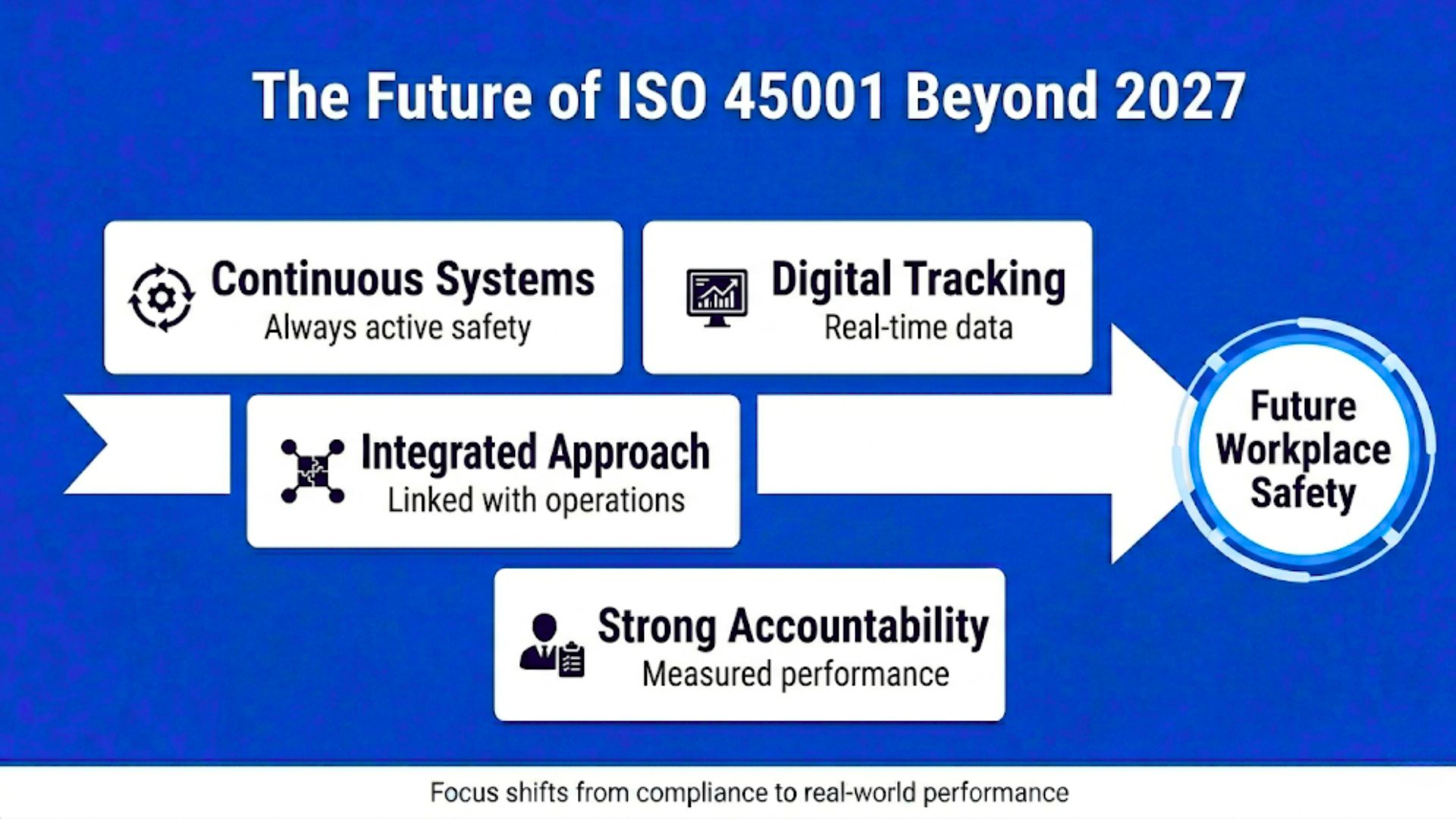
Looking beyond ISO 45001:2027, the direction is fairly clear. Workplace safety standards are gradually shifting from being periodic and compliance-driven to becoming continuous and system-driven. Instead of preparing for audits at fixed intervals, organizations are moving toward systems that monitor, update, and improve safety processes in real time.
This reflects a broader evolution in how organizations approach ISO 45001. Rather than treating it as a standard that only matters during certification or surveillance audits, many businesses are beginning to use it as an ongoing framework for managing workplace risks and improving safety performance throughout the year.
One of the biggest shifts is the increasing role of technology. As businesses adopt digital tools, safety management is becoming more data-oriented. This could include real-time incident tracking, automated risk alerts, and better visibility across locations.
Managing all of this manually can quickly become difficult, especially as operations grow. That is why organizations looking to modernize their safety programs often begin comparing different platforms and features, leading them to explore what might be the best ISO 45001 software for supporting their specific processes and compliance goals. While not every organization will adopt advanced systems immediately, the overall expectation is moving toward greater transparency and faster response times.
These changes are not limited to large enterprises. Interest in ISO 45001 for small businesses has also grown as smaller organizations look for practical ways to manage risks, improve consistency, and prepare for customer or regulatory requirements. Digital tools and streamlined processes are making it easier for smaller teams to implement structured safety practices without creating unnecessary administrative burden.
Future versions beyond ISO 45001:2027 may continue to strengthen connections between safety, quality, and environmental management systems. Overall, the future of workplace safety is less about adding complexity and more about improving how systems function in real-world conditions. Organizations that adapt to this mindset early will not only be better prepared for future updates but will also build more resilient and sustainable operations over time.
If navigating ISO 45001:2027 feels like balancing evolving requirements, audits, and day-to-day operations, that’s exactly where the right system makes a difference.
P3 LogiQ helps you simplify the entire ISO 45001 certification process by turning complex standards into structured, manageable workflows that actually work in real conditions.
From evaluating your current setup and identifying gaps to building audit-ready systems and improving documentation, everything is aligned with how your business operates.
Instead of scrambling to handle updates at the last minute, you can move toward a more structured and predictable approach to compliance.
If you want a clearer view of where you stand and how to prepare for what’s ahead, you can book a free demo call or sign up to see how a smoother, step-by-step certification process can actually work in practice.
There is no officially confirmed release date for ISO 45001:2027 yet. Based on typical ISO revision cycles, the expected window is around 2026 to 2027, but this remains an estimate rather than a fixed timeline.
The final publication depends on multiple stages like draft approvals and industry feedback. Because of this, timelines can shift slightly depending on how extensive the changes are.
The latest version of ISO 45001 currently in use is ISO 45001:2018. It replaced OHSAS 18001 and introduced a more structured approach to managing workplace health and safety.
This version focuses on risk-based thinking, leadership involvement, and continuous improvement. It is still the active standard that organizations follow until a revised version is officially released.
The ISO 45001:2027 revision status is currently in the review and discussion phase. ISO committees are evaluating whether updates are needed based on changes in workplace risks and operational practices.
As of now, no final draft or officially approved version has been published. Most available insights are based on industry expectations rather than confirmed updates.
The ISO 45001:2027 revision timeline typically spans a few years from initial review to final publication. It includes stages like systematic review, draft development, and multiple rounds of feedback.
After the final version is released, organizations usually get a transition period of around 2 to 3 years. This allows time to align systems and processes with the updated requirements.
If ISO 45001 2027 is officially published, organizations certified under ISO 45001:2018 will be expected to transition to the updated version. This is a standard process followed in most ISO revisions.
The transition usually involves updating documentation, aligning processes, and ensuring new requirements are implemented in practice. Companies are typically given a defined timeframe to complete this shift.
While no official requirements have been published yet, most ISO revisions build on the existing framework rather than replacing it entirely. Any future update is more likely to refine current expectations and address emerging workplace challenges than introduce a completely new management system structure.
Industry discussions often focus on topics such as worker well-being, psychosocial risks, digital safety management, and stronger integration with other business systems. However, organizations should wait for official ISO publications before treating any of these areas as confirmed changes.
No. Organizations can continue strengthening their occupational health and safety management systems using ISO 45001:2018. Improvements in risk management, employee participation, training, and performance monitoring remain valuable regardless of when a revised version is published.
The best approach is to maintain a well-functioning management system and stay informed about official ISO developments. Organizations that regularly review risks, conduct internal audits, and update their processes are generally better positioned to adapt when revisions are released.
Any future revision is expected to remain applicable to organizations of all sizes. While implementation methods may differ based on available resources and operational complexity, the core principles of managing workplace health and safety are designed to be flexible enough for both small businesses and large enterprises.



Businesses need document management systems (DMS) to ensure ISO and R2 compliance, improve efficiency, and stay audit-ready. The article highlights key features like version control, security, and automation while reviewing the top 5 DMS solutions. P3 LogiQ stands out for its compliance-focused automation and secure document tracking
Read More
Recycling businesses gain efficiency, compliance, and sustainability with RIOS certification. It streamlines quality management, environmental responsibility, and worker safety, helping companies avoid legal risks and boost credibility. P3 LogiQ simplifies the certification process with automation, document control, and compliance tracking, making operations smarter and safer.
Read More
Audit Management Software (AMS) automates compliance tracking, streamlines workflows, and reduces audit risks. Key features include automated scheduling, compliance checklists, CAPA tracking, vendor risk management, and integrations.
Read More
Learn how audit management systems simplify ISO and R2 compliance by automating audits, managing documentation, and minimizing compliance risks efficiently.
Read More
In 2025, many businesses still face challenges in compliance management due to outdated methods like spreadsheets and fragmented software. This inefficiency leads to missed deadlines, increased risk, and regulatory penalties. The blog emphasizes the importance of modern compliance tools that automate workflows, enhance risk management, and streamline regulatory processes to meet ISO and R2 standards.
Read More
The rise in e-waste and environmental concerns makes responsible electronics recycling essential. The R2 Certification sets a global standard for safe, sustainable, and data-secure recycling practices. Developed by Sustainable Electronics Recycling International (SERI), R2 helps businesses manage environmental risks, data security, worker safety, and legal compliance.
Read More
Businesses face increasing challenges in managing complex regulatory compliance. Manual methods such as spreadsheets and paperwork can lead to missed deadlines, inefficiencies, and costly penalties. Compliance management software offers a streamlined solution to reduce risks, automate processes, and improve operational efficiency.
Read More
Maintaining R2 Certification is crucial for businesses in the e-waste recycling industry, ensuring regulatory compliance, sustainability, and strong stakeholder trust. This guide outlines 10 best practices to help businesses simplify operations, reduce risks, and stay compliant.
Read More
Unlock the value of ISO risk management certification. Explore its impact on compliance, risk mitigation, and business expansion.
Read More
Explore the top 5 ISO risk management software tools for 2025, including document management solutions for streamlined compliance and increased efficiency.
Read More
Find the ideal document management software (DMS) for your business. Learn how to choose with expert tips, key features, and insightful guidance
Read More
Unlock the power of a Document Management System (DMS). Learn how it can revolutionize your business operations.
Read More






.png)


.png)





.jpg)



.jpg)
.jpg)











.jpg)



.png)

.png)
.png)





.png)

