

Think about the businesses you trust the most. Whether it's a software provider, a manufacturer, or even your favorite online store, there's usually one thing they have in common: they deliver a consistent experience. You know what to expect, and they rarely leave quality to chance.
That consistency doesn't happen because of a single process or a detailed checklist. It comes from a set of practices that help businesses stay focused on customers, make better decisions, improve continuously, and keep everyone working toward the same goals.
That's exactly what the ISO 9001 certification quality management principles are designed to do.
First introduced as part of the ISO 9001:2015 standard, the globally recognized framework for quality management systems, these principles give organizations a structured way to build quality into everything they do, not just inspect for it at the end.
According to the International Organization for Standardization (ISO), these principles provide the foundation for effective quality management and help organizations improve performance, create value, and enhance customer satisfaction.
These principles work together to create a practical framework for managing quality across the organization. Rather than focusing only on compliance, they help businesses build stronger processes, make better decisions, improve efficiency, and drive continuous improvement in a structured way.
In this blog, you'll learn the seven foundational ISO 9001 quality management principles and why they continue to matter in 2026.
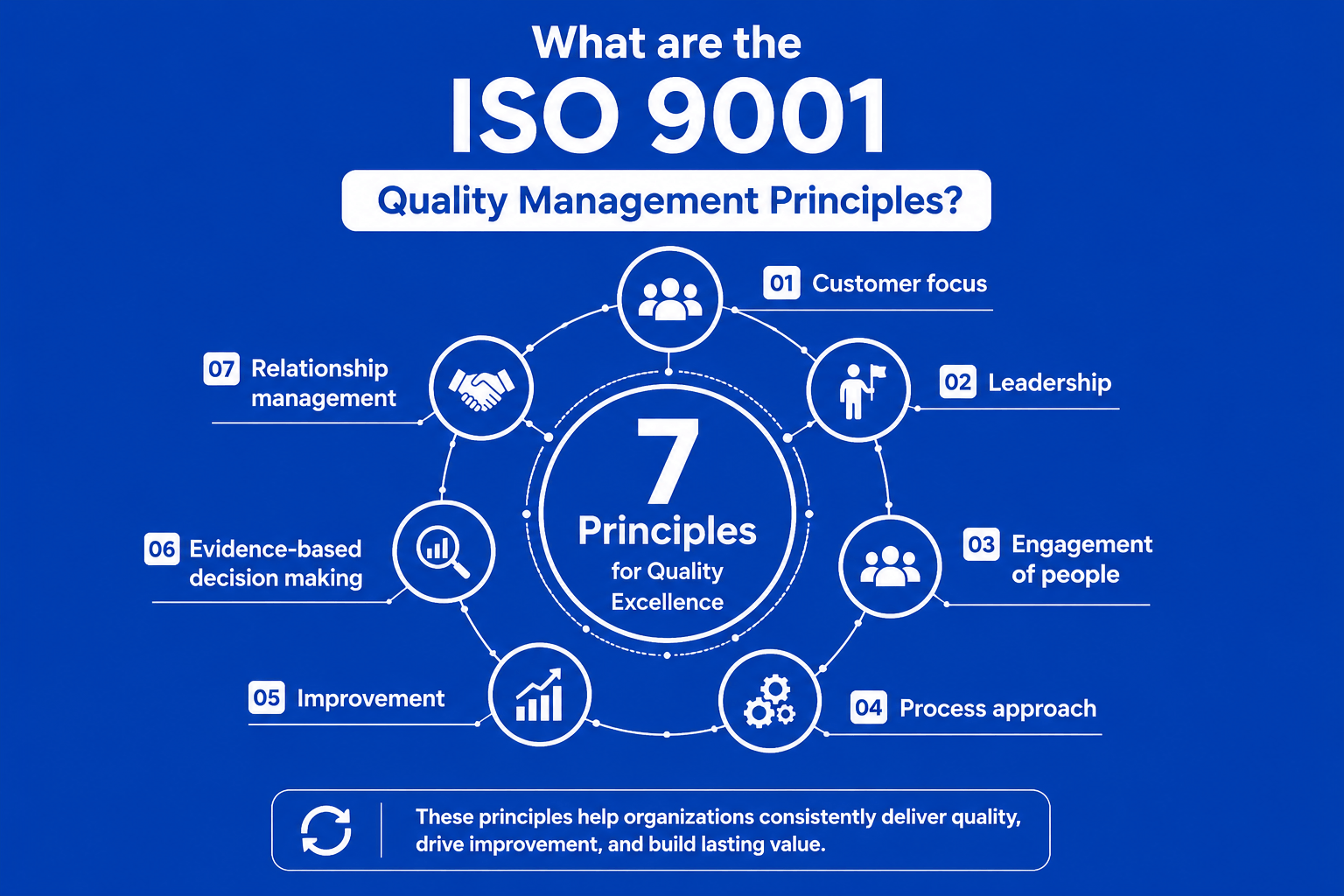
Before you dive into the seven principles, it's helpful to understand why they exist in the first place.
When you're implementing ISO 9001, it's easy to focus on procedures, documentation, and audit requirements. However, the standard wasn't built around paperwork. It was built around a set of quality management principles that help organizations consistently deliver quality products and services.
These principles act as a guide for how you should approach quality across your business. They help you make better decisions, improve processes, strengthen customer relationships, and create a culture where quality becomes part of everyday work.
ISO developed the quality management principles to give organizations a common framework for managing quality effectively.
Rather than prescribing exactly how every business should operate, the principles provide a set of proven concepts that can be applied across different industries, sizes, and business models. Whether you're running a small company or a global organization, the same principles can help you achieve more consistent results.
If you've worked with older ISO quality management guidance, you may remember that there were originally eight quality management principles.
During the ISO 9001:2015 revision, ISO updated the framework and combined some overlapping concepts to better align with modern quality management practices and the way businesses now manage quality systems through digital tools, automation, and the best ISO compliance software available in the market.
The principle known as system approach to management was integrated into the process approach, reducing the total number from eight to seven.
This update reflected a broader shift in quality management, where organizations increasingly focus on connected processes, better visibility, and more efficient system control rather than managing quality activities in isolation.
Today, ISO 9001 is based on these seven quality management principles:
The principles aren't just theoretical concepts. They influence how your quality management system performs in the real world.
When you apply them effectively, you can:
Rather than treating quality as a separate activity, the principles help you build it into the way your business operates every day.
The quality management principles are not individual requirements that auditors will check one by one. Instead, they form the foundation of the ISO 9001 standard.
Many of the requirements you see throughout ISO 9001 are influenced by these principles. For example, customer focus appears throughout leadership requirements, improvement is reflected in corrective actions and continual improvement activities, and evidence-based decision making is supported through performance monitoring and evaluation.
Understanding the principles can make ISO 9001 easier to implement because they explain the thinking behind many of the standard's requirements. Instead of asking, "What does the standard want me to do?" you'll start to understand, "Why does the standard ask for this in the first place?"
Each of the seven ISO 9001 quality management principles plays a different role in strengthening your quality management system. Some focus on customers and leadership, while others help improve processes, decision-making, and long-term business performance.
The table below gives you a quick comparison of these principles and shows how each one contributes to overall quality success.
7 foundational ISO 9001 quality management principles you must follow in 2026
ISO 9001 is based on seven quality management principles that influence many of the standard's requirements. Together, they help you improve performance, strengthen customer satisfaction, and support long-term business success.
Here are the seven foundational ISO 9001 quality management principles and how you can apply them in your organization.
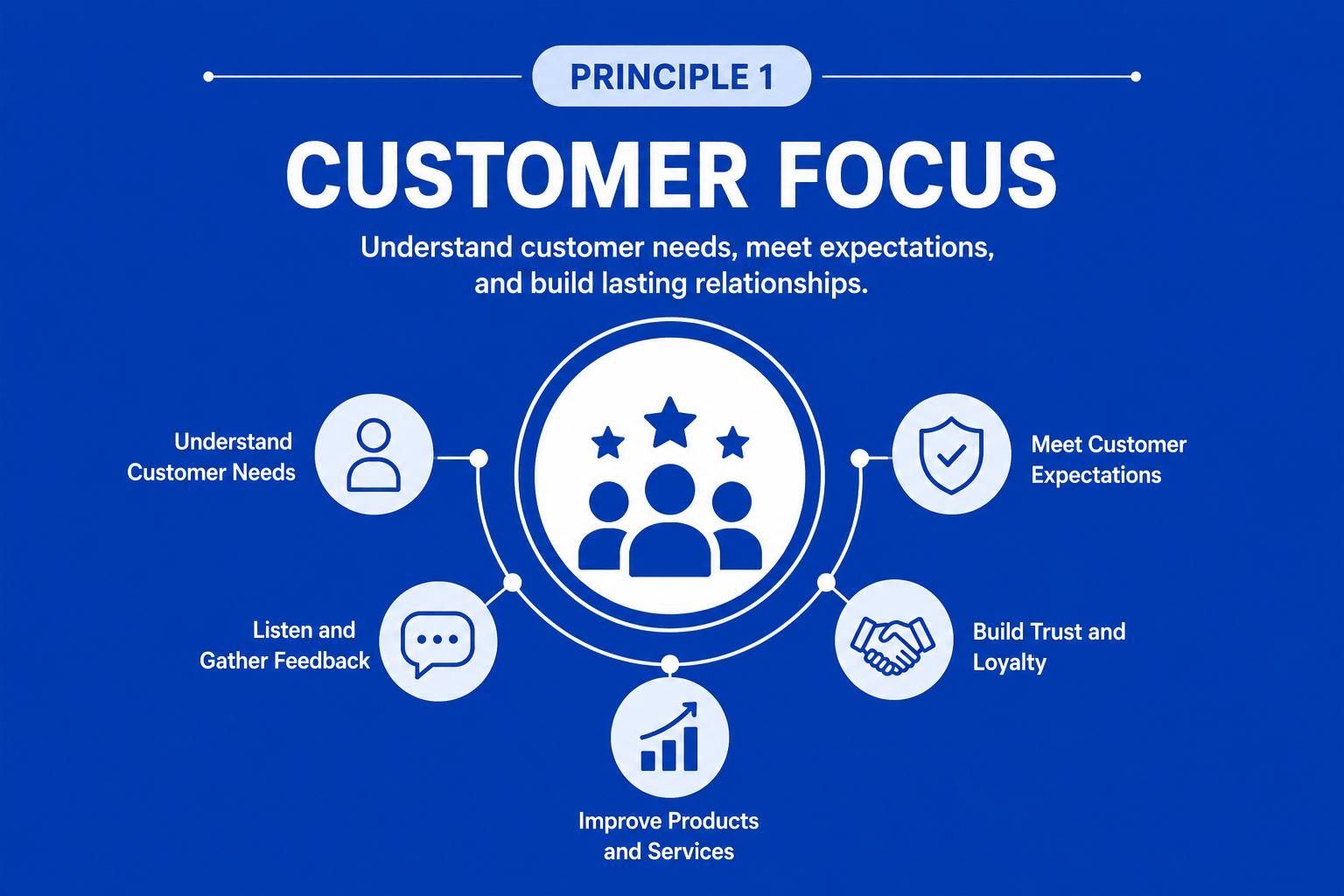
No matter what industry you're in, the people who buy your products or use your services ultimately decide whether you're delivering quality. If their expectations aren't being met, even well-designed processes can fall short.
That's why customer focus is the first quality management principle in ISO 9001. It encourages you to understand customer requirements, monitor satisfaction, and use feedback to improve how your business operates.
When you consistently meet customer expectations, trust grows naturally. When expectations are missed, complaints increase, customer loyalty weakens, and quality issues become more visible.
Customer focus means understanding what your customers expect and making sure your products or services consistently deliver on those expectations. For organizations implementing ISO 9001 for small businesses, this becomes even more important because smaller teams usually work more closely with customers and can respond faster to feedback, service issues, and changing expectations.
It also means paying attention to changing customer needs and continuously looking for ways to improve the overall customer experience over time.
You can put this principle into practice by:
Suppose you run an online store and start receiving repeated complaints about delayed deliveries. Instead of treating each complaint separately, you review the issue, improve your shipping process, and provide better delivery updates.
As delivery performance improves, complaints decrease and customer satisfaction increases.
Many businesses struggle with customer focus because they:
Customer focus isn't something you review once a year. The more consistently you listen to customers and respond to their feedback, the easier it becomes to improve quality and build stronger relationships.

Strong quality management starts with leadership. No matter how well your processes are documented, they are unlikely to deliver consistent results if leadership is not actively supporting quality goals.
That's why ISO 9001 places a strong emphasis on leadership. It encourages leaders to set a clear direction, provide the necessary resources, and create an environment where quality becomes part of everyday decision-making.
When leadership is genuinely committed to quality, employees understand what is expected, priorities become clearer, and improvement efforts are more likely to succeed.
Leadership means ensuring that quality is aligned with your organization's overall direction and objectives. In practice, many organizations use structured frameworks such as an ISO 9001 checklist to help leadership regularly review priorities, monitor progress, and ensure quality goals stay aligned with broader business objectives.
It also involves taking accountability for the effectiveness of the quality management system rather than treating quality as the responsibility of a single department.
You can demonstrate this principle by:
Suppose your company is experiencing a rise in customer complaints. Instead of leaving the issue entirely to the quality team, leadership reviews the data, identifies the root causes, allocates resources to address the problem, and tracks progress over time.
This visible involvement helps teams stay focused on improvement and shows that quality is a business priority, not just a compliance requirement.
Many businesses struggle with leadership because they:
Leadership is not about approving policies or attending management reviews. It is about creating a culture where quality is valued, supported, and reinforced through everyday actions.

A quality management system is only as effective as the people who use it every day. You can have well-defined processes and clear objectives, but achieving consistent results becomes difficult if employees are not actively involved.
That’s why ISO 9001 emphasizes the engagement of people. When employees understand their responsibilities, feel valued, and are encouraged to contribute, they are more likely to identify issues, suggest improvements, and help maintain quality standards. Strong employee involvement can also influence implementation efficiency, as poor engagement often leads to delays, rework, and higher ISO 9001 certification cost during the certification journey.
When people are engaged, quality becomes part of the organization’s culture rather than something that is driven only by procedures and audits.
This principle focuses on ensuring that people at all levels of the organization are competent, empowered, and involved in achieving quality objectives. It recognizes that employees play a direct role in delivering consistent products, services, and customer experiences.
You can strengthen employee engagement by:
Suppose your production team regularly encounters a recurring quality issue. Instead of relying solely on managers to find a solution, you involve the employees who work with the process every day. Their insights help identify the cause of the problem and lead to a practical improvement that reduces defects.
Because the solution came from the people closest to the process, it is often easier to implement and sustain.
Many businesses struggle with this principle because they:
When people feel informed, supported, and involved, they are more likely to take ownership of their work. That involvement can have a significant impact on quality performance and continual improvement.
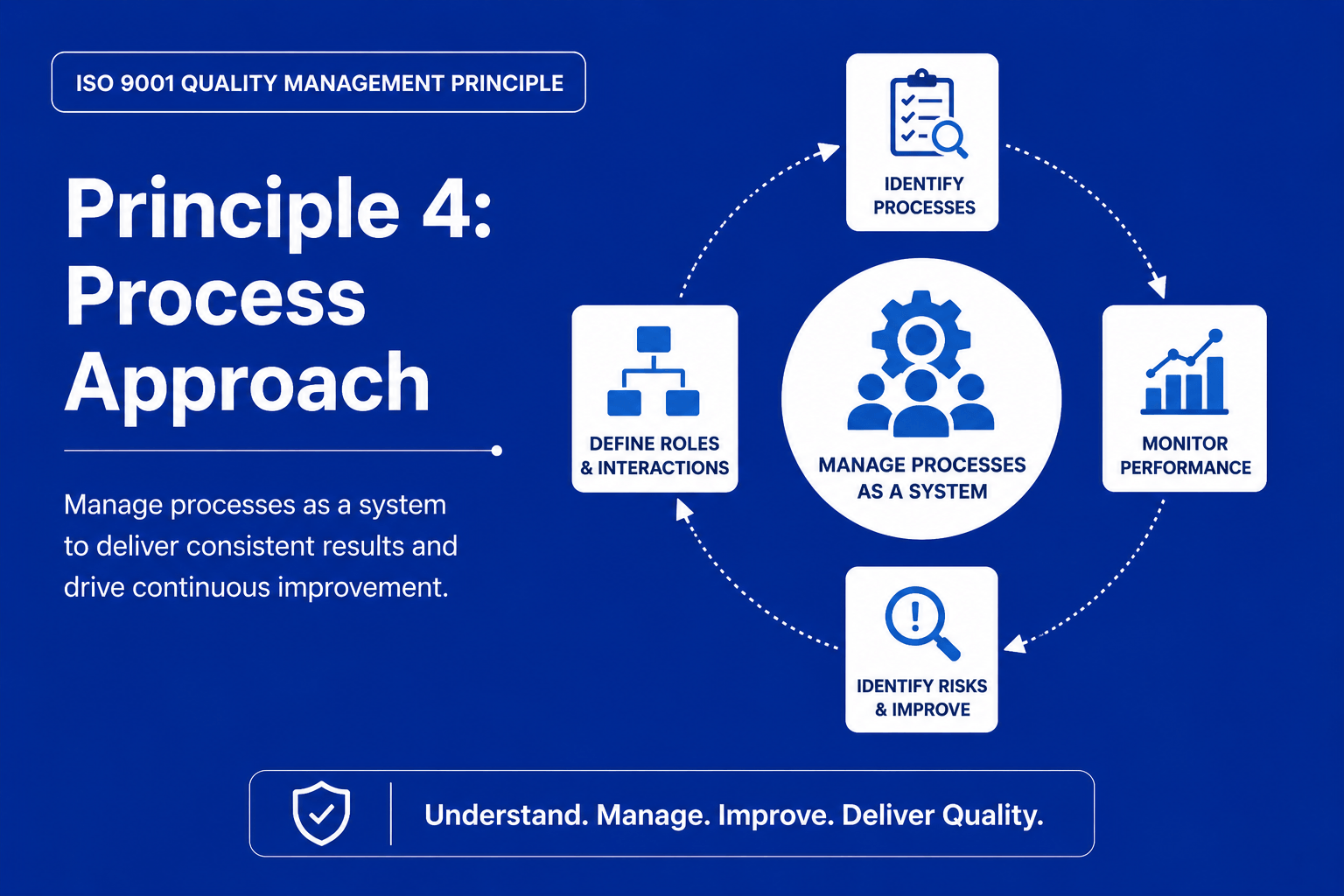
When quality problems occur, the issue is often not with a single task but with how different activities work together. That's why ISO 9001 encourages you to look at your business as a collection of connected processes rather than separate departments or functions.
The process approach helps you understand how work flows from one stage to the next, where potential issues can arise, and how different activities affect the final outcome. This makes it easier to deliver consistent results and identify opportunities for improvement.
When you manage processes as a system instead of focusing on individual tasks, quality becomes more predictable and easier to control.
The process approach means identifying the key processes within your organization, understanding how they interact, and managing them in a way that helps you achieve your intended results. One of the major ISO 9001 benefits is that this structured approach helps businesses improve consistency, reduce inefficiencies, and gain better control over operational performance.
Rather than looking at activities in isolation, you focus on how inputs, actions, and outputs connect across the entire workflow.
You can apply this principle by:
Suppose you're receiving frequent customer complaints about late deliveries. Instead of focusing only on the shipping team, you review the entire process from order placement to dispatch. During the review, you discover that delays are actually occurring during order processing.
By improving that stage of the process, you reduce delivery delays and improve customer satisfaction.
Many businesses struggle with the process approach because they:
The process approach helps you see the bigger picture. When you understand how your processes work together, it becomes easier to improve efficiency, reduce errors, and deliver more consistent results.
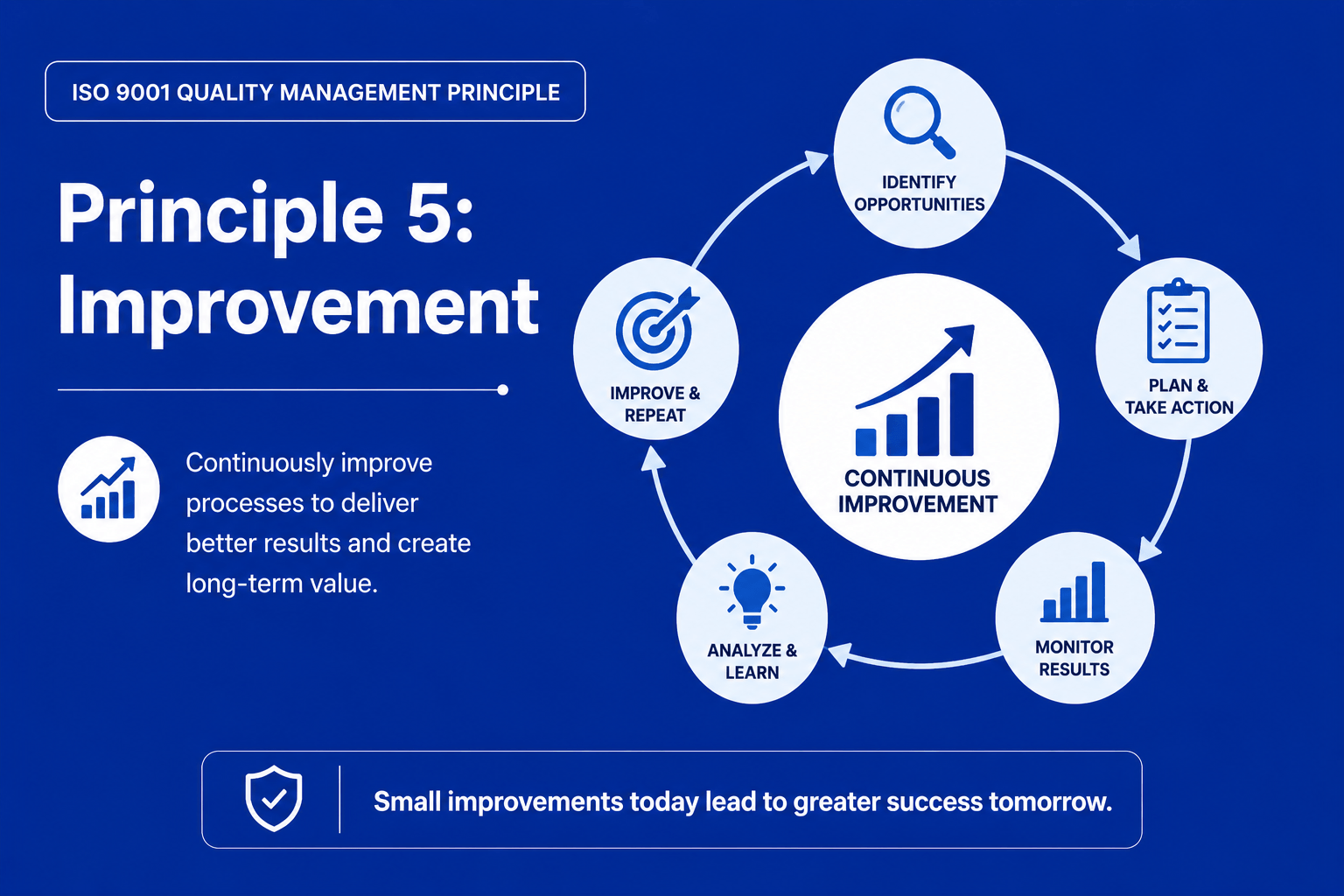
No matter how well your business is performing today, there is always room to improve. Customer expectations change, markets evolve, and new challenges emerge. That's why improvement is a core quality management principle in ISO 9001.
The standard encourages you to treat improvement as an ongoing activity rather than something you do only when problems occur. Small, consistent improvements over time can often have a bigger impact than occasional large-scale changes.
When improvement becomes part of your everyday approach, you're better prepared to adapt, solve problems, and maintain long-term success.
Improvement means continually looking for ways to make your products, services, processes, and overall quality management system more effective.
Many organizations now rely on digital tools and the best ISO 9001 software to track performance, identify improvement opportunities, and streamline corrective actions more efficiently. This includes correcting issues when they occur, preventing them from happening again, and identifying opportunities to perform better in the future.
You can put this principle into practice by:
Suppose you notice that customer complaints about product defects have increased over the past few months. Instead of simply fixing individual defects, you investigate the cause and discover a recurring issue in the production process.
After making process improvements and monitoring the results, defect rates begin to decline and customer satisfaction improves.
Many businesses struggle with improvement because they:
Improvement is not about constantly making dramatic changes. It's about regularly looking for better ways to work and taking action when opportunities for improvement become clear.
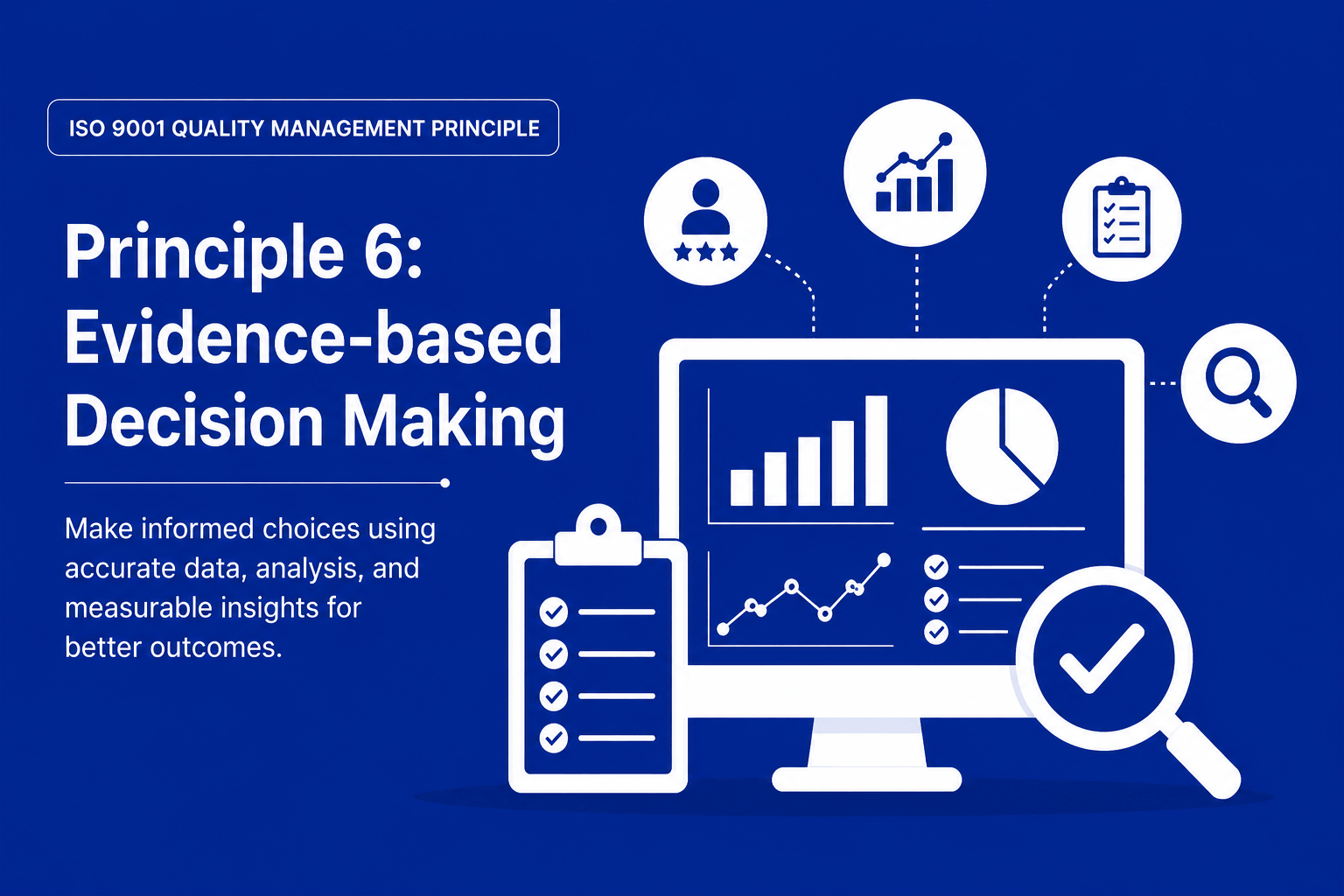
Good decisions are easier to make when they're backed by facts rather than assumptions. That's the idea behind evidence-based decision making, one of the key principles of ISO 9001.
Every business generates valuable information through customer feedback, audits, inspections, performance reports, and day-to-day operations.
Whether you're following an ISO 9001 compliance guide or strengthening an existing quality management system, the real value comes from understanding what that data is telling you and using it to make informed decisions. When used effectively, this information helps identify issues earlier, reveal what's working, and improve decision-making with greater confidence.
Relying on evidence doesn't eliminate risk completely, but it does help you make decisions based on reality rather than guesswork.
This principle encourages you to collect, analyze, and use relevant data when making decisions that affect quality performance.
Instead of relying solely on opinions or past experience, you use objective information to understand situations and determine the best course of action.
You can apply this principle by:
Suppose you're seeing an increase in customer complaints and assume the problem is related to product quality. After reviewing the data, you discover that most complaints are actually linked to delayed deliveries rather than the product itself.
Because you looked at the evidence first, you can focus on the real issue instead of spending time and resources fixing the wrong problem.
Many businesses struggle with this principle because they:
Evidence-based decision making doesn't mean tracking every possible metric. It means using reliable information to understand what's happening in your business and making decisions with greater confidence.

No business operates on its own. Your ability to deliver consistent quality often depends on the people and organizations you work with, including suppliers, partners, contractors, and other interested parties.
That's why ISO 9001 includes relationship management as one of its quality management principles. Strong relationships can improve communication, reduce disruptions, and help you achieve better results over the long term.
When you work collaboratively with key stakeholders, it's often easier to maintain quality, respond to challenges, and create value for everyone involved.
Relationship management means identifying the parties that influence your organization's performance and building mutually beneficial relationships with them. Strong collaboration often depends on clear communication, shared expectations, and effective ISO 9001 document control, especially when working with suppliers, vendors, and external partners.
The goal isn't simply to manage suppliers. It's to create stronger partnerships that support quality objectives and long-term success.
You can apply this principle by:
Suppose one of your suppliers frequently delivers materials later than expected, causing delays in your production schedule. Rather than switching suppliers immediately, you work together to understand the cause of the delays and improve planning and communication.
As a result, delivery performance improves, production disruptions decrease, and both businesses benefit from a stronger working relationship.
Many businesses struggle with relationship management because they:
Relationship management is about recognizing that quality is often influenced by people outside your organization. The stronger those relationships are, the easier it becomes to achieve consistent results and support continual improvement.
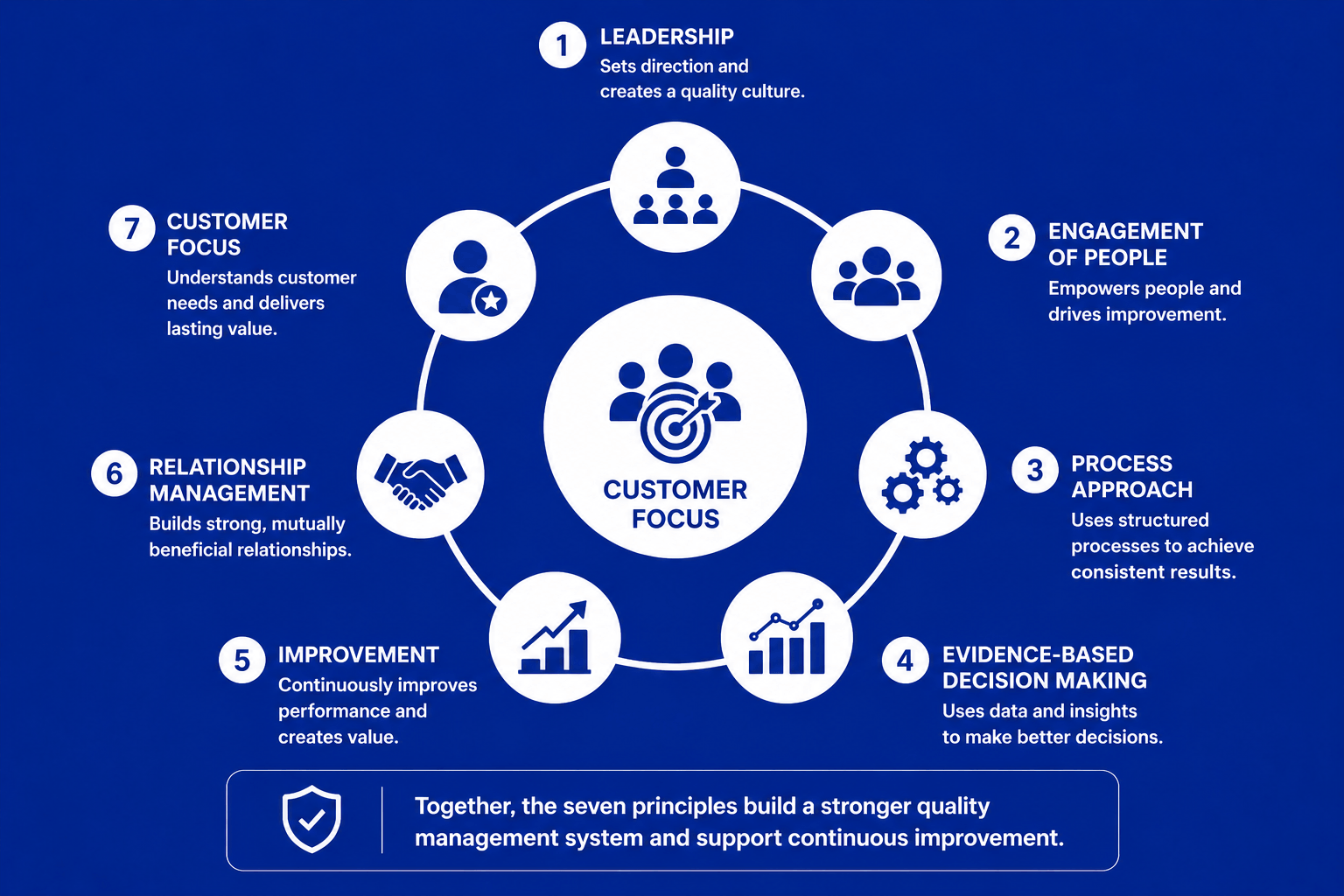
It's easy to look at the seven quality management principles as separate concepts, but that's not how they work in practice. Each principle supports the others, and the real value comes from applying them together rather than focusing on one in isolation.
For example, you can collect customer feedback, but without leadership support, improvement efforts may never move forward. You can define excellent processes, but without engaged employees, those processes may not be followed consistently. Likewise, making decisions without reliable data can make it difficult to identify what actually needs improvement.
When these principles work together, they create a stronger and more effective quality management system.
You can think of the principles as a connected system:
While all seven principles are important, customer focus remains the common thread running through the entire quality management system.
Leadership helps align the organization around customer needs. Employees contribute to delivering quality outcomes. Processes ensure consistency. Data helps you understand customer expectations and performance. Improvement addresses gaps. Strong relationships help maintain reliable delivery.
When these principles are applied together, they create a system that is better equipped to meet customer requirements, improve performance, and support long-term success.
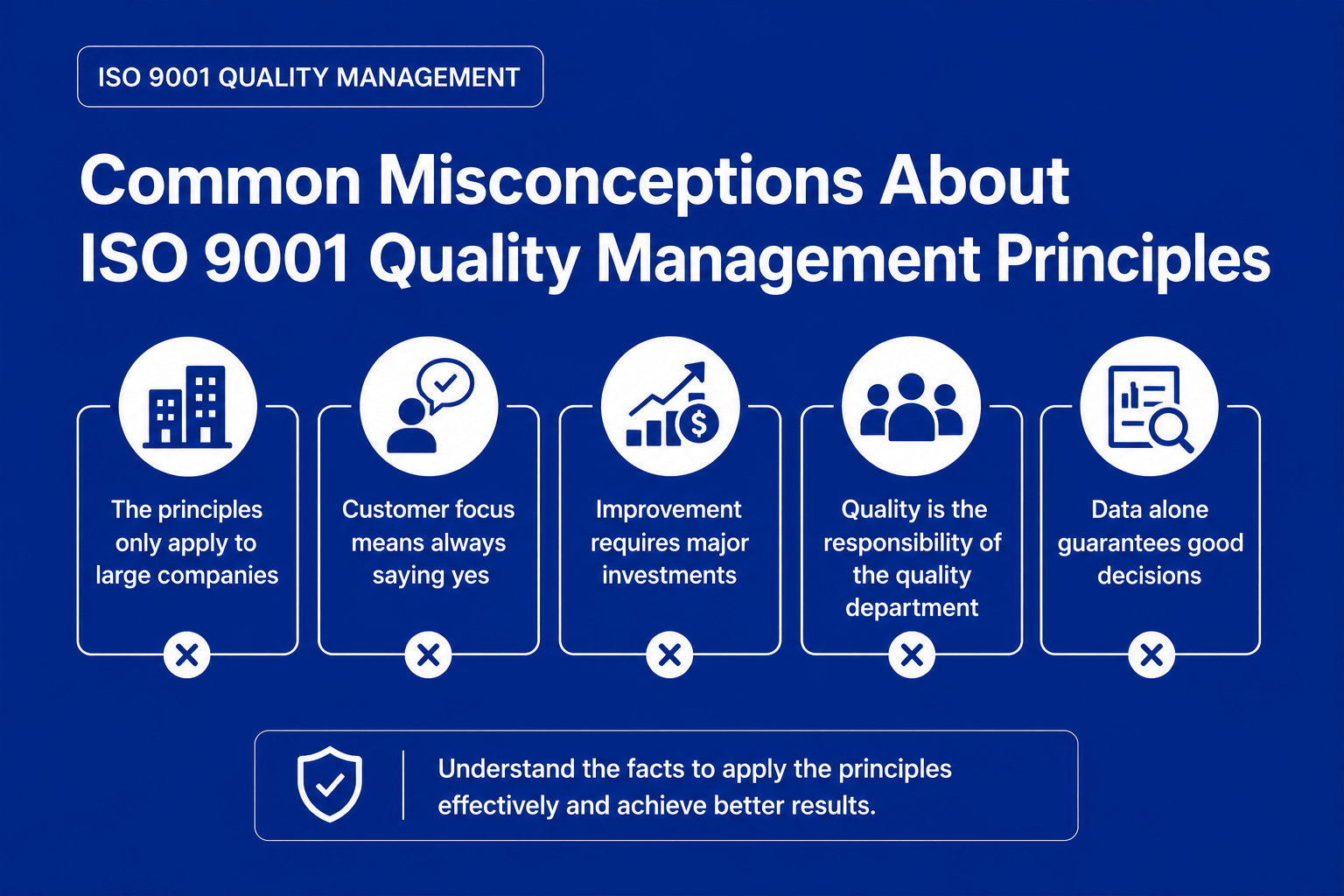
The seven quality management principles are straightforward in theory, but they're often misunderstood in practice. Here are some of the most common misconceptions.
ISO 9001 can be used by organizations of any size. Whether you run a small business with a handful of employees or a multinational company, the principles remain relevant. The way you apply them may differ, but the underlying ideas stay the same.
Customer focus is about understanding and meeting customer requirements, not agreeing to every request. In some cases, saying yes to unrealistic expectations can create quality issues, delays, or unnecessary costs. The goal is to deliver value while maintaining consistent quality.
Not every improvement requires new technology, additional staff, or a large budget. Many improvements come from small changes, such as simplifying a process, reducing errors, improving communication, or addressing recurring issues before they become bigger problems.
One of the biggest misconceptions is that quality belongs to a single team. While quality professionals may help manage the system, consistent quality depends on the involvement of leadership, employees, suppliers, and other stakeholders across the organization.
Data is an important part of decision-making, but it doesn't automatically lead to the right conclusions. Information still needs to be analyzed, interpreted, and used in the proper context. Good decisions come from combining reliable data with experience, knowledge, and sound judgment.
Understanding these misconceptions can help you apply the quality management principles more effectively and avoid common mistakes that limit their impact.
File name
(all lowercase, evergreen name)
why-these-iso-9001-principles-matter-in-2026
Alt text (in sentence case, with period)
The ISO 9001 quality management principles help businesses stay resilient in 2026 by improving customer focus, decision-making, compliance, and operational performance.
Caption / Description (in sentence case, with period)
The ISO 9001 quality management principles help businesses stay resilient in 2026 by improving customer focus, decision-making, compliance, and operational performance.
The seven quality management principles are not new, but the way businesses operate in 2026 makes them more relevant than ever.
Customer expectations have changed significantly. People expect faster responses, seamless digital experiences, consistent service, and fewer mistakes. If those expectations are not met, switching to a competitor is easier than ever. That is one reason customer focus remains central to ISO 9001.
Businesses now have access to more data than ever before. Customer feedback, performance reports, audit findings, and real-time operational metrics all generate valuable insights. With AI and digital quality management systems (QMS) becoming more common, the real challenge is no longer collecting data. It is using that data effectively to make better decisions and improve performance.
Regulatory expectations are also increasing across industries. Businesses are under growing pressure to maintain stronger documentation, improve traceability, reduce risk, and demonstrate compliance more consistently. This is also where many ISO 9001 implementation challenges begin, especially when organizations struggle to adapt quickly without disrupting day-to-day operations.
This makes leadership, process control, and evidence-based decision making even more important.
Supply chains have also become more complex. Many organizations now rely on global suppliers, contractors, technology platforms, and third-party partners. A single disruption in one part of the supply chain can quickly affect quality, delivery timelines, and customer satisfaction. That is why process approach and relationship management matter more than ever.
Trust has become just as important as performance. Customers, suppliers, regulators, and employees all want to work with organizations they can depend on. The seven quality management principles help build that trust by creating a more consistent, reliable, and improvement-focused way of working.
That is why these principles continue to matter in 2026. They help businesses stay customer-focused, improve operational performance, and respond more effectively in an increasingly complex business environment.
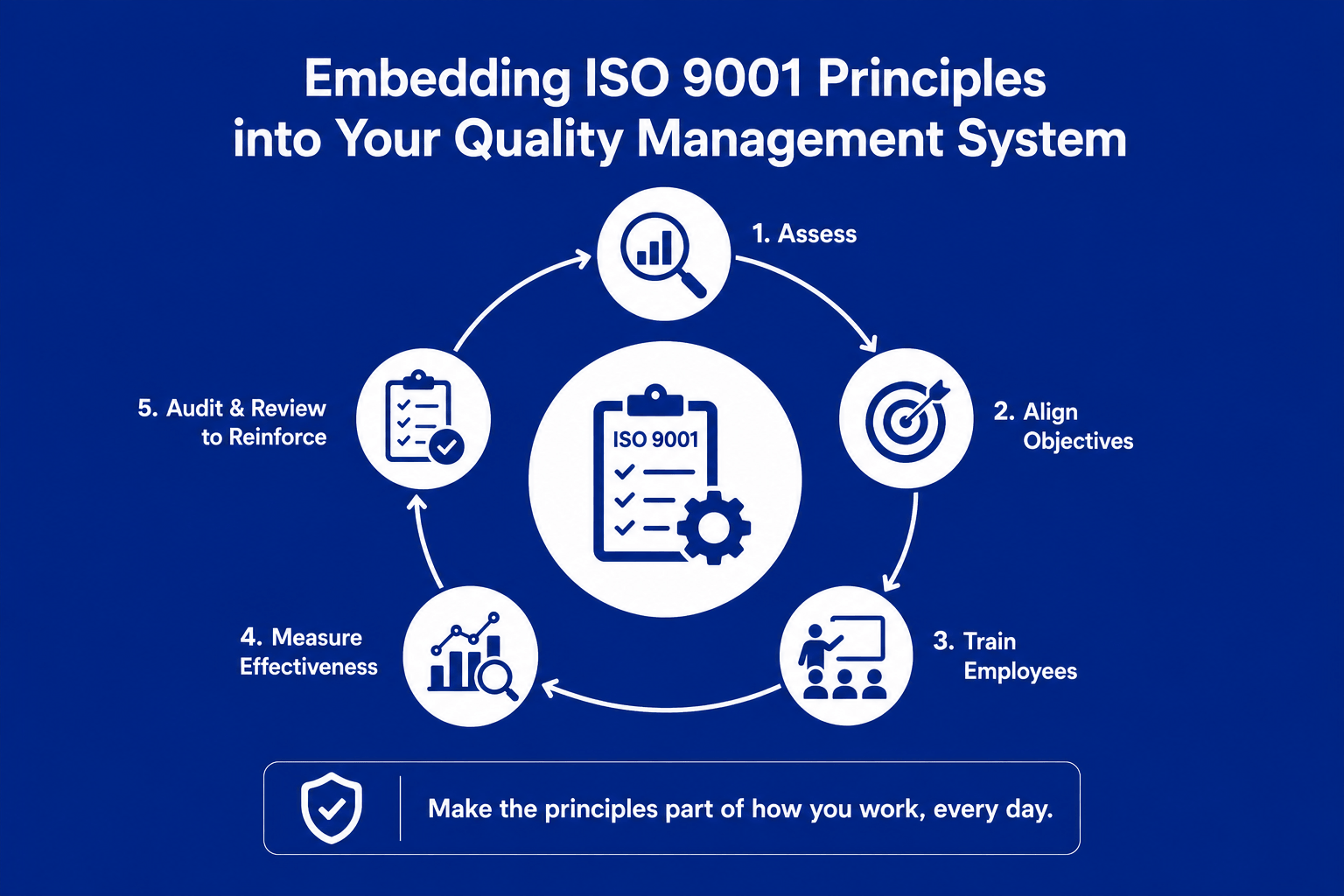
Understanding the seven quality management principles is one thing. Applying them consistently across your organization is what makes them valuable. The good news is that you don't need to treat them as separate initiatives. They can be built into the way your quality management system already operates.
Start by evaluating how well each principle is reflected in your existing processes and practices.
For example, are you actively measuring customer satisfaction? Are employees involved in improvement activities? Do you use data to support decisions?
This assessment can help you identify strengths, gaps, and areas that may need more attention.
Your quality objectives should support the principles you're trying to strengthen. If customer focus is a priority, you might track customer satisfaction or complaint trends. If improvement is a focus area, you might set objectives related to reducing defects or improving process performance.
When objectives are aligned with the principles, it becomes easier to turn them into measurable actions.
Employees are more likely to support the quality management system when they understand how it relates to their daily work. Rather than focusing only on ISO terminology, explain how the principles apply to the tasks, decisions, and responsibilities they handle every day.
The more relevant the training feels, the more likely it is to have a lasting impact.
The principles should be reflected in performance data, not just documentation. Regularly reviewing metrics such as customer satisfaction, process performance, audit results, and improvement activities can help you determine whether your quality management system is delivering the intended results.
Consistent measurement also makes it easier to identify opportunities for improvement.
Internal audits and management reviews provide valuable opportunities to evaluate how effectively the principles are being applied. They can help you identify gaps, review progress, and ensure that quality remains aligned with business objectives.
Over time, these activities help reinforce the principles and keep them integrated into the way your organization operates.
Embedding the seven quality management principles isn't about creating additional procedures. It's about making them part of the decisions, processes, and behaviors that already drive your quality management system.
File name
(all lowercase, evergreen name)
p3-logiq-iso-9001-principles-everyday-practice
Alt text (in sentence case, with period)
P3 LogiQ helps businesses apply ISO 9001 principles in everyday operations through structured quality management practices.
Caption / Description (in sentence case, with period)
P3 LogiQ helps businesses apply ISO 9001 principles in everyday operations through structured quality management practices.
Understanding the seven quality management principles is a great starting point. The real challenge is applying them consistently across your processes, teams, and day-to-day operations.
P3 LogiQ helps you simplify ISO 9001 compliance by bringing your quality management activities into one centralized platform. From document control and corrective actions to audits, training, risk management, and performance tracking, you get the tools needed to support the principles discussed throughout this guide.
If you're preparing for ISO 9001 certification or looking to strengthen an existing quality management system, P3 LogiQ can help you build a more structured, efficient, and improvement-focused approach to quality.
Book a free demo today or sign up to see how P3 LogiQ helps you turn ISO 9001 quality management principles into everyday practice.
The seven quality management principles are customer focus, leadership, engagement of people, process approach, improvement, evidence-based decision making, and relationship management.
These principles form the foundation of ISO 9001 and help organizations build a quality management system that supports consistent performance, customer satisfaction, and continual improvement.
The principles themselves are not requirements that organizations must comply with individually during certification audits.
Instead, they provide the underlying philosophy behind ISO 9001. Many of the standard's requirements are designed around these principles, which is why understanding them can make implementation much easier.
The quality management principles are not contained within a single clause of ISO 9001. They influence multiple clauses throughout the standard.
For example, customer focus is reflected in Clause 5, improvement appears in Clause 10, and evidence-based decision making is supported through performance evaluation activities in Clause 9.
Earlier versions of ISO quality management standards were based on eight quality management principles. During revisions, ISO combined and refined some concepts to simplify the framework.
The principle known as "system approach to management" was integrated into the process approach, resulting in the seven principles used today.
The principles help organizations understand the purpose behind ISO 9001 requirements instead of simply following procedures to meet audit expectations.
When these principles are embedded into everyday operations, it often becomes easier to implement, maintain, and improve an effective quality management system.
ISO does not rank the principles in order of importance, and all seven work together to support an effective quality management system.
That said, customer focus is often viewed as the central principle because the ultimate goal of quality management is to consistently meet customer requirements and improve customer satisfaction.
Yes. The quality management principles are designed to be applicable to organizations of all sizes and sectors.
A small business may apply them differently than a large multinational company, but the principles themselves remain equally relevant and beneficial.
Several of the principles directly contribute to customer satisfaction. Customer focus helps you understand customer needs, while improvement and evidence-based decision making help you respond more effectively to issues and changing expectations.
Together, the principles create a system that supports consistent quality and a better customer experience over time.
No. ISO 9001 is designed for organizations in any industry, including service providers, healthcare organizations, educational institutions, technology companies, and government agencies.
The principles focus on managing quality and improving performance, which are objectives that apply across virtually every sector.
There is no specific requirement to review the principles on a fixed schedule. However, organizations should regularly evaluate whether their quality management system reflects and supports them.
Internal audits, management reviews, performance evaluations, and improvement activities can all help ensure the principles remain integrated into daily operations and long-term planning.



Businesses need document management systems (DMS) to ensure ISO and R2 compliance, improve efficiency, and stay audit-ready. The article highlights key features like version control, security, and automation while reviewing the top 5 DMS solutions. P3 LogiQ stands out for its compliance-focused automation and secure document tracking
Read More
Recycling businesses gain efficiency, compliance, and sustainability with RIOS certification. It streamlines quality management, environmental responsibility, and worker safety, helping companies avoid legal risks and boost credibility. P3 LogiQ simplifies the certification process with automation, document control, and compliance tracking, making operations smarter and safer.
Read More
Audit Management Software (AMS) automates compliance tracking, streamlines workflows, and reduces audit risks. Key features include automated scheduling, compliance checklists, CAPA tracking, vendor risk management, and integrations.
Read More
Learn how audit management systems simplify ISO and R2 compliance by automating audits, managing documentation, and minimizing compliance risks efficiently.
Read More
In 2025, many businesses still face challenges in compliance management due to outdated methods like spreadsheets and fragmented software. This inefficiency leads to missed deadlines, increased risk, and regulatory penalties. The blog emphasizes the importance of modern compliance tools that automate workflows, enhance risk management, and streamline regulatory processes to meet ISO and R2 standards.
Read More
The rise in e-waste and environmental concerns makes responsible electronics recycling essential. The R2 Certification sets a global standard for safe, sustainable, and data-secure recycling practices. Developed by Sustainable Electronics Recycling International (SERI), R2 helps businesses manage environmental risks, data security, worker safety, and legal compliance.
Read More
Businesses face increasing challenges in managing complex regulatory compliance. Manual methods such as spreadsheets and paperwork can lead to missed deadlines, inefficiencies, and costly penalties. Compliance management software offers a streamlined solution to reduce risks, automate processes, and improve operational efficiency.
Read More
Maintaining R2 Certification is crucial for businesses in the e-waste recycling industry, ensuring regulatory compliance, sustainability, and strong stakeholder trust. This guide outlines 10 best practices to help businesses simplify operations, reduce risks, and stay compliant.
Read More
Unlock the value of ISO risk management certification. Explore its impact on compliance, risk mitigation, and business expansion.
Read More
Explore the top 5 ISO risk management software tools for 2025, including document management solutions for streamlined compliance and increased efficiency.
Read More
Find the ideal document management software (DMS) for your business. Learn how to choose with expert tips, key features, and insightful guidance
Read More
Unlock the power of a Document Management System (DMS). Learn how it can revolutionize your business operations.
Read More










.png)


.png)




.jpg)





.jpg)
.jpg)












.jpg)



.png)

.png)
.png)





.png)

