.jpg)

A plant manager I spoke with recently was running a mid-sized manufacturing facility in the US.
They had safety checks in place. Their team followed OSHA rules. Waste was handled as per local guidelines. Internal audits happened from time to time.
On the surface, everything looked under control.
But during a client audit, a problem showed up.
There was no structured system behind any of it.
Chemicals were being handled. Emissions were managed. But no one could show how environmental risks were tracked or improved over time. There was no clear framework. No baseline. No way to prove consistency.
The same was true for safety. Incidents were recorded, but there was no process to identify root causes or prevent them from happening again.
That is when ISO 14001 and ISO 45001 came into the picture.
And the conversation shifted.
It was no longer about whether they were compliant.
But more so about whether they could prove it and improve it over time.
At the same time, it is becoming hard for businesses to ignore safety and environmental responsibilities. Rules are getting stricter, expectations are rising, and clients are paying more attention to how companies manage compliance.
Because of this, many companies are moving away from manual tracking and adopting structured systems to stay organized and audit-ready. This is where ISO 14001 software is increasingly used to simplify compliance and streamline documentation and reporting.
And this shift is showing up clearly in how many businesses in the US operate today. They are doing the work and trying to stay compliant, but without a system in place, consistency and scale quickly become difficult to sustain.
According to Global Standards' analysis of the ISO Survey 2024 dataset published through IAF CertSearch, there are 676,232 ISO 14001 certificates and 542,527 ISO 45001 certificates issued worldwide.
Which raises a more important question.
Are you actually compliant… or just assuming you are?
Do you need ISO 14001, ISO 45001, or both?
Understanding ISO 14001 vs. ISO 45001 is important for businesses that want to manage both environmental impact and workplace safety in a structured way.
In this guide, I will break down both standards in simple terms, so you can decide what works best for your business in the US.

ISO 14001 is an international standard for Environmental Management Systems, also called an EMS.
In simple terms, it gives your business a structured way to manage its impact on the environment.
This includes things like:
It does not tell you exactly what your environmental performance should look like. Instead, it gives you a framework to track, manage, and improve it over time, based on ISO 14001 clauses, which outline the standard's requirements.
ISO 14001 was first published in 1996. The current version, ISO 14001:2015, is the one most businesses use today in the US.
It applies to almost any organization. Small businesses, large manufacturers, logistics companies, government agencies, and nonprofits can all get certified. There is no minimum size requirement.
For businesses, ISO 14001 is especially important in industries where environmental impact is part of daily operations. This includes manufacturing, construction, transportation, energy, and chemical processing.
At the same time, it is becoming more common in service-based industries. Many companies now use it to show clients and investors that they take sustainability seriously.
One more thing worth knowing.
Many large companies now expect their suppliers to have ISO 14001 certification. If you are trying to win contracts or expand into global markets, this can give you a clear advantage, along with the broader benefits of ISO 14001.
Now that you understand how ISO 14001 focuses on environmental impact, let’s look at the other side.
Because managing your impact outside the business is only part of the picture.
The other part is what happens inside your workplace.
ISO 45001 is an international standard for Occupational Health and Safety Management Systems, also called an OHSMS.
Its job is simple. It helps your business protect the people who show up to work every day.
That includes identifying workplace hazards before they become accidents, putting controls in place to reduce risk, and building a culture where safety is not just a policy on paper.
In many organizations, this is now supported through ISO 45001 software, which helps teams manage incidents, audits, risk registers, and safety documentation in a more structured and consistent way.
ISO 45001 was published in March 2018. It replaced OHSAS 18001, the occupational health and safety standard that many US-based companies had used for years. OHSAS 18001 was officially withdrawn in 2021 and is no longer valid for certification.
The shift was important.
ISO 45001 takes a more proactive approach. Instead of reacting to incidents after they happen, it pushes businesses to identify and manage risks before anything goes wrong.
It also places a stronger focus on leadership and worker involvement.
Safety is not just the responsibility of one team. It starts at the top and involves everyone in the organization.
Like ISO 14001, it applies to businesses of all sizes and industries. But it is especially important in high-risk environments like construction, manufacturing, healthcare, transportation, and mining.
For businesses in the US, ISO 45001 works alongside OSHA requirements set by the Occupational Safety and Health Administration.
It does not replace them.
Instead, it gives you a structured way to meet those requirements consistently and prove that your safety processes are working.
The numbers tell an important story.
According to the International Labour Organization, nearly 3 million people die each year from work-related accidents and diseases worldwide.
ISO 45001 exists to reduce that risk.
It helps businesses move from reacting to incidents to preventing them in the first place.
Companies that implement ISO 45001 often see real results, with the benefits of ISO 45001 including fewer incidents, lower workers’ compensation costs, less downtime, and better employee retention.
At a high level, the difference is simple.
ISO 14001 focuses on your impact on the environment.
ISO 45001 focuses on the safety of your people.
But in practice, the differences go deeper.
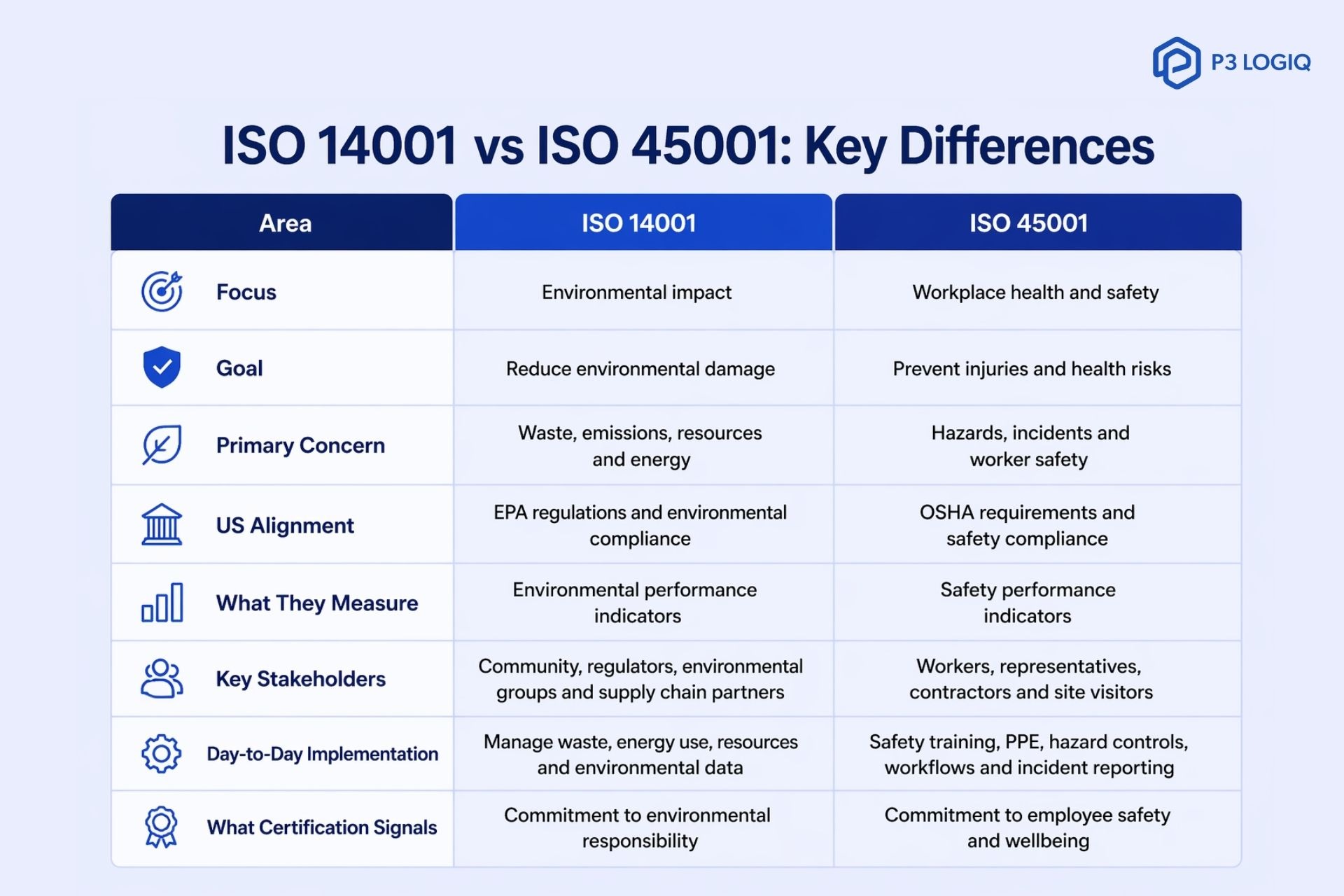
Both standards are built on a similar framework. They require management commitment, internal audits, and continuous improvement.
But they solve different problems.
Here is how they compare across the areas that matter most to your business.
ISO 14001 looks at your impact on the external environment. This includes air, water, land, waste, and energy use.
ISO 45001 focuses on your internal environment. It deals with the health, safety, and well-being of your workers and anyone on site.
One looks outward. The other looks inward.
ISO 14001 supports compliance with environmental regulations, including rules set by the Environmental Protection Agency, along with state-level environmental laws.
ISO 45001 supports compliance with workplace safety regulations set by the Occupational Safety and Health Administration, including injury reporting and safety standards.
ISO 14001 tracks environmental performance. This includes waste levels, energy use, and emissions.
ISO 45001 tracks safety performance. This includes workplace incidents, lost-time injuries, near-miss reports, and how effectively workplace hazards are identified and controlled.
ISO 14001 involves external stakeholders like regulators, local communities, environmental groups, and supply chain partners.
ISO 45001 focuses more on internal stakeholders. This includes employees, contractors, and anyone who enters your workplace.
ISO 14001 often involves improving how you manage waste, reduce resource use, and track environmental data through consistent operational practices to maintain ISO 14001 over time.
ISO 45001 focuses on strengthening safety practices. This includes training employees, using protective equipment, reducing hazards, and improving incident reporting.
ISO 14001 shows that your business takes environmental responsibility seriously.
ISO 45001 shows that your business values its people and invests in keeping them safe.
Now that the differences are clear, the next question is just as important.
Can you use both together?
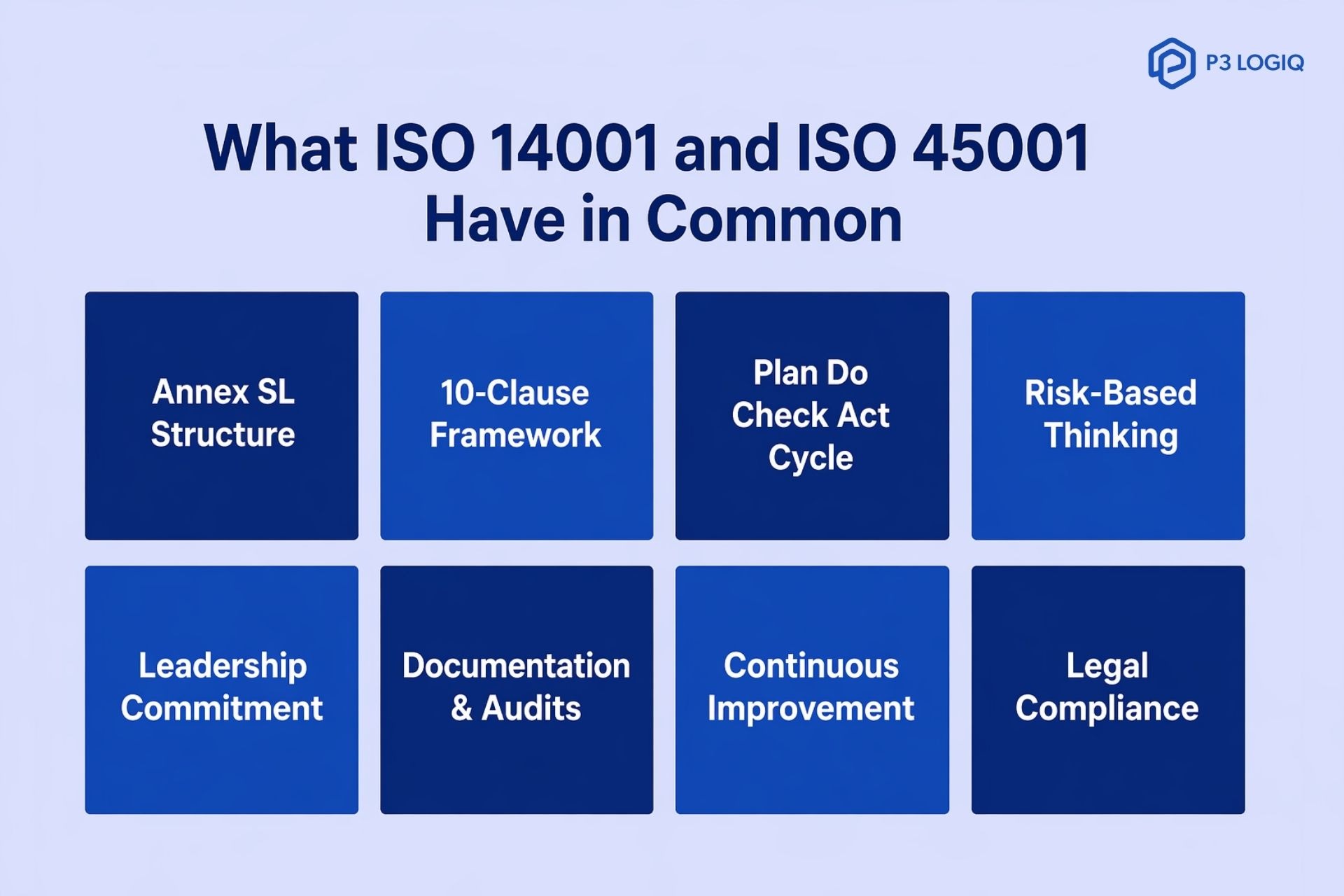
Even though they focus on different things, these two standards have a lot in common.
They are built on the same high-level structure, called Annex SL. This is the framework ISO uses across all its management system standards.
In practice, this means both follow the same 10-clause structure and use a shared approach to managing processes.
This includes a simple improvement cycle often called Plan, Do, Check, Act, along with core elements like risk assessment, documentation, performance tracking, and management review.
Here is a quick look at what they share.
This shared structure is what makes it easier to combine both standards into a single system.
That is why many businesses choose to manage them together.
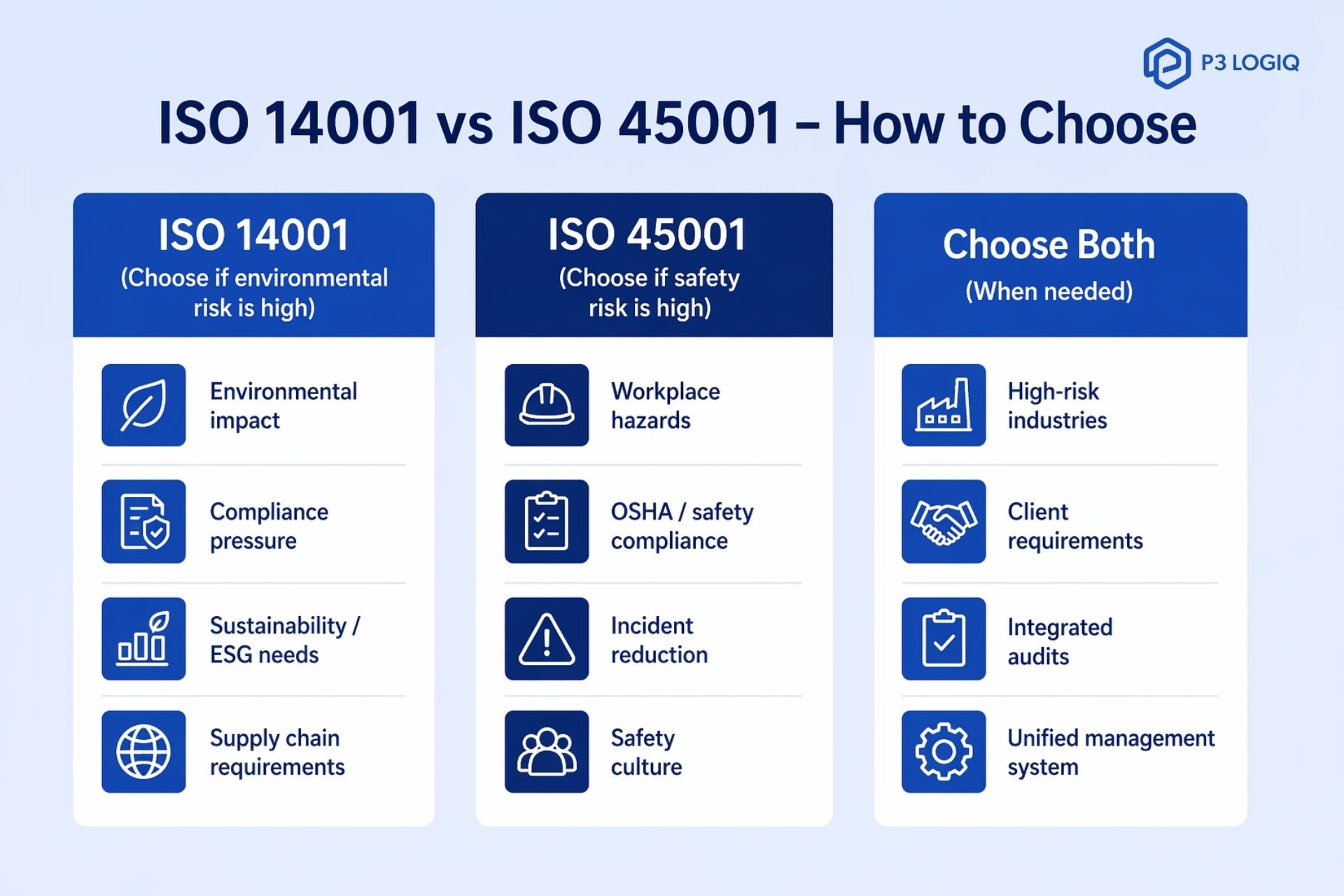
This is the question most businesses reach once they understand both standards.
The honest answer depends on where your biggest risk and pressure are coming from right now.
Here is a simple way to think through it.
For many mid-sized businesses in the US in industrial sectors, the answer is eventually both.
But you do not need to start there.
Start where the pressure is highest, then build your system step by step.
If you are still unsure, ask yourself:
If you answered mostly “environmental impact,” start with ISO 14001. If “workplace safety,” start with ISO 45001. If both, consider integrating them together.
If you are still not sure which standard fits your business best, P3 LogiQ can help you move forward with clarity. You can speak with our team to understand the right next steps.
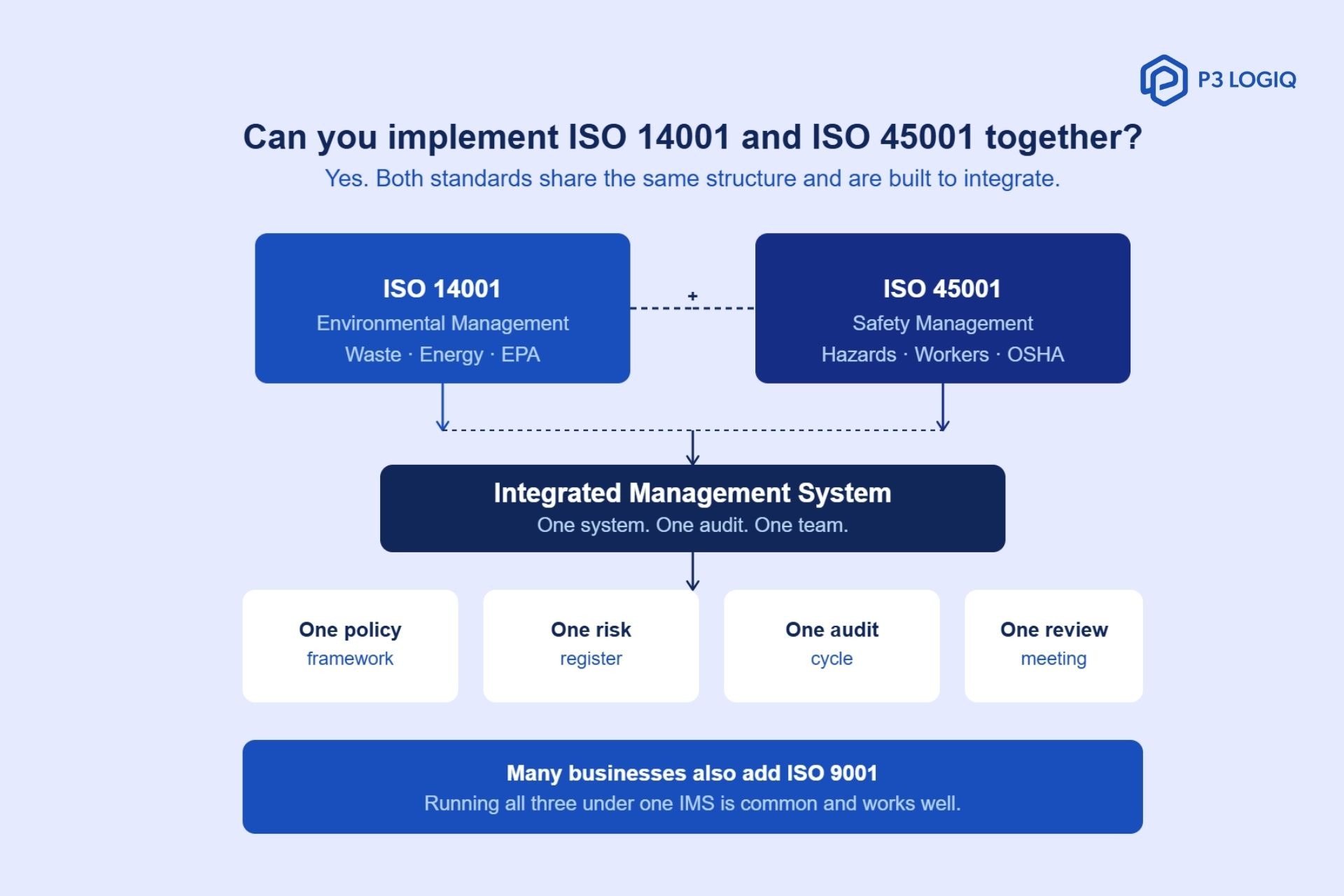
Yes, and many businesses already do.
To manage the complexity of standards, organizations often look for some of the best ISO softwares for 14001 to handle their environmental compliance and resource tracking.
Or industries in high-risk sectors, such as construction, manufacturing, and energy, frequently prioritize workplace safety by also seeking the best ISO software for 45001 to manage hazardous environments.
However, ISO 45001 was designed to be compatible with ISO 14001. Both standards follow the same structure, use similar clauses, and share the same management system approach.
This means you can combine them into a single integrated management system, often called an IMS.
Instead of running two separate systems with different audits and documentation, you manage everything in one place.
One policy framework. One risk register. One management review. One audit cycle.
The benefits are clear.
You reduce duplication across teams. Documentation becomes easier to manage. Audit costs are lower. And leadership spends less time handling separate compliance systems.
Here is a practical tip if you plan to integrate both.
Create a single risk register that includes environmental aspects from ISO 14001 and safety hazards from ISO 45001. This helps you manage both standards together without adding extra work.
Many businesses also include ISO 9001, the quality management standard, as part of the same system.
Running all three under one integrated setup is common and works well for growing organizations.
P3 LogiQ is designed specifically for this, offering the best software for different standards altogether. It allows you to streamline your audits and manage your entire IMS in one intuitive dashboard.
Book a demo today to see how simple integrated compliance can be.
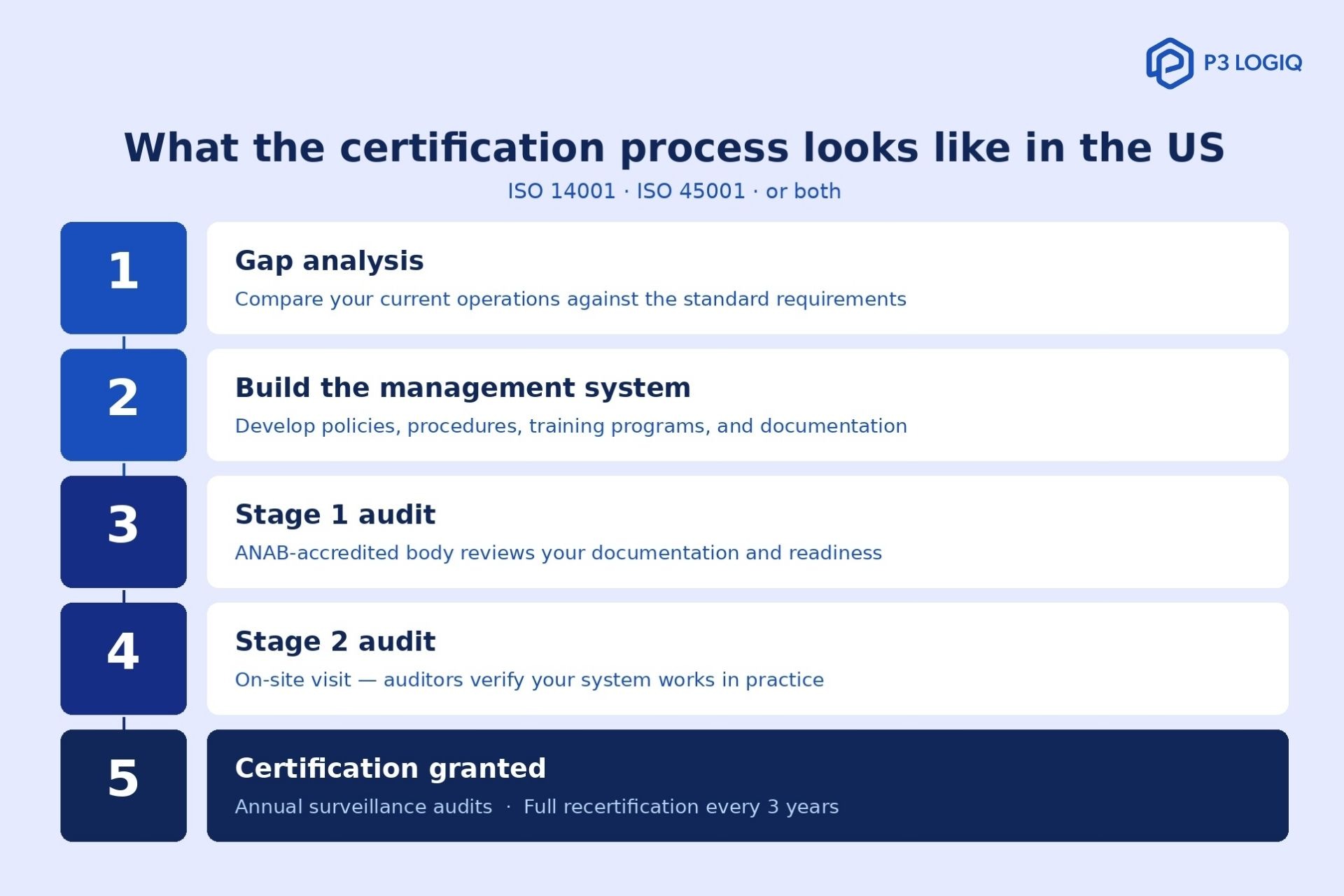
Getting ISO certified is more straightforward than most businesses expect. When you break it down, the process follows a clear set of steps.
Start by comparing your current operations against the requirements of the standard. This helps you understand what is already in place and what needs to be improved for the process to get ISO 14001 or 45001.
At this stage, you develop or update your:
Everything should align with the requirements of ISO 14001, ISO 45001, or both.
An accredited third-party certification body reviews your documentation. In the US, certification bodies are commonly accredited by recognized accreditation organizations such as the ANSI National Accreditation Board (ANAB). This stage checks if your organization is ready for the full audit.
Auditors visit your site to verify that your system is working in practice. This onsite verification is a major milestone in the process to get ISO 45001 or any other standard, as auditors speak with employees and look for evidence of safety implementation.
They will:
If you meet the requirements, your certification is issued. After that:
In the US, some well-known certification bodies include NQA, SGS, Bureau Veritas, and UL Solutions.
Each will provide a quote based on your organization’s size, scope, and industry.
The timeline varies based on how prepared your business is. Most mid-sized companies complete certification in 3 to 12 months. Costs also vary. The best way to get an accurate estimate is to request a quote directly from a certification body.
This is usually one of the first questions business owners ask. And it is a fair one.
The honest answer is that there is no single fixed price.
Cost depends on your company size, number of employees, number of locations, industry risk level, and how much of your system is already in place before the audit begins.
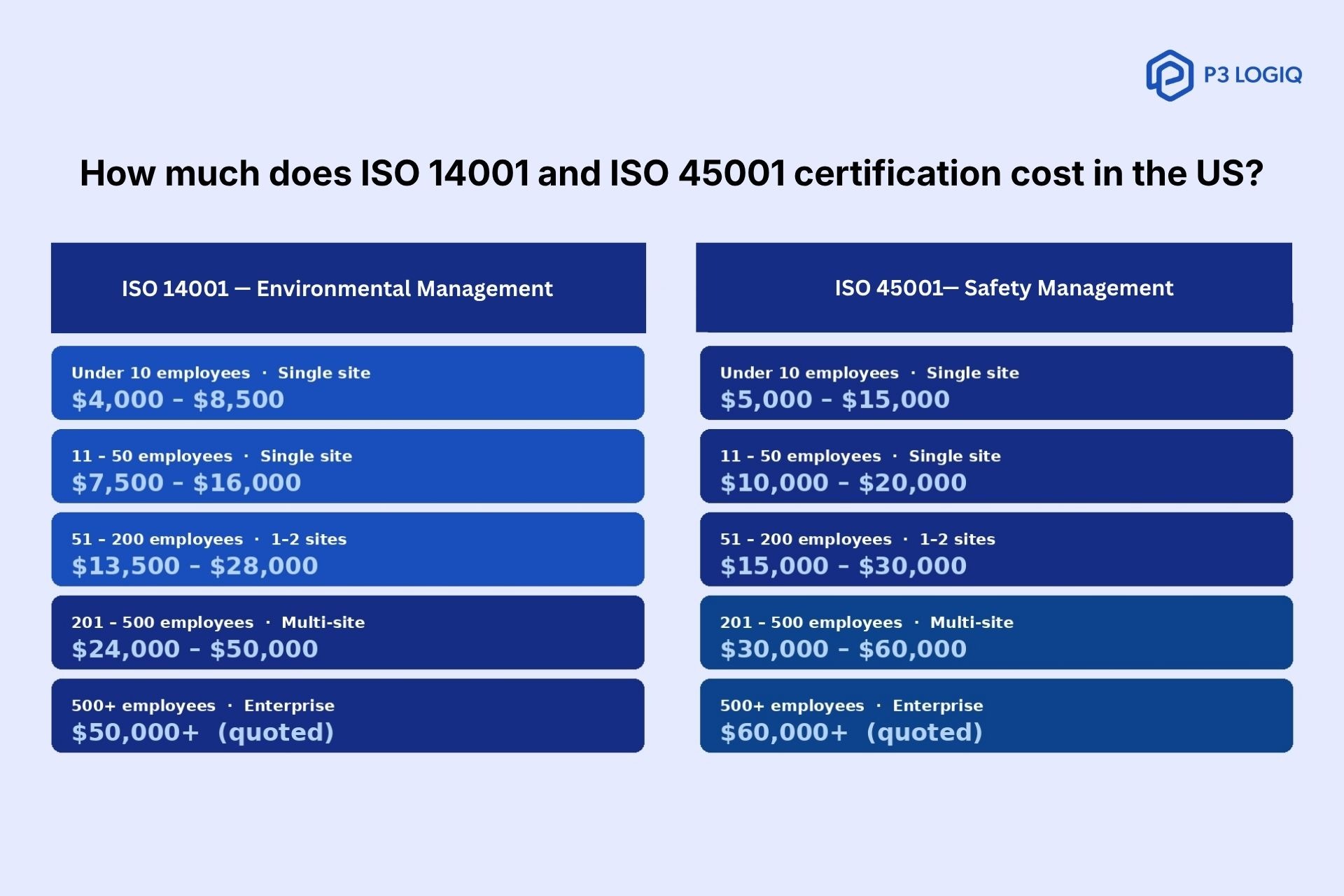
That said, here are realistic ranges based on current US market data across all business sizes.
The total ISO 14001 certification cost depends on your organization’s size, complexity, and number of locations.
For a small business with fewer than 10 employees at a single location, initial certification typically runs between $4,000 USD and $8,500 USD.
For businesses with 11 to 50 employees, expect to spend somewhere between $7,500 USD and $16,000 USD.
For medium-sized organizations with 51 to 200 employees, costs generally fall between $13,500 USD and $28,000 USD.
For larger organizations with 200 to 500 employees, the range moves up to $24,000 USD to $50,000 USD. At this level, audit complexity increases significantly. More processes, more environmental aspects to assess, and often multiple sites that need to be covered.
For enterprise-level organizations above 500 employees or those operating across multiple sites, costs typically exceed $50,000 USD and are quoted individually based on scope.
After initial certification, annual surveillance audits for small businesses run $1,500 USD to $3,500 USD per year. For larger organizations, expect $4,000 USD to $8,000 USD or more. Full recertification is required every three years and is priced similarly to the initial audit.
The ISO 45001 cost follows a similar structure.
For a small business with up to 50 employees at one site, total certification typically ranges from $5,000 USD to $15,000 USD.
For medium-sized organizations with 50 to 250 employees, costs usually fall between $15,000 USD and $30,000 USD.
For larger businesses with 250 to 500 employees, particularly in high-risk industries like construction, manufacturing, or logistics, costs commonly range from $30,000 USD to $60,000 USD. The higher the risk profile of your operations, the more audit days are required.
For enterprise organizations with 500 or more employees or multiple facilities, total project costs can run well above $60,000 USD. These organizations typically need 9 to 18 months to complete certification and often run dedicated internal project teams alongside external consultants.
Annual surveillance audits for smaller businesses run $1,000 USD to $2,000 USD per year. For mid to large organizations, budget $3,000 USD to $8,000 USD annually.
A few things can move the number up or down at any size.
How ready you are before you start? If your documentation and processes are already solid, you have less ground to cover. That brings the cost down noticeably.
Whether you hire a consultant. Bringing in outside help speeds up the process and reduces the risk of failing the audit. Consultant day rates in the US typically run from $800 USD to $2,500 USD depending on their credentials and your industry.
Whether you run both standards together or not. If you pursue ISO 14001 and ISO 45001 under one integrated management system, a combined audit typically costs 30 to 40 percent less than two separate audits. For larger organizations, that saving is significant.
Multiple sites add cost. Each site adds audit days, travel, and preparation time. The more locations you operate, the more the final quote reflects that complexity.
For most businesses in the USA, yes.
Not having a system in place can end up costing far more. According to OSHA's 2025 annual penalty adjustments, serious violations can result in fines of up to $16,550 per violation, while willful or repeated violations can reach $165,514 per violation.
Add in downtime, insurance claims, and lost contracts, and the numbers add up fast.
On the other hand, Organizations implementing ISO 14001 often improve environmental performance and resource efficiency, while ISO 45001 helps reduce workplace risks and strengthen safety outcomes.
Both certifications also help businesses qualify for larger contracts and more regulated supply chains.
In most cases, the system pays for itself. Not immediately. But faster than most business owners expect.
The plant manager from the start of this guide was not doing anything wrong.
Their team was following OSHA rules. They were managing waste responsibly. They were doing the work every day.
The gap was not an effort. It was structured.
Without ISO 14001 or ISO 45001, there was no consistent system to track performance, fix issues, or clearly show the outside world that the business was fully under control.
That is where these standards matter.
They do not replace what you are already doing. They organize it. They give it structure, consistency, and a way to improve over time instead of relying on informal processes.
ISO 14001 helps you manage your environmental impact in a clear, repeatable way. ISO 45001 helps you protect your workers by identifying risks and reducing accidents before they happen.
They are not competing standards. They are designed to work together. For many US businesses in manufacturing, construction, energy, logistics, and similar industries, they are becoming less optional and more expected.
The good part is that you do not need to do everything at once.
Start with a gap analysis. Understand where your current system stands. Then focus on the standard that solves your most urgent problem first. Build from there at a pace your business can support.
Businesses that start early do not just stay compliant. They stay ahead.
Image Name
p3 logiq-iso-9001-45001-integrated-management-platform
Alt Text
P3 LogiQ’s integrated management platform for ISO 9001 and ISO 45001 compliance, audits, and much more in a centralized system.
Caption
P3 LogiQ enables organizations to manage ISO 9001 quality and ISO 45001 safety requirements through a single integrated platform.
Managing ISO 14001 and ISO 45001 manually gets harder as your operations grow. Tracking environmental aspects, safety hazards, audits, corrective actions, and compliance deadlines across separate spreadsheets creates gaps, and gaps are exactly what auditors find.
P3 LogiQ brings everything into one centralized platform. Documentation, risk registers, internal audits, corrective actions, and management reviews for both standards are managed together in a single dashboard, so nothing falls through the cracks.
Instead of running two disconnected compliance systems, your team works from one place. This reduces duplication, keeps your audit trail clean, and makes it easier to stay ready year-round, not just when an audit is approaching.
If you are planning your ISO 14001 or ISO 45001 journey, you can book a demo with P3 LogiQ to see how both systems can be managed in one place.
You can also sign up for P3 LogiQ to simplify ISO 14001 and ISO 45001 compliance and stay audit-ready year-round.
ISO 14001 focuses on environmental management, including waste, emissions, energy use, and regulatory compliance. ISO 45001 focuses on occupational health and safety, helping businesses reduce workplace risks and prevent injuries. Both are management system standards but address completely different operational areas.
ISO 14001 is focused on a business’s environmental impact and sustainability performance. ISO 45001 focuses on worker health and safety inside the organization. One manages external environmental effects, while the other manages internal workplace risks, safety conditions, and employee protection systems.
Yes, both standards can be implemented together because they follow the same Annex SL structure. Businesses often integrate them into a single management system to reduce duplication, simplify documentation, and improve efficiency while managing both environmental and safety requirements in one framework.
ISO 14001 is most important for industries with environmental impact, such as manufacturing, energy, construction, and logistics. ISO 45001 is critical for high-risk sectors like construction, mining, and manufacturing. However, both standards can apply to any organization depending on operational risks and compliance needs.
Yes, both ISO 14001 and ISO 45001 follow the Annex SL structure. This includes shared elements like leadership, risk-based thinking, documentation, audits, and continuous improvement. This common structure makes it easier for organizations to align and integrate both systems.
Yes. Both ISO 14001 and ISO 45001 follow the Annex SL framework, which means they share the same 10-clause structure covering leadership, planning, risk management, support, operation, performance evaluation, and improvement. Because of this shared structure, the two standards can be easily integrated into a single management system, helping organizations reduce duplication, simplify audits, and manage environmental and safety requirements together.
Yes. Businesses can pursue both ISO 14001 and ISO 45001 together through an integrated management system. Since both follow the Annex SL structure, they can be implemented simultaneously, reducing duplication in documentation, audits, and training while improving efficiency across environmental and safety management processes.
Industries like manufacturing, construction, energy, logistics, and chemicals benefit most from ISO 14001 and ISO 45001. These sectors face higher environmental impact and workplace safety risks, making structured management systems essential for compliance, risk reduction, and meeting client and regulatory expectations.
Implementation typically takes between 3 to 12 months, depending on company size, complexity, and existing systems. Organizations with structured documentation and internal processes can achieve certification faster, while businesses starting from scratch may require additional time for gap analysis, training, and system development.
Yes. ISO 14001 supports compliance with environmental regulations such as EPA requirements, while ISO 45001 aligns with OSHA workplace safety standards. Both frameworks help businesses create structured systems to consistently meet legal obligations, reduce compliance risk, and demonstrate accountability during audits or inspections.


Businesses need document management systems (DMS) to ensure ISO and R2 compliance, improve efficiency, and stay audit-ready. The article highlights key features like version control, security, and automation while reviewing the top 5 DMS solutions. P3 LogiQ stands out for its compliance-focused automation and secure document tracking
Read More
Recycling businesses gain efficiency, compliance, and sustainability with RIOS certification. It streamlines quality management, environmental responsibility, and worker safety, helping companies avoid legal risks and boost credibility. P3 LogiQ simplifies the certification process with automation, document control, and compliance tracking, making operations smarter and safer.
Read More
Audit Management Software (AMS) automates compliance tracking, streamlines workflows, and reduces audit risks. Key features include automated scheduling, compliance checklists, CAPA tracking, vendor risk management, and integrations.
Read More
Learn how audit management systems simplify ISO and R2 compliance by automating audits, managing documentation, and minimizing compliance risks efficiently.
Read More
In 2025, many businesses still face challenges in compliance management due to outdated methods like spreadsheets and fragmented software. This inefficiency leads to missed deadlines, increased risk, and regulatory penalties. The blog emphasizes the importance of modern compliance tools that automate workflows, enhance risk management, and streamline regulatory processes to meet ISO and R2 standards.
Read More
The rise in e-waste and environmental concerns makes responsible electronics recycling essential. The R2 Certification sets a global standard for safe, sustainable, and data-secure recycling practices. Developed by Sustainable Electronics Recycling International (SERI), R2 helps businesses manage environmental risks, data security, worker safety, and legal compliance.
Read More
Businesses face increasing challenges in managing complex regulatory compliance. Manual methods such as spreadsheets and paperwork can lead to missed deadlines, inefficiencies, and costly penalties. Compliance management software offers a streamlined solution to reduce risks, automate processes, and improve operational efficiency.
Read More
Maintaining R2 Certification is crucial for businesses in the e-waste recycling industry, ensuring regulatory compliance, sustainability, and strong stakeholder trust. This guide outlines 10 best practices to help businesses simplify operations, reduce risks, and stay compliant.
Read More
Unlock the value of ISO risk management certification. Explore its impact on compliance, risk mitigation, and business expansion.
Read More
Explore the top 5 ISO risk management software tools for 2025, including document management solutions for streamlined compliance and increased efficiency.
Read More
Find the ideal document management software (DMS) for your business. Learn how to choose with expert tips, key features, and insightful guidance
Read More
Unlock the power of a Document Management System (DMS). Learn how it can revolutionize your business operations.
Read More







.png)


.png)




.jpg)



.jpg)
.jpg)








.jpg)



.png)

.png)
.png)


.png)

