.jpg)
I was talking to a business owner some time back who was caught in a tough spot.
He had just come across a massive RFP for a new contract that he knew he could win. He had the team, the equipment, and the experience to do the job better than anyone else.
But when the results came in, he found out he had lost the bid.
And when he asked why, the answer felt frustratingly simple. The buyer needed to see an ISO certification, and he just didn't have one.
This is a common hurdle for many growing companies. In fact, studies from the ISO 9001 Council show that certification often acts as a badge of quality. It is often the primary key that helps companies access new markets and customers. Without it, you might not even get a seat at the table.
"I have the best shop in the state," he told me. "But they wouldn't even look at my work because I didn't have the right badge on my website. Now I'm looking at these standards, and I'm lost. Which one do I even get? I keep seeing ISO 9001 and 45001 everywhere. Are they the same? Do I need both?"
If you are a business owner, you have probably asked the same thing. It can feel like alphabet soup when you are just trying to grow your company and keep your team safe.
Whether you have been searching for ISO 9001 and ISO 45001 or just stumbled onto these terms, here is the truth. Choosing between ISO 9001 and ISO 45001 is not about picking which "rules" to follow.
It is about deciding where your business needs the most help right now. Is it the quality of what you ship out, or the safety of the people inside your building?
In this guide, I will break down the difference between ISO 9001 and ISO 45001 so you can stop guessing and start growing.

Let’s start with the big one.
ISO 9001 is all about your output. It is a Quality Management System (QMS) that focuses on one person: your customer.
Think of it as a promise. When you have this certification, you are telling the world that your processes are rock solid. Whether you make car parts, provide IT services, or anything in between, your customers know they will get the same high quality every single time they work with you.
In the US, this is the most common standard businesses pursue. In fact, it has become the foundational benchmark that the vast majority of small businesses prioritize before moving on to any other certification
Why? Because it opens doors.
Many big corporations and government agencies will not even let you bid on a project unless you are ISO 9001 certified. It proves you aren't just winging it. You have a system for leadership, a plan for risks, and a commitment to getting better every day.
If your main goal is to win more contracts and make sure your customers stay happy, ISO 9001 is your starting point. A dedicated ISO 9001 management software can help you build and maintain that system without the overwhelm.

Now, let’s look at the other side of the coin.
While ISO 9001 looks at the product leaving your building, ISO 45001 looks at the people inside it. It is the global standard for Occupational Health and Safety.
If you are in an industry with physical risks, like construction, manufacturing, or logistics, this is your most important shield. It helps you find hazards before they turn into accidents.
In the US, we have OSHA regulations that tell you what you must do to avoid fines. ISO 45001 goes a step further. It gives you a way to build a real safety culture.
It replaced the old OHSAS 18001 system in 2018 to make safety part of your daily leadership, not just an HR checklist. When you implement this, you aren't just following rules. You are protecting your team and your bottom line from the high cost of workplace injuries. An ISO 45001 compliance tool can make that process a lot more manageable.
When you are looking at these two standards, it helps to see them side by side. One is focused on the "what" (your product), and the other is focused on the "who" (your people).
Think of it this way. If a customer receives a broken part, that is an ISO 9001 issue. But if a worker gets hurt while making that part, that is an ISO 45001 issue.
Both are important, but they protect different parts of your business. Here is a quick breakdown of how they stack up against each other:

This makes it easier to quickly see which standard fits your business needs.
It is also important to remember the "Why" behind each one.
ISO 9001 is often about growth and reputation. It shows the world that you are a professional partner who delivers on your promises. Most small businesses start here because it is the most recognized "badge" of quality in the world.
ISO 45001 is about responsibility and protection. It shows your team that you care about their well-being. It also protects your wallet. A single workplace injury can cost a business in the USA an average of $43,000 in direct costs, according to the National Safety Council work injury report.
So, while one helps you win the contract, the other helps you keep the profit from that contract by avoiding accidents and fines.
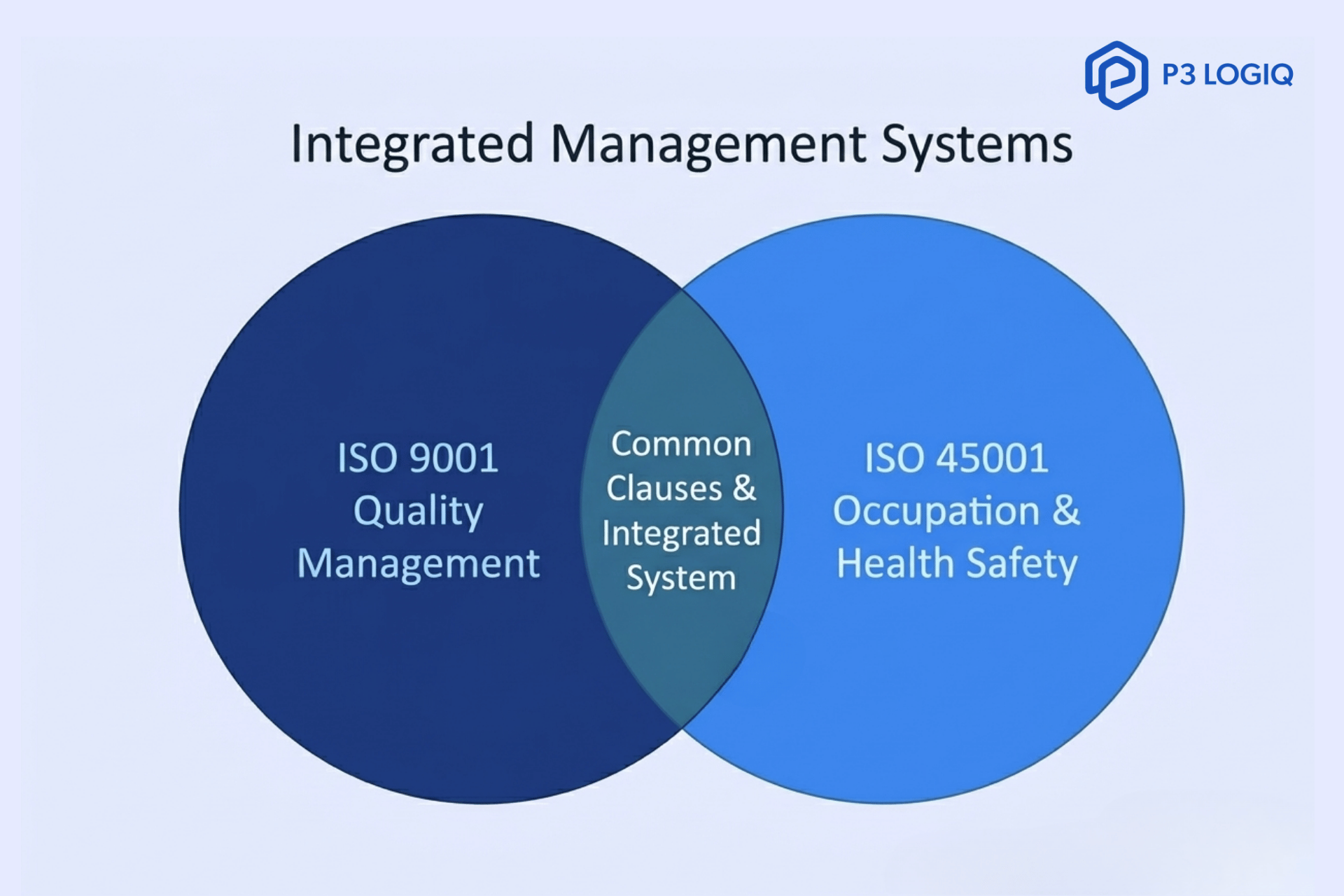
Despite having different goals, ISO 9001 and ISO 45001 share a lot of the same "structural DNA." If you are a business owner considering both ISO 9001 and 45001, this is great news. It means you aren't reinventing the wheel twice.
Both standards are built on a framework called Annex SL, also known as the Harmonized Structure. This is just a fancy way of saying they use the same outline.
Think of it like building two different rooms in the same house. They have different furniture, but the foundation and the main walls are identical. Experts from the American Society of Safety Professionals (ASSP) highlight that this shared structure is designed to help you integrate your safety management directly into your overall business operations.
Because of this, they both focus on:
By using this shared structure, you aren't doing double the work. You are just applying the same smart management style to two different parts of your business.
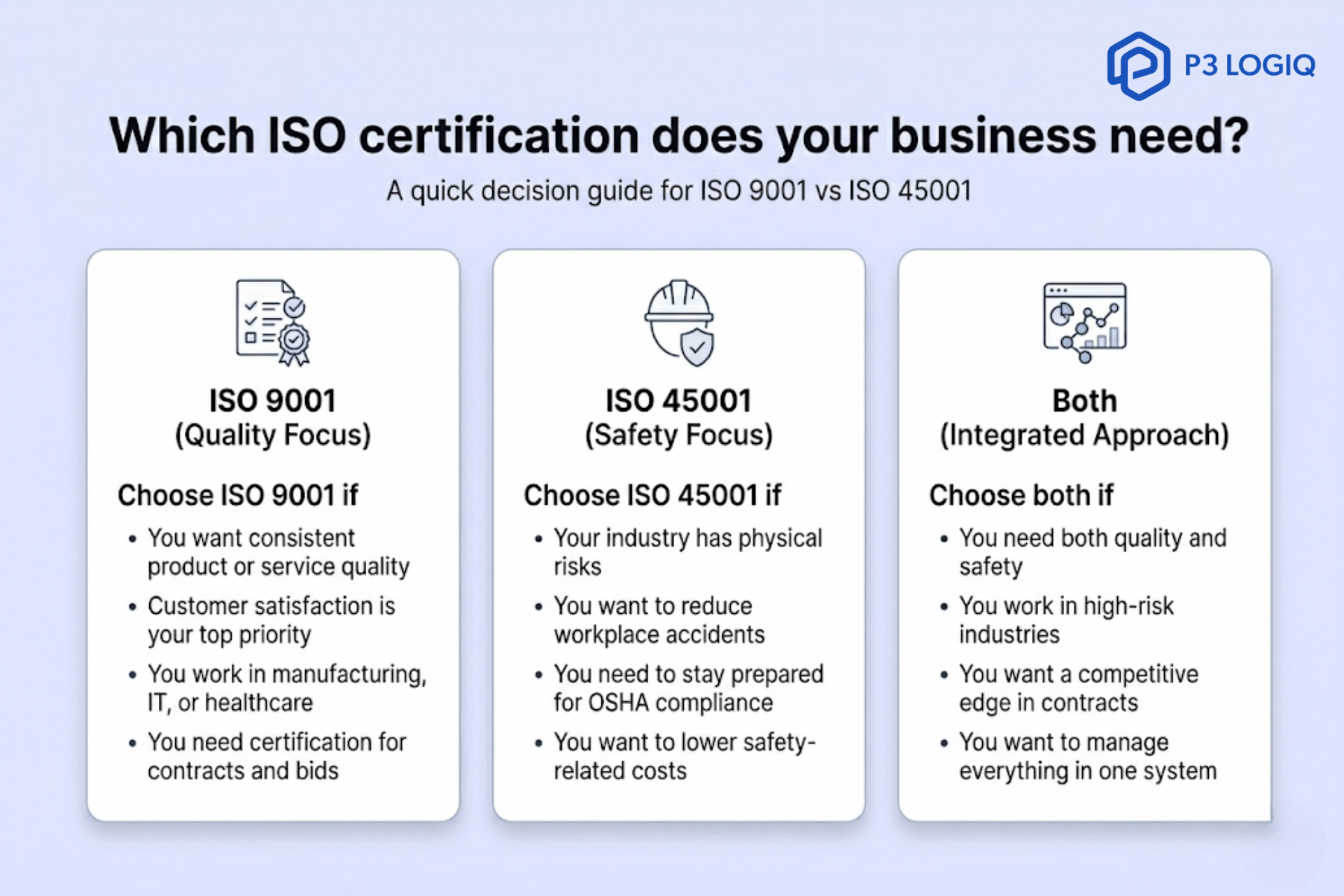
Think of this as your decision guide. Every business is different, so your priority depends on what matters most to your operations right now.
Your main goal is to keep your customers happy and deliver good quality every time. If you work in manufacturing, IT, or healthcare, this matters a lot.
ISO 9001 helps you show that you can do this consistently. It builds trust and tells your customers they can rely on you to deliver what you promised.
In many industries, especially for government or large company contracts, you often need ISO 9001 just to get considered. The ISO 9001 benefits go beyond winning the bid. They help you improve processes and maintain quality as your business grows.
Your work involves physical risks like construction, manufacturing, or warehousing. You want to reduce workplace accidents and stay prepared for OSHA checks while also lowering insurance costs.
But it is not just about avoiding fines. ISO 45001 is also beneficial for you to build a safer workplace and attract better employees who value safety.
If you are exploring ISO 9001 and 45001 together, this option is for businesses that work in high-risk industries and that also need to maintain strong product or service quality. Having both certifications can give you a clear advantage when applying for contracts that require high standards.
To manage both easily, tools like ISO risk management software can help you track quality and safety in one place, instead of dealing with multiple spreadsheets.
Yes, many businesses already use ISO 9001 and 45001 together, as mentioned above. Using both standards together helps you manage quality and workplace safety at the same time, without running two separate systems.
You can create what is called an Integrated Management System (IMS). This simply means combining both systems into one setup so your processes, audits, and documentation work together instead of separately.
According to the International Organization for Standardization, companies are increasingly combining management systems to keep things simple and more efficient. This helps teams avoid duplicate work and stay more organized.
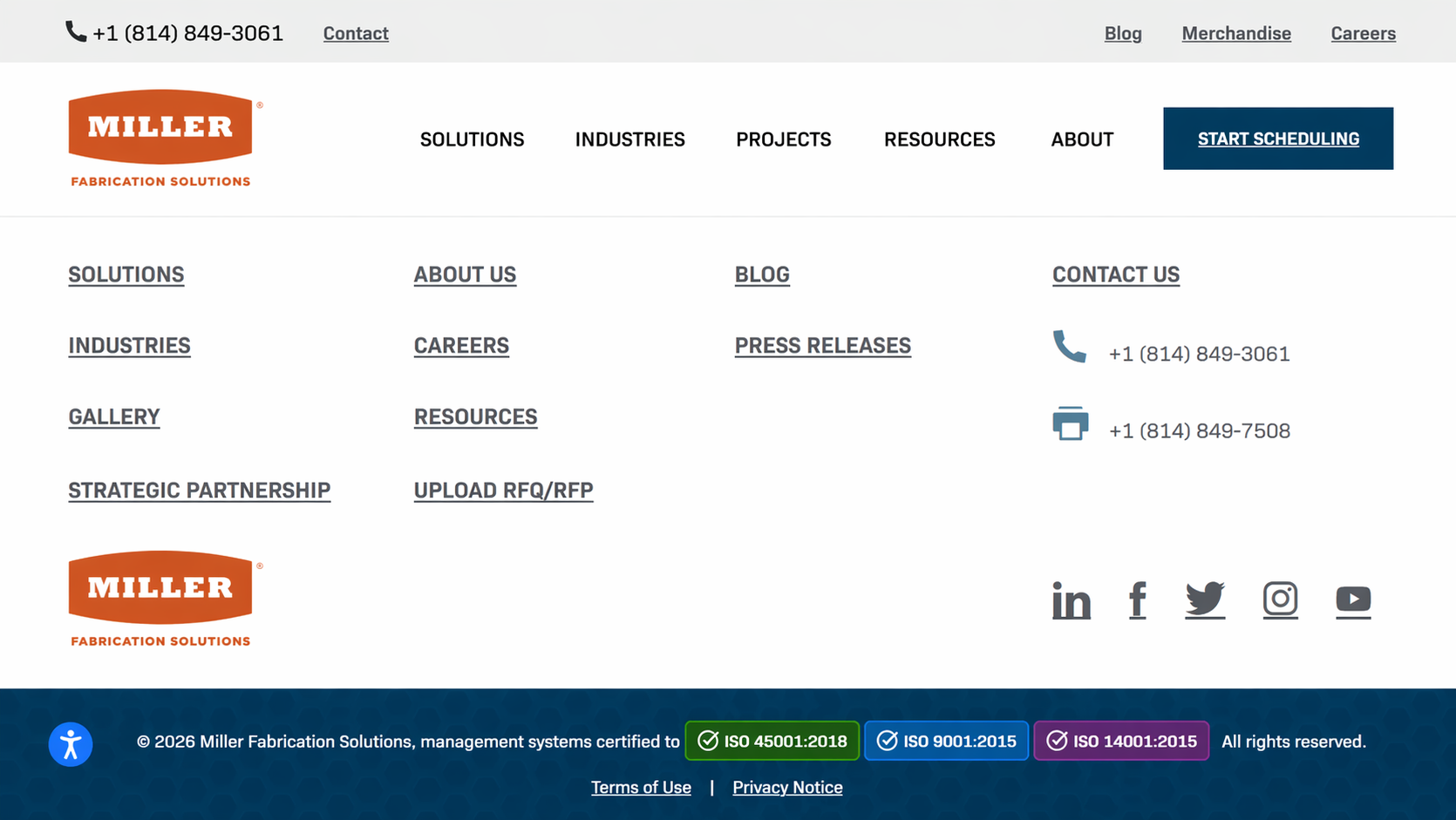
A good example of this in practice is Miller Fabrication Solutions, a manufacturing company based in the US. As shown in the footer above, the company is certified to ISO 9001:2015 and ISO 45001:2018 (along with ISO 14001).
In real terms, this means:
By using both systems together, Miller Fabrication Solutions can run its operations smoothly while also keeping the workplace safe.
This is exactly how an integrated system works in practice, not as separate frameworks, but as one connected system guiding daily operations.
There are also clear benefits. Businesses that focus on both quality and safety often see fewer errors, fewer workplace incidents, and smoother daily operations. It also makes audits easier and builds stronger trust with clients.
If you are planning to manage both standards without adding extra complexity, tools like P3 LogiQ can help you bring everything into one place. This makes it easier to track processes, audits, and risks without relying on scattered tools.
If you want to see how this can work for your business, you can start with a quick demo to understand how both ISO 9001 and ISO 45001 can be managed together more easily.
The cost of ISO 9001 and 45001 certification in the US depends on your business size, number of employees, and how prepared your system is.
For ISO 9001, most businesses spend around $10,000 or more in total. This usually includes preparation work, consultant support, and the certification audit itself. The audit alone can cost between $3,000 and $5,000 USD, while preparation and consulting can range from $5,700 to $15,000 USD, depending on your needs.
You can get a clearer idea of the ISO 9001 certification cost based on your business setup. There are also ongoing costs for annual audits.
For workplace safety, the ISO 45001 certification cost is similar for small and mid-sized businesses, but it can increase for larger or multi-site companies. This is because audits need to cover multiple locations and higher-risk operations. Costs also vary based on how strong your current safety system is and whether you need external consultants.
One simple way to reduce costs is to implement both standards together. When you combine them into one system, you avoid doing the same work twice and make the process more efficient.
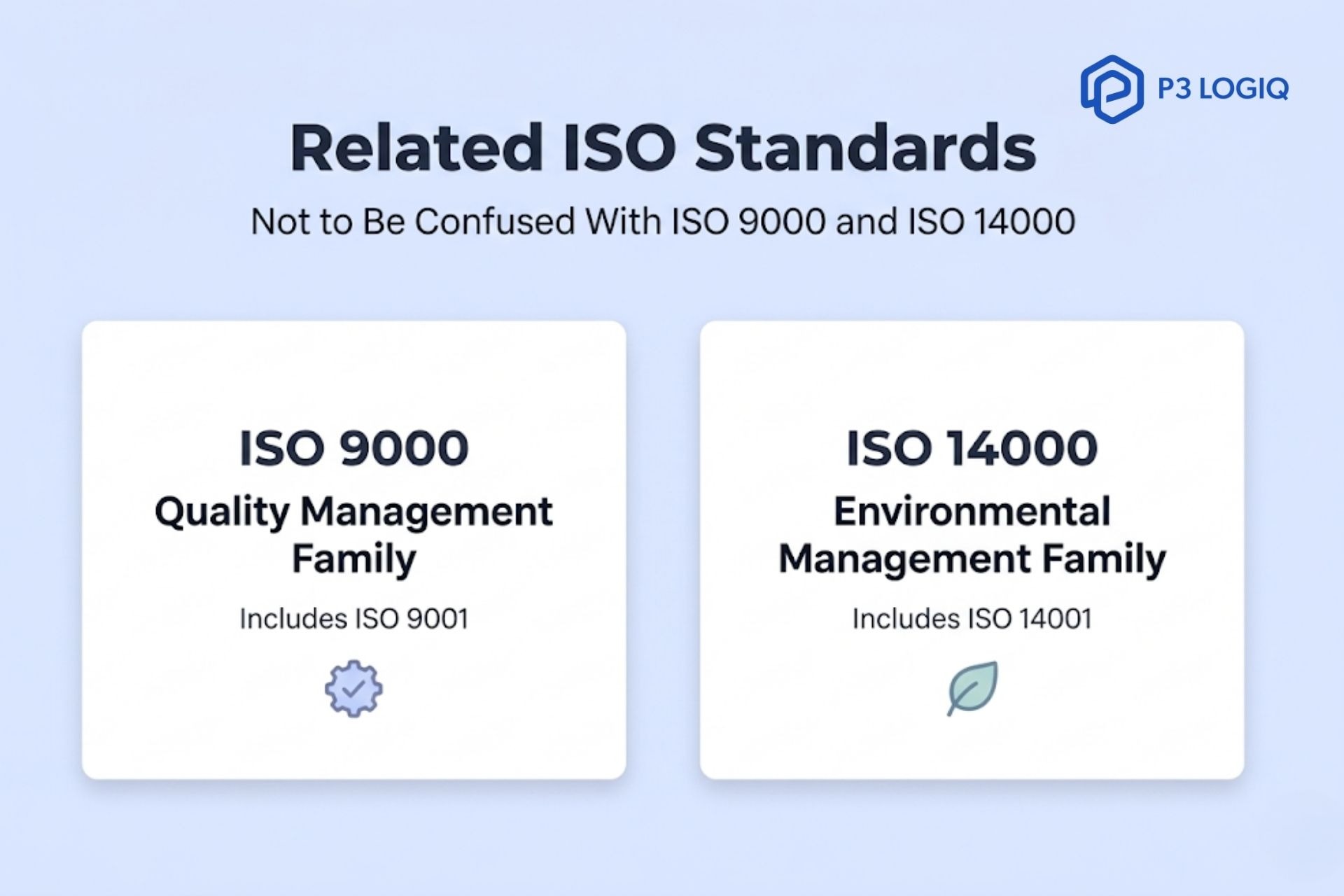
If you are wondering about the difference between ISO 9000 and ISO 14000, the answer is simpler than it sounds.
ISO 9000 is an umbrella of standards focused on quality management. ISO 9001 is the main standard within this group that businesses get certified for.
ISO 14000 is an umbrella of standards focused on environmental management. ISO 14001 is the certification standard in this case.
Each one has a clear role. ISO 9001 helps you improve quality, ISO 14001 focuses on reducing environmental impact, and ISO 45001 is about keeping your workplace safe.
Many businesses in the US choose to use all three together. This helps them manage quality, safety, and environmental responsibilities in a more structured and organized way.
Getting started with ISO certification is easier when you break it into simple steps.
Identify your priority. You may want to improve quality, workplace safety, or both, depending on your business needs.
Review your current processes. This helps you understand what is already working and where the gaps are. A step-by-step guide on how to get ISO 9001 certification is the fastest way to bridge those gaps and move toward your audit.
Build your system. This includes creating clear processes, policies, and goals that your team can follow.
Train your team. Everyone should understand their role and how the system works in day-to-day tasks.
Finally, choose a certification body. In the US, it is best to work with the one accredited by the ANSI National Accreditation Board, so your certification is widely accepted.
ISO 9001 is all about delivering consistent quality to your customers. ISO 45001 focuses on keeping your workplace safe and protecting your team. When you look at ISO 9001 and 45001 side by side, one helps you deliver consistent results while the other protects your team.
Both follow a similar structure, which makes it easier to use them together as your business grows.
You can start with one based on what your business needs right now or combine both to build a more complete system over time. Many businesses in the US do exactly this to improve both quality and safety without adding extra complexity.
In the end, instead of just the certification. It is about building systems that actually help your business run better every day.
Managing ISO 9001 and ISO 45001 manually can quickly become difficult as your business grows. P3 LogiQ helps simplify the process by bringing documentation, audits, corrective actions, and risk management into one centralized platform.
Instead of handling multiple spreadsheets and disconnected systems, teams can manage quality and workplace safety together through a single dashboard. This makes compliance easier, improves visibility, and reduces operational confusion.
You can start with a quick demo today to see how P3 LogiQ helps businesses manage ISO quality and safety systems more efficiently.
The fundamental distinction lies in their primary objective. ISO 9001 focuses on improving product and service quality to keep customers satisfied by streamlining internal operations. In contrast, ISO 45001 focuses on workplace safety, helping businesses reduce risks, prevent accidents, and create a safer, healthier environment for all employees.
The decision depends entirely on your specific organizational needs. Choose ISO 9001 if your primary goal is to enhance product consistency and improve the customer experience. Choose ISO 45001 if your business involves high-risk activities or physical safety hazards. Many modern companies choose both to balance high-quality output and total employee safety.
ISO 9001 and ISO 45001 can be seamlessly combined into one integrated management system. Since they follow a similar Annex SL structure, businesses can manage quality and safety together without duplicating documentation or work. This integration makes internal processes significantly simpler, more efficient, and easier for the workforce to follow consistently.
Yes, both standards follow the high-level framework known as Annex SL, which makes the integration process much easier. This shared structure helps businesses align their core processes, documentation, and external audits. By utilizing this common language, managing both systems together becomes more organized, cohesive, and far less time-consuming for management.
Neither standard is inherently more important than the other; their value is determined by your industry. ISO 45001 is absolutely critical for safety-focused industries like construction or manufacturing, while ISO 9001 is essential for maintaining brand reputation and quality. The right choice depends strictly on your business priorities and operational risks.
Yes, small businesses can certainly implement both standards to gain a competitive edge. They can choose to start with one based on their immediate operational needs and gradually expand over time. Alternatively, they can combine both from the beginning to build a strong, professional system for quality and safety from the ground up.


Businesses need document management systems (DMS) to ensure ISO and R2 compliance, improve efficiency, and stay audit-ready. The article highlights key features like version control, security, and automation while reviewing the top 5 DMS solutions. P3 LogiQ stands out for its compliance-focused automation and secure document tracking
Read More
Recycling businesses gain efficiency, compliance, and sustainability with RIOS certification. It streamlines quality management, environmental responsibility, and worker safety, helping companies avoid legal risks and boost credibility. P3 LogiQ simplifies the certification process with automation, document control, and compliance tracking, making operations smarter and safer.
Read More
Audit Management Software (AMS) automates compliance tracking, streamlines workflows, and reduces audit risks. Key features include automated scheduling, compliance checklists, CAPA tracking, vendor risk management, and integrations.
Read More
Learn how audit management systems simplify ISO and R2 compliance by automating audits, managing documentation, and minimizing compliance risks efficiently.
Read More
In 2025, many businesses still face challenges in compliance management due to outdated methods like spreadsheets and fragmented software. This inefficiency leads to missed deadlines, increased risk, and regulatory penalties. The blog emphasizes the importance of modern compliance tools that automate workflows, enhance risk management, and streamline regulatory processes to meet ISO and R2 standards.
Read More
The rise in e-waste and environmental concerns makes responsible electronics recycling essential. The R2 Certification sets a global standard for safe, sustainable, and data-secure recycling practices. Developed by Sustainable Electronics Recycling International (SERI), R2 helps businesses manage environmental risks, data security, worker safety, and legal compliance.
Read More
Businesses face increasing challenges in managing complex regulatory compliance. Manual methods such as spreadsheets and paperwork can lead to missed deadlines, inefficiencies, and costly penalties. Compliance management software offers a streamlined solution to reduce risks, automate processes, and improve operational efficiency.
Read More
Maintaining R2 Certification is crucial for businesses in the e-waste recycling industry, ensuring regulatory compliance, sustainability, and strong stakeholder trust. This guide outlines 10 best practices to help businesses simplify operations, reduce risks, and stay compliant.
Read More
Unlock the value of ISO risk management certification. Explore its impact on compliance, risk mitigation, and business expansion.
Read More
Explore the top 5 ISO risk management software tools for 2025, including document management solutions for streamlined compliance and increased efficiency.
Read More
Find the ideal document management software (DMS) for your business. Learn how to choose with expert tips, key features, and insightful guidance
Read More
Unlock the power of a Document Management System (DMS). Learn how it can revolutionize your business operations.
Read More



.png)
.png)



.jpg)



.jpg)
.jpg)




.jpg)

.png)
.png)
.png)


.png)

