

Ever noticed how some businesses just feel.. smooth?
Orders arrive on time. Support actually responds. Nothing feels chaotic behind the scenes. Now compare that to a place where things are messy. Delays, confusion, things slipping through the cracks.
That difference usually isn’t luck.
It often comes down to how the business is run and what they prioritize.
Now here’s where it gets interesting. Two companies can be equally “organized,” but for completely different reasons. One might be focused on getting processes right and delivering consistent quality. The other might be more focused on reducing waste, cutting environmental impact, and staying responsible in how they operate.
That’s basically the difference between ISO 9001 and ISO 14001.
If you look at how the International Organization for Standardization itself explains it, ISO 9001 is built around quality management, making sure products and services are consistent and reliable.
ISO 14001, on the other hand, focuses on environmental management, helping organizations reduce their environmental impact and operate more sustainably. Both are global standards. Both help businesses improve. But they solve very different problems.
In this blog, I will break down the real difference between ISO 9001 and ISO 14001 in simple terms.
And more importantly, help you figure out which one actually makes sense for your business.
Let’s keep this simple.
ISO 9001 is really about one thing...
making sure your business delivers consistent quality, not just on good days, but every day.
Because if you think about it, work isn’t always consistent.
Some days everything runs perfectly.
Other days... things slip. A delay here. A missed detail there. Maybe a client isn’t fully happy.
That pattern? That’s exactly what ISO 9001 tries to fix.
That pattern? That’s exactly what ISO 9001 tries to fix.
You might already have good people and solid intentions. The challenge is making sure everyone follows the same process every time. When information is scattered across documents, emails, and spreadsheets, consistency becomes difficult to maintain.
That's why conversations around ISO 9001 often extend beyond the standard itself and into tools that support it. If you've ever compared the best ISO 9001 software options, you're really looking for a way to make quality management easier to maintain as your business grows.
Instead of relying on people to “figure things out,” it pushes you to build clear, repeatable processes.
ISO 9001 doesn’t tell you to “work harder.”
It makes you stop and ask:
Where is the delay actually happening?
Is it planning, communication, or execution?
Once you see the gap, you fix the process... not just the one mistake.
Do that a few times, and things start changing.
Customers know what to expect.
Your team isn’t guessing anymore.
And you spend way less time fixing the same problems again and again.
This focus on structured improvement is why ISO standards continue to evolve over time. As organizations face new business expectations, regulatory requirements, and sustainability goals, standards are updated to remain relevant. That's also why many businesses keep an eye on resources such as an ISO 14001:2026 Complete Guide, which helps explain the latest environmental management requirements and what has changed from previous versions.
Whether you're working on quality management, environmental management, or both, the goal remains the same: create systems that are consistent, measurable, and capable of improving over time.
At its core, ISO 9001 comes down to three things:
It doesn’t matter whether you’re a startup or a large company.
If you want your work to feel reliable, this is the structure that helps you get there.
A global symbol of environmental responsibility, ISO 14001 reflects a commitment to sustainability, compliance, and continuous improvement.
ISO 14001 usually comes into the picture a bit differently.
Not when everything is broken.
But when something starts feeling off.
Maybe there’s more waste than expected.
Utility bills keep creeping up.
Or clients casually start asking what you’re doing about sustainability.
Nothing urgent. But enough to make you pause.
If you've reached that point, you've probably already started looking for answers. Maybe you've read a few articles, spoken with consultants, or even searched for the best ISO 14001 software to understand how other organizations track environmental goals, compliance requirements, and improvement initiatives. What you're really trying to figure out is whether there's a more structured way to manage all of this.
That's where ISO 14001 fits in.
It gives you a framework for understanding how your operations affect the environment and where improvements can realistically be made. Instead of reacting to waste, rising resource consumption, or compliance concerns as they appear, you start looking at them as part of a system that can be measured, managed, and improved over time.
It gives you a structured way to understand how your operations impact the environment, and then improve that step by step.
Not all at once. Not dramatically. Just... steadily.
In day-to-day terms, that usually means:
And just as important... getting your team to actually notice these things.
Because most of the time, waste doesn’t feel like a problem. It just feels normal.
A machine running longer than necessary. Materials being discarded without much thought. Lights left on after everyone has gone home.
When you start looking closely at these everyday habits, the ISO 14001 benefits become much easier to understand. You're not chasing sustainability goals just to tick a box. You're finding practical ways to reduce waste, use resources more efficiently, and build processes that make environmental responsibility part of how the business operates every day.
The goal isn't perfection. It's creating a system that helps you make better environmental decisions consistently, one improvement at a time.
Take a simple example.
You run a small printing setup.
Paper gets wasted in test prints.
Machines stay on longer than needed.
Ink usage isn’t really tracked.
Individually, it’s nothing serious. But over time, it adds up… in cost and impact.
With ISO 14001, you start paying attention.
You reduce unnecessary prints.
You switch off machines when they’re not in use.
You track basic resource usage.
Small changes. But consistent ones.
And slowly, it turns into a system that saves money… and makes your business more responsible at the same time.
This is where things get real.
Because at this point, it’s not about understanding standards anymore…
It’s about figuring out what’s actually going wrong in your business.
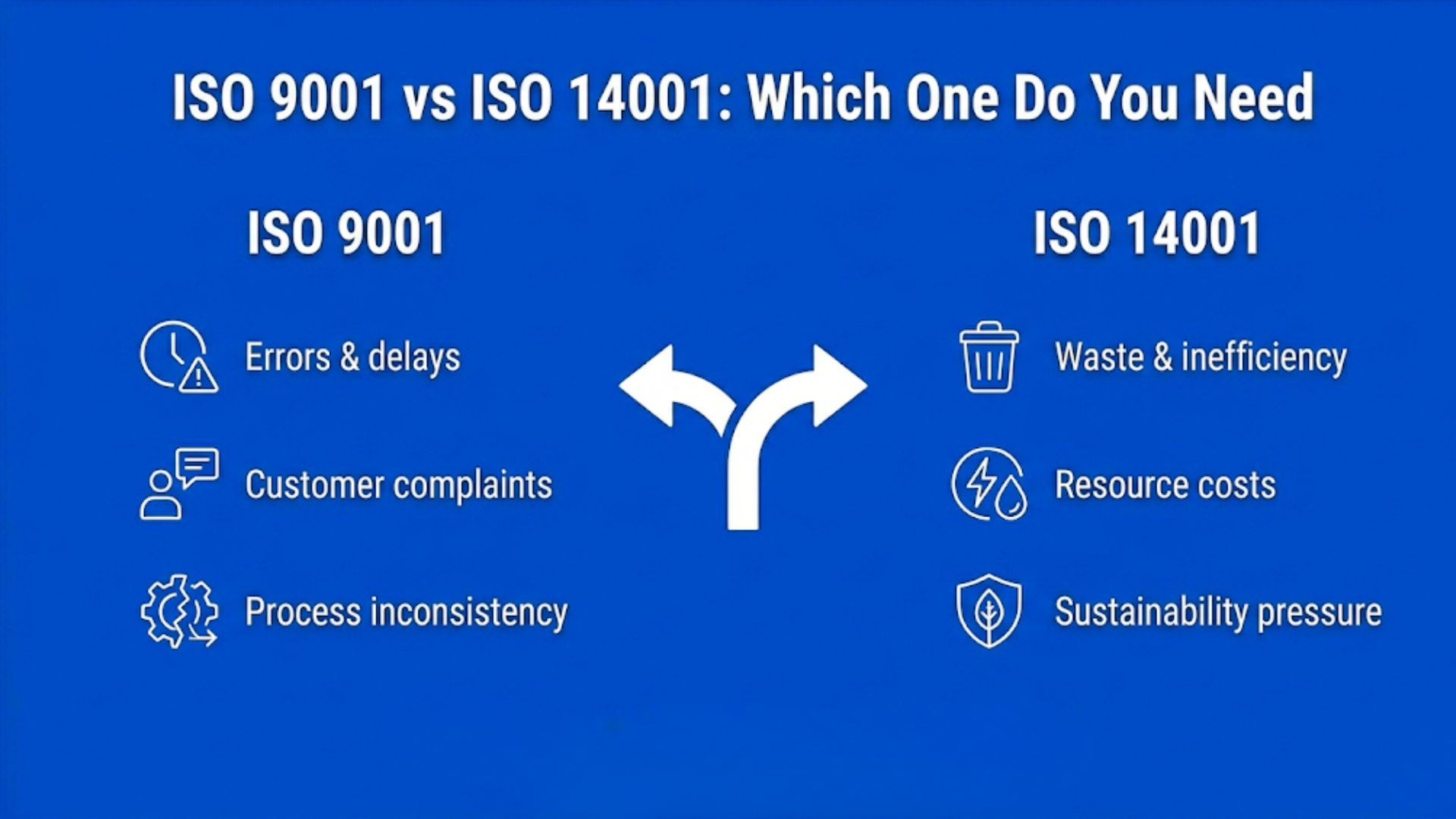
You don’t need both just because they sound important.
You need the one that solves your current problem.
So think about your day-to-day work for a second.
Where do things break more often?
If it’s this:
Then the issue is clearly around quality and process control. That’s ISO 9001 territory.
Now look at the other side.
If you’re noticing:
Then the problem is more about resource usage and environmental impact. That’s where ISO 14001 comes in.
And honestly… a lot of businesses sit somewhere in between.
Things feel slightly messy internally.
And at the same time, there’s no real control over waste.
In that case, using both standards together can actually bring clarity instead of confusion.
A simple way to decide?
Ask yourself this:
What is costing you more right now… lost customers or wasted resources?
If customers aren’t coming back or your output feels inconsistent, fixing quality will give faster results.
If money is quietly leaking through waste or you’re feeling pressure around environmental practices, that’s where your focus should go.
You don’t need to fix everything at once.
Start where the problem is most visible. Build from there.
Once you know what’s not working, the next step is… making sure it actually gets fixed properly.
Not just once. But consistently.
That’s where platforms like P3 LogiQ come in.
Whether your focus is fixing inconsistent processes, reducing waste, or managing both together, it adapts to what your business needs right now.
You don’t have to force-fit a standard. You build the right one around your real challenges.
It brings your processes, documentation, and tracking into one flow, so you’re solving the problem at its root, not just preparing for an audit.
Book a free demo call or sign up and P3 LogiQ will help you move ahead with the right ISO approach, with a smoother and more practical path to certification.
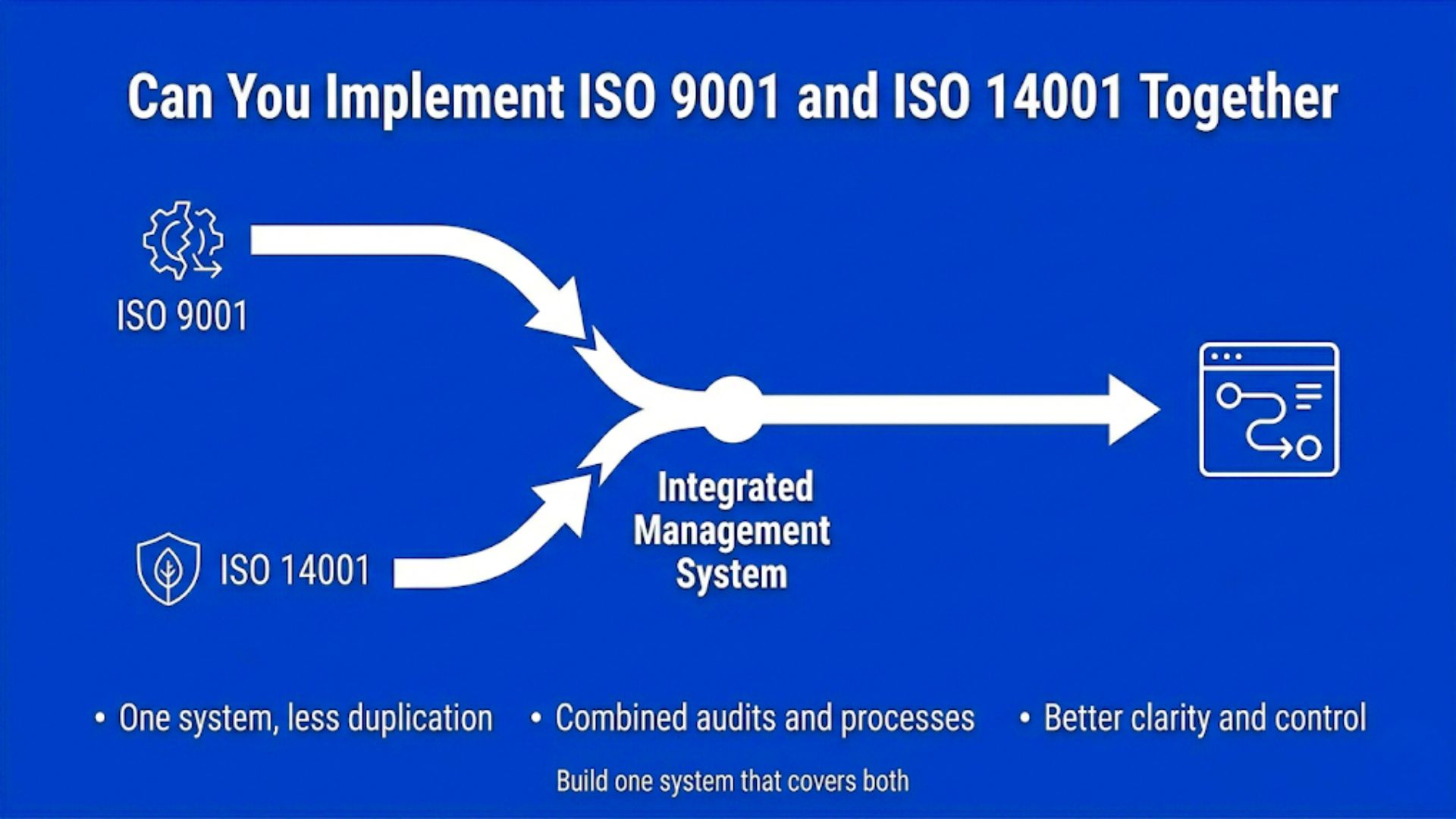
Short answer… Yes, you can.
And in many cases, it actually makes things easier.
The reason is pretty simple.
What that means in practice is:
So you’re not doubling your work. You’re just expanding it a bit.
Think about it like this.
Quality issues and environmental impact don’t happen separately in real life. They’re both part of how your business operates.
When you manage them together:
Instead of building two systems, you build one that covers both.
You map your processes once.
Identify risks once.
And add controls for quality and environmental impact within the same flow.
Over time, that reduces duplication, saves effort, and gives you better control.
And more importantly… it actually supports how your business runs, instead of adding extra layers on top of it.
This is the part no one really talks about.
On paper, ISO 9001 and ISO 14001 look structured, logical… even straightforward. But when a business actually starts implementing them, things get messy pretty quickly.
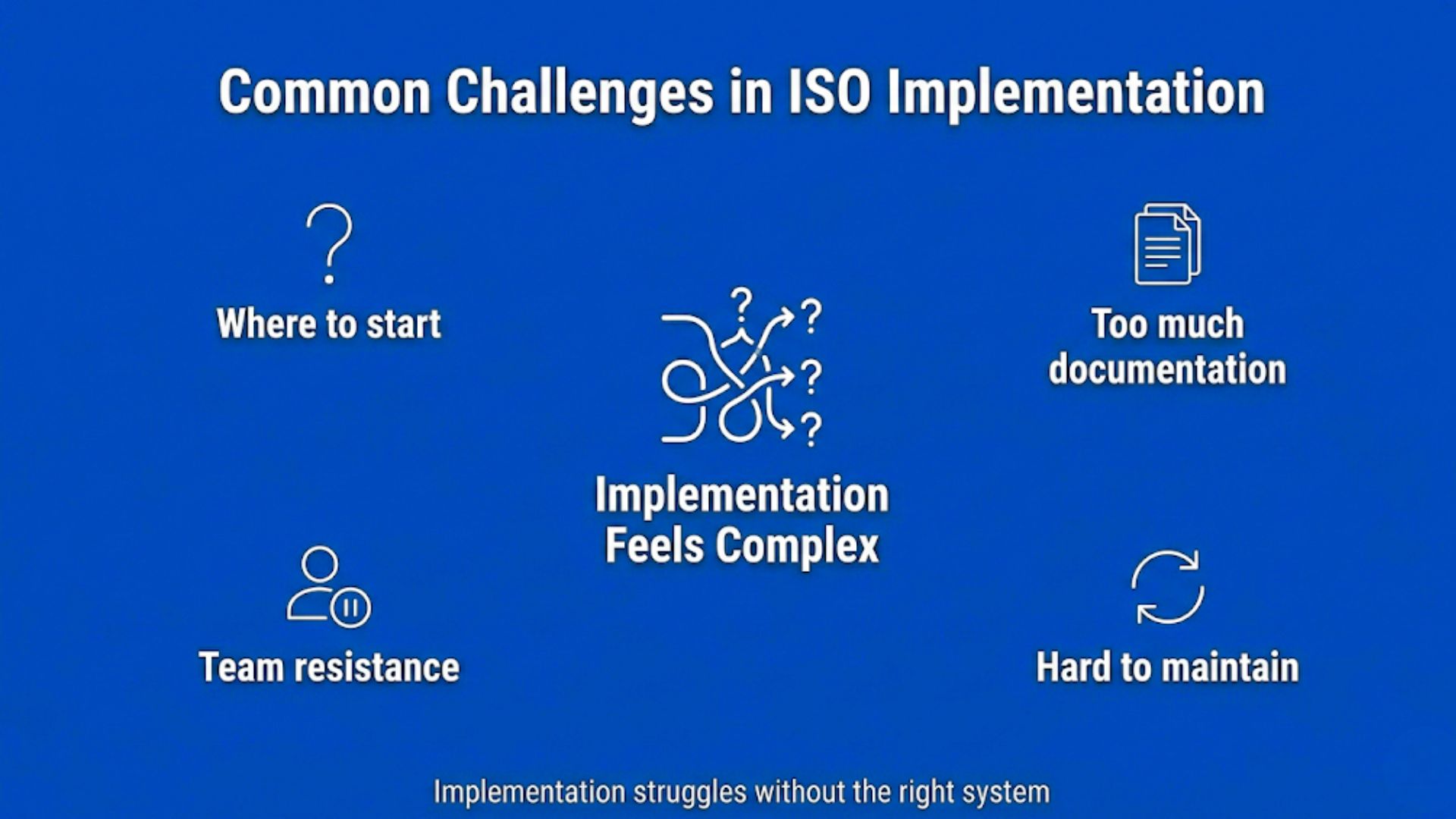
The first big hurdle is usually figuring out where to start.
Most teams know they need documentation, processes, audits, and compliance controls. But translating those requirements into real, day-to-day work is where confusion often begins.
This is one of the most common ISO 9001 implementation challenges businesses face during the early stages of certification. The standard outlines what needs to be achieved, but it doesn't tell you exactly how to apply those requirements to your specific organization. That often leaves teams wondering where to begin, which processes should be documented first, who should own each requirement, and how much documentation is actually needed.
If you're asking yourself these questions, you're in good company. The most effective approach is to avoid building the entire system at once. Start with your core business processes, understand how work actually flows through your organization, and then build your quality management system around those realities. Once that foundation is in place, the rest of the implementation process becomes much easier to manage.
Then comes documentation.
What needs to be written?
Not because it’s “hard,” but because it’s overwhelming.
What needs to be written?
How detailed should it be?
How detailed should it be?
How do you keep it updated?
And how do you keep it updated without turning it into a full-time job?
Another common issue is employee resistance.
People are used to doing things a certain way. When new processes come in, especially ones that feel “formal,” there’s often pushback. Not because they’re wrong, but because change slows things down at first.
Then there’s the challenge of actually maintaining the system.
Getting certified is one thing. Keeping everything aligned, updated, and audit-ready over time… that’s where many businesses struggle. Processes drift. Documentation gets outdated. Small gaps start creeping in again.
And finally, a big one… lack of clarity and guidance.
Many teams try to piece everything together from different sources. A bit from ISO docs, a bit from consultants, a bit from templates. It works, but it’s rarely smooth.
That’s usually when businesses realize… implementation isn’t just about understanding the standard.
It’s about having a system that actually fits how they work.
Now that you’ve got a clear picture of how ISO 9001 and ISO 14001 actually play out in real business scenarios, the next step is simple. Choose what fits your current needs and build from there.
This is where P3 LogiQ makes the process feel a lot more manageable.
Whether you’re focusing on quality, environmental responsibility, or planning to bring both together, It helps you set things up in a way that actually works day to day. Your processes, documentation, audits, and tracking stay connected, so you’re not dealing with scattered systems or last-minute fixes.
It’s not about overcomplicating certification. It’s about making sure your system reflects how your business actually runs.
With P3 LogiQ, you get a smoother path to certification, better visibility into your processes, and a setup that grows with your business instead of slowing it down.
Book a free demo call or sign up and we will help you move forward with the right ISO standard, with clarity, structure, and a lot less friction in the process.
The difference is simpler than it sounds. ISO 9001 focuses on how well your business delivers its products or services.
It’s about consistency, fewer mistakes, and making sure customers get what they expect every time. If your operations feel messy or unpredictable, this is usually where the gap is.
ISO 14001 looks at a completely different side of the business. It focuses on how your operations impact the environment, things like waste, energy use, and resource management. So instead of improving output quality, it helps you run your business in a more responsible and controlled way.
Not necessarily. You don’t need both unless your business actually requires both. A lot of companies make the mistake of going after multiple certifications just because it sounds impressive, not because it solves a real problem.
If your biggest issue is customer complaints, delays, or inconsistent work, ISO 9001 will give you more immediate value.
Yes, and in many cases, it’s actually a smarter way to do it. Both standards follow a similar structure, which means you don’t have to build everything from scratch twice. A lot of the core elements like documentation, audits, and reviews can be combined into one system.
That said, doing both together only works well if your business actually has the capacity to manage it.
There isn’t a fixed answer here because it depends on your current setup. Some businesses find ISO 9001 easier because they already have basic processes in place and just need to organize them better.
Others find ISO 14001 more straightforward because improvements like reducing waste or controlling resource use feel more visible and immediate.
The easiest way to decide is to look at where your business is losing the most right now. Not in theory, but in actual day-to-day operations. Where do things go wrong more often?
If you’re losing customers, missing deadlines, or dealing with repeated mistakes, that points toward a quality issue, so ISO 9001 is the better starting point.
No, ISO 9001 certification is not required before implementing ISO 14001. Organizations can pursue either certification independently depending on their business goals and compliance priorities.
However, companies that already have ISO 9001 may find ISO 14001 implementation easier because both standards share similar management system principles such as risk management, documentation, audits, and continual improvement.
ISO 9001 mainly helps organizations improve operational consistency, customer satisfaction, internal efficiency, and quality control processes. It is widely used to strengthen service delivery and reduce process-related issues.
ISO 14001 focuses more on environmental performance, regulatory compliance, sustainability initiatives, and reducing environmental risks. Businesses often use it to improve environmental responsibility and strengthen stakeholder trust.
ISO 9001 is widely used across industries including manufacturing, healthcare, IT, education, logistics, construction, and professional services because quality management applies to almost every type of organization.
ISO 14001 is especially common in industries with environmental impact such as manufacturing, energy, chemicals, transportation, construction, and waste management, although service-based businesses also implement it.
The certification timeline depends on company size, operational complexity, existing systems, and resource availability. Smaller organizations may complete implementation within a few months, while larger businesses often require longer preparation periods.
Organizations implementing both standards together may reduce overall implementation time because many processes, audits, and management system elements can be aligned within one integrated framework.
The decision usually depends on business priorities, industry requirements, customer expectations, and regulatory obligations. Organizations focused on quality improvement and customer satisfaction often prioritize ISO 9001 first.
Businesses dealing with environmental risks, sustainability goals, or environmental compliance requirements may prioritize ISO 14001. Many companies eventually implement both standards to strengthen overall business performance and credibility.


Businesses need document management systems (DMS) to ensure ISO and R2 compliance, improve efficiency, and stay audit-ready. The article highlights key features like version control, security, and automation while reviewing the top 5 DMS solutions. P3 LogiQ stands out for its compliance-focused automation and secure document tracking
Read More
Recycling businesses gain efficiency, compliance, and sustainability with RIOS certification. It streamlines quality management, environmental responsibility, and worker safety, helping companies avoid legal risks and boost credibility. P3 LogiQ simplifies the certification process with automation, document control, and compliance tracking, making operations smarter and safer.
Read More
Audit Management Software (AMS) automates compliance tracking, streamlines workflows, and reduces audit risks. Key features include automated scheduling, compliance checklists, CAPA tracking, vendor risk management, and integrations.
Read More
Learn how audit management systems simplify ISO and R2 compliance by automating audits, managing documentation, and minimizing compliance risks efficiently.
Read More
In 2025, many businesses still face challenges in compliance management due to outdated methods like spreadsheets and fragmented software. This inefficiency leads to missed deadlines, increased risk, and regulatory penalties. The blog emphasizes the importance of modern compliance tools that automate workflows, enhance risk management, and streamline regulatory processes to meet ISO and R2 standards.
Read More
The rise in e-waste and environmental concerns makes responsible electronics recycling essential. The R2 Certification sets a global standard for safe, sustainable, and data-secure recycling practices. Developed by Sustainable Electronics Recycling International (SERI), R2 helps businesses manage environmental risks, data security, worker safety, and legal compliance.
Read More
Businesses face increasing challenges in managing complex regulatory compliance. Manual methods such as spreadsheets and paperwork can lead to missed deadlines, inefficiencies, and costly penalties. Compliance management software offers a streamlined solution to reduce risks, automate processes, and improve operational efficiency.
Read More
Maintaining R2 Certification is crucial for businesses in the e-waste recycling industry, ensuring regulatory compliance, sustainability, and strong stakeholder trust. This guide outlines 10 best practices to help businesses simplify operations, reduce risks, and stay compliant.
Read More
Unlock the value of ISO risk management certification. Explore its impact on compliance, risk mitigation, and business expansion.
Read More
Explore the top 5 ISO risk management software tools for 2025, including document management solutions for streamlined compliance and increased efficiency.
Read More
Find the ideal document management software (DMS) for your business. Learn how to choose with expert tips, key features, and insightful guidance
Read More
Unlock the power of a Document Management System (DMS). Learn how it can revolutionize your business operations.
Read More






.png)


.png)



.jpg)



.jpg)
.jpg)




.jpg)

.png)

.png)
.png)


.png)

