.jpg)

A few years ago, a mid-sized automotive parts manufacturer in Ohio ran into a problem they could not shake.
Customer complaints were climbing. Production delays were becoming routine. Quality defects were cutting into margins on every order.
During a weekly operations meeting, the plant manager asked the question that was on everyone's mind. "We're producing more parts than ever. So why are quality issues still slipping through?"
The quality supervisor had an answer nobody wanted to hear. "The problem isn't our people. The problem is that every team is following a different process."
That conversation became a turning point. The company realized that consistent manufacturing quality cannot depend on individual memory or years of experience. It needs a system that produces the same outcome regardless of which operator is on the line, which shift is running, or how many orders came in that week.
That is when they started looking seriously at ISO 9001 certification.
Today, manufacturers across the United States face exactly the same challenge. Whether you're producing automotive components in Ohio, industrial equipment in Texas, medical devices in California, or consumer goods in North Carolina, consistent product quality is non-negotiable.
ISO 9001 manufacturing standards give you a structured framework to get there: better quality control, clearer processes, fewer defects, and a certification that customers and supply chain partners can verify.
Managing these requirements also requires the right systems. ISO 9001 compliance software helps manufacturers organize quality processes, maintain documentation, track improvements, and stay prepared for audits as their QMS evolves.
Understanding how these frameworks connect starts with the basics of ISO standards and their role in compliance and certification.
In this guide, I will cover what ISO 9001 means for manufacturing operations, how the 2015 standard works, what ISO 9001 for manufacturing actually involves, and why 2026 is the right time to pay attention.

ISO 9001 is an internationally recognized standard that defines the requirements for a Quality Management System, or QMS, within an organization.
It was developed by the International Organization for Standardization. ISO is not a government body. It is an independent international organization made up of representatives from national standards bodies across more than 160 countries.
ISO 9001 sits within the ISO 9000 family, which covers quality management concepts and practices. Within this family, ISO 9001 is the only standard that contains specific requirements organizations can be certified against, while other ISO 9000 standards provide guidance and supporting information.
According to the ISO Survey 2022, more than 1.26 million valid ISO 9001:2015 certificates were recorded worldwide, highlighting its position as one of the most widely adopted quality management standards globally.
So what does ISO 9001 in manufacturing actually look like on the floor?
It means incoming materials are inspected against defined criteria.
It means production processes are documented and followed consistently, not done from memory or habit.
It means nonconforming parts get identified, contained, and addressed before they leave your facility.
It means equipment is calibrated on a schedule, operators are trained to a defined standard, and customer complaints feed back into a process that actually does something with them.
For a buyer or supply chain partner reviewing your credentials, an ISO 9001 certificate answers one specific question: can this supplier deliver consistent quality, batch after batch, without us needing to verify every shipment ourselves?
Certification is the documented, third-party-verified answer to that question.
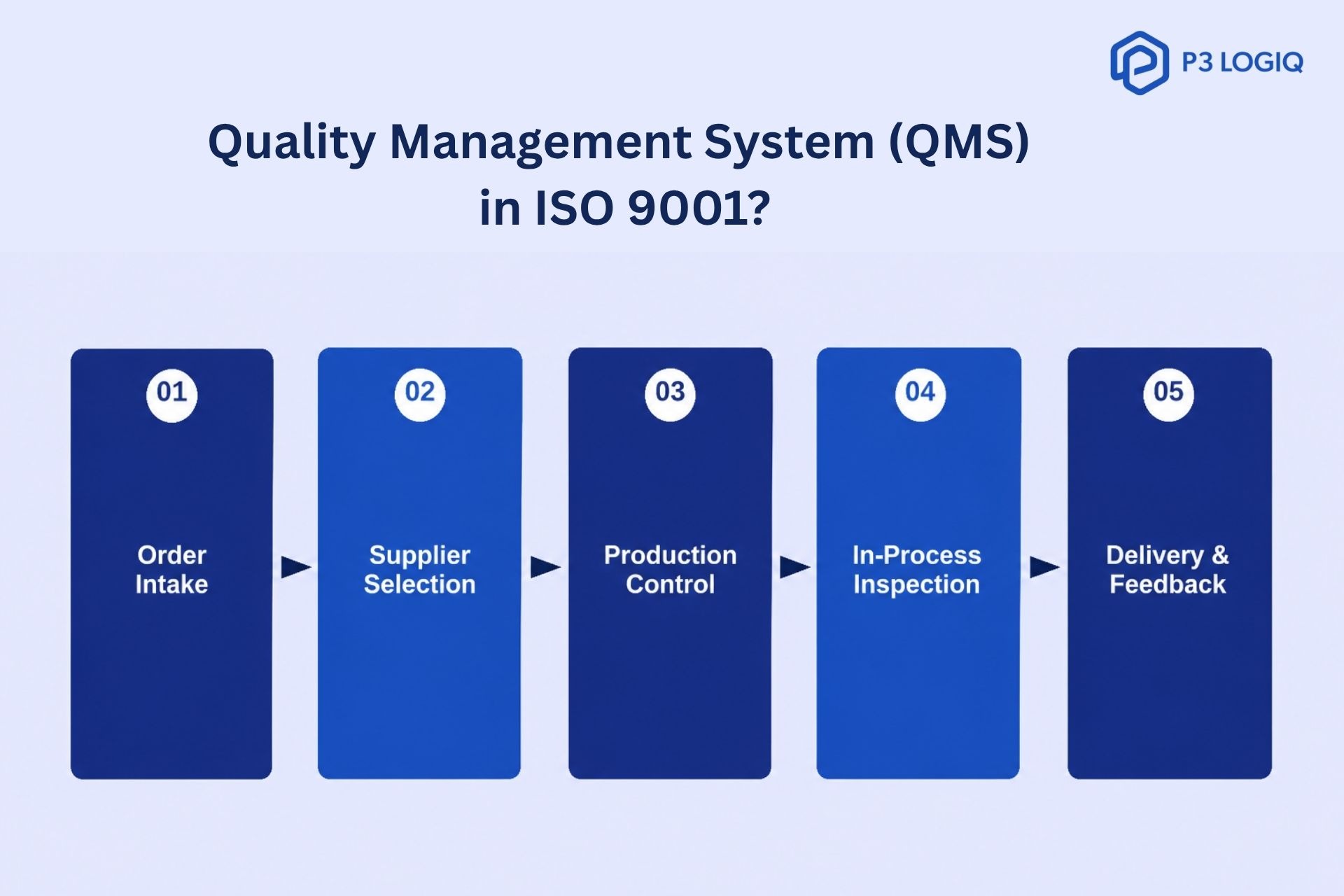
A QMS is the backbone of ISO 9001.
It is the internal system your manufacturing operation builds to plan, control, and improve how you produce and deliver products. Not just for one good batch. Consistently, run after run.
A useful way to picture it: think about how a commercial airline pilot approaches every flight. They do not rely on memory or instinct, regardless of how many hours they have logged. They work through a defined pre-flight checklist, in the same sequence, every single time.
A QMS works the same way for production. It defines the checks, records, and approvals that happen at every stage of your process: from order intake and supplier selection to in-process inspection and nonconformance handling.
Manufacturers looking to streamline these processes often evaluate the best ISO 9001 software for compliance to improve documentation, visibility, and control.
The outcome does not depend on which shift is running, which operator is on the line, or what kind of day it is.
Predictable inputs. Predictable outputs. Documented throughout.
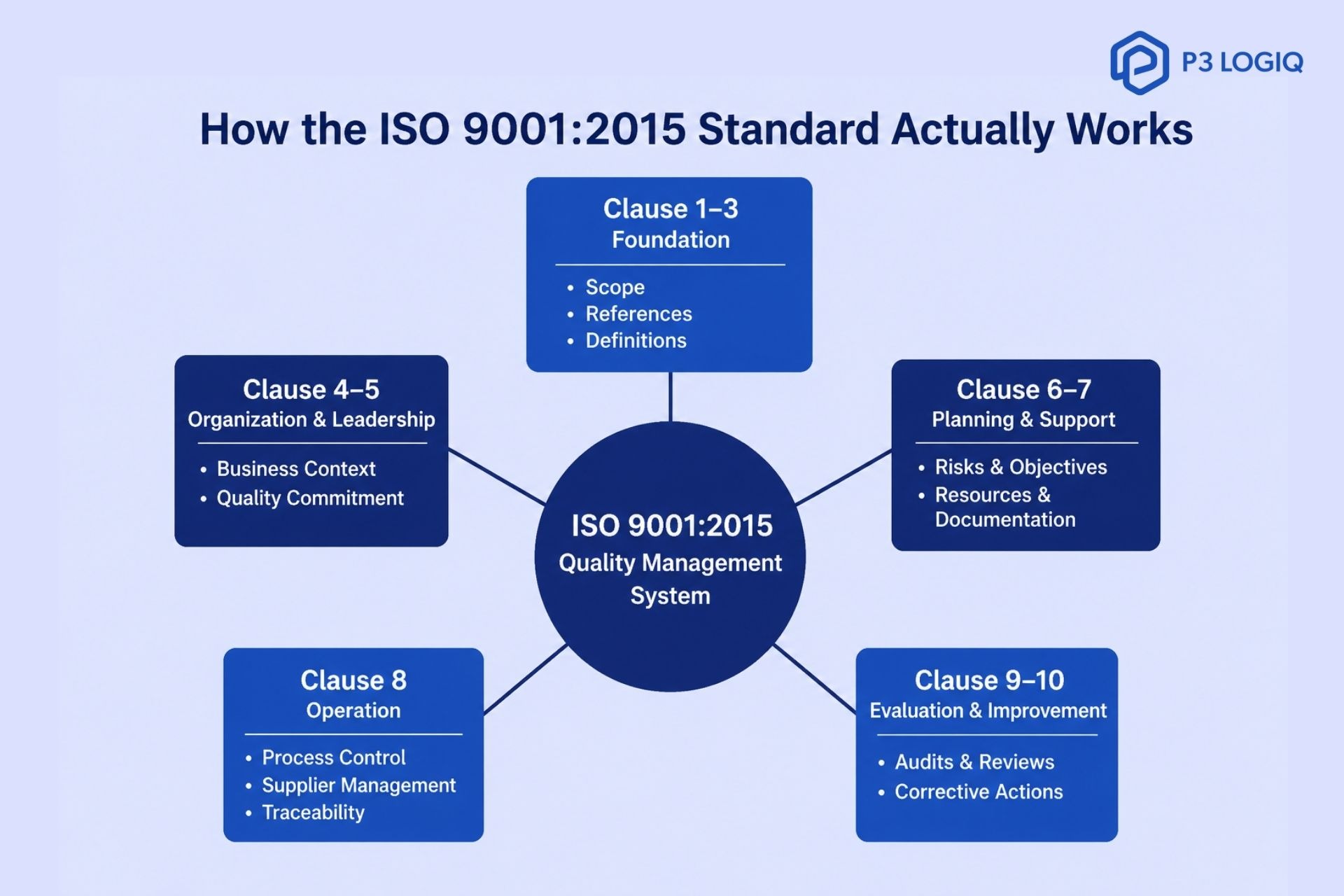
ISO 9001:2015 is organized around a 10-clause framework called the High Level Structure, or HLS. This structure provides a common framework for developing and managing quality management systems.
ISO 14001 certification for environmental management follows the same HLS framework, allowing organizations to align environmental processes with their quality management practices.
ISO 45001 certification for occupational health and safety also uses the HLS framework, helping organizations integrate workplace safety requirements with their existing management systems.
For manufacturers who already hold either of those certifications, adding ISO 9001 is significantly easier than building a QMS from scratch, because the structure is already familiar.
These 10 clauses are the ISO 9001 standards for manufacturing that your QMS gets built around.
Defines the boundaries and applicability of the standard to your organization.
Lists supporting standards referenced within ISO 9001.
Establishes the shared vocabulary used throughout the standard.
Understanding your business environment, your stakeholders (customers, suppliers, regulators), and the scope of your QMS.
Top management's role in setting quality policy, defining responsibilities, and demonstrating commitment. Not a poster on the wall. Documented accountability.
Risk and opportunity assessment, quality objectives, and planning for changes to your processes.
Resources, people, infrastructure, work environment, calibration of measurement equipment, and documented information.
The core of manufacturing requirements. Production planning and control, supplier management, identification and traceability, and control of nonconforming outputs. Most of the day-to-day QMS work lives here.
Monitoring, measurement, analysis, internal audits, and management review. This is what keeps the system honest.
Nonconformities, corrective actions, and continual improvement.
Every ISO 9001:2015-certified manufacturing organization is audited against these same ISO 9001 clauses. If your business is pursuing certification today, this is the framework your QMS will be measured against.
Quality control in manufacturing typically gets treated as a final step. Parts come off the line, someone checks them, problems get flagged.
ISO 9001 approaches it differently.
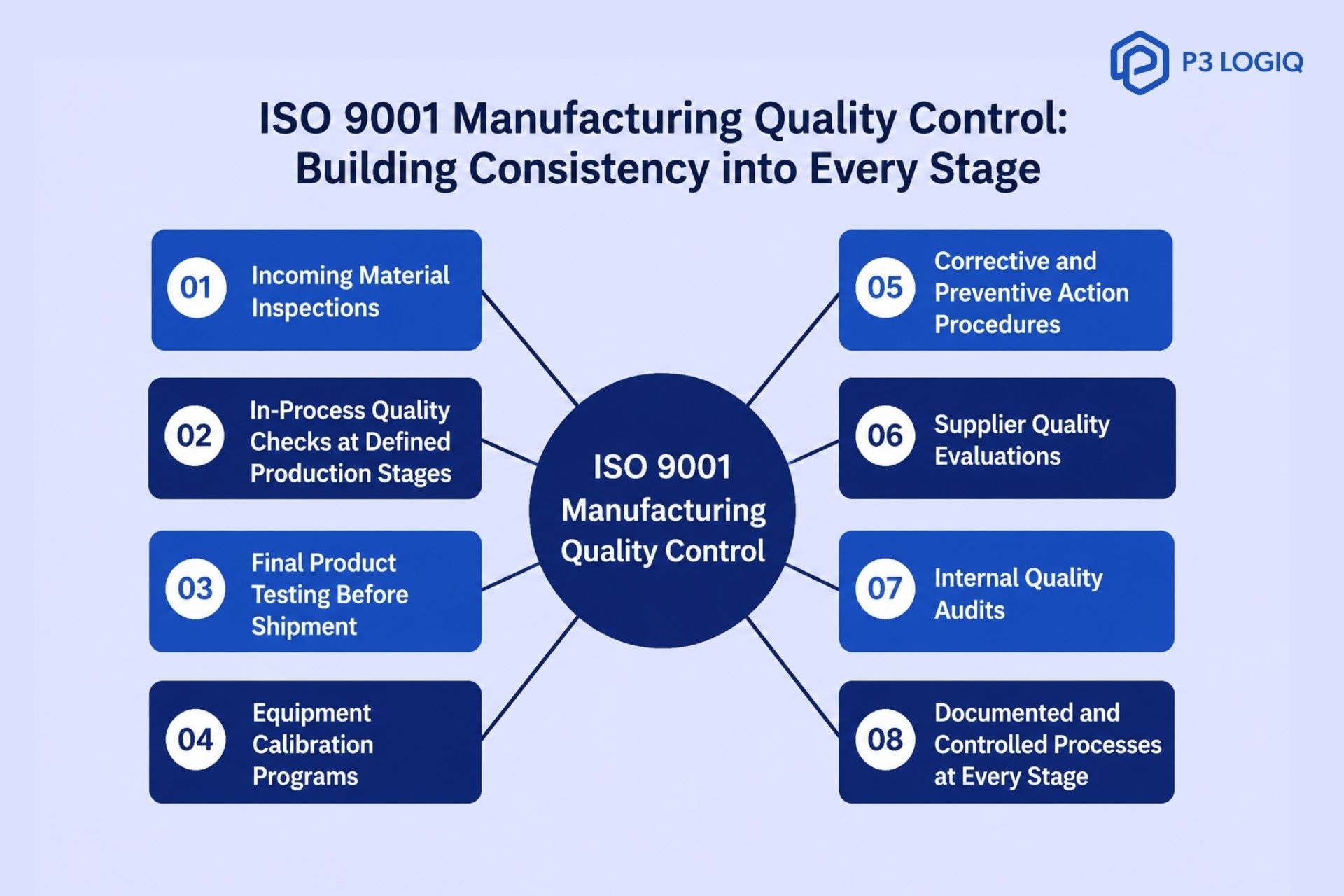
ISO 9001 manufacturing quality control is built into every stage of production, not just the end. Manufacturers monitor critical process steps, verify incoming materials, check equipment calibration, and evaluate finished products before shipment. This approach catches defects earlier, before they become a customer complaint, a warranty claim, or a recall.
Effective quality control under ISO 9001 typically includes:
By embedding quality checks throughout the process rather than concentrating them at the end, manufacturers reduce the cost and consequences of catching problems late.
These practices help organizations maintain effective quality systems by ensuring processes remain controlled, documented, and aligned with quality requirements over time. Following an ISO 9001 compliance guide can further support ongoing compliance efforts.
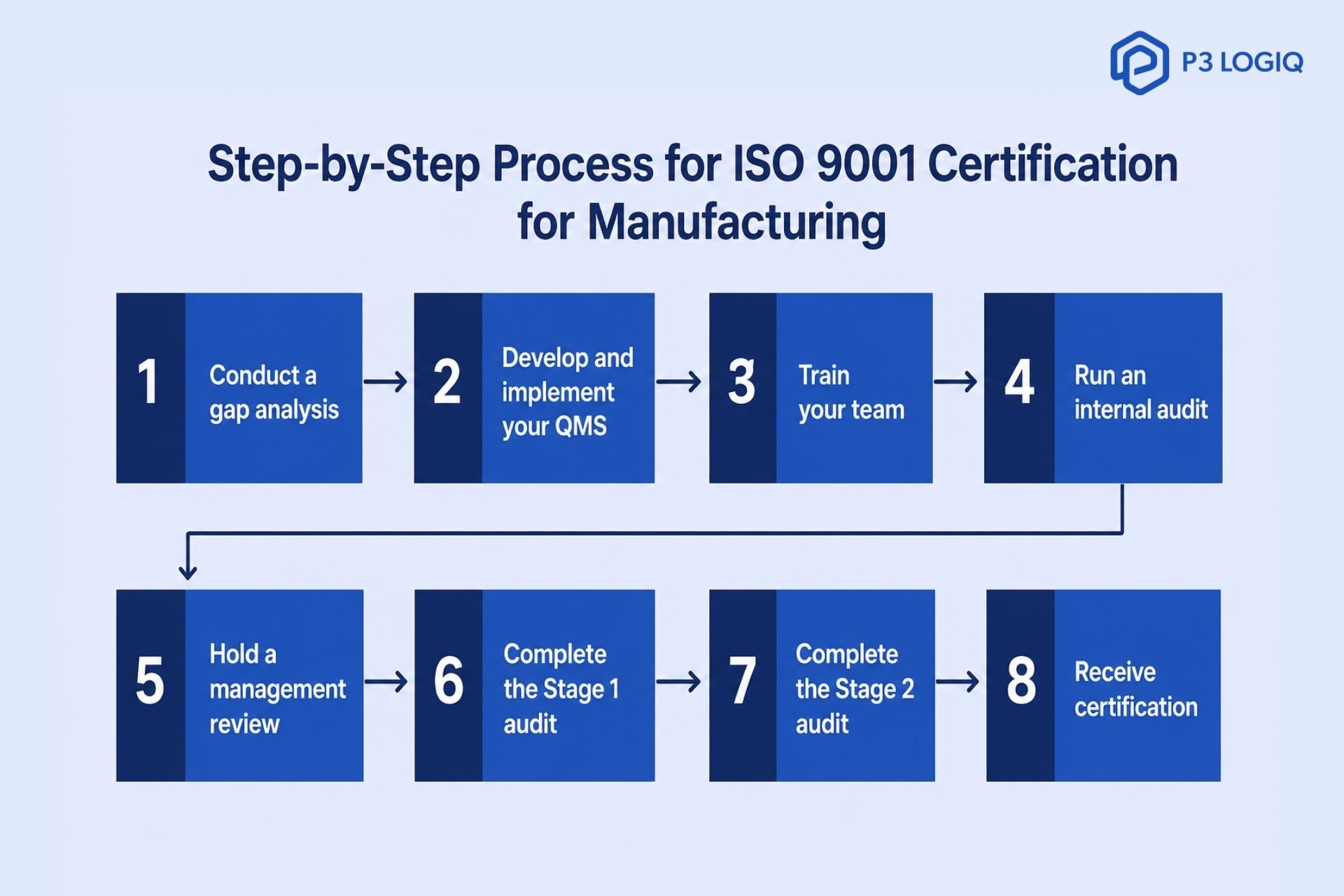
Becoming ISO 9001 certified is a structured process. It is not a single audit followed by a certificate. It is a full review of how your operation runs.
The ISO 9001 certification step-by-step process typically involves assessing current practices, building a QMS, conducting audits, and completing certification requirements.
Here is how it typically works for a manufacturing company.
.png)
Compare your current processes against ISO 9001:2015 requirements. Most manufacturers already have some version of inspection processes, work instructions, and supplier controls. The gap analysis identifies what needs formalizing or building out before you are ready for an external audit.
Create or update your quality policy, procedures, work instructions, inspection plans, and records. The goal is not to build a separate paperwork system. It is to accurately document how your operation actually runs.
Employees need to understand the QMS and their specific role in maintaining it. This is where the standard moves from a document to daily practice on the floor.
Before the external audit, your team audits your own processes to identify and correct issues internally.
Leadership formally reviews quality performance, audit results, risks, and improvement opportunities. This is a required step under ISO 9001, not just a good idea.
An accredited certification body reviews your QMS documentation and assesses readiness for the on-site audit.
Auditors visit your facility, observe operations, interview staff, and verify that your documented system matches what is actually happening on the floor.
If the audit is successful, your ISO 9001 certificate is issued. Certification is valid for three years, with annual surveillance audits required to maintain it.
Most ISO 9001 certification manufacturing timelines run three to six months for a typical operation. Larger or more complex operations may take longer.
Need support during your ISO 9001 certification journey? P3 LogiQ helps manufacturers streamline QMS implementation, manage documentation, and stay prepared for audits. Book a demo to get started.
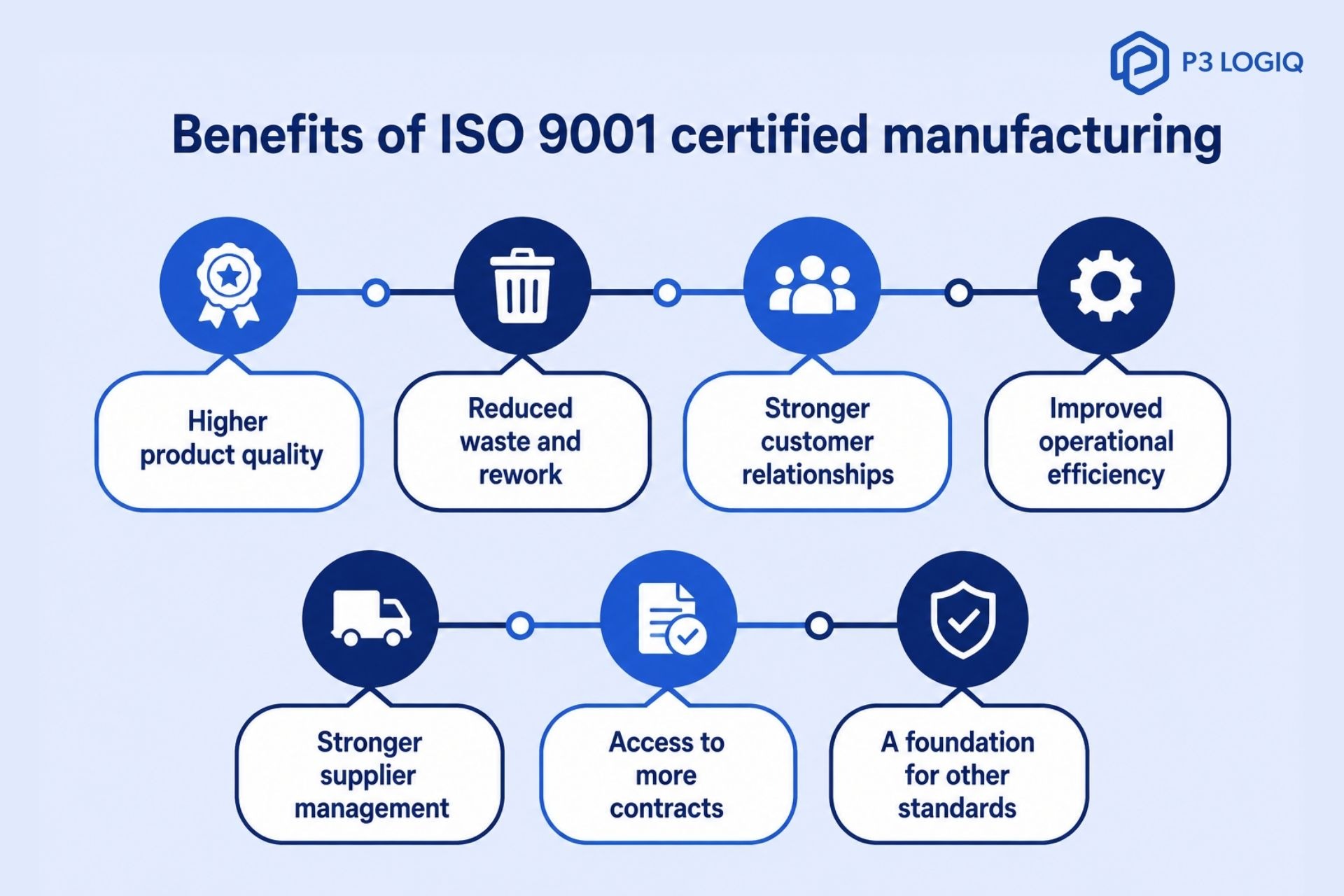
Manufacturers that achieve certification typically see measurable improvements across their operations. The benefits of ISO 9001 extend beyond certification itself, helping organizations improve quality, reduce waste, strengthen customer relationships, and create more efficient processes.
Standardized processes reduce variation across production runs, which means fewer surprises for customers and fewer defects to chase internally.
Catching problems earlier in the process rather than at the end reduces the cost of scrap, rework, and warranty claims.
Consistent quality reduces complaints and builds the kind of reliability that keeps customers coming back.
Defined procedures and clear responsibilities mean less confusion, faster onboarding for new team members, and less time spent firefighting.
ISO 9001 requires you to formally evaluate and monitor suppliers, which reduces the risk of incoming material problems disrupting production.
Many OEMs, government agencies, and large buyers require ISO 9001 certification before they will work with a supplier. Certification is often what gets you into the conversation, not just an advantage once you are there.
Because ISO 9001 shares its framework with ISO 14001 and ISO 45001, certified manufacturers find it easier to add environmental or safety certifications later. It is also a direct prerequisite for IATF 16949 in automotive.
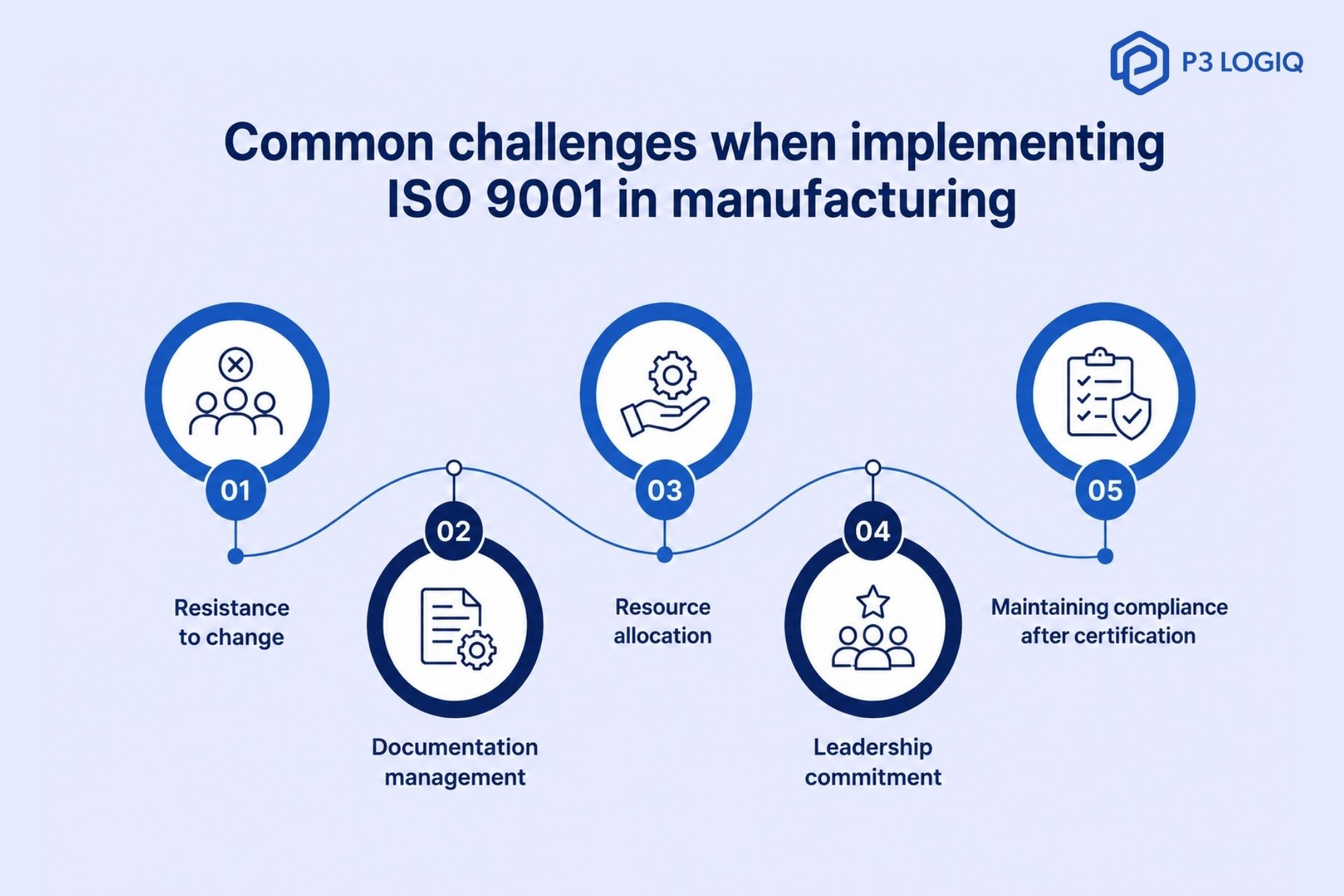
The benefits are real. So are the challenges. Most manufacturers encounter at least a few of these ISO 9001 implementation challenges during implementation.
Team members who have worked a certain way for years may push back on new documentation requirements or updated procedures. Involving people early and explaining the reasoning behind each change makes a significant difference.
Creating and maintaining accurate records takes consistent discipline. It is easy to let documentation slip once the day-to-day pressures of production take over.
Implementation takes time, personnel, and often some process redesign. Organizations that treat it as an add-on to existing workloads tend to struggle.
ISO 9001 requires active involvement from management, not just sign-off. Organizations where quality is seen as the quality team's problem tend to find implementation harder than it needs to be.
Getting certified is one challenge. Keeping the system alive and improving through annual surveillance audits and the three-year recertification cycle is a different one.
None of these is insurmountable. But they do require planning, not just paperwork.
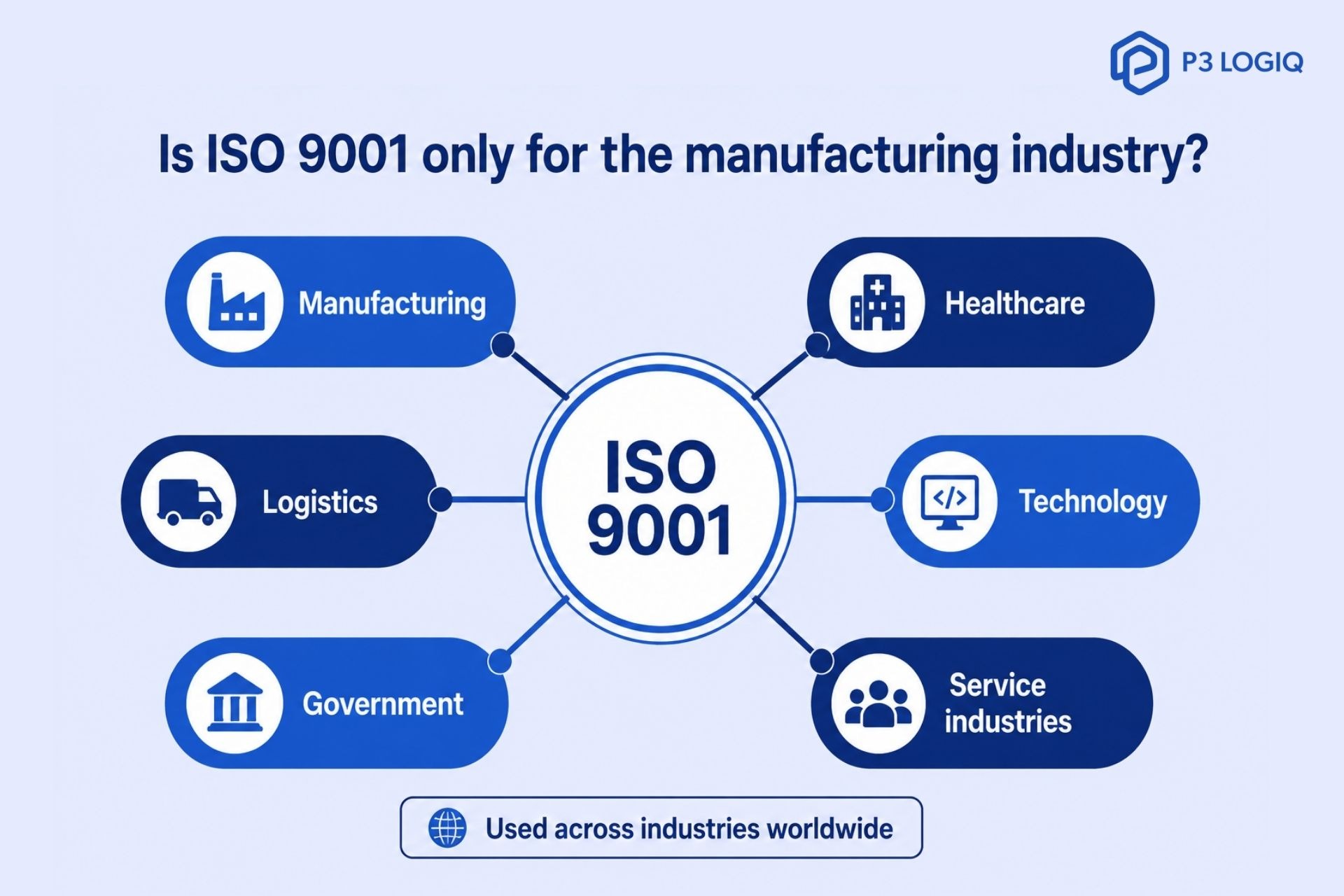
This is a common question, and the answer is no.
ISO 9001 applies to organizations in virtually every sector. Service providers, healthcare organizations, technology companies, logistics providers, and government agencies all use it.
But manufacturing is where ISO 9001 certification is most common, and for good reason. The standard's focus on process control, traceability, documented procedures, and consistent output maps directly onto what manufacturing operations need.
Effective ISO 9001 document control helps manufacturers maintain accurate records, manage revisions, and ensure employees are working from the correct procedures.
Product quality in manufacturing has direct, measurable consequences: defects, returns, recalls, and lost contracts.
For manufacturers, certification is rarely a branding exercise. It is usually a requirement from a specific customer, a supply chain prerequisite, or an industry regulation that needs to be satisfied.
If your manufacturing business sells to other businesses, particularly larger ones with their own quality requirements, ISO 9001 will come up sooner or later. Either as a hard requirement or as the difference between winning a bid and losing one.
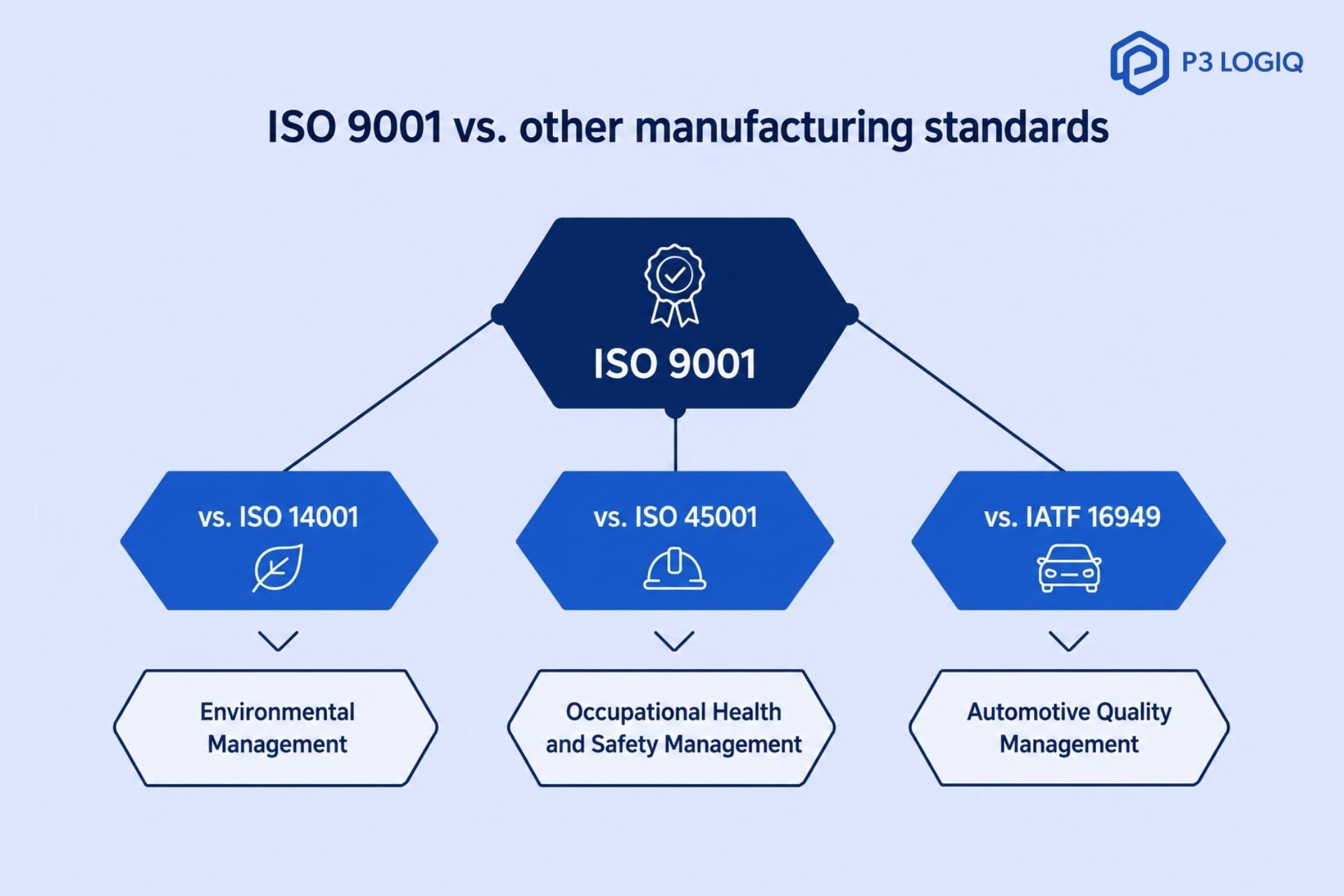
ISO 9001 is often the starting point for manufacturers working across multiple certification frameworks. Here is how it relates to the ones you will commonly see.
When comparing ISO 9001 vs ISO 14001, ISO 9001 focuses on quality management, while ISO 14001 covers environmental management. Both use the same 10-clause HLS framework, which makes running them as an integrated system far more efficient than managing them separately.
Manufacturers comparing ISO 9001 vs ISO 45001 should know that ISO 45001 covers occupational health and safety management. It uses the same structural framework as ISO 9001, applied to worker safety rather than product quality.
IATF 16949 is the automotive industry's quality management standard. It is built directly on top of ISO 9001, with additional requirements specific to automotive supply chains. You cannot achieve IATF 16949 certification without first satisfying ISO 9001.
For most manufacturers, ISO 9001 is the foundation that everything else builds on.
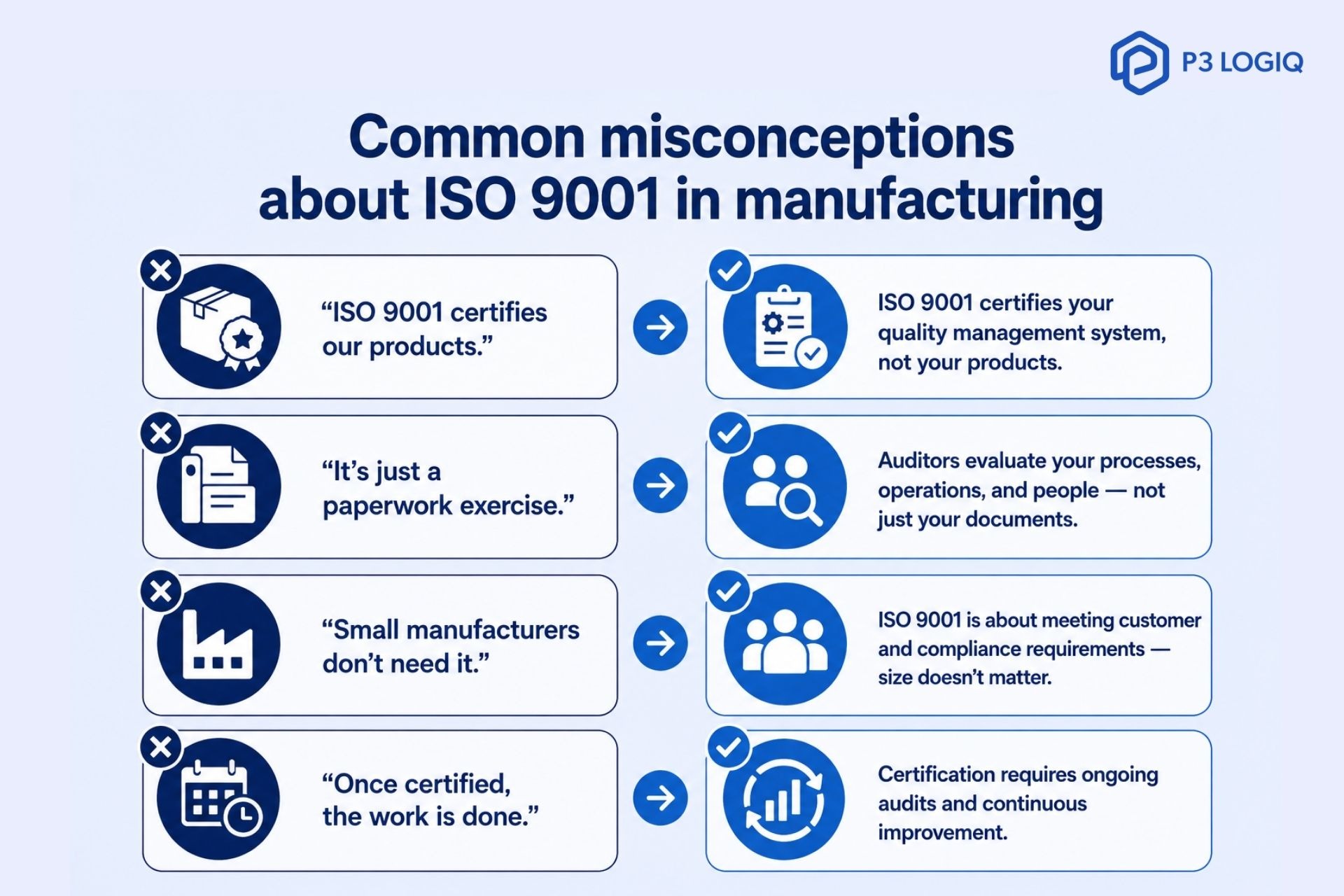
A few things manufacturers regularly get wrong about the standard.
It doesn't. ISO 9001 certifies your quality management system, the process for consistently producing and improving quality. Two certified manufacturers can have very different defect rates. What certification confirms is that each has a documented, controlled, and audited system for managing quality.
Documentation is part of it. But auditors also walk your floor, observe operations, and interview your staff. A QMS that lives in a binder and nowhere else will not make it through a Stage 2 audit.
Small and mid-sized manufacturers get certified regularly, often because a single large customer made it a condition of doing business. ISO 9001 for small businesses is not about company size but about building structured processes that meet customer and compliance requirements.
Size is not the deciding factor. Supply chain requirements are.
Certification requires annual surveillance audits and a full recertification audit every three years. Continuous improvement is a requirement of the standard itself, not something optional you do later.
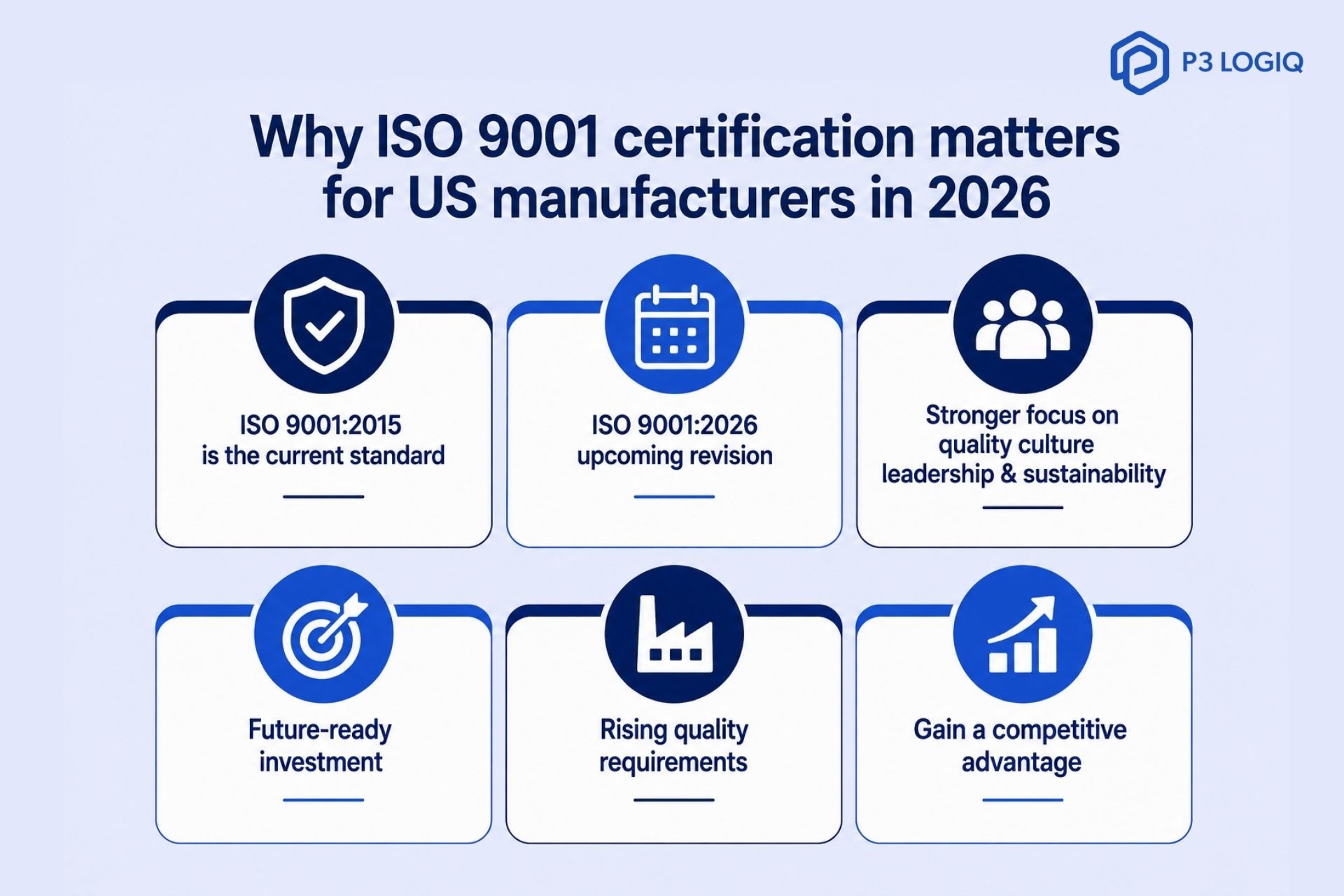
ISO 9001:2015 is still the current, active version of the standard and the version your QMS will be audited against today.
What is worth knowing is that ISO 9001:2026 is currently being revised for the first time since 2015. A Draft International Standard was published in August 2025, with a Final Draft expected in 2026 and full publication likely in the fall. Once the updated version is released, certified organizations will receive a multi-year transition window.
Early indicators point to a stronger emphasis on quality culture, leadership ethics, and sustainability considerations. It is described as an evolution of the 2015 framework, not a rebuild.
What this means practically: getting certified to ISO 9001:2015 now is not a short-term investment. The foundation you build today carries over into the next version of the standard.
At the same time, the conditions driving US manufacturers toward ISO 9001 are not easing up. Supply chain quality requirements, OEM audit programs, reshoring, and customer expectations around traceability are all pushing in the same direction. Certification now means your quality system is already working while competitors are still preparing for it.

ISO 9001 is not a certification to collect. It is a quality management framework that changes how your manufacturing operation runs: more consistent, more traceable, better positioned under audit, and better positioned for the contracts that require it.
Whether you are pursuing ISO 9001 certification for the first time or improving an existing QMS, the right support makes the process faster and the outcomes stronger.
P3 LogiQ helps manufacturing companies build, manage, and maintain ISO 9001 quality management systems, from initial gap analysis through certification readiness and ongoing compliance. Our team works with your operation to build a system that meets certification requirements and delivers measurable business value.
Schedule a free demo to talk through your ISO 9001 goals and find out what a practical path to certification looks like for your organization. Sign up today to take the next step toward a more efficient, audit-ready QMS.
ISO 9001 for manufacturing is an internationally recognized quality management standard that helps manufacturers establish consistent processes for producing high-quality products. It provides a structured framework for managing operations, reducing errors, improving customer satisfaction, and supporting continuous improvement across manufacturing.
ISO 9001 improves efficiency by standardizing processes, reducing defects, minimizing waste, and establishing clear quality controls. The framework requires data-driven decision-making and continual improvement, helping manufacturers lower costs, reduce rework, and consistently meet customer and regulatory requirements.
ISO 9001 manufacturing standards include requirements for quality management systems, process control, documentation, employee competency, risk-based thinking, performance monitoring, corrective actions, and continual improvement. The current version is ISO 9001:2015, organized across 10 clauses.
Most manufacturing companies complete the process within three to six months. Larger organizations or those with more complex operations may require additional time. The timeline depends on company size, existing quality processes, and how much of a gap exists between current practices and ISO 9001 requirements.
ISO 9001 certification is not legally required for most manufacturers. However, many customers, government contracts, and supply chain partners require or strongly prefer certified suppliers. In sectors like automotive and aerospace, certification is often a practical prerequisite for doing business.
ISO 9001 applies across virtually all manufacturing sectors, including automotive, aerospace, electronics, medical devices, industrial equipment, food processing equipment, metal fabrication, and consumer goods. The standard is flexible enough to apply to organizations of different sizes and production types.
Manufacturers typically need a documented quality policy, process procedures, work instructions, risk assessments, training records, internal audit reports, corrective action records, and management review documentation. Exact requirements vary based on the organization's size and processes.
After initial certification, manufacturers undergo annual surveillance audits conducted by their certification body. A full recertification audit is required every three years. These audits confirm ongoing compliance and continued improvement of the quality management system.
ISO 9001 is a general quality management standard that applies across industries. IATF 16949 is an automotive-specific quality standard built on top of ISO 9001, with additional requirements for automotive production and supply chains. ISO 9001 certification is a prerequisite for IATF 16949.
ISO 9001 quality management manufacturing refers to the structured system a manufacturer uses to plan, control, monitor, and continuously improve how products are produced and delivered. It covers everything from supplier selection and process documentation to inspection, corrective action, and customer feedback.



Businesses need document management systems (DMS) to ensure ISO and R2 compliance, improve efficiency, and stay audit-ready. The article highlights key features like version control, security, and automation while reviewing the top 5 DMS solutions. P3 LogiQ stands out for its compliance-focused automation and secure document tracking
Read More
Recycling businesses gain efficiency, compliance, and sustainability with RIOS certification. It streamlines quality management, environmental responsibility, and worker safety, helping companies avoid legal risks and boost credibility. P3 LogiQ simplifies the certification process with automation, document control, and compliance tracking, making operations smarter and safer.
Read More
Audit Management Software (AMS) automates compliance tracking, streamlines workflows, and reduces audit risks. Key features include automated scheduling, compliance checklists, CAPA tracking, vendor risk management, and integrations.
Read More
Learn how audit management systems simplify ISO and R2 compliance by automating audits, managing documentation, and minimizing compliance risks efficiently.
Read More
In 2025, many businesses still face challenges in compliance management due to outdated methods like spreadsheets and fragmented software. This inefficiency leads to missed deadlines, increased risk, and regulatory penalties. The blog emphasizes the importance of modern compliance tools that automate workflows, enhance risk management, and streamline regulatory processes to meet ISO and R2 standards.
Read More
The rise in e-waste and environmental concerns makes responsible electronics recycling essential. The R2 Certification sets a global standard for safe, sustainable, and data-secure recycling practices. Developed by Sustainable Electronics Recycling International (SERI), R2 helps businesses manage environmental risks, data security, worker safety, and legal compliance.
Read More
Businesses face increasing challenges in managing complex regulatory compliance. Manual methods such as spreadsheets and paperwork can lead to missed deadlines, inefficiencies, and costly penalties. Compliance management software offers a streamlined solution to reduce risks, automate processes, and improve operational efficiency.
Read More
Maintaining R2 Certification is crucial for businesses in the e-waste recycling industry, ensuring regulatory compliance, sustainability, and strong stakeholder trust. This guide outlines 10 best practices to help businesses simplify operations, reduce risks, and stay compliant.
Read More
Unlock the value of ISO risk management certification. Explore its impact on compliance, risk mitigation, and business expansion.
Read More
Explore the top 5 ISO risk management software tools for 2025, including document management solutions for streamlined compliance and increased efficiency.
Read More
Find the ideal document management software (DMS) for your business. Learn how to choose with expert tips, key features, and insightful guidance
Read More
Unlock the power of a Document Management System (DMS). Learn how it can revolutionize your business operations.
Read More








.png)


.png)



.jpg)





.jpg)
.jpg)











.jpg)



.png)

.png)
.png)





.png)

