

Ever tried fixing something at the last minute right before it breaks completely?
Like ignoring a strange noise in your car until it suddenly stops working, or skipping regular health checkups and only reacting when something goes wrong, workplace safety often follows the same pattern in many organizations. Issues are addressed only after incidents happen, not before.
In many workplaces, safety doesn’t fail because people don’t care. It usually breaks down because there is no clear structure guiding what needs to be done, when, and by whom.
Teams rely on scattered processes, informal practices, or past experience, which works for a while but eventually leads to gaps, missed risks, or delayed action. That’s exactly where understanding the ISO 45001 clauses makes a difference. And this is also where a practical ISO 45001 certification guide becomes useful, not as a checklist to pass an audit, but as a way to connect each clause to real actions inside your organization.
Instead of reacting to problems, ISO 45001:2018 is designed to help organizations build a system that identifies risks early, prevents incidents, and improves safety continuously, with a clear roadmap that moves teams from uncertainty to structured, repeatable safety practices.
This structure is formally defined by ISO under its high-level framework for management system standards, which follows a 10-clause format used across multiple standards for consistency and integration.
According to, ISO 45001 OH&S requirements framework sets out the requirements for an occupational health and safety (OH&S) management system and is built to help organizations provide safe and healthy workplaces by preventing work-related injury and ill health, while continually improving OH&S performance.
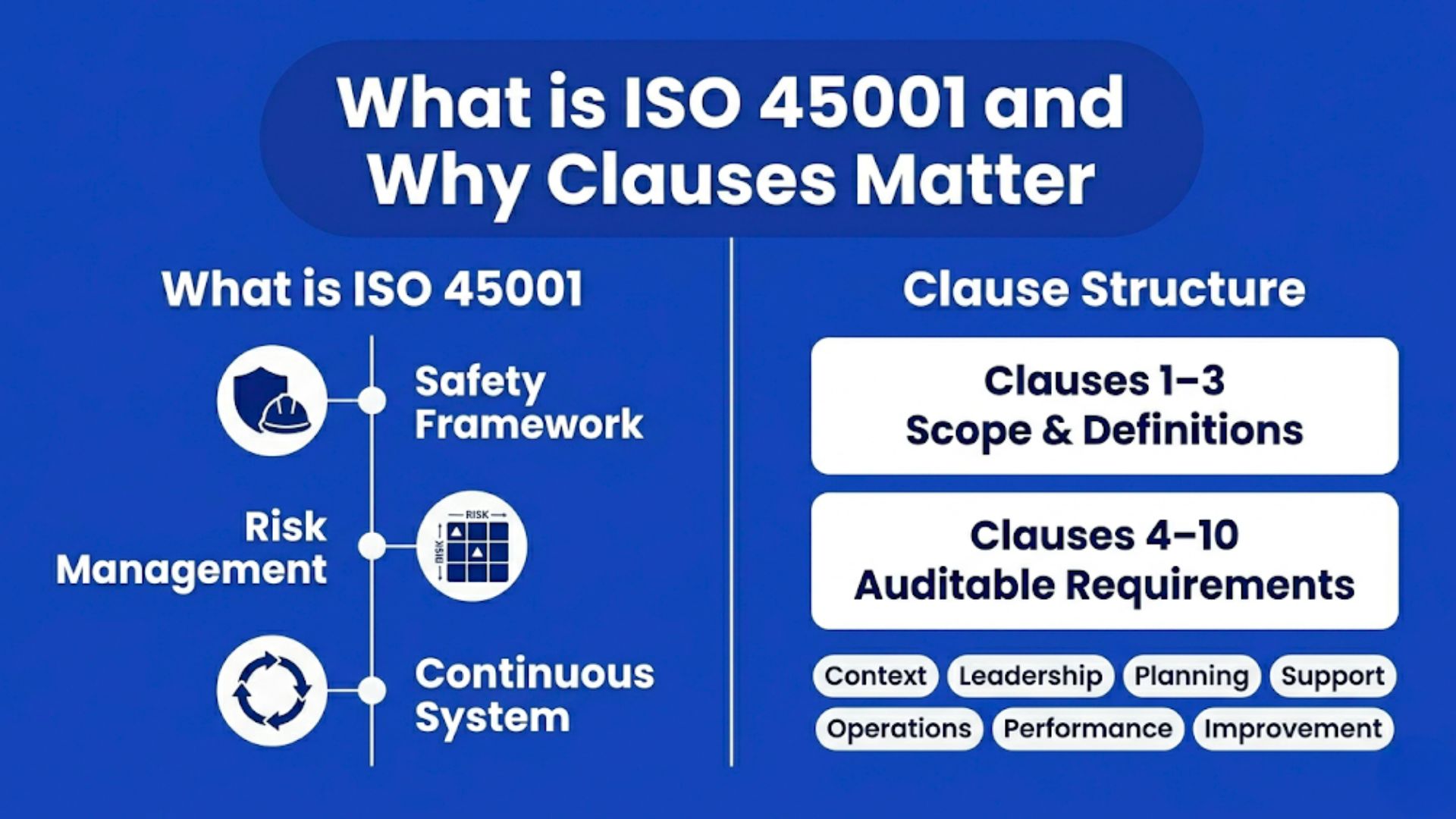
The ISO standard follows the Annex SL structure, which includes Clauses 1 to 10, covering scope, normative references, terms and definitions, and then moving into system requirements like context, leadership, planning, support, operation, performance evaluation, and improvement.
In this blog, I will break down all the ISO 45001 clauses in a simple and practical way, so you can clearly understand how the ISO 45001 software actually works beyond documentation. You’ll see how each ISO 45001 clause fits into the bigger picture, how the 45001:2018 clauses are structured, and how these ISO 45001 elements connect back to the core intent of the ISO 45001 standard in real-world operations.
.jpg)
ISO 45001 is an international standard for occupational health and safety management systems (OHSMS), published by the International Organization for Standardization (ISO).
The current version, ISO 45001:2018, provides a structured framework that organizations use to identify workplace hazards, assess risks, and put controls in place to prevent injuries, illnesses, and unsafe conditions.
Instead of treating safety as a one-time checklist, ISO 45001 builds a system that runs continuously across operations. It applies to any organization, regardless of size or industry, and is designed to integrate with other ISO standards like ISO 9001 (quality) and ISO 14001 (environment), since all of them follow the same Annex SL structure defined by ISO.
To understand how the standard works, you need to look at its clause structure. ISO 45001 is divided into 10 clauses in total:
This distinction matters in practice. Certification audits are based only on clauses 4 through 10, which means auditors evaluate how well your organization has defined its context (Clause 4), established leadership involvement (Clause 5), planned risks and objectives (Clause 6), supported the system with resources (Clause 7), executed operations (Clause 8), measured performance (Clause 9), and driven improvement (Clause 10).
In simple terms, the clauses are not just sections of a document. They act as a connected system. If one part is weak, like planning or performance evaluation, it directly affects how effective your entire safety management system actually is.
Let’s start with the full list of clauses so you can see how ISO 45001 is built from the ground up. Once you understand this structure, the detailed explanations that follow will make a lot more sense.
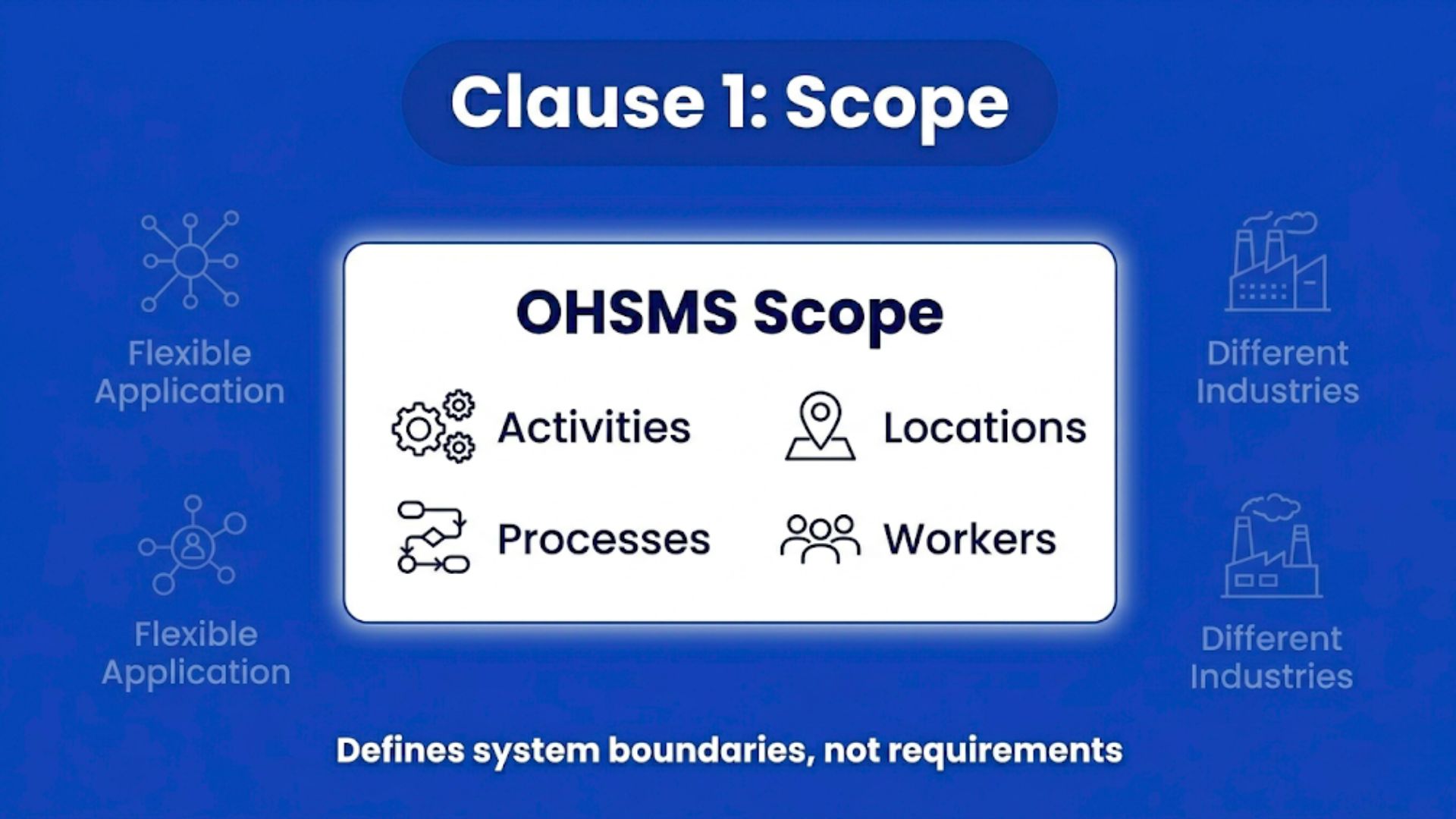
Clause 1 sets the foundation for the entire ISO 45001 standard by clearly defining what the standard is intended to cover. According to ISO 45001:2018 (published by the International Organization for Standardization), the focus is on providing a framework that enables organizations to manage occupational health and safety risks, prevent work-related injuries and ill health, and continuously improve OH&S performance.
At first glance, this clause looks simple, but it plays an important role in setting expectations. It makes it clear that ISO 45001 is not limited to a specific industry or type of organization.
Whether it’s a manufacturing unit, construction company, logistics provider, or even a service-based business, the standard is designed to be flexible enough to apply across different operational environments. This flexibility is also where the benefits of ISO 45001 for your business start to become visible, as the framework can be adapted to suit different risk levels, team structures, and operational realities.
The key idea in Clause 1 is boundaries. It establishes that ISO 45001 gives a framework for managing occupational health and safety, but it does not force a single way of applying it across all organizations. Instead, each organization defines the scope of its own Occupational Health and Safety Management System (OHSMS), deciding which locations, activities, processes, and workers are included.
This step matters more than it looks. The scope you define here directly influences everything that follows in Clauses 4 through 10, from how risks are identified to how controls are implemented and audited. A poorly defined scope can either leave out important risks or make the system unnecessarily complex.
This is also the stage where many businesses realize they need better structure to manage everything clearly, especially when operations are spread across teams or sites. That is why tools like the best ISO 45001 software are introduced at this point, not to change the scope itself, but to help keep it organized and consistently applied as the system grows.
Finally, the scope must stay aligned with the organization’s real working conditions and external context, which is further developed in Clause 4. So, Clause 1 sets the boundary, and the later clauses make sure that boundary is applied in a practical and controlled way
So while Clause 1 does not contain auditable requirements, it quietly defines the playing field. Every process, document, and control you build in ISO 45001 ultimately operates within the boundaries set here.
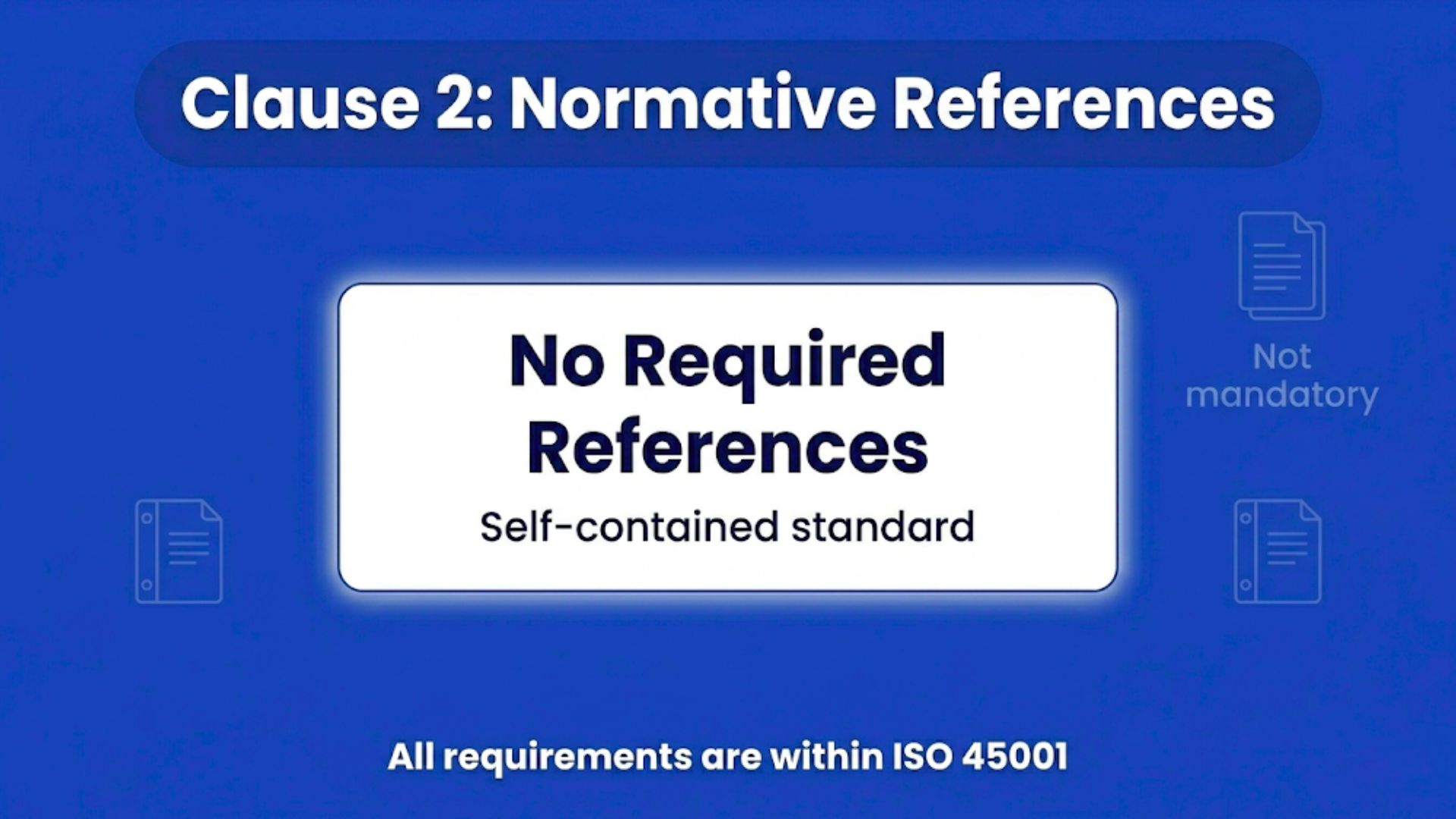
Clause 2 is one of the shortest sections in ISO 45001, and it is also one of the easiest to understand. It simply explains whether the standard depends on any external documents or additional ISO standards for its application.
In ISO 45001:2018, Clause 2 clearly states that there are no normative references. In practical terms, this means you do not need to follow any other ISO standard alongside ISO 45001 to implement it correctly. Everything required is already included within the standard itself.
This becomes especially useful when you are building an ISO 45001 checklist for small businesses. Since there are no linked or mandatory external standards to track, the checklist stays simple and focused. You can concentrate on core safety actions like identifying workplace hazards, applying controls, and maintaining basic compliance without getting pulled into multiple documentation layers.
In real-world use, many organizations still refer to external inputs such as local safety laws, industry guidelines, or internal operating procedures. These help strengthen the system, but they are not part of Clause 2 requirements. Most of those obligations are handled later under Clause 6, which deals with legal and other requirements.
Overall, Clause 2 keeps ISO 45001 self-contained and easy to approach. For small businesses, this removes unnecessary complexity and makes it easier to build and follow a practical safety checklist that actually works on the ground.
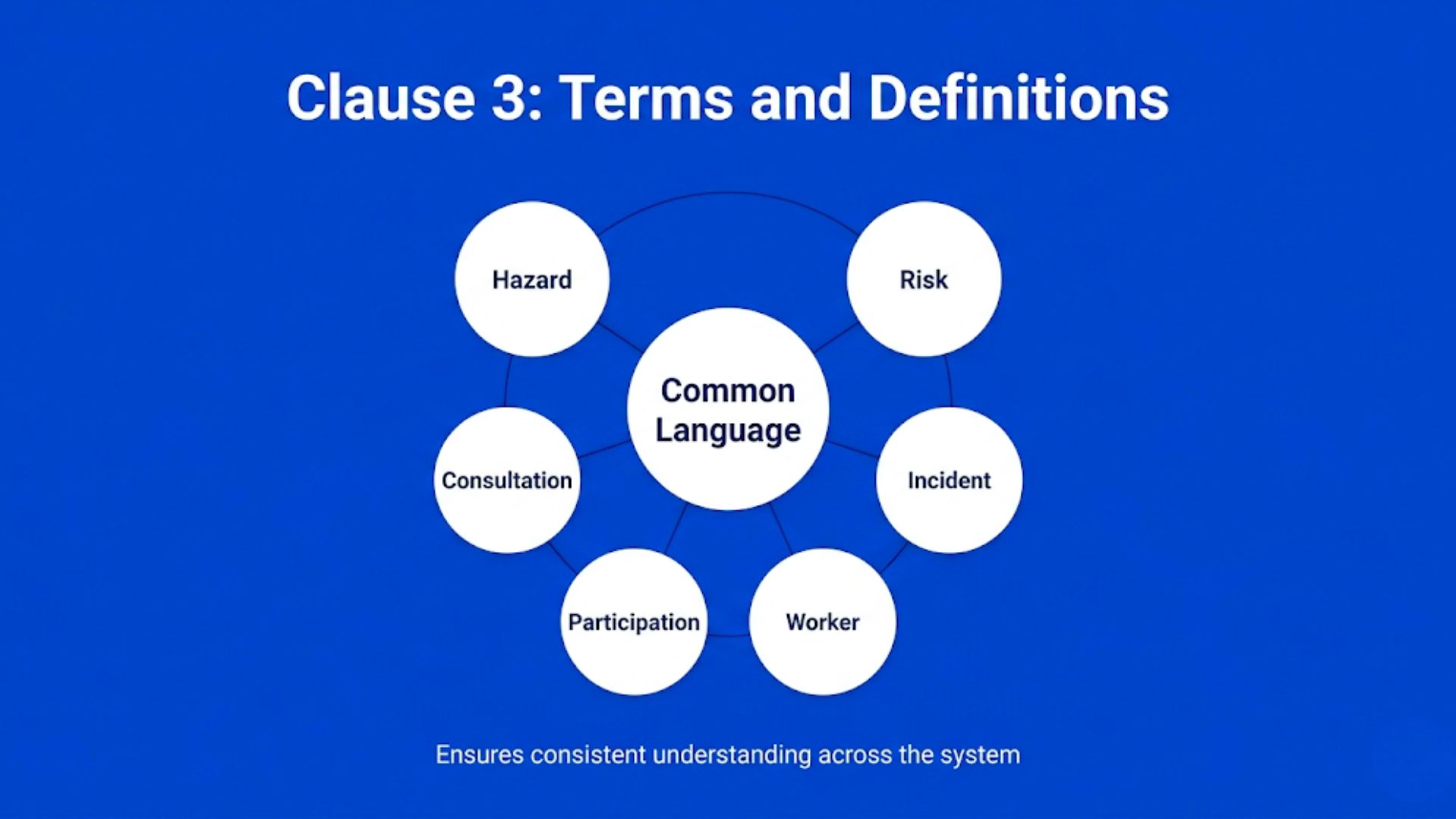
Clause 3 provides the standardized terms and definitions used throughout ISO 45001. At first glance, this might seem like a reference section you can skim through, but in reality, it plays a critical role in how the entire standard is interpreted and applied.
ISO 45001:2018 includes a detailed list of definitions for key concepts such as “hazard,” “risk,” “incident,” “worker,” “participation,” and “consultation.” These terms are not just descriptive. They are intentionally defined to remove ambiguity and ensure that organizations, auditors, and stakeholders are all working with the same understanding.
From a practical standpoint, misinterpreting these terms is one of the most common reasons organizations struggle during implementation, audits, or even the broader ISO 45001 certification process itself. What often looks like a small terminology gap at the beginning tends to expand into larger inconsistencies as the system develops.
For example, the difference between a “hazard” (a source of potential harm) and a “risk” (the likelihood and severity of that harm) directly affects how risk assessments are structured under Clause 6, which is a core step in the ISO 45001 certification process. If this distinction is not clearly understood, the entire risk evaluation approach can become misaligned with ISO expectations.
Similarly, misunderstanding “worker participation” can lead to weak compliance under Clause 5, but more importantly, it can disrupt how evidence is demonstrated during the ISO 45001 certification process. Certification bodies do not just look for documented procedures, they look for consistent application.
If participation is treated as a formality rather than an active system element, it usually becomes visible during audits through gaps in consultation records, decision-making processes, or feedback mechanisms.
Another important aspect is that ISO definitions may differ slightly from everyday usage or even local regulatory language. This creates a subtle but critical challenge during the ISO 45001 certification process, where alignment becomes essential. Organizations need to ensure that internal documentation, training materials, and communication frameworks consistently reflect ISO terminology. Without this alignment, even well-intentioned processes can appear inconsistent when reviewed against the standard’s requirements.
Although Clause 3 is not directly audited, its influence runs through every stage of the ISO 45001 certification process. Auditors typically assess whether organizations are applying concepts correctly in practice, even if they are not explicitly testing definitions.
When foundational understanding is off, it rarely stays isolated. It tends to surface in planning under Clause 6, operational controls under Clause 8, and performance evaluation under Clause 9. In that sense, Clause 3 quietly shapes how effectively the entire management system holds together, especially when it is being examined through the lens of certification.

Clause 4 is where ISO 45001 shifts from theory to system design. It requires organizations to understand the internal and external factors that can impact their occupational health and safety performance and use that understanding to build their OHSMS.
This clause is divided into four key parts: understanding the organization and its context, identifying the needs and expectations of workers and other interested parties, defining the scope of the OHSMS, and establishing the system itself. Together, these elements form the foundation on which all other clauses are built.
In practice, this means organizations need to evaluate factors such as workplace conditions, regulatory environment, workforce structure, operational risks, and even cultural aspects that influence safety behavior. External factors could include legal requirements, industry risks, or supply chain dependencies, while internal factors may include management structure, processes, and existing safety practices.
A critical requirement here is identifying “interested parties,” which typically include employees, contractors, regulators, and sometimes clients. Organizations must understand what these groups expect in terms of health and safety and incorporate those expectations into the system.
The scope defined in this clause becomes especially important. It determines what parts of the organization are covered under the OHSMS and must align with the realities of operations. This ties directly back to Clause 1 but is implemented in detail here.
Clause 4 is heavily audited because it sets direction. If the context is poorly defined, the rest of the system often becomes misaligned. Risks may be missed, controls may be ineffective, and compliance gaps can emerge later.
In simple terms, this clause answers one key question: what does safety look like for your organization, based on how it actually operates?

Clause 5 focuses on the role of top management and the active involvement of workers in the Occupational Health and Safety Management System (OHSMS). Compared to older standards like OHSAS 18001, ISO 45001 places much stronger emphasis on leadership accountability and genuine worker participation, not just documented procedures.
Top management is expected to take full ownership of the system. This means setting the OH&S policy, ensuring resources are available, integrating safety into day-to-day operations, and actively shaping a safe working culture. In practice, leadership is not passive here; it has to be visible and involved.
When you look at this through an ISO 45001 compliance guide, Clause 5 becomes the starting point for understanding whether the system is actually working. Most compliance checks don’t begin with documents; they begin by asking whether leadership is engaged and whether safety responsibility is clearly driven from the top.
Alongside leadership, the clause also focuses on worker participation. Employees are expected to report hazards, share feedback, and take part in safety discussions. Since they work closest to operational risks, their input is essential in identifying issues early.
In smaller organizations, this usually happens in simple and practical ways like short team discussions, informal safety talks, or direct reporting to managers rather than formal committees.
Overall, Clause 5 shifts safety from a paperwork-based requirement to a shared responsibility. It ensures leadership drives the system while workers actively support it, which is exactly what most ISO 45001 compliance guides aim to verify in real-world implementation.
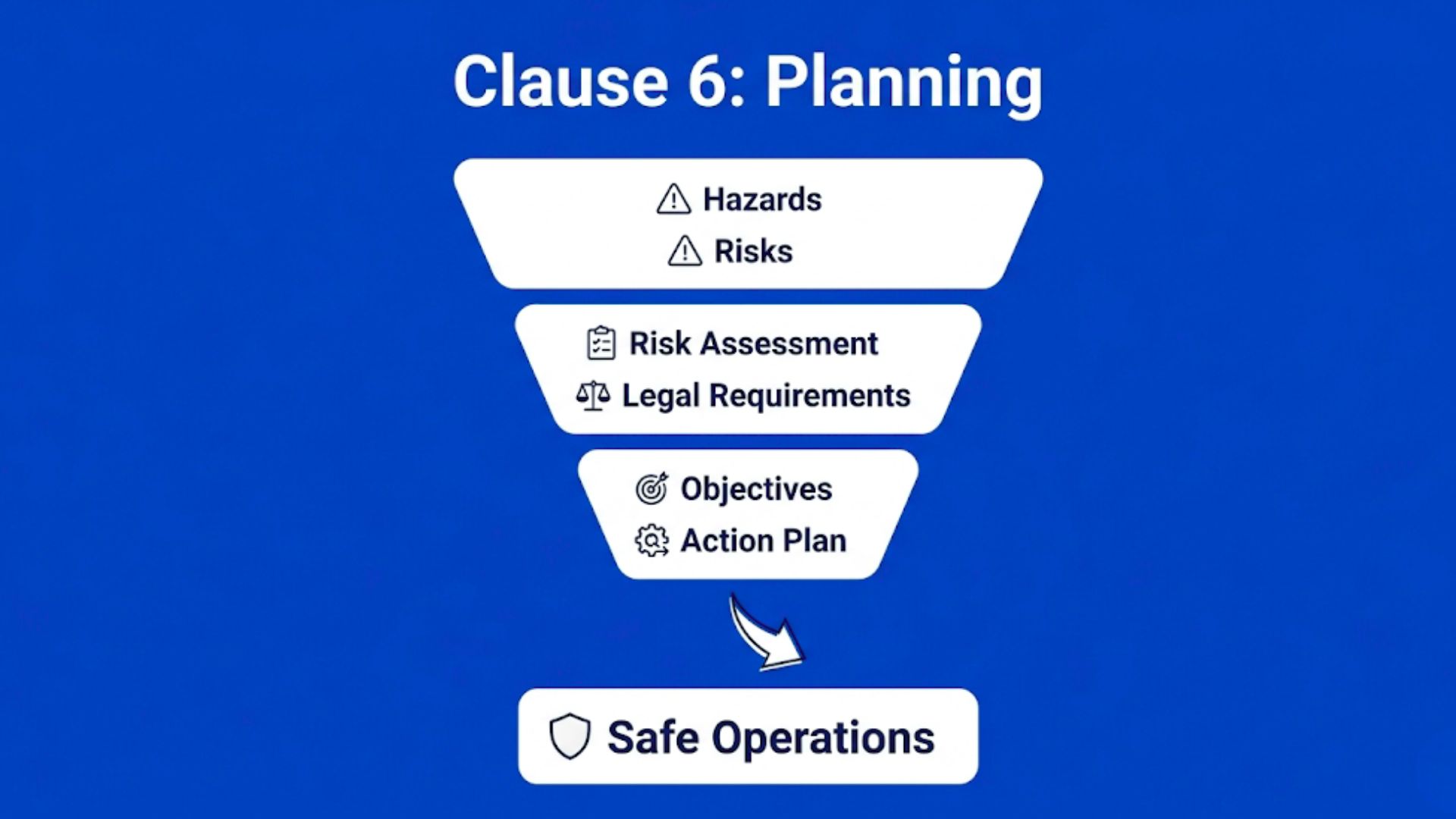
Clause 6 focuses on planning actions to address risks and opportunities within the OHSMS. It introduces the concept of risk-based thinking, which is central to ISO 45001 and ensures that organizations take a proactive approach to workplace safety.
The clause requires organizations to identify hazards, assess risks, and determine appropriate controls. It also includes identifying legal and other requirements that apply to the organization, which may vary depending on location, industry, and type of operations.
A key part of this clause is setting OH&S objectives. These objectives must be measurable, aligned with the organization’s policy, and supported by clear plans that define responsibilities, timelines, and resources. This ensures that safety improvements are not vague intentions but structured initiatives.
In real-world implementation, this is where tools like risk assessment matrices, hazard identification processes, and compliance registers come into play. Organizations need to systematically evaluate what could go wrong, how severe the impact could be, and what steps are needed to control or eliminate those risks. A well-structured approach here can also influence the overall ISO 45001 certification cost, since clearer risk planning often reduces the need for repeated corrections during audits.
Another important aspect is that planning is not a one-time activity. Risks evolve as operations change, new processes are introduced, or external conditions shift. This means organizations must continuously review and update their risk assessments and plans.
Clause 6 is heavily audited because it directly affects how well risks are managed. If hazards are not properly identified or assessed, the entire safety system becomes reactive instead of preventive, which can lead to additional audit findings and increased effort during certification.
In simple terms, this clause defines how organizations prepare for safety, rather than just responding to incidents after they occur.
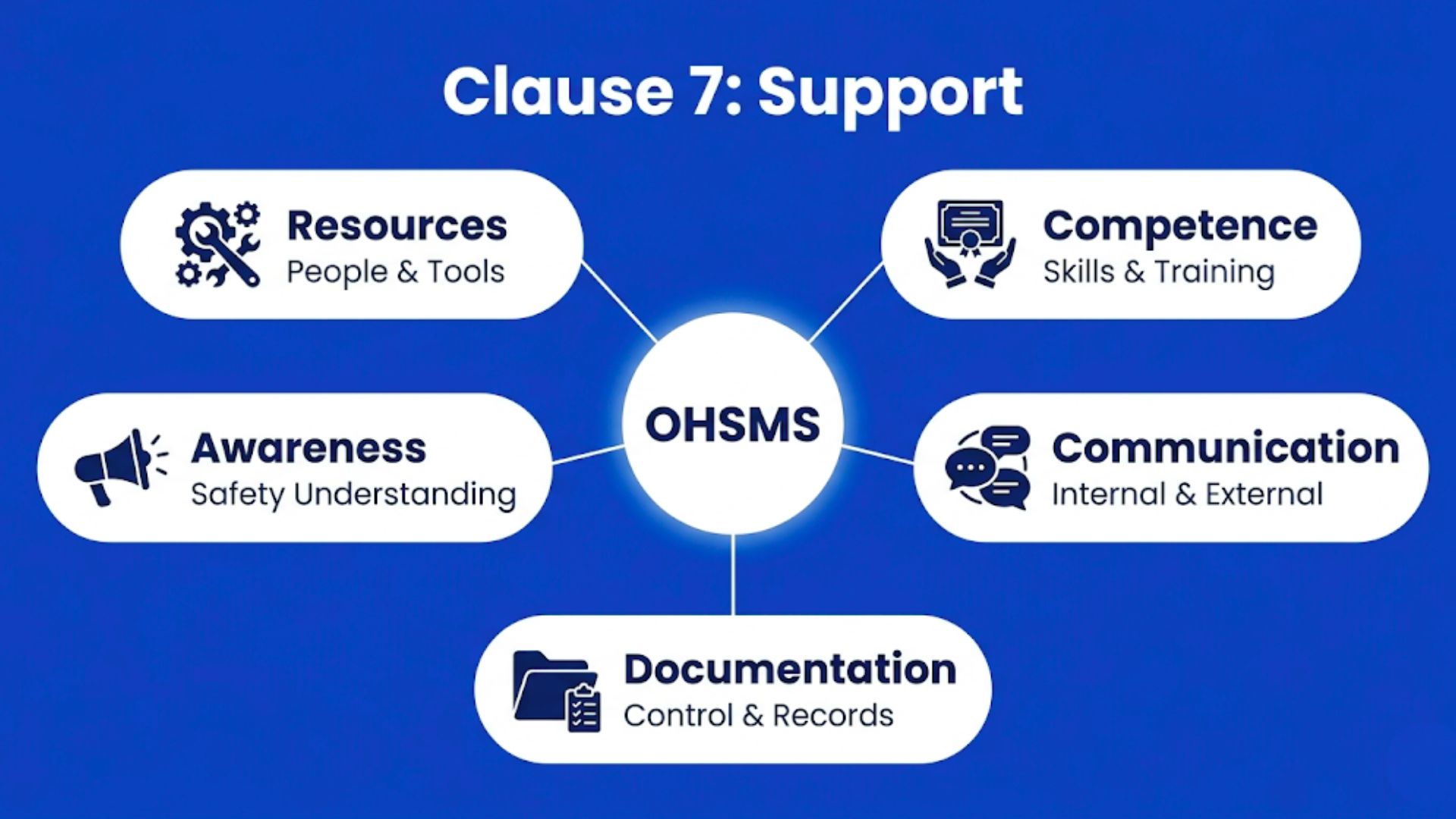
Clause 7 focuses on the resources and support systems required to effectively implement and maintain the OHSMS. It ensures that the organization has the necessary infrastructure, competence, and communication processes in place.
This includes providing adequate resources such as personnel, tools, equipment, and financial support. It also covers competence and training, requiring organizations to ensure that workers have the necessary skills and knowledge to perform their tasks safely.
Awareness is another key element. Employees must understand the OH&S policy, their roles within the system, and the potential risks associated with their work. Without this awareness, even well-designed systems can fail during execution.
The clause also addresses communication, both internal and external. Organizations must establish clear channels for sharing safety information, reporting incidents, and engaging with stakeholders. Effective communication is essential for ensuring that safety practices are consistently followed.
Documentation, referred to as “documented information,” is also covered here. This includes maintaining records, procedures, and evidence required to demonstrate compliance. However, ISO 45001 does not require excessive documentation. The focus is on maintaining what is necessary for effective system operation.
In practice, many organizations struggle with this clause by either under-documenting or over-documenting their processes. Finding the right balance is key to maintaining both compliance and usability.
Clause 7 supports all other clauses by ensuring that the system has the necessary inputs to function effectively.
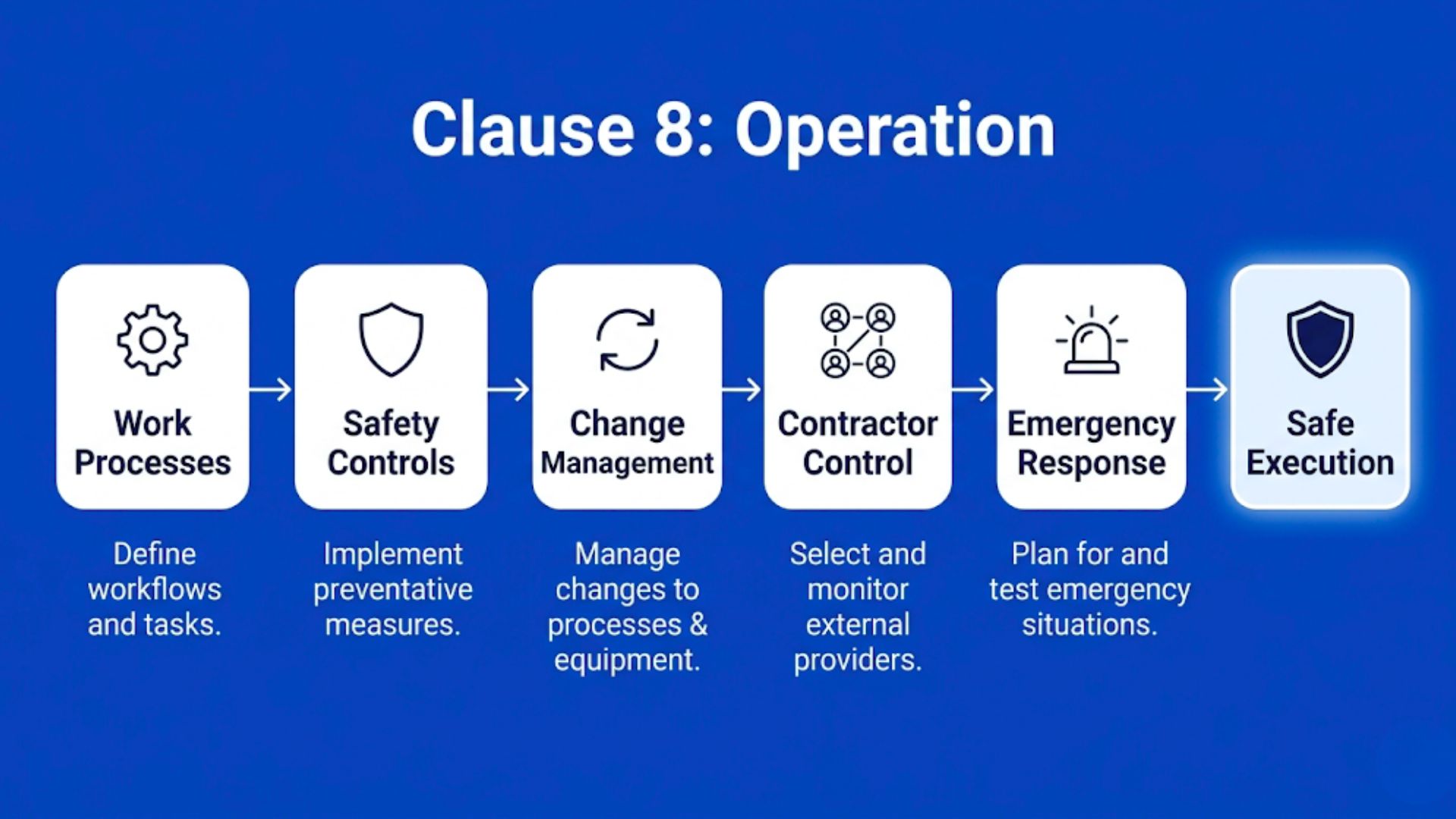
Clause 8 is where planning turns into action. It focuses on the operational controls required to manage identified risks and ensure safe working conditions.
Organizations are required to implement processes that control how work is carried out. This includes defining procedures, setting safety controls, and ensuring that operations are conducted in a way that minimizes risk.
A significant part of this clause involves managing changes. Whenever new processes, equipment, or materials are introduced, organizations must assess the associated risks and update controls accordingly. This prevents new hazards from being overlooked.
The clause also addresses outsourcing and contractor management. Organizations must ensure that external parties working on their behalf follow the same safety standards. This is especially important in industries like construction and manufacturing, where contractors play a major role.
Emergency preparedness and response is another critical component. Organizations must identify potential emergency situations and establish plans to respond effectively. This includes conducting drills, training employees, and ensuring that necessary resources are available.
Clause 8 is highly practical and directly linked to day-to-day operations. It is often where the effectiveness of the entire system becomes visible. This clause ensures that safety is not just planned, but actually implemented in real work environments.
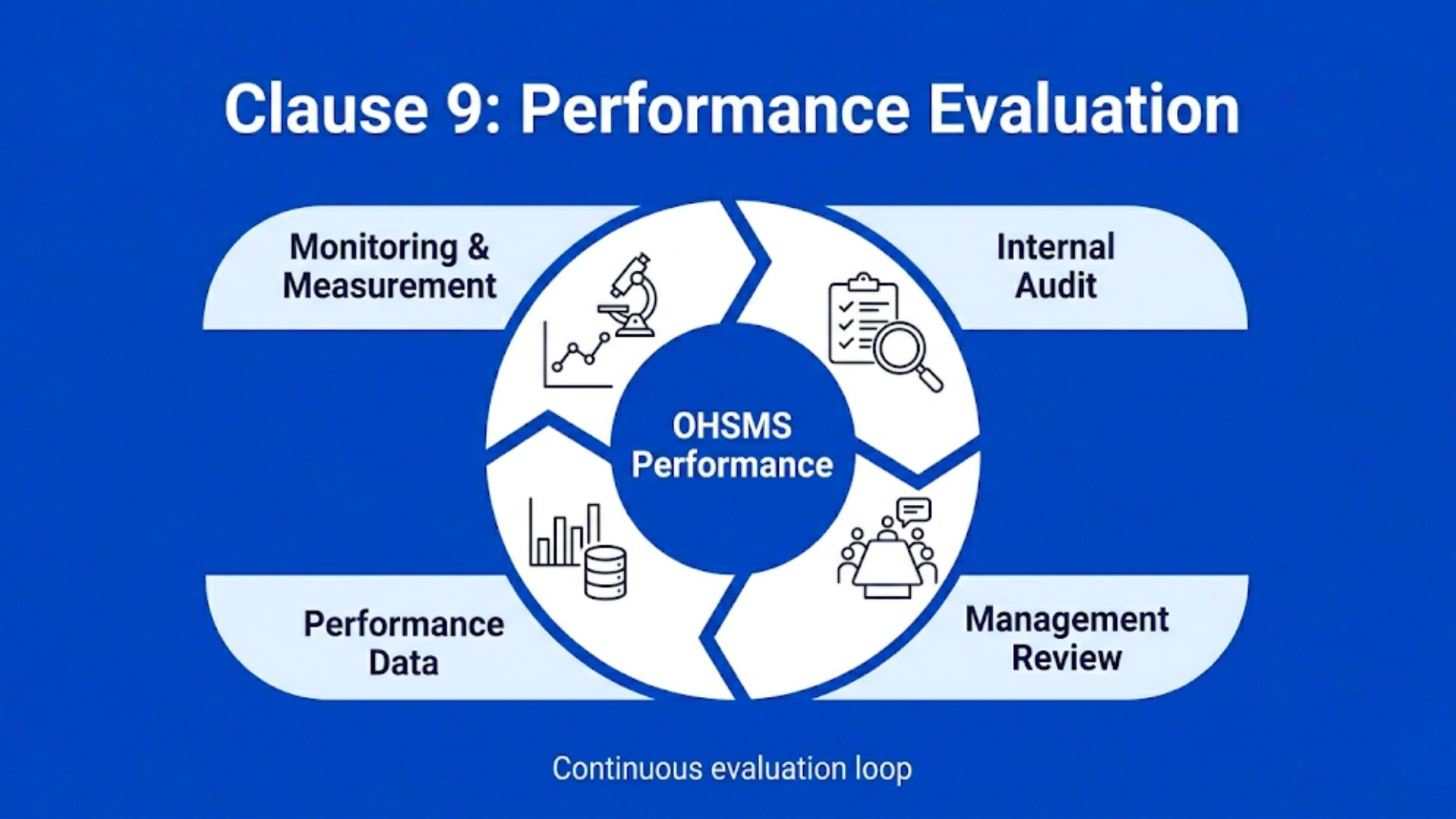
Clause 9 focuses on measuring and evaluating the effectiveness of the OHSMS. It ensures that organizations are not operating blindly but are actively tracking their safety performance.
This includes monitoring and measurement of key indicators such as incident rates, near misses, compliance levels, and achievement of safety objectives. Organizations must define what to measure, how to measure it, and how often.
Internal audits are another major component. These audits help identify gaps in the system and ensure that processes are being followed as intended. They also provide an opportunity to detect issues before external certification audits.
Management review is the final part of this clause. Top management must periodically review the performance of the OHSMS, assess its effectiveness, and make decisions for improvement. This ensures that the system remains aligned with organizational goals.
In practice, data plays a central role here. Organizations need reliable and accurate data to make informed decisions. Poor data collection or analysis can lead to incorrect conclusions and ineffective improvements.
Clause 9 is critical because it closes the feedback loop. Without proper evaluation, organizations cannot determine whether their safety measures are working.
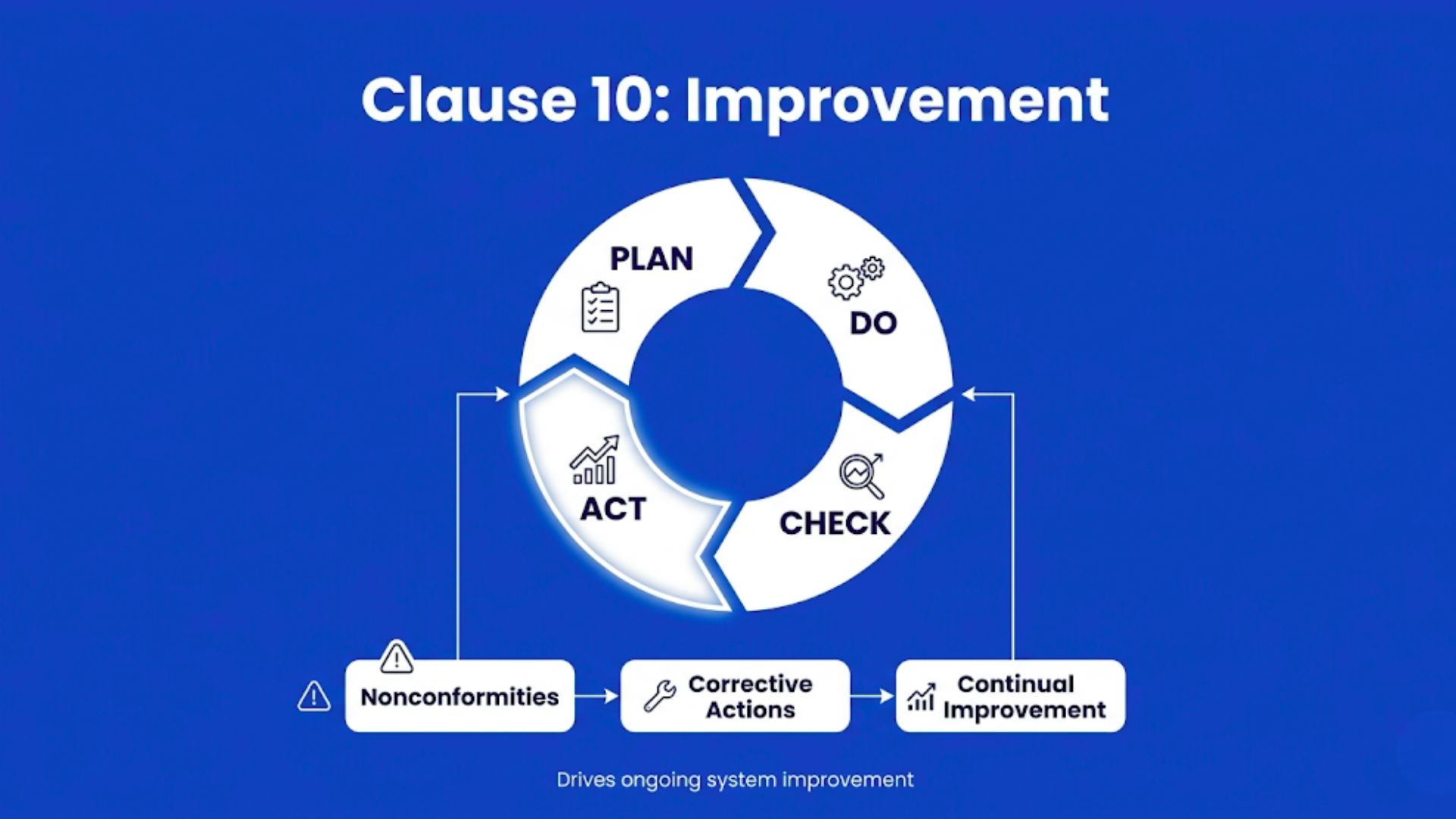
Clause 10 focuses on continual improvement of the OHSMS. It ensures that organizations do not remain static but continuously enhance their safety performance over time.
The clause requires organizations to identify nonconformities, investigate incidents, and take corrective actions to prevent recurrence. This includes analyzing root causes rather than just addressing surface-level issues.
Corrective actions must be tracked and verified to ensure they are effective. This prevents the same problems from occurring repeatedly and strengthens the overall system.
Continual improvement goes beyond fixing problems. It also involves proactively identifying opportunities to enhance safety, whether through new technologies, improved processes, or better training programs.
In real-world scenarios, organizations that actively focus on improvement tend to build stronger safety cultures and achieve better long-term outcomes.
Clause 10 completes the PDCA cycle by feeding improvements back into planning and execution.This clause ensures that the OHSMS evolves with the organization and continues to improve over time.
If you’ve made it this far, one thing is clear. ISO 45001 isn’t difficult clause by clause. It gets complex when everything has to work together.
That’s where most teams struggle.
P3 LogiQ helps you turn this into a clear, audit-ready system. No scattered documentation or last-minute fixes, just a structure that actually works in real operations.

If you want to see how this would actually look inside your organization, you can book a free demo call and walk through a practical setup tailored to your operations.
Or, if you prefer to explore it hands-on, you can sign up and start building your ISO 45001 system step by step with guided workflows.

Avoiding these mistakes is often just as important as understanding the clauses themselves. While ISO 45001 provides a clear framework, successful implementation depends on how consistently the requirements are applied in day-to-day operations.
If you're new to ISO 45001, it's easy to think of each clause as a separate task on a checklist. You finish one clause, move to the next, and slowly work your way through the standard.
The challenge is that ISO 45001 doesn't really work like that. Each clause influences the others. If your planning process is weak, your operational controls may not be effective. If your controls are weak, measuring performance becomes much harder. The clauses are connected, and treating them as separate projects often creates gaps that show up later.
Many organizations spend months creating policies, procedures, and records because they know auditors will want to see them.
The problem starts when those documents exist only for the audit. If employees don't follow them, understand them, or even know they exist, the paperwork isn't helping the business. Good documentation should support the way work is actually done, not describe an ideal process that only exists on paper.
One of the easiest ways to weaken an ISO 45001 system is to keep it within the management team.
The people working on the shop floor, in warehouses, on project sites, or in daily operations often have the clearest view of workplace risks. They see what works, what doesn't, and where problems are likely to occur. When workers are included in safety discussions and decision-making, the system becomes more practical and much more effective.
Internal audits are not supposed to be a rehearsal for the certification audit. Their real purpose is to help you find weaknesses before they become bigger issues.
The same applies to corrective actions. If a problem keeps coming back, it usually means the root cause was never fully addressed. Organizations that use audits and corrective actions to genuinely improve their systems tend to get far more value from ISO 45001 than those that simply focus on passing audits.
At the end of the day, most ISO 45001 problems don't happen because the standard is difficult. They happen because the system is treated as a compliance project instead of something that should support the way people actually work every day.
Implementing ISO 45001 often feels complex because teams try to tackle all clauses at once. In practice, the process becomes much clearer when you follow a structured, step-by-step approach that aligns with how the clauses are designed to work together.
The first step is to define the scope and context of your organization. This comes from Clause 1 and Clause 4, where you identify what parts of your operations are covered and what internal and external factors influence workplace safety. Getting this right early ensures that your entire system is built on a realistic foundation.
Next, align leadership and responsibilities as required in Clause 5. Top management needs to take ownership of the system, establish an OH&S policy, and clearly assign roles across the organization. At the same time, you need to create channels for worker participation so safety is not limited to management decisions.
Once the direction is clear, build a risk assessment framework under Clause 6. This involves identifying hazards, evaluating risks, and determining controls. You also need to map legal and regulatory requirements and define measurable safety objectives with clear action plans.
After planning, move to creating the necessary support systems outlined in Clause 7. This includes developing documentation, conducting training, building awareness, and setting up communication processes. The goal here is to ensure that your team has the knowledge and resources required to follow the system effectively.
With the foundation in place, implement operational controls under Clause 8. This is where safety processes are integrated into day-to-day activities, including managing contractors, controlling changes, and preparing for emergencies. At this stage, the system becomes visible in real work environments.
Once operations are running, track performance through Clause 9. Monitor key metrics, conduct internal audits, and carry out management reviews to evaluate how well the system is working. This step provides the data needed to make informed decisions.
Finally, focus on continuous improvement under Clause 10. Investigate incidents, address root causes, and implement corrective actions. Over time, this creates a cycle where the system keeps evolving and becoming more effective.
Understanding the ISO 45001 clauses is one thing, but turning them into a system that works in real operations is where most teams get stuck. That’s usually where delays, audit stress, and unnecessary rework start to show up.
P3 LogiQ helps you move past that confusion. Instead of a documentation-heavy approach, the focus is on building a clear, structured ISO 45001 system that fits how your organization actually runs.
From defining scope to aligning all 45001 ISO 2018 clauses with your day-to-day processes, the goal is simple: make compliance predictable and manageable.
If you’re planning your ISO 45001 journey or trying to fix gaps in your current setup, this is a good place to start. You can book a free demo call with P3 LogiQ or sign up to see how a smoother, step-by-step certification process can come together without the usual chaos.
ISO 45001 is structured into 10 clauses that define how an occupational health and safety management system should be built and maintained.
These include Scope (Clause 1), Normative References (Clause 2), Terms and Definitions (Clause 3), Context of the Organization (Clause 4), Leadership and Worker Participation (Clause 5), Planning (Clause 6), Support (Clause 7), Operation (Clause 8), Performance Evaluation (Clause 9), and Improvement (Clause 10).
For ISO 45001 certification, only Clauses 4 through 10 are mandatory. These are the auditable sections of the standard, where certification bodies evaluate whether your organization has properly implemented an occupational health and safety management system.
Clauses 1 to 3 are not audited because they serve as foundational references rather than requirements. That said, misunderstanding these sections can still create issues during implementation, since they influence how the auditable clauses are interpreted and applied.
ISO 45001 follows the Annex SL structure, which is a standardized framework used across multiple ISO management system standards. This structure is designed to make integration easier for organizations that implement more than one ISO standard, such as ISO 9001 or ISO 14001.
The clauses are organized in a logical flow based on the PDCA cycle (Plan–Do–Check–Act). Planning is covered in Clauses 4 to 6, execution in Clauses 7 and 8, evaluation in Clause 9, and improvement in Clause 10, creating a continuous system rather than a one-time process.
There is no single “most important” clause in ISO 45001 because the standard is designed as an interconnected system. Each clause supports the others, and weaknesses in one area often affect overall performance.
That said, Clause 5 (Leadership and Worker Participation) and Clause 6 (Planning) are often seen as critical because they define direction and risk control. Without strong leadership and proper planning, even well-documented systems tend to fail during execution and evaluation.
The time required to implement ISO 45001 varies depending on factors such as organization size, complexity, existing safety practices, and resource availability. For smaller organizations, implementation can take around 3 to 6 months, while larger or more complex operations may take 6 to 12 months or longer.
It’s important to understand that implementation is not just about documentation or passing an audit. Building a functioning OHSMS that aligns with Clauses 4 to 10 takes time, especially when it involves cultural changes, training, and continuous improvement processes.
Yes. Organizations of all sizes must address the relevant requirements of Clauses 4 to 10. However, the complexity and documentation required may vary depending on the organization's size, activities, and risk profile.
Certification auditors typically review evidence related to leadership, risk assessments, objectives, operational controls, competence, internal audits, management reviews, corrective actions, and continual improvement across Clauses 4 through 10.
The clauses align with the Plan-Do-Check-Act (PDCA) model. Clauses 4 to 6 support planning, Clauses 7 and 8 focus on implementation, Clause 9 covers performance evaluation, and Clause 10 addresses improvement.
ISO 45001 requires organizations to maintain and retain documented information supporting the effectiveness of their OH&S management system. The exact documents vary, but commonly include policies, risk assessments, objectives, training records, audit reports, and management review records.
As of 2026, the core clause structure of ISO 45001 remains based on the High-Level Structure used across ISO management system standards. Organizations should verify whether any amendments, interpretations, or guidance documents have been released that affect implementation requirements.
These FAQs are highly aligned with search intent for users looking to understand the ISO 45001 clause structure, certification requirements, implementation, and auditing expectations.



Businesses need document management systems (DMS) to ensure ISO and R2 compliance, improve efficiency, and stay audit-ready. The article highlights key features like version control, security, and automation while reviewing the top 5 DMS solutions. P3 LogiQ stands out for its compliance-focused automation and secure document tracking
Read More
Recycling businesses gain efficiency, compliance, and sustainability with RIOS certification. It streamlines quality management, environmental responsibility, and worker safety, helping companies avoid legal risks and boost credibility. P3 LogiQ simplifies the certification process with automation, document control, and compliance tracking, making operations smarter and safer.
Read More
Audit Management Software (AMS) automates compliance tracking, streamlines workflows, and reduces audit risks. Key features include automated scheduling, compliance checklists, CAPA tracking, vendor risk management, and integrations.
Read More
Learn how audit management systems simplify ISO and R2 compliance by automating audits, managing documentation, and minimizing compliance risks efficiently.
Read More
In 2025, many businesses still face challenges in compliance management due to outdated methods like spreadsheets and fragmented software. This inefficiency leads to missed deadlines, increased risk, and regulatory penalties. The blog emphasizes the importance of modern compliance tools that automate workflows, enhance risk management, and streamline regulatory processes to meet ISO and R2 standards.
Read More
The rise in e-waste and environmental concerns makes responsible electronics recycling essential. The R2 Certification sets a global standard for safe, sustainable, and data-secure recycling practices. Developed by Sustainable Electronics Recycling International (SERI), R2 helps businesses manage environmental risks, data security, worker safety, and legal compliance.
Read More
Businesses face increasing challenges in managing complex regulatory compliance. Manual methods such as spreadsheets and paperwork can lead to missed deadlines, inefficiencies, and costly penalties. Compliance management software offers a streamlined solution to reduce risks, automate processes, and improve operational efficiency.
Read More
Maintaining R2 Certification is crucial for businesses in the e-waste recycling industry, ensuring regulatory compliance, sustainability, and strong stakeholder trust. This guide outlines 10 best practices to help businesses simplify operations, reduce risks, and stay compliant.
Read More
Unlock the value of ISO risk management certification. Explore its impact on compliance, risk mitigation, and business expansion.
Read More
Explore the top 5 ISO risk management software tools for 2025, including document management solutions for streamlined compliance and increased efficiency.
Read More
Find the ideal document management software (DMS) for your business. Learn how to choose with expert tips, key features, and insightful guidance
Read More
Unlock the power of a Document Management System (DMS). Learn how it can revolutionize your business operations.
Read More









.png)


.png)





.jpg)


.jpg)
.jpg)











.jpg)



.png)

.png)
.png)





.png)

