.jpg)

Remember those school group projects? One person usually did most of the work, someone was unsure about what to do, and another person just wanted credit at the end. When roles were unclear, the project quickly became stressful.
Workplaces can face similar problems. When processes and responsibilities are not clearly defined, tasks can get repeated, deadlines may be missed, and teams may spend more time solving issues than doing important work.
This is where ISO 9001 certification helps. It provides a structured quality management system that helps organizations create clear processes, improve consistency, and build accountability. While businesses often focus on better quality and customer satisfaction, employees benefit too through clearer roles, smoother workflows, and better ways of working.
ISO 9001 software compliance can make these improvements easier by simplifying documentation, managing processes, and supporting continuous improvement. It helps teams stay organized and work toward common goals.
The ISO 9001 benefits for an organization go beyond compliance and quality improvements. They can also create a more supportive workplace where employees feel confident about their roles and responsibilities.
In this blog I will help you understand how ISO 9001 can improve the daily work experience for employees.
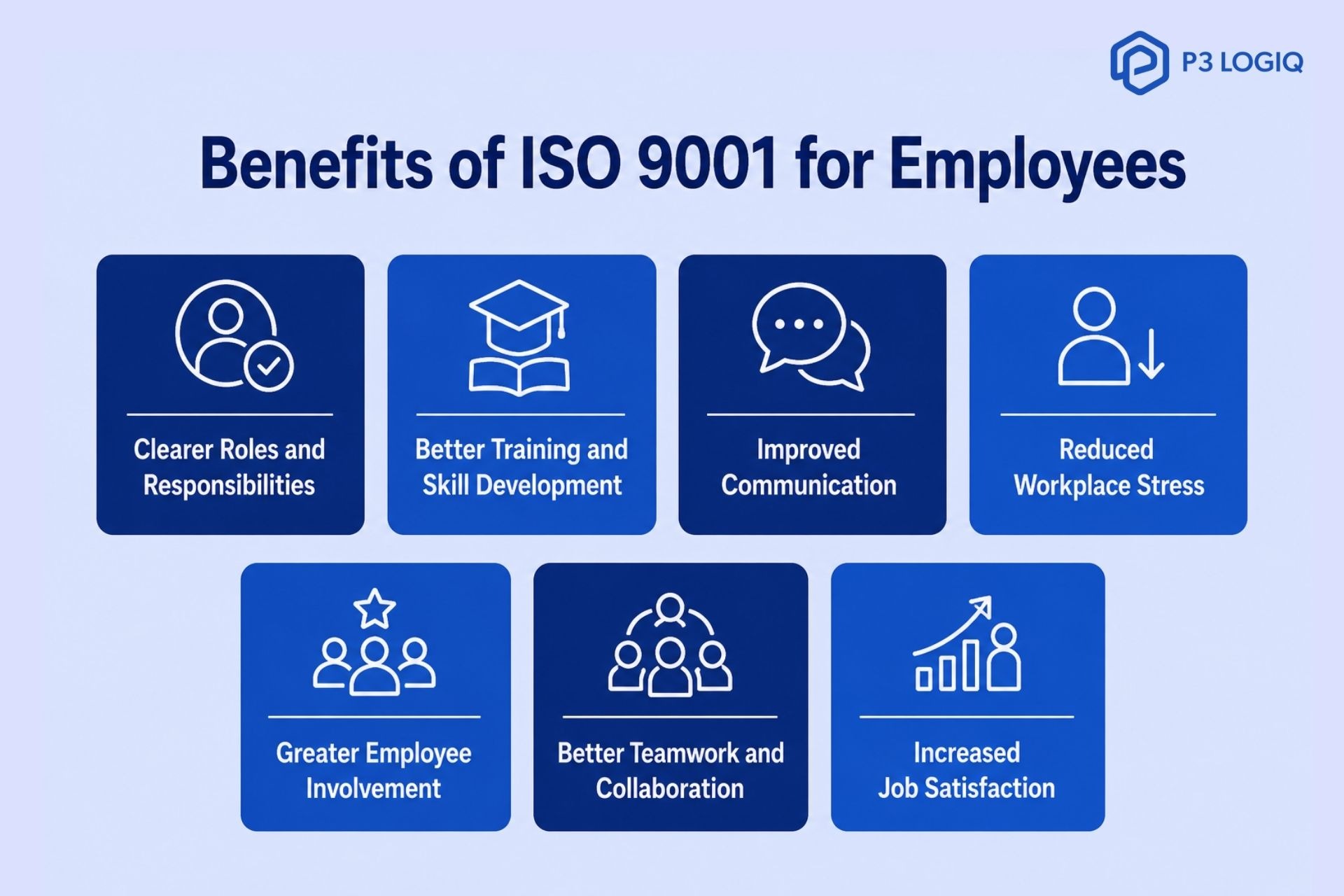
ISO 9001 helps create a more structured and efficient workplace for your employees through ISO 9001 document control. As processes improve and continuous improvement becomes part of daily operations, they get a better work experience and more opportunities to grow.
ISO 9001 follows the PDCA cycle (Plan–Do–Check–Act), which helps employees work in structured steps and continuously improve processes in daily tasks.
One of the key ISO 9001 benefits for your organization is creating clear roles and responsibilities across teams. The standard helps you define processes, assign ownership, and establish accountability throughout your business.
For example, in a manufacturing or service team, ISO 9001 ensures that each employee knows exactly who is responsible for quality checks, documentation, and approvals. This removes confusion like “who should handle this issue?” and helps teams complete tasks faster with fewer errors.
When your employees understand their responsibilities and expectations, they can work more efficiently and make decisions with greater confidence. Clear roles also help you reduce confusion, prevent repeated tasks, and improve collaboration between teams.
ISO 9001 helps organizations identify employee training needs and provide the right support to improve skills, which can easily be tracked through training management software. It ensures your teams have the knowledge and resources they need to perform their roles effectively. This focus on continuous learning helps employees improve their performance and stay prepared for changing workplace requirements.
For instance, ISO 9001 directly creates clear onboarding by requiring strong job skills under Clause 7.2. New hires are smoothly brought in using written step-by-step guides (SOPs), role-specific checklists, and guided shadowing. This official setup ensures clear duties from day one, speeding up learning time while lowering daily work risks.
ISO 9001 improves communication by standardizing how information flows between departments. For example, when a production team identifies a quality issue, it is logged through a defined process and automatically shared with quality and operations teams. This eliminates informal communication gaps, reduces confusion, and ensures everyone works from the same set of documented information through tools like document management software, which helps streamline access, sharing, and control of critical business documents across teams.
It does this by making information easier to find, update, and manage consistently across departments.
Unclear processes and frequent errors can create challenges for your teams. ISO 9001 helps you establish standardized procedures that reduce confusion and improve consistency. This makes it easier for your organization to focus on ISO 9001 compliance through effective quality management practices. With better processes in place, your teams can spend less time fixing preventable issues and more time focusing on meaningful work.
ISO 9001 encourages employee participation through feedback systems, suggestion programs, and continuous improvement initiatives. Employees are actively involved in identifying process gaps, submitting improvement ideas, and contributing to internal audits, making them part of the organization’s quality improvement cycle.
Understanding the ISO 9001 clauses and requirements helps you align employee responsibilities with your continuous improvement goals. This involvement helps your teams feel valued and develop a stronger sense of ownership in their work.
Quality management systems encourage different departments to work together toward common goals. ISO 9001 helps you create better collaboration across your organization and helps your teams understand how their work impacts overall performance. As a result, your employees can experience stronger cooperation and a more positive workplace culture.
Many people ask, "What does ISO 9001 mean to employees?" For your organization, it means creating a workplace with clear expectations, better support, and opportunities for growth as aligned with the ISO 9001 checklist. When your employees have the right tools, resources, and processes to succeed, they can work with greater confidence and improve productivity, all while feeling more satisfied in their roles.
This also improves job satisfaction by giving employees a sense of ownership, recognition, and career growth. When employees see their feedback implemented and their skills developed through structured training, it builds confidence and strengthens long-term engagement with the organization.
The ISO 9001 certification benefits for employees go beyond quality compliance. By creating clearer processes, improving communication, supporting training, and encouraging continuous improvement, ISO 9001 helps organizations build a more organized and effective workplace.
However, managing ISO 9001 requirements manually can make it challenging to maintain consistency across teams. That’s where we help.
With P3 LogiQ, we help you simplify quality management by bringing documentation, processes, audits, and compliance activities into one centralized platform. This allows you to maintain compliance, improve process visibility, and build systems that support both business success and employee growth.

Ready to see how it works? Book a demo now to explore P3 LogiQ’s quality management capabilities and understand how we can support your ISO 9001 goals.
You can also sign up to get started and take the next step toward a more efficient, compliant, and employee-focused workplace.
ISO 9001 certification benefits for employees include clearer responsibilities, better communication, improved training, and consistent processes. By implementing ISO 9001, you can create a structured workplace where your employees understand expectations, reduce mistakes, and contribute more effectively toward quality goals and organizational success.
ISO 9001 means creating a workplace where employees have clear processes, defined responsibilities, and proper guidance. By establishing a structured quality management system, you can help your teams understand their roles, improve consistency, and see how their work supports quality, customer satisfaction, and business improvement.
ISO 9001 improves employee performance by helping you create standardized processes and clear work expectations. When your employees have access to documented procedures and proper training, they can complete tasks more consistently, reduce errors, improve productivity, and deliver better results that support your organization’s quality objectives.
ISO 9001 helps you define roles, responsibilities, and accountability across your organization. When employees understand their duties and expectations, they can make better decisions and complete tasks more efficiently. Clear responsibilities also reduce confusion, improve teamwork, and help your organization maintain consistent quality standards.
ISO 9001 supports employee growth by encouraging training, skill development, and involvement in improvement activities. By creating opportunities for learning, you can help your teams build stronger capabilities, improve their knowledge, take on new responsibilities, and contribute more effectively to your organization’s long-term success.
Continuous improvement is a core principle of ISO 9001. It helps you regularly review processes, identify improvement opportunities, and encourage employees to share ideas. By involving your teams in problem-solving, you can create a workplace focused on learning, innovation, and achieving better results over time.
Yes. ISO 9001 helps you create clear processes and expectations that reduce workplace confusion. When employees know their responsibilities and have proper guidance, they can complete tasks with more confidence. This helps reduce preventable issues, improve efficiency, and create a more organized work environment.
ISO 9001 encourages teamwork by helping you align departments around common goals and consistent processes. When employees understand their responsibilities and how their work connects with others, they can collaborate more effectively, improve communication, reduce delays, and support better overall organizational performance.
ISO 9001 helps you build a workplace culture based on clear communication, accountability, and continuous improvement. By creating organized processes and supporting employee involvement, you can encourage trust, collaboration, and teamwork while helping employees feel more supported in their daily responsibilities.
Employee involvement helps you identify practical improvements and address workplace challenges more effectively. By encouraging your teams to share feedback, suggest ideas, and participate in improvement activities, you can strengthen your quality management system and create processes that better support business goals.



Businesses need document management systems (DMS) to ensure ISO and R2 compliance, improve efficiency, and stay audit-ready. The article highlights key features like version control, security, and automation while reviewing the top 5 DMS solutions. P3 LogiQ stands out for its compliance-focused automation and secure document tracking
Read More
Recycling businesses gain efficiency, compliance, and sustainability with RIOS certification. It streamlines quality management, environmental responsibility, and worker safety, helping companies avoid legal risks and boost credibility. P3 LogiQ simplifies the certification process with automation, document control, and compliance tracking, making operations smarter and safer.
Read More
Audit Management Software (AMS) automates compliance tracking, streamlines workflows, and reduces audit risks. Key features include automated scheduling, compliance checklists, CAPA tracking, vendor risk management, and integrations.
Read More
Learn how audit management systems simplify ISO and R2 compliance by automating audits, managing documentation, and minimizing compliance risks efficiently.
Read More
In 2025, many businesses still face challenges in compliance management due to outdated methods like spreadsheets and fragmented software. This inefficiency leads to missed deadlines, increased risk, and regulatory penalties. The blog emphasizes the importance of modern compliance tools that automate workflows, enhance risk management, and streamline regulatory processes to meet ISO and R2 standards.
Read More
The rise in e-waste and environmental concerns makes responsible electronics recycling essential. The R2 Certification sets a global standard for safe, sustainable, and data-secure recycling practices. Developed by Sustainable Electronics Recycling International (SERI), R2 helps businesses manage environmental risks, data security, worker safety, and legal compliance.
Read More
Businesses face increasing challenges in managing complex regulatory compliance. Manual methods such as spreadsheets and paperwork can lead to missed deadlines, inefficiencies, and costly penalties. Compliance management software offers a streamlined solution to reduce risks, automate processes, and improve operational efficiency.
Read More
Maintaining R2 Certification is crucial for businesses in the e-waste recycling industry, ensuring regulatory compliance, sustainability, and strong stakeholder trust. This guide outlines 10 best practices to help businesses simplify operations, reduce risks, and stay compliant.
Read More
Unlock the value of ISO risk management certification. Explore its impact on compliance, risk mitigation, and business expansion.
Read More
Explore the top 5 ISO risk management software tools for 2025, including document management solutions for streamlined compliance and increased efficiency.
Read More
Find the ideal document management software (DMS) for your business. Learn how to choose with expert tips, key features, and insightful guidance
Read More
Unlock the power of a Document Management System (DMS). Learn how it can revolutionize your business operations.
Read More








.png)


.png)



.jpg)



.jpg)
.jpg)





.jpg)

.png)

.png)
.png)


.png)

