.jpg)

A friend of mine works as an operations manager at a mid-sized manufacturing company in Ohio, with around 400 employees. Compliance is a big part of her job, and she handles it well.
When ISO 14001:2026 started coming up, she was already paying attention. She read early drafts, joined a few webinars, and followed updates from the ISO committee.
But then things got confusing. The clauses changed. The terminology shifted. Harmonized Structure (HS) alignment added complexity, and supply chain requirements became stricter than before.
She knew this update was coming. She also knew she couldn’t ignore it. Her clients were already asking questions, and some competitors had started preparing early. Falling behind on something this important wasn’t an option.
She just didn’t know where to begin.
If that sounds like you right now, you’re in the right place.
ISO 14001:2026 is the latest revision of the Environmental Management System standard that introduces updated requirements around climate, biodiversity, supply chain control, and change management.
ISO 14001 certification helps businesses understand and manage their environmental impact.
For easy updates and tracking, businesses nowadays use ISO 14001 compliance software that helps manage requirements, reduce manual documentation, and keep the certification process more organized.
This guide is for anyone trying to understand the ISO 14001:2026 revision timeline and the changes that occurred without reading long technical documents or sitting through confusing webinars.
We’ll break down what changed, what the timeline looks like, and how to prepare without disrupting your current system.
Before diving into the ISO 14001 latest version, here's a quick overview of what ISO 14001 actually covers.

ISO 14001 is the global standard for Environmental Management Systems (EMS). It helps organizations understand and manage how their operations affect the environment.
It covers energy use, waste, emissions, water use, and even the impact of your supply chain.
It is not a legal requirement in the US. But that matters less today.
According to the ISO Survey 2024, there are over 670,000 certifications worldwide. Customers, investors, and large buyers now expect it. It is no longer seen as a “nice to have.”
Here is something US businesses should pay attention to. The US is falling behind. China leads with over 355,000 certificates. Italy has over 23,000. Spain holds over 7,700. The United States has fewer than 2,500, ranking 20th globally.
That gap matters. Environmental rules are getting stricter across global supply chains. It is starting to affect who wins contracts.
In simple terms, ISO 14001 is more than a green label. It provides real proof of your environmental efforts, backed by evidence instead of statements on a website.
The benefits of ISO 14001 are clear. Better compliance. Lower risk. Smoother operations.
This is where many people get confused, especially with the 2026 update.
ISO 14000 is not one standard. It is a group of standards. Each one covers a different part of environmental management. Some focus on audits. Others on labeling, performance, or life cycle assessment.
ISO 14001 is part of that group.
It is the only standard in the ISO 14000 family that organizations can get certified to. This is what auditors check, and this is what companies hold as proof.
So when someone says “ISO 14000 certified,” they usually mean ISO 14001.
The rest of the ISO 14000 standards support the system, but they do not lead to certification.
For eleven years, ISO 14001:2015 was the standard.
It worked well. But business conditions have changed.
Climate risk is now a real concern. Biodiversity is no longer a niche topic. Investors and regulators expect clearer reporting on environmental impact.
For those tracking the 14001:2026 revision status, the update was officially released on April 15, 2026. The International Organization for Standardization published the ISO 14001:2026 version, replacing the 2015 version.
This is not a full reset.
For organizations still operating under the 2015 edition, understanding what the ISO 14001 latest version requires is the first step toward a smooth transition.
The latest version of 14001 focuses on improving what already exists. More clarity. Better structure. Stronger focus on risk, context, and change.
Some updates, however, will affect daily operations.
As these updates start impacting operations, cost becomes part of the planning. Changes to systems, audits, and internal processes can all influence the overall ISO 14001 cost.
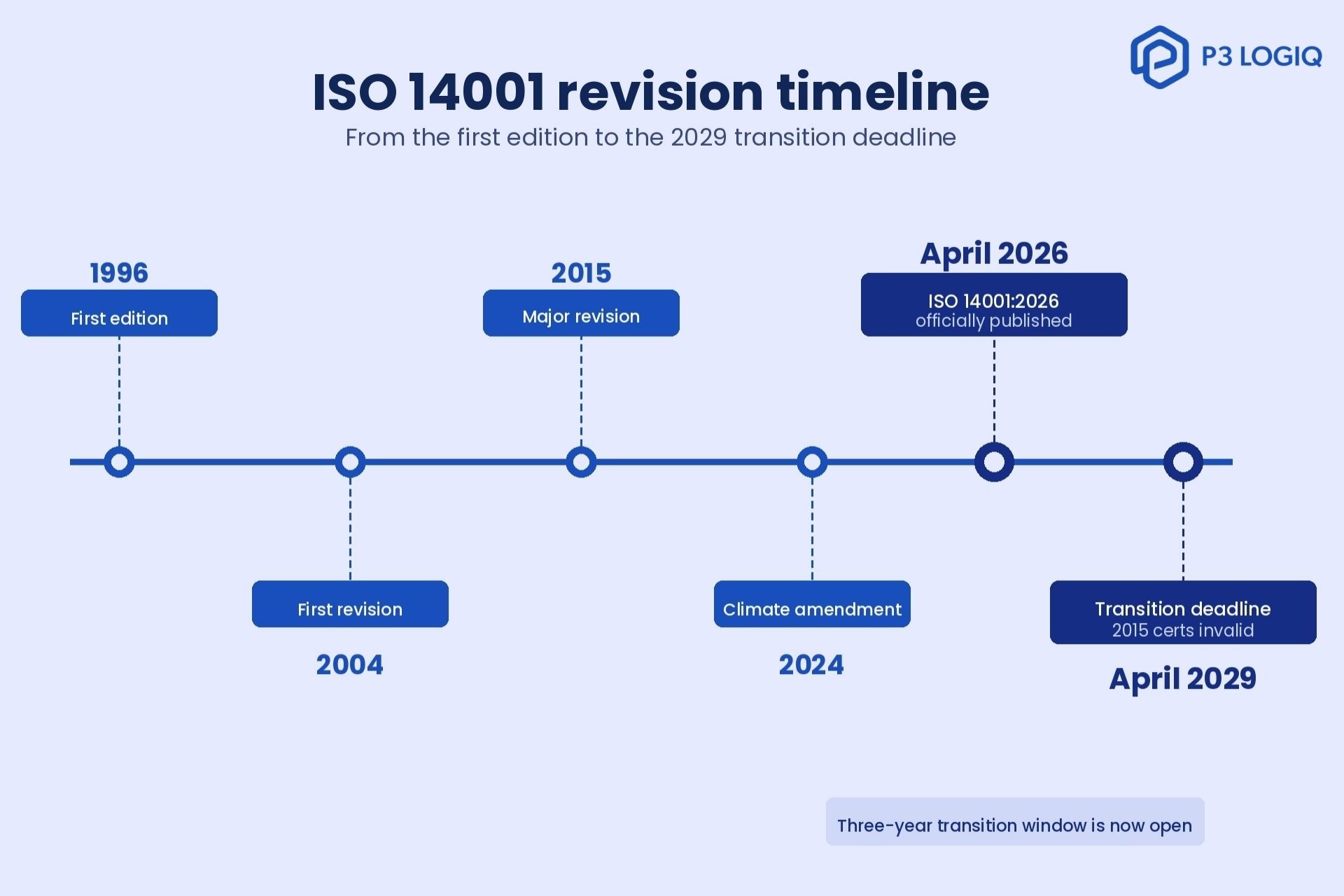
Here is how the standard has evolved:
1996: First version
2004: First revision
2015: Major update
2024: Climate amendment added
April 2026: Latest version released
April 2029: Transition deadline
Organizations certified to the 2015 version have three years to transition.
After April 2029, those certificates will no longer be valid.
Three years may sound like enough. It often is not.
Certification bodies need time to align. Auditors get booked early. Internal updates take time, especially when they involve suppliers, risk planning, and leadership decisions.
Starting early gives you more control. Waiting puts you in line.
This is the question many EHS managers, operations leads, and compliance teams are asking right now.
Just to ease your concern, ISO 14001 revision 2026 is not a complete rewrite.
The core structure is still the same. The Plan-Do-Check-Act model remains unchanged.
But some parts are stricter and clearer. There is one new requirement. Climate, biodiversity, and supply chain expectations are now clearly defined, not implied.
The changes are easier to understand when you look at the ISO 14001 clauses list, where each clause connects to the next and forms one system.
The clause-level differences between ISO 14001:2015 and ISO 14001:2026 are outlined below for clearer understanding.
Under ISO 14001:2015, organizations had to understand their internal and external context. Climate and biodiversity were not clearly mentioned.
ISO 14001:2026 now names these factors directly. This includes pollution levels, natural resources, climate priorities, and biodiversity loss.
This is not a small change.
Earlier, companies could focus on energy use and waste. Now that is not enough.
If biodiversity loss, water scarcity, or local pollution affects your business, you must document and track it. It must also connect to your goals, risks, and controls.
A study by Deloitte and Environmental Defense Fund found that 87% of institutions expect climate risk to affect their business.
This shift applies across industries. Companies now treat climate as a real business risk, not only an environmental concern.
The focus is now on risk, resilience, and long-term impact.
For US manufacturers, construction firms, and agriculture businesses, this change has a direct operational impact.
ISO 14001:2026 restructures how risks and opportunities are handled.
A new Clause 6.1.4 combines risk and opportunity into one system. It also connects them more clearly to action planning.
Another update to Clause 6.1.2 strengthens the existing life-cycle perspective introduced in ISO 14001:2015. The 2026 revision adds clearer guidance on addressing upstream suppliers, downstream impacts, and their connection to EMS scope definition.
According to the McKinsey 2024 Supply Chain Survey, only 9% of organizations have fully aligned supply chains. Around 30% are behind.
This shows a clear gap. Many organizations are not ready.
The updated clause is designed to identify these gaps earlier, before they become business risks.
For companies already doing this well, the transition is manageable. Others will need to move beyond documentation and show real action.
This is the only completely new clause.
ISO 14001:2015 did not require a formal process for managing changes. ISO 14001:2026 now requires it. Organizations must review and control changes before they happen.
Think about common changes:
Each one must be reviewed for environmental impact before implementation. Auditors will check how you define changes, how you assess impact, and how you control them. Evidence can include change logs, meeting notes, or workflow records.
If your process is informal today, you will need to formalize it.
McKinsey research and transformation insights show that 70% of change programs fail due to poor execution and alignment. This clause addresses that risk directly.
Unmanaged change can quickly weaken your entire system.
Beyond Clause 6.3, ISO 14001:2026 also introduces broader updates across supply chain control, leadership accountability, and biodiversity requirements.
If your current system is not aligned with ISO 14001:2026, now is the right time to review gaps and start preparing for the update.
P3 LogiQ is a compliance software platform that helps manage ISO 14001 documentation, tracking, and updates in one place.
Sign up with P3 LogiQ to simplify your ISO 14001 compliance process.
The term “outsourced processes” has been replaced with “externally provided products, services, and processes.”
This change expands responsibility beyond your operations to your full supply chain.
Organizations must now define and document their level of control over suppliers.
According to Gartner Supply Chain Future Insights, 67% of supply chain leaders are now responsible for sustainability metrics.
This means environmental responsibility is now enforced through supply chains.
For US companies, this leads to:
Environmental impact must be actively managed and recorded.
ISO 14001:2015 required leadership involvement. In practice, this often meant minimal participation.
ISO 14001:2026 raises this expectation. Leaders must now actively support environmental management across the organization.
Auditors will expect to see active involvement, with clear evidence beyond signed policies and yearly reviews.
For many US organizations, this is a significant shift.
A June 2024 Deloitte Global survey found that companies with cross-functional ESG teams perform better. 38% reported strong progress, compared to 10% without such teams.
The new standard pushes organizations toward shared responsibility and leadership involvement.
ISO 14001:2026 places biodiversity alongside climate, pollution, and resource use in Clause 4.1.
Once included, it affects the entire system. It connects to planning, operations, performance, and improvement.
Many assume biodiversity only affects industries like mining or agriculture. That is no longer accurate.
All organizations depend on supply chains. These supply chains often operate in ecologically sensitive areas.
The WEF Global Risks Report 2024 identifies biodiversity loss as a major long-term risk.
For US businesses, this means real exposure. It can affect supply chains, insurance, and investor confidence.
For sectors like construction, energy, and manufacturing, biodiversity must now be formally assessed and managed.
Honestly, it depends on where your organization stands today.
The changes are not drastic, but they are intentional. Climate, biodiversity, life cycle thinking, and supply chain controls are now clearly required. They are no longer implied.
If your EMS is strong and actively used, the transition will be manageable. You will need to update your context, formalize change management, and strengthen supply chain records. But you are not starting from scratch.
Transition costs vary depending on organization size, system maturity, and certification scope. For most mid-sized businesses, costs typically include gap analysis, documentation updates, training, and transition audits, and may range from a few thousand dollars to higher amounts for more complex or multi-site organizations.
If your EMS has gaps, especially in leadership involvement, supply chain control, or risk planning, this update will bring them to the surface.
Auditors will focus on real practices, with evidence beyond updated documents.
Organizations that treated ISO 14001:2015 as paperwork will feel the impact more. Those who built it into daily operations will find the transition much easier.
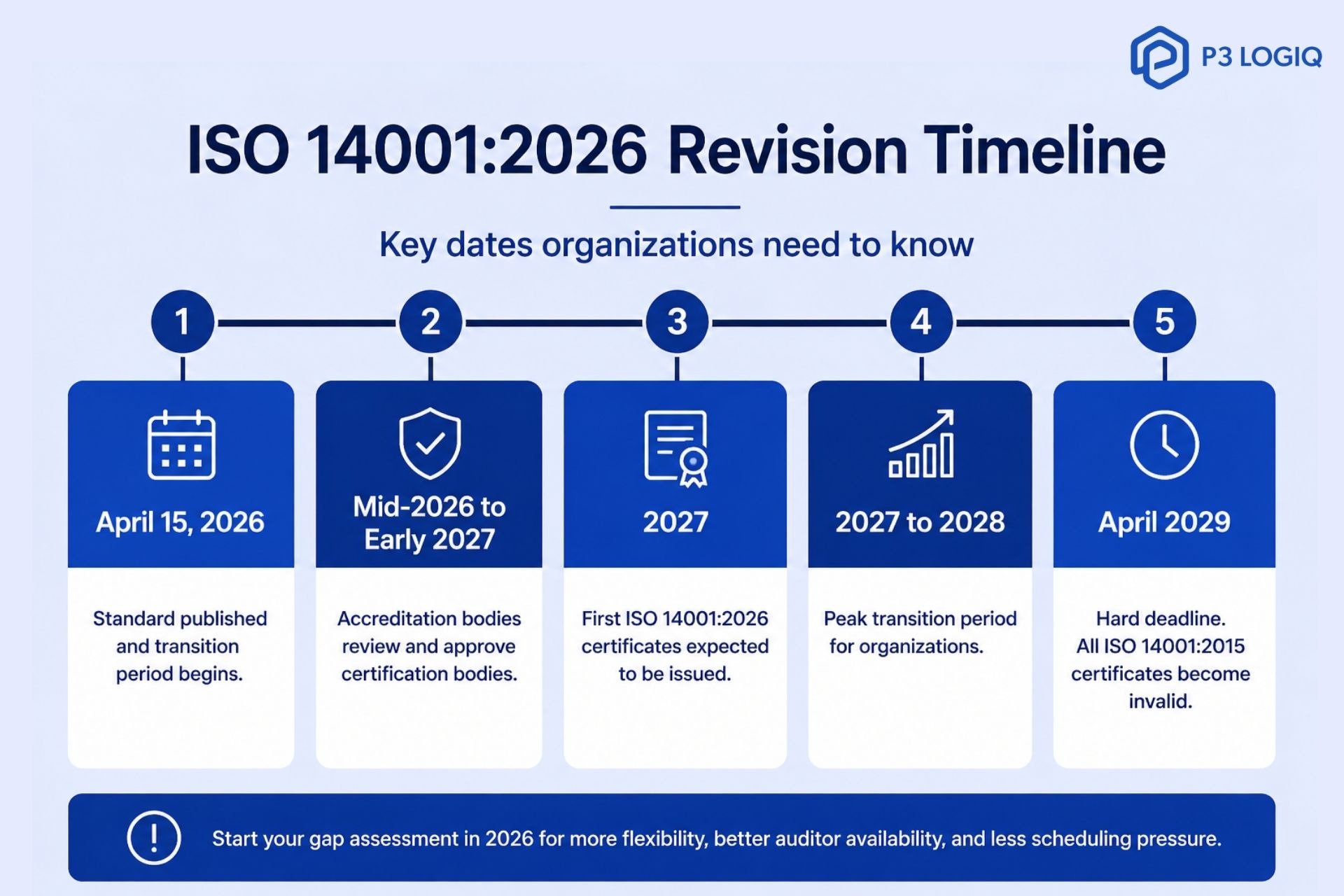
ISO 14001:2026 was published on April 15, 2026. ISO 14001:2015 was withdrawn the same day. The transition window is now open.
Here is how the next three years look:
April 15, 2026: ISO 14001:2026 published. ISO 14001:2015 withdrawn. Transition begins. Organizations can start gap assessments right away.
Mid-2026 to early 2027: Accreditation bodies review and approve certification bodies. Not all will be ready at the same time.
2027: First ISO 14001:2026 certificates are expected to be issued.
2027 to 2028: Peak transition period. Organizations run gap analyses, update EMS documents, train teams, and plan audits.
April 2029: Final deadline. All ISO 14001:2015 certificates become invalid. Organizations that have not transitioned lose certification.
The three-year window may seem enough. It often is not.
Certification bodies will face higher demand as 2029 gets closer. Auditor availability will tighten.
Organizations that start in 2026 will have more flexibility, better access to auditors, and less pressure.
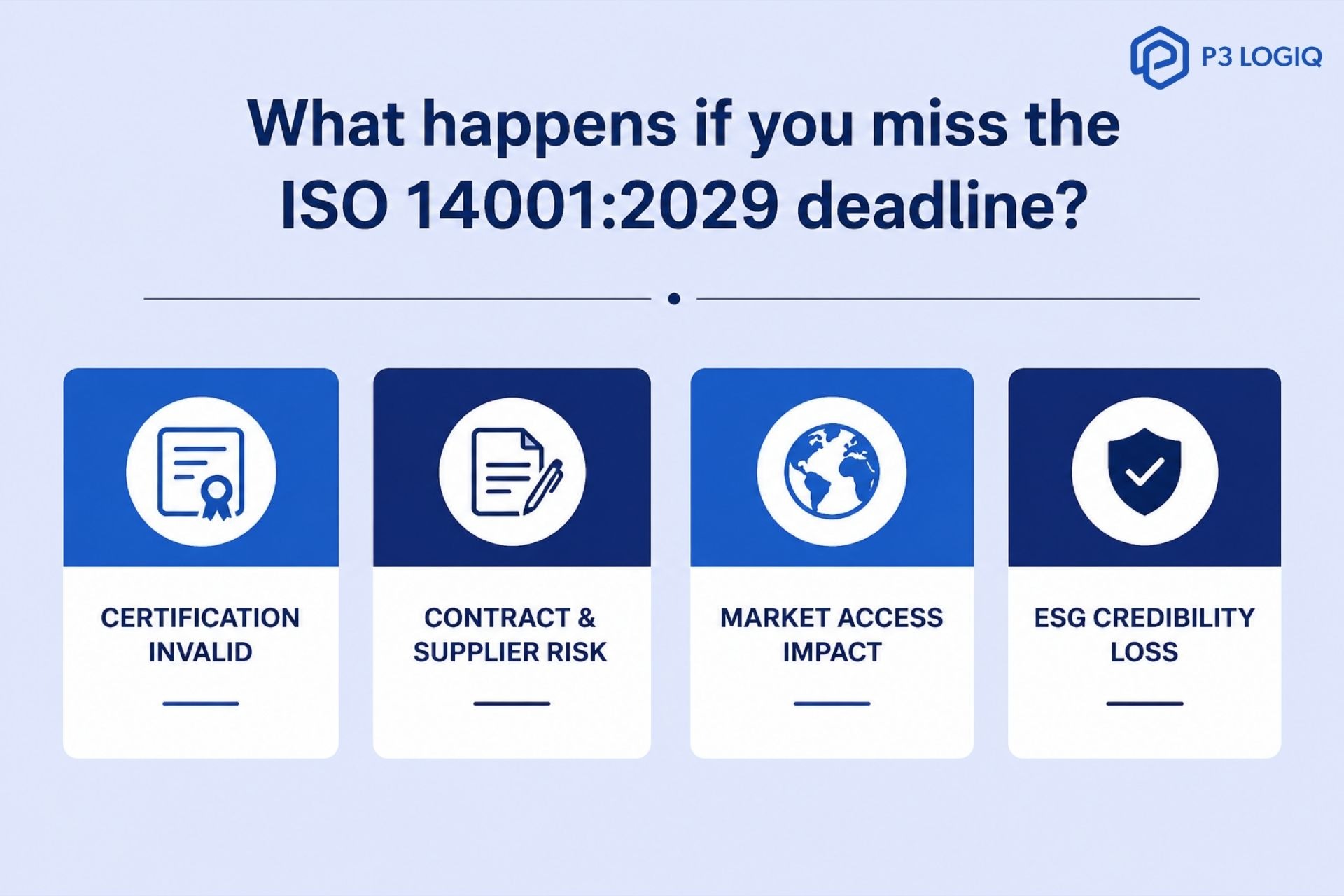
This is a critical question. Many businesses overlook it.
Here is the direct answer.
Your ISO 14001 certificate becomes invalid after April 2029 if you do not transition.
There is no grace period. There are no exceptions.
Here is what that means in practice.
If your contracts or supplier agreements require ISO 14001, you will be in breach immediately. Clients are not required to wait.
For US companies working with Europe, the risk is higher. Environmental and supply chain rules are stricter. A lapsed certificate can block you from contracts.
There is also the ESG impact. If you use ISO 14001 to support environmental reporting, you will lose that verified backing.
Without certification, your claims carry less weight.
There is also a reputational risk. Losing certification sends a clear signal about your compliance standards.
This situation is avoidable.
The transition is manageable when you start early.
ISO 14001:2026 applies to any organization that has or plans to get ISO 14001 certification. But some industries will feel the impact more.
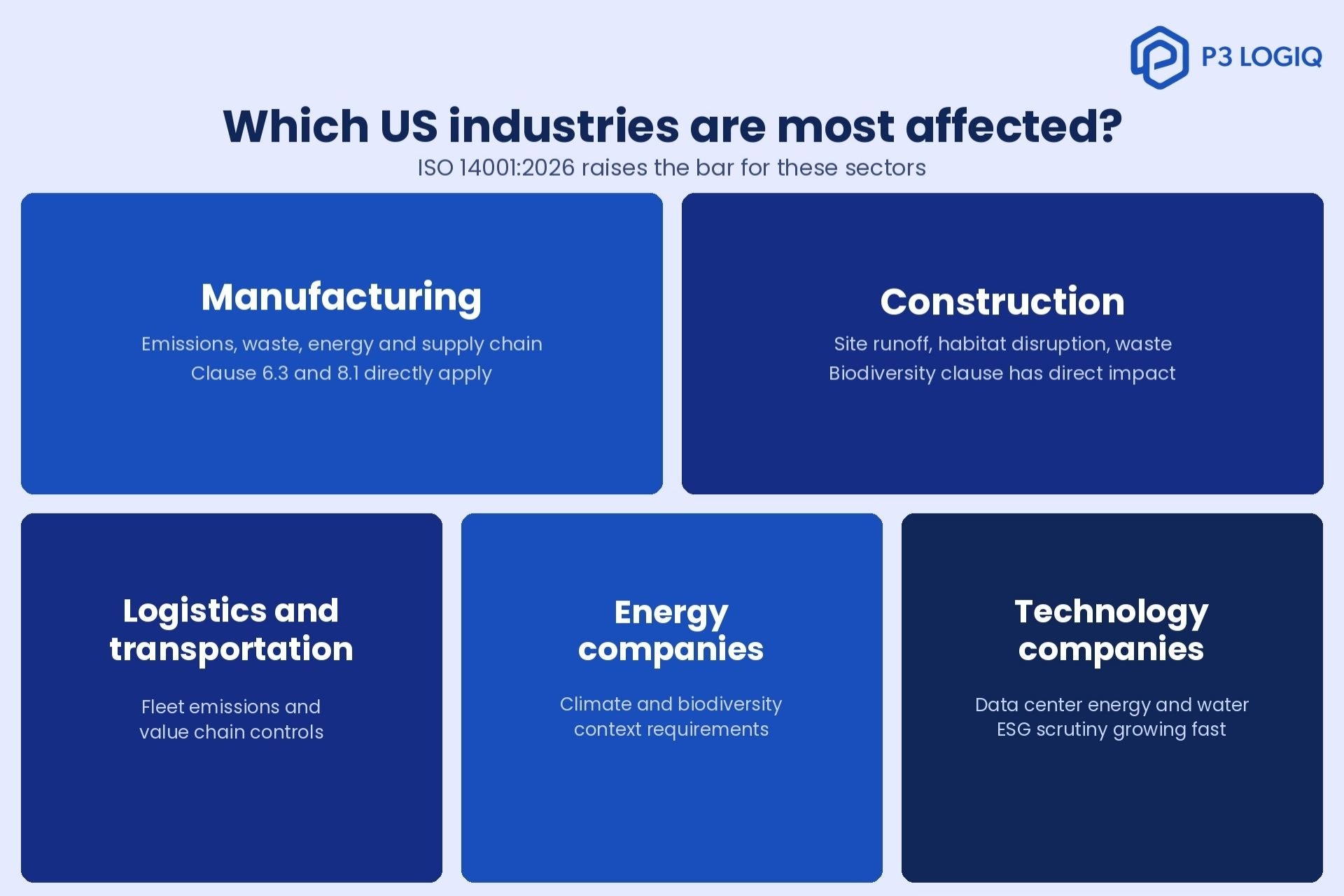
This is the most affected sector.
US manufacturers deal with emissions, waste, energy use, and resource consumption every day.
The new supply chain rules and Clause 6.3 change management directly affect how production is handled, especially when processes, materials, or suppliers change often.
Construction is another high-impact sector.
Activities like site runoff, land use, habitat impact, and waste all fall under ISO 14001.
The new focus on biodiversity is especially important for projects near sensitive environments
These companies will feel the supply chain changes the most.
Fleet emissions, fuel use, and packaging are already key concerns.
Environmental control now extends across the entire value chain, including both internal operations and external partners.
Energy companies already operate under strict environmental rules.
Now they must formally include climate risk and biodiversity in their EMS.
For oil, gas, and utilities, this goes beyond documentation and into daily operations.
This is a growing segment.
Data centers use large amounts of energy and water.
With rising ESG pressure from investors and clients, ISO 14001 is becoming part of the core system used to show environmental responsibility.
In many of these sectors, environmental management does not work alone. It often connects with workplace safety systems, where ISO 14001 vs. ISO 45001 reflects how companies manage both environmental impact and employee safety together.
Any US company that exports to Europe, works on federal contracts, or is part of a large supply chain should treat this update as directly relevant.
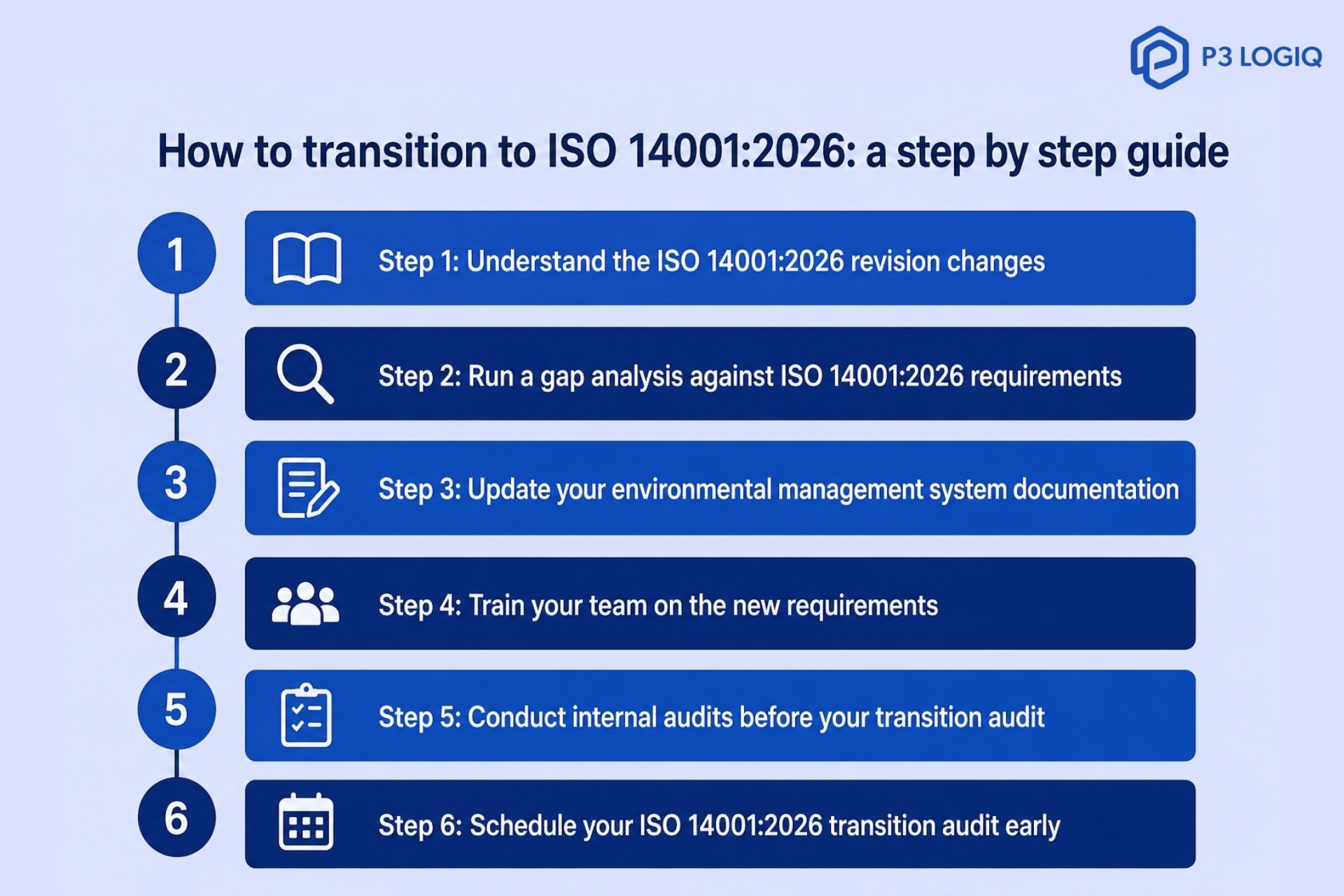
Whether your organization already has ISO 14001 or is starting fresh, the transition follows a clear path.
Start here.
Review the key differences between ISO 14001:2015 and ISO 14001:2026. Focus on Clause 6.3, updated context requirements in Clauses 4.1 and 4.2, stronger supply chain rules in Clause 8.1, and biodiversity updates.
The standard is available through ISO and ANSI. Read Annex A carefully. It gives practical guidance and answers many common questions.
Compare your current EMS with the new requirements. Identify what already works, what needs updates, and what needs to change.
Focus on change management, supply chain records, and how you handle climate and biodiversity in your context. These areas often show the biggest gaps.
Starting early helps you fix issues before your next audit, reducing cost and disruption.
Using a structured ISO 14001 checklist can make this process easier to track and implement.
Close the gaps you identified. Update policies, procedures, and records to match the 2026 requirements.
If you are adding Clause 6.3 for the first time, build a clear process to review changes before they happen.
You do not need a complex system. Simple records like change logs, meeting notes, or workflows are enough, as long as they show control.
Also, update your context analysis. Clearly document how climate, biodiversity, pollution, and resource use affect your operations.
Updated documents only work if your team understands them.
Train your EHS team, operations managers, and leadership on what changed and why.
Teams handling suppliers must understand the new expectations for external processes.
ISO 14001 requires organizations to demonstrate environmental action through verified evidence. The 2026 update expects leadership to stay actively involved throughout the year, not only during annual reviews.
Run internal audits before your transition audit.
Check your system against ISO 14001:2026 requirements.
ISO 14001:2026 puts more focus on clearly defining audit objectives, scope, and criteria in audit plans and reports, making auditor reviews more detailed and explicit.
Internal audits should also verify that corrective actions from previous cycles have been properly closed and documented before the transition audit.
These audits help you find issues early and prepare your team for the real audit.
Contact your certification body and discuss your transition timeline. Confirm their readiness for ISO 14001:2026 and auditor availability.
Book early. As 2029 gets closer, auditors will be harder to schedule.
Organizations that act in 2026 or 2027 will have more flexibility and less pressure.
No. This is a common concern.
If your organization is already certified to ISO 14001:2015, you do not need to start over.
Your certification body will conduct a transition audit. This is a focused review of how your EMS meets the new 2026 requirements.
A transition audit is smaller in scope than a full audit. It looks only at what changed, not your entire system.
If your EMS has gaps or has not been maintained well, the audit may highlight more issues. That is why a gap analysis is important. It shows where you stand before the audit.
If you are getting certified for the first time, you will certify directly to ISO 14001:2026. The 2015 version is no longer active.
Managing this manually can get complex. With P3 LogiQ, you can map your EMS, track gaps, and stay audit-ready in one place. Book a demo to see how it works.
ISO 14001:2026 does not work alone.
In the US, companies are under growing pressure to measure and report environmental performance clearly. This pressure is now moving across supply chains.
Large companies expect the same level of accountability from their vendors and partners.
For US companies working with Europe, rules are stricter. The Corporate Sustainability Reporting Directive (CSRD), the EU’s mandatory environmental reporting rule, requires companies to report across their full value chain, including suppliers.
ISO 14001 supports this by providing a clear system for managing environmental impact across climate, water, pollution, and biodiversity.
Without a structured system, environmental claims are hard to prove.
With ISO 14001:2026, organizations can show verified evidence instead of only statements.
Beyond environmental performance, ISO 14001:2026 also strengthens legal compliance by giving organizations a documented framework that regulators and clients can independently verify.
For US businesses, this goes beyond compliance and builds a strong foundation for ESG reporting.
The transition window is open. The April 2029 deadline is fixed. Early action gives you an advantage.
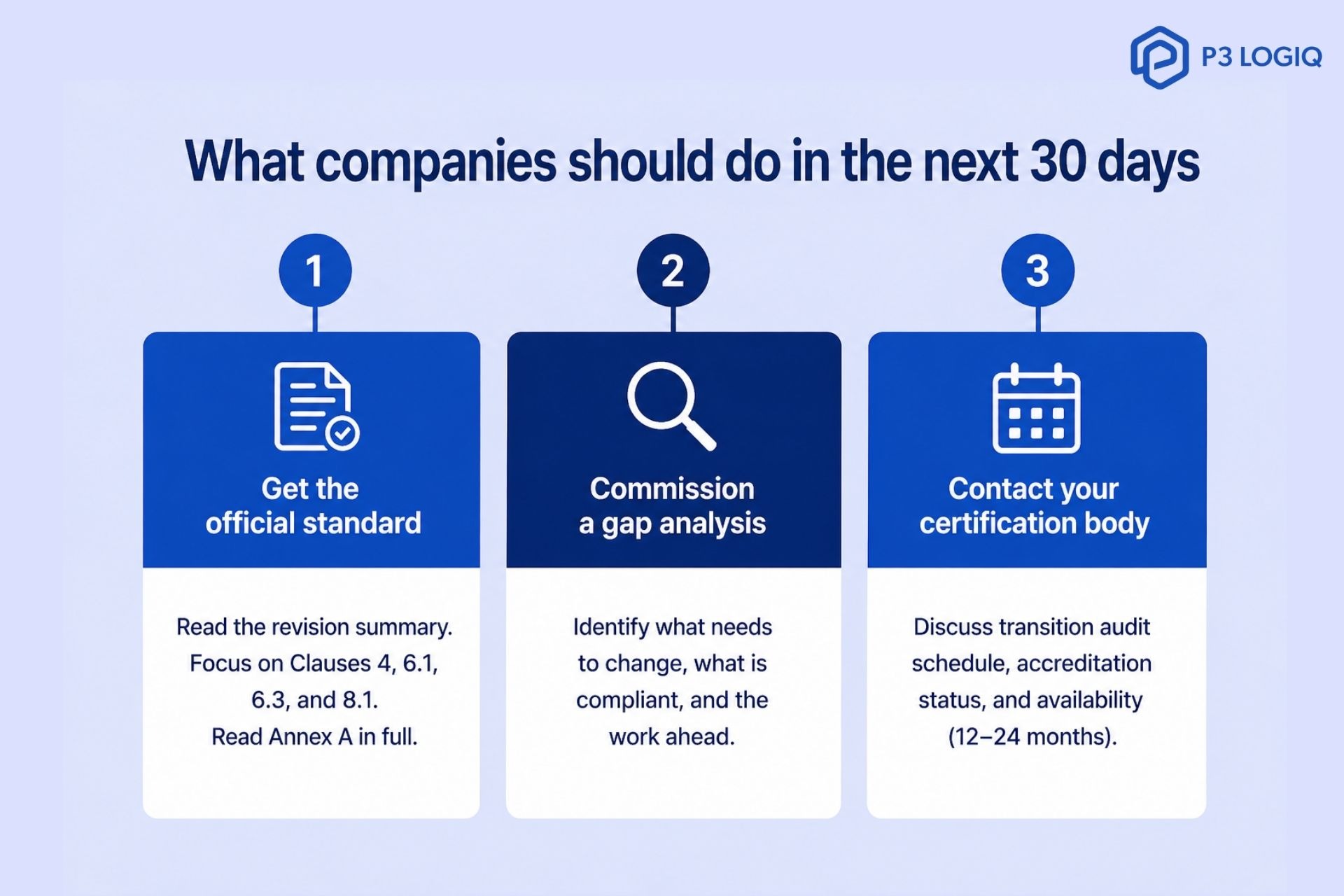
Here are three things to do now.
Access ISO 14001:2026 directly through ISO or ANSI. Start with the revision summary, then review Clauses 4, 6.1, 6.3, and 8.1.
Read Annex A. It provides practical guidance and helps answer key questions.
Compare your current system with the new requirements. Identify what works and what needs to change.
This gives you a clear action plan and reduces uncertainty.
Discuss their audit schedule, readiness for ISO 14001:2026, and availability.
Early conversations give you more flexibility in scheduling.
ISO 14001:2026 is a direction forward, not a disruption.
Organizations that act early will build stronger systems, better supply chain control, and more credible reporting.
Following practices to maintain ISO 14001 helps keep your system effective over time.
The next move is yours, so it’s better to start now than rush later.
ISO 14001:2026 sets a clear direction for environmental management. Climate, biodiversity, supply chain control, and change management are now central.
For certified organizations, the focus is on strengthening existing systems. For new ones, this is the right time to build a system that meets current expectations.
The timeline is already moving. Gap analysis, documentation updates, team alignment, and audits all take time.
Progress depends on how early you start and how well your system is managed.
If you are planning your transition, P3 LogiQ helps you manage your EMS in one place. From documentation to audit readiness, everything stays organized as your system evolves.
Book a demo to see how the platform works or contact us to learn how we can streamline ISO 14001 compliance management, audits, corrective actions, and reporting for your company.
ISO 14001:2026 was published on April 15, 2026. On the same date, ISO 14001:2015 was withdrawn. This marked the start of the official transition period, giving certified organizations a defined window to update their environmental management systems and align with the latest requirements.
The latest version is ISO 14001:2026. It is the fourth edition of the standard and reflects current expectations around environmental management. The update places a stronger focus on climate impact, biodiversity, supply chains, and structured change management while keeping the overall framework familiar for existing users.
Organizations certified to ISO 14001:2015 have until April 2029 to complete their transition. This three-year period includes time for gap analysis, system updates, internal audits, and the transition audit. Starting early helps avoid delays, especially as audit demand increases closer to the deadline.
Yes, ISO 14001:2026 fully replaces the 2015 version. While existing certificates remain valid during the transition period, all organizations must update their systems before April 2029. After that date, ISO 14001:2015 certificates will no longer be recognized under any circumstances.
No, new certifications to ISO 14001:2015 are no longer issued. Organizations starting now should go directly for ISO 14001:2026 certification. This avoids unnecessary rework later and ensures your environmental management system is aligned with current requirements from the beginning.
ISO 14001:2026 applies to all certified organizations, including small businesses. While certification is not mandatory, small businesses must still transition from ISO 14001:2015 by April 2029 if they want to maintain certification. The update may also require adjustments in supply chain documentation, change management, and environmental risk tracking.
Yes. ISO 14001:2026 expands environmental responsibility beyond internal operations and places a stronger focus on supply chain oversight. Organizations must define, document, and monitor how externally provided products, services, and processes are controlled, including supplier environmental risks, compliance expectations, and related environmental impacts.
Clause 6.3 introduces formal change management requirements in ISO 14001:2026. Organizations must review operational, supplier, process, or system changes before implementation and assess possible environmental impacts. The clause also requires documented controls to reduce risks and maintain environmental management system effectiveness during changes.
ISO 14001:2026 formally includes biodiversity within organizational context requirements under Clause 4.1. Organizations must now evaluate how biodiversity loss, land use, pollution, and natural resource pressures affect their operations, risks, objectives, and environmental planning activities as part of their environmental management system framework.
ISO 14001:2026 places a stronger emphasis on evidence-based auditing and documented compliance. Organizations must clearly define audit objectives, scope, and criteria while maintaining records that demonstrate leadership involvement, corrective actions, environmental controls, supplier oversight, and ongoing compliance with updated environmental management system requirements.



Businesses need document management systems (DMS) to ensure ISO and R2 compliance, improve efficiency, and stay audit-ready. The article highlights key features like version control, security, and automation while reviewing the top 5 DMS solutions. P3 LogiQ stands out for its compliance-focused automation and secure document tracking
Read More
Recycling businesses gain efficiency, compliance, and sustainability with RIOS certification. It streamlines quality management, environmental responsibility, and worker safety, helping companies avoid legal risks and boost credibility. P3 LogiQ simplifies the certification process with automation, document control, and compliance tracking, making operations smarter and safer.
Read More
Audit Management Software (AMS) automates compliance tracking, streamlines workflows, and reduces audit risks. Key features include automated scheduling, compliance checklists, CAPA tracking, vendor risk management, and integrations.
Read More
Learn how audit management systems simplify ISO and R2 compliance by automating audits, managing documentation, and minimizing compliance risks efficiently.
Read More
In 2025, many businesses still face challenges in compliance management due to outdated methods like spreadsheets and fragmented software. This inefficiency leads to missed deadlines, increased risk, and regulatory penalties. The blog emphasizes the importance of modern compliance tools that automate workflows, enhance risk management, and streamline regulatory processes to meet ISO and R2 standards.
Read More
The rise in e-waste and environmental concerns makes responsible electronics recycling essential. The R2 Certification sets a global standard for safe, sustainable, and data-secure recycling practices. Developed by Sustainable Electronics Recycling International (SERI), R2 helps businesses manage environmental risks, data security, worker safety, and legal compliance.
Read More
Businesses face increasing challenges in managing complex regulatory compliance. Manual methods such as spreadsheets and paperwork can lead to missed deadlines, inefficiencies, and costly penalties. Compliance management software offers a streamlined solution to reduce risks, automate processes, and improve operational efficiency.
Read More
Maintaining R2 Certification is crucial for businesses in the e-waste recycling industry, ensuring regulatory compliance, sustainability, and strong stakeholder trust. This guide outlines 10 best practices to help businesses simplify operations, reduce risks, and stay compliant.
Read More
Unlock the value of ISO risk management certification. Explore its impact on compliance, risk mitigation, and business expansion.
Read More
Explore the top 5 ISO risk management software tools for 2025, including document management solutions for streamlined compliance and increased efficiency.
Read More
Find the ideal document management software (DMS) for your business. Learn how to choose with expert tips, key features, and insightful guidance
Read More
Unlock the power of a Document Management System (DMS). Learn how it can revolutionize your business operations.
Read More










.png)


.png)





.jpg)




.jpg)
.jpg)











.jpg)



.png)

.png)
.png)





.png)

