
.jpg)
Imagine this.
You walk into a restaurant you’ve never been to before. One day, the food was amazing. The next time, it’s average. Thirdly, your order is wrong.
No consistency.
Now flip that to a business.
One team follows a process. Another team does it their own way. Documents are missing, approvals are unclear, and when something goes wrong, no one really knows why.
That’s exactly the kind of chaos ISO 9001 is designed to fix.
The International Organization for Standardization(ISO) itself highlights this gap in its guidance around ISO 9001 for small enterprises, where it explains that implementing ISO 9001 is not just about meeting requirements, but about translating them into practical, day-to-day processes that people actually follow. The guidance focuses on simplifying implementation and avoiding unnecessary complexity, which is exactly where many organizations struggle.
It’s also worth noting that this approach is especially relevant for smaller teams, where resources are limited and systems need to stay lean to actually work in practice. The emphasis is less on building heavy documentation structures and more on making sure the intent of ISO 9001 certification is clearly understood and consistently applied across everyday operations.
But here’s the catch.
Implementing ISO 9001 isn’t as simple as creating a few documents or ticking boxes on a checklist. Many businesses struggle with ISO 9001 implementation challenges right from the beginning, whether it’s understanding the ISO 9001 checklist and requirements, aligning teams, or maintaining proper documentation and process control.
And this is where things usually break.
Teams resist change. Processes feel forced. Documentation becomes overwhelming. And instead of improving quality management, the system starts feeling like extra work.
So the real question is:
Why do so many companies face challenges in ISO 9001 implementation, even when the standard itself is clear?
In this blog, I will break down the most common ISO 9001 implementation challenges, why they happen in real business scenarios, and what you can actually do to overcome them without overcomplicating your system.
Create a few SOPs, maintain some records, clear the audit and you’re done.
That’s where the misunderstanding starts.
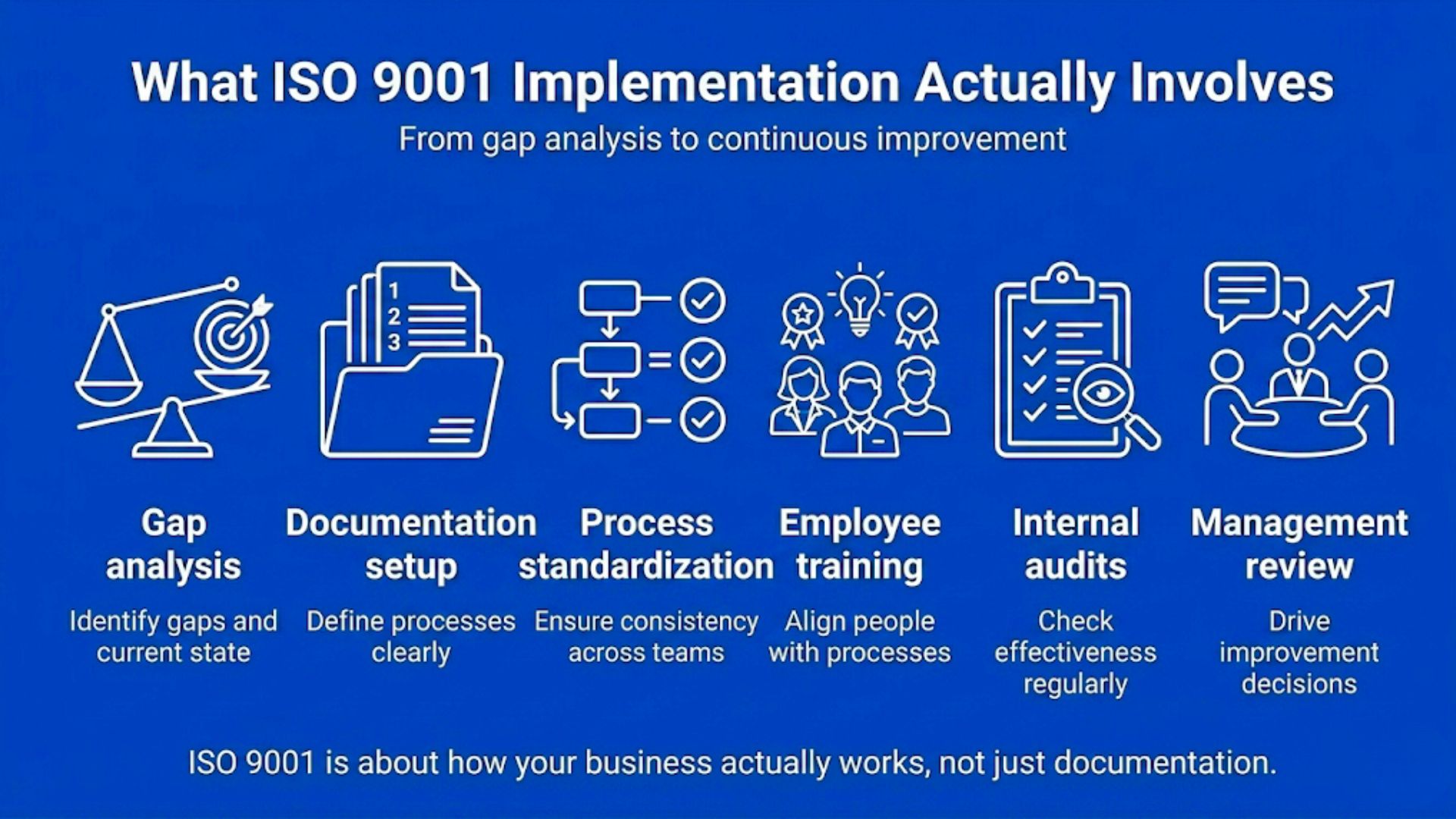
ISO 9001 implementation is not just paperwork. It’s about building a working quality management system (QMS) that actually improves how your business runs day to day.
The documents are just proof. The real focus is on how consistently your processes work, how well your teams follow them, and how effectively you improve over time.
To understand where most ISO 9001 implementation challenges come from, you need to first understand what the ISO 9001 certification process actually looks like in practice.
Here’s a simple breakdown.
This is the starting point.
You compare your current processes with ISO 9001 requirements to identify what’s missing or not aligned.
In simple terms, you’re asking:
What are we already doing right, and where are the gaps?
Most businesses discover that they already follow some processes informally, but they’re not documented or standardized. That gap becomes the foundation of the entire implementation.
This is where many people think ISO 9001 begins and ends.
But documentation is not about creating bulky files. It’s about clearly defining how your processes actually work.
This includes:
A good QMS keeps things clear and usable. A bad one becomes paperwork nobody reads.
Once processes are documented, the next step is making sure they are followed consistently across the organization.
This means:
This is where real operational improvement starts. And also where resistance usually begins.
Even the best processes fail if people don’t understand or follow them.
Training ensures that employees:
This step is often underestimated, but it directly impacts how successful your ISO 9001 implementation will be.
Internal audits are like regular health checks for your QMS.
You review whether:
The goal is not to “catch mistakes” but to identify issues early and fix them before external audits.This is also where internal audits indirectly connect with ISO 9001 certification cost. When internal audits are done properly and regularly, they reduce the chances of surprises during the external certification audit.
That means fewer corrective actions, less rework, and a smoother overall certification journey. On the other hand, if gaps are only discovered at the final stage, the effort required to fix them can increase both the time and the overall cost involved in achieving ISO 9001 certification.
This is where leadership steps in.
Top management reviews:
Based on this, decisions are made to improve the system.
Without this step, ISO 9001 becomes a routine activity instead of a strategic tool.
On paper, these steps look simple and logical.
But in real business scenarios, challenges can appear at almost every stage:
That’s why ISO 9001 implementation challenges are not about the standard itself.
They come from how these steps are executed inside a real organization.
If you’re going through these steps and it already feels more complicated than expected, that’s usually where things start to slip.
Instead of figuring everything out through trial and error, book a free call or sign up with P3 LogiQ.
You’ll get a clearer view of where your current system stands, what gaps actually matter, and how to approach each step without overcomplicating it.
Our team works closely with you to structure your ISO 9001 implementation in a way that fits your business, not just the standard.
That means defining processes that your teams can actually follow, setting up documentation that stays usable, and making sure audits, training, and reviews all connect properly.
Once you move beyond the initial ISO 9001 setup, things usually start getting more practical and a little more challenging. It’s no longer just about documents or processes on paper. Your team, daily operations, deadlines, and real business pressures all start becoming part of the system.
This is also where many businesses begin noticing gaps they didn’t expect earlier. Processes may look fine during planning but become harder to follow consistently in day-to-day work.
BSI, one of the world’s largest certification bodies, also highlights that ISO 9001 works best when quality management becomes part of everyday operations rather than just a separate compliance activity. That’s usually the difference between a system people actually use and one that only shows up during audits.
And honestly, these challenges are pretty common. They often show up during audits, slow down certification, or lead to systems that exist more for compliance than for actually improving how your business runs.
ISO 9000 is often seen as the foundation that explains the core principles of quality management systems, while ISO 9001 is the standard that defines the actual requirements organizations need to meet.
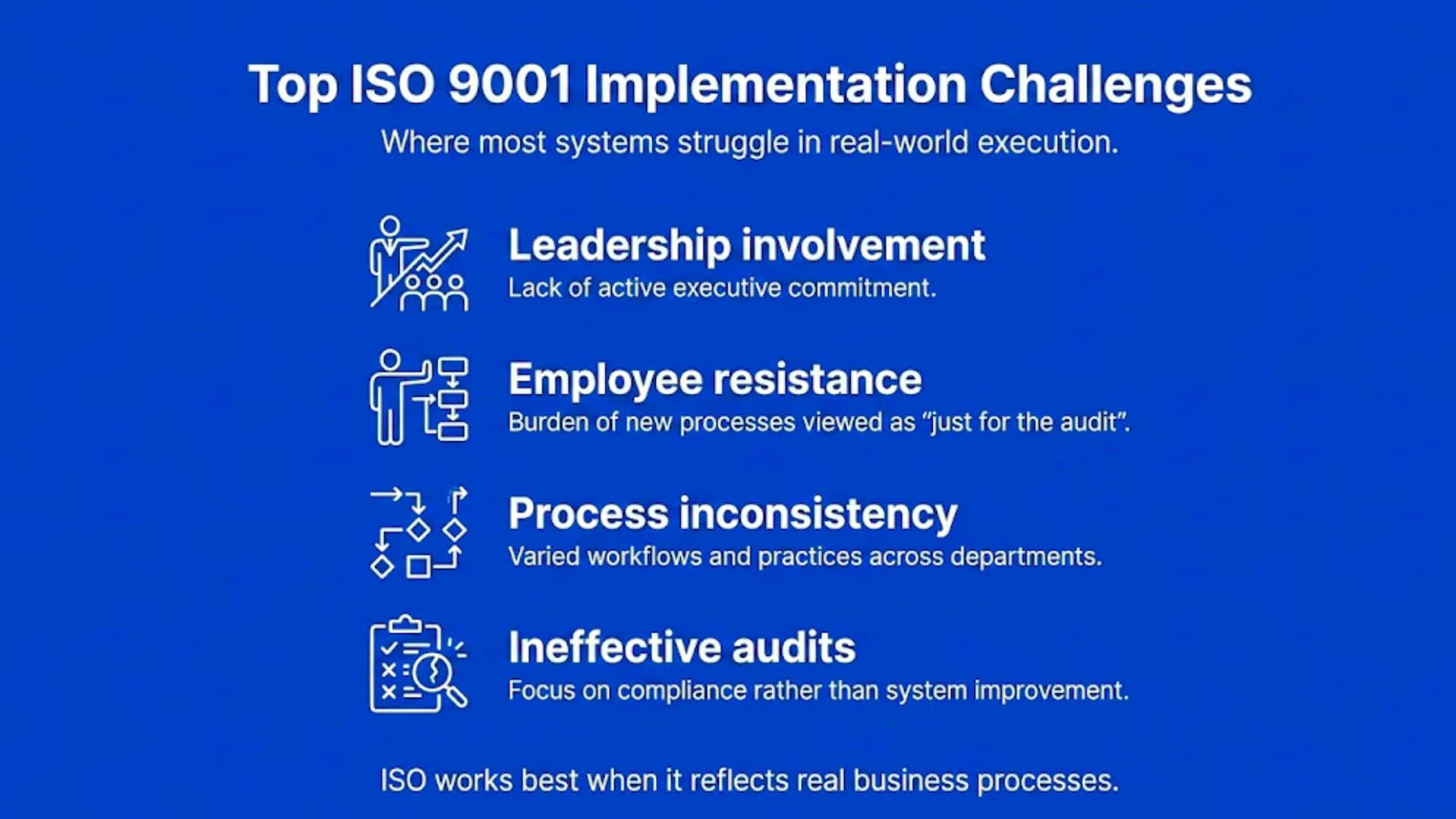
Within ISO 9001:2015, different ISO 9001 clauses outline how the system should be structured and maintained, and Clause 5 specifically places leadership at the center of the system for a reason. It requires top management to take accountability for the effectiveness of the quality management system and ensure it is integrated into everyday business processes (ISO 9001:2015, Clause 5.1).
In reality, many organizations delegate ISO 9001 clauses entirely to a quality manager or a small team to handle. Leadership steps in only during audits or certification milestones. That disconnect creates a visible gap. Quality objectives are defined, but they are not always connected to real business priorities. Management reviews happen, but they often lack direction or strong decision-making input.
When leadership is not actively involved, the system slowly loses its presence in day-to-day operations. Teams start treating ISO 9001 clauses as a documentation checklist rather than a way of working. This is where the intent behind ISO 9000 principles becomes important again, especially the focus on leadership responsibility and process-based thinking.
ISO 9001 introduces structure, and structure often disrupts existing habits. For employees who are used to informal or flexible ways of working, this shift can feel unnecessary or even intrusive.
The resistance usually isn’t loud or direct. It shows up in behavior. People continue to follow old methods while updating records just enough to appear compliant. Documentation gets filled out after the fact rather than during the process. Audits are seen as interruptions instead of improvement tools.
At its core, this is not a technical issue. It’s cultural. Without proper communication and training on why these changes matter, ISO becomes associated with extra workload and increased monitoring. That creates a disconnect between documented processes and actual execution. Over time, two systems start to exist in parallel, one for audits and one for real work. That gap is exactly where compliance starts to break.
ISO 9001 is designed to be flexible so it can apply across industries, but that flexibility often leads to misinterpretation. Teams struggle to translate clauses into practical actions.
This becomes even more visible in frameworks like ISO 9001 for small businesses, where teams usually don’t have dedicated quality departments or extensive documentation systems. In such cases, the standard can feel more complex than it actually is, simply because there are fewer internal resources to interpret and implement it correctly.
Concepts like risk-based thinking or the process approach are either oversimplified or made unnecessarily complex. Clause 4, which deals with understanding the context of the organization, is often treated as a formality rather than a foundation for the system..
ISO 9001 requires documented information, but it does not prescribe excessive documentation (ISO 9001:2015, Clause 7.5). Still, many organizations misunderstand this balance.
Some create highly detailed documentation for every activity, which makes processes difficult to follow in practice. Others keep documentation minimal but fail to clearly define responsibilities or steps. In both cases, usability becomes a problem.
Document control adds another layer of complexity. Without proper control mechanisms, multiple versions of the same document start circulating. Teams may unknowingly follow outdated procedures, while newer versions remain unused. This creates confusion during daily operations and becomes a clear issue during audits, where consistency and traceability are expected.
Consistency is one of the core principles behind ISO 9001. If the same process produces different outcomes depending on who performs it, the system is not under control.
In fact, this expectation continues to evolve as standards are updated, including newer discussions around ISO 9001:2026 certification, which is expected to further emphasize process stability, risk awareness, and performance consistency across operations. While the core idea remains the same, the focus is increasingly on how reliably organizations can maintain uniform outcomes in real working conditions.
In many organizations, different teams or individuals develop their own ways of working. These variations might seem harmless at first, but they introduce unpredictability. For example, when customer requirements are captured differently by each team member, the information passed to delivery or production becomes inconsistent. That inconsistency leads to errors, rework, and difficulty in identifying root causes when issues arise.
Internal audits are meant to act as an early warning system. Clause 9.2 requires organizations to evaluate both conformity and effectiveness through regular audits (ISO 9001:2015, Clause 9.2).
However, in practice, audits are often reduced to a routine exercise. They are conducted quickly, sometimes just before external audits, with a focus on checking whether documents exist rather than whether processes actually work.
When audits are treated this way, deeper issues remain hidden. Inefficiencies, recurring mistakes, and process deviations go unnoticed. Even when non-conformities are identified, corrective actions are often superficial because root causes are not thoroughly analyzed.
The result is predictable. The same issues resurface during external audits, leading to repeated findings and delayed improvements.
And this is usually the point where the benefits of ISO 9001 actually become easier to notice, not in theory, but in how differently things run when audits are taken seriously. When internal audits are used properly, teams start catching small issues early instead of letting them build up. Processes feel more controlled, not because everything is perfect, but because problems are identified and fixed before they spread across departments.
Across all these challenges, the pattern is consistent. ISO 9001 does not fail because the standard is flawed. It struggles when organizations treat it as a documentation requirement instead of a system that should reflect and improve how the business actually operates.
And once these issues start stacking up, companies don’t just struggle with certification. They struggle with sustaining the system itself.
If these challenges are already reflecting in your audits, costs, or daily operations, it’s usually a sign that the system needs more structure, not more effort.This is exactly where P3 LogiQ comes in.

With a clear, end-to-end approach, the focus stays on fixing the gaps that actually impact your business, aligning processes across teams, and making sure your ISO 9001 system works consistently, not just during audits but in everyday operations.
Book a free demo call or sign up and start building a more structured, predictable path to ISO 9001 certification.
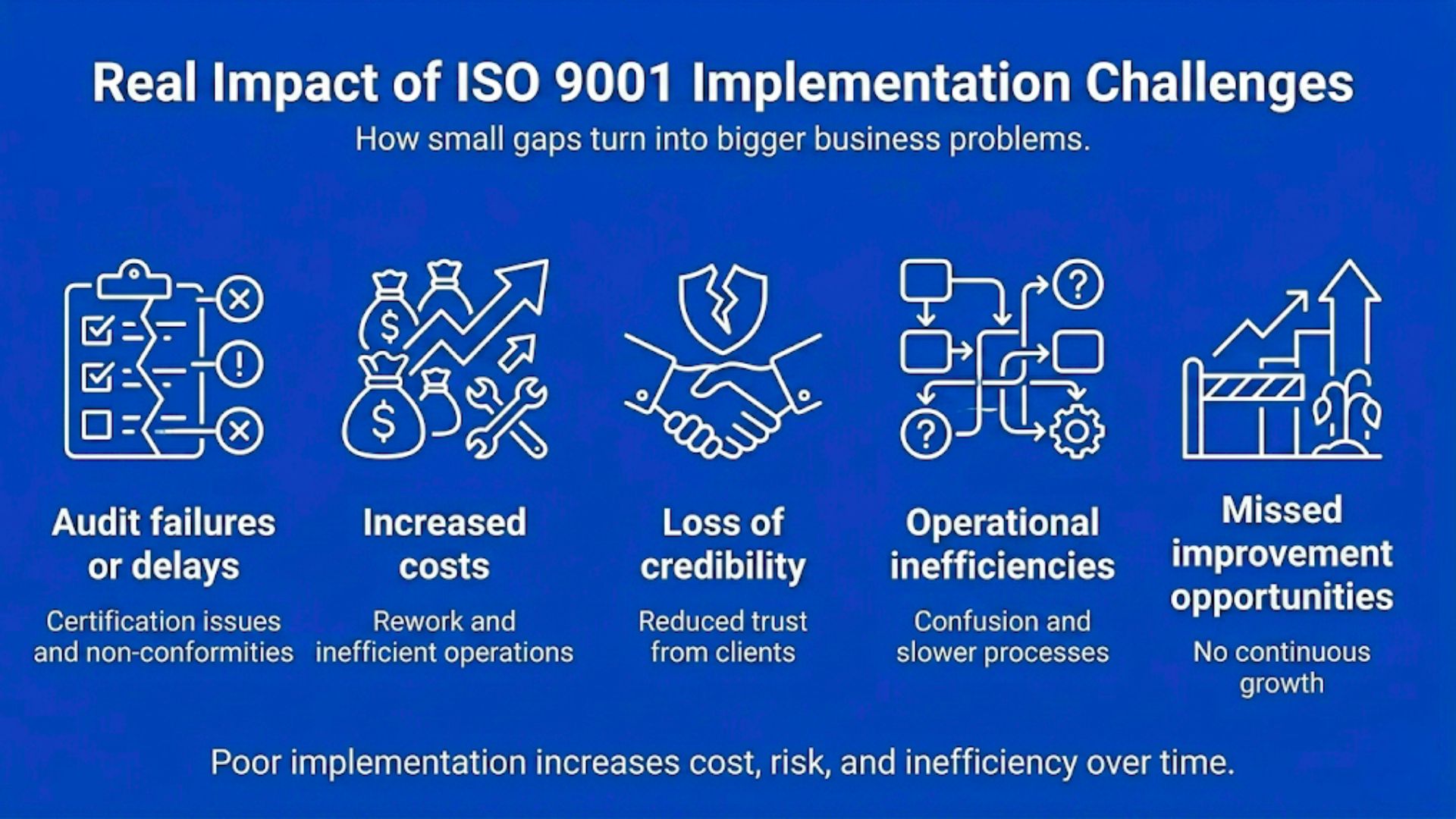
When these implementation gaps start piling up, the impact doesn’t stay limited to the quality team or audit timelines. It begins to affect how the entire business operates, often in ways that aren’t immediately visible but become expensive over time.
One of the most direct consequences shows up during certification or surveillance audits. When processes are inconsistent, documentation doesn’t match actual practices, or internal audits haven’t identified real gaps, non-conformities become almost inevitable.
Certification bodies like BSI and DNV consistently report that organizations face major or multiple minor non-conformities during initial and surveillance audits, which leads to delays in certification or additional audit cycles. Each delay means more time spent on corrective actions, more coordination, and in some cases, rescheduling audits altogether.
It’s not just about “failing” an audit. Even a delay can disrupt business plans, especially if certification is tied to client requirements or market entry.
The financial impact builds quietly but steadily.
When processes are not standardized, errors and rework increase. That means more time, more resources, and higher operational costs. If documentation is unclear or outdated, teams spend extra effort clarifying tasks instead of executing them.
Then there’s the cost of fixing issues late. Bringing in external consultants to “fix” the system before an audit, retraining teams, or reworking documentation all add up. In some industries, non-compliance can also lead to contractual penalties or loss of business opportunities.
If you break it down logically, poor implementation creates a cycle where you keep spending money to correct avoidable mistakes instead of improving the system.
ISO 9001 certification is supposed to signal reliability and consistency. But when the system behind it is weak, that credibility starts to erode.
Clients and partners don’t just look at the certificate. They look at how consistently you deliver. If they notice frequent errors, delays, or miscommunication, the certification begins to feel like a formality rather than proof of quality.
In extreme cases, repeated audit issues or failure to maintain the system can lead to suspension or withdrawal of certification. Even before that happens, the perceived value of being “ISO certified” starts to decline internally and externally.
This is where the long-term damage really shows.
Without clear processes and standardization, teams spend more time resolving confusion than executing work. Tasks get duplicated, responsibilities overlap, and communication gaps increase.
For example, if different teams follow different versions of a process, handoffs become messy. Errors increase, turnaround times slow down, and productivity drops. These inefficiencies are often normalized over time, which makes them harder to identify and fix.
ISO 9001 is meant to reduce this kind of friction. But when implemented poorly, it can unintentionally add another layer of complexity instead of removing it.
At its core, ISO 9001 is built around continuous improvement. Clauses related to performance evaluation and improvement (Clause 9 and Clause 10) are designed to help organizations identify trends, fix root causes, and evolve their processes.
But when internal audits are ineffective, data is not properly analyzed, and corrective actions are treated as formalities, those opportunities are lost.
Instead of using the system to proactively improve, organizations end up reacting to problems after they occur. The same issues repeat, lessons are not captured, and the system becomes static.
Over time, this creates a gap between what the business could achieve with a well-functioning quality management system and what it actually achieves.
What makes these impacts tricky is that they don’t always appear immediately. They build gradually through small inefficiencies, repeated errors, and missed signals. By the time they become visible, fixing them requires significantly more effort than getting the implementation right in the first place.
Once you understand where ISO 9001 implementations typically break down, the next step is not adding more complexity. It’s fixing the fundamentals in a way that actually fits how your business operates.
A practical approach works better than a “perfect” one. The goal is not to build the most detailed system. The goal is to build a system people will actually use.
Most implementation issues begin with assumptions. Companies assume they are “almost compliant” or jump straight into documentation without understanding where they actually stand.
A proper gap analysis changes that.
It compares your current processes with ISO 9001 requirements clause by clause and identifies what already exists, what is missing, and what needs improvement. This step gives you a clear baseline instead of forcing you into blind implementation.
Without this, teams often waste time building processes that are either unnecessary or misaligned. With it, the implementation becomes focused and realistic, because you’re working with your existing system, not against it.
ISO 9001 does not work as a bottom-up initiative. It needs direction from the top.
This doesn’t mean leadership needs to manage documentation or attend every training session. It means they need to define priorities, assign clear ownership, and stay involved in decision-making.
When leadership sets measurable quality objectives aligned with business goals and regularly reviews performance, the system starts to carry weight across departments.
It also changes how teams perceive ISO. Instead of seeing it as a compliance task, they begin to see it as part of how the organization operates. That shift alone reduces resistance and improves accountability.
Documentation should support work, not slow it down.
A common mistake is trying to document everything in extreme detail, which makes processes hard to follow. The opposite mistake is keeping documentation too vague, which creates confusion.
The balance is clarity.
Each document should answer simple questions: what needs to be done, who is responsible, and how it should be done. If employees cannot quickly understand and apply it, the document is not effective, regardless of how “ISO-compliant” it looks.
When documentation is simple and aligned with actual workflows, adoption becomes much easier. People don’t need to memorize processes. They can refer to them and use them in real time.
Generic ISO training rarely works.
Explaining the standard at a high level might create awareness, but it doesn’t help employees understand what changes in their daily work. That gap is where resistance and confusion start.
Training needs to be role-specific.
A production team should understand process controls and quality checks relevant to their tasks. A sales team should understand how to capture and communicate customer requirements correctly. Managers should understand performance tracking and corrective actions.
When training is tied directly to responsibilities, it becomes practical. Employees can connect ISO requirements to what they actually do, which improves both adoption and consistency.
Even well-written documentation can fail if it’s not controlled properly.
ISO 9001 requires organizations to manage documented information, which includes ensuring the right versions are available, approved, and updated (ISO 9001:2015, Clause 7.5).
In practice, this means having a clear system for version control, approvals, and access. Teams should always know they are using the latest document, and outdated versions should be removed from circulation.
Without this, confusion returns quickly. Different teams may follow different versions of the same process, which leads to inconsistencies and audit issues.
With proper control in place, documentation stays reliable and aligned with actual operations.
What ties all of these steps together is simplicity and alignment.
ISO 9001 doesn’t require you to reinvent your business. It requires you to understand it, structure it, and improve it in a controlled way. When implementation follows that mindset, the system becomes sustainable instead of burdensome.
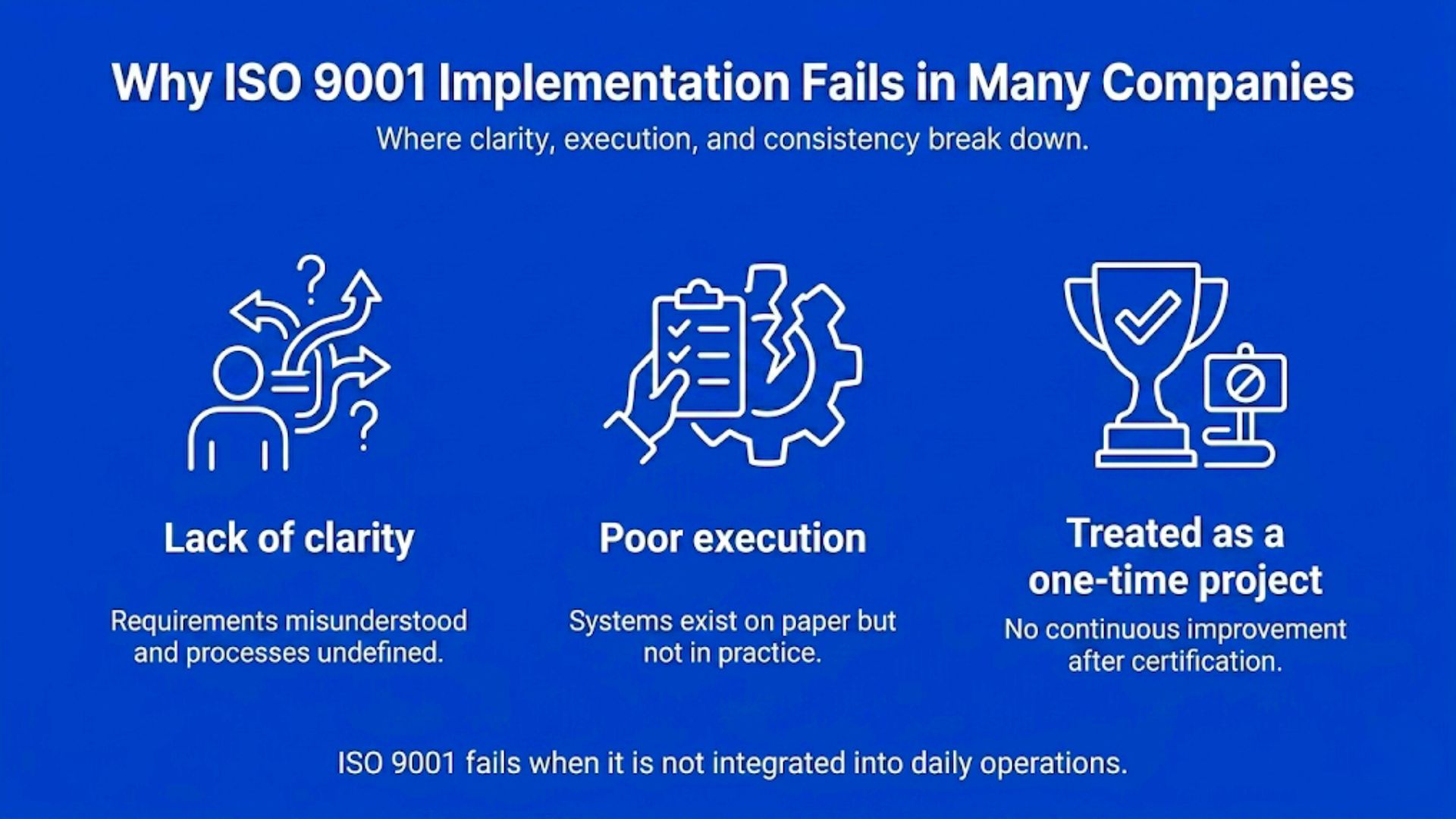
If you look closely at how companies approach ISO 9001, the problem usually isn’t the standard itself. It’s how organizations try to implement it.
There isn’t a single global “failure rate” published by ISO, but the signals are clear when you connect a few data points.
According to ISO Survey reports, over 1 million organizations hold ISO 9001 certification globally, yet far more start the process than actually reach certification or sustain it long term. Certification bodies and consultants consistently report high drop-off rates during implementation phases, especially among small and mid-sized companies.
Now combine that with audit data. Studies from certification bodies like BSI and DNV show that a significant percentage of organizations receive major or minor non-conformities during initial audits, often forcing delays or rework. That’s not outright “failure,” but it’s friction that slows or derails implementation.
So the pattern is simple: companies don’t fail because ISO 9001 is difficult. They fail because they approach it the wrong way.
Here’s where things typically break down:
A lot of organizations start ISO 9001 without fully understanding what it actually requires.
They treat it like a checklist instead of a management system. Clauses like “context of the organization” or “risk-based thinking” are often misunderstood or skipped entirely. Teams don’t clearly define processes, ownership, or measurable objectives.
The result is confusion at every level.
Employees don’t know what to follow. Managers don’t know what to measure. Leadership doesn’t see the value.
When clarity is missing at the beginning, everything that follows becomes inconsistent.
Even when companies understand ISO 9001 conceptually, execution is where things fall apart.
Processes get documented but not followed. SOPs are written just for auditors, not for actual operations. Internal audits are rushed or treated as a formality. Corrective actions are documented but not truly implemented.
There’s also a common pattern: one person or a small team handles the entire ISO implementation. Everyone else stays disengaged.
That creates a system that looks complete on paper but doesn’t function in reality.
Audit time exposes this gap quickly.
This is probably the biggest reason implementations don’t last.
Companies approach ISO 9001 like a finish line. Once they get certified, they relax the system. Documentation stops being updated. Internal audits become irregular. Management reviews turn into checkbox meetings.
But ISO 9001 is designed as a continuous improvement system. If it isn’t maintained, it naturally degrades.
You’ll see signs like outdated documents, repeated non-conformities, and eventually, difficulty in passing surveillance audits.
At that point, organizations either scramble to fix everything last minute or slowly drift away from compliance.
All of these issues point to a deeper problem: implementation without integration.
ISO 9001 only works when it becomes part of how a company actually operates, not something layered on top.
And that’s exactly where the real challenges begin.
Because once you move past the theory, the practical side of ISO 9001 implementation brings its own set of obstacles.
Most companies don’t struggle with ISO 9001 because it’s complex. They struggle because the implementation turns chaotic. Too many moving parts, unclear ownership, disconnected execution.
That’s the problem P3 LogiQ is built to solve.
Instead of forcing teams to manage compliance across scattered spreadsheets, endless email threads, and disconnected documents, the platform helps bring everything into one structured workflow. From document tracking and process visibility to audit preparation and corrective actions, the goal is to make ISO implementation feel more manageable in real day-to-day operations, not just during certification time.
If you want to understand how this works in a more practical way, check out this video where P3 LogiQ walks through how it helps streamline the path to ISO compliance and reduce the operational confusion that usually slows teams down.
<iframe width="560" height="315" src="https://www.youtube.com/embed/INwADfkaLIQ?si=wU_rGs4_0hVkLkh_" title="YouTube video player" frameborder="0" allow="accelerometer; autoplay; clipboard-write; encrypted-media; gyroscope; picture-in-picture; web-share" referrerpolicy="strict-origin-when-cross-origin" allowfullscreen></iframe><br>
P3 LogiQ is built to help you manage all of this from one place. Instead of relying on spreadsheets, email threads, or disconnected tools, you can handle documentation, audits, training records, corrective actions, and compliance tracking directly through the platform. Everything stays organized, visible, and easier to track across teams.
The idea is not to add more complexity to ISO 9001. It’s to make the entire process easier to manage as your business grows. So whether you’re preparing for certification or trying to keep your system consistent after implementation, P3 LogiQ helps you stay structured without turning compliance into extra manual work.
We will guide you through a clear, controlled process so your implementation stays efficient, predictable, and free from last-minute fixes. Book a free demo call or signup with P3 LogiQ and take the first step toward a more structured and reliable ISO 9001 certification process.
The biggest challenge is not the standard itself, but how it is implemented inside the organization. Most companies struggle with aligning people, processes, and documentation in a way that actually works in daily operations.
In many cases, ISO is treated as a compliance task rather than a business system. This leads to weak adoption, inconsistent execution, and a gap between what is documented and what is actually followed.
The timeline depends on the size of the organization, process complexity, and how prepared the company is before starting. On average, it can take anywhere from 3 to 6 months for smaller organizations and longer for larger or more complex setups.
However, delays are common when there is poor planning, lack of clarity, or repeated rework. A structured approach with proper gap analysis and execution can significantly reduce the timeline.
Yes, and in many cases, small businesses face more practical challenges than larger organizations. Limited resources, smaller teams, and lack of in-house expertise can make implementation harder.
At the same time, smaller businesses can also implement ISO faster if they keep the system simple and aligned with their actual operations instead of overcomplicating it.
Documentation is often seen as the hardest part, but the real issue is not the volume of documents. It’s creating documentation that is clear, relevant, and usable.
Problems arise when companies either over-document everything or rely on generic templates that don’t match their processes. The goal is not more documents, but better, practical ones.
Avoiding failure comes down to getting the basics right from the beginning. This includes proper gap analysis, leadership involvement, clear processes, and role-based training.
More importantly, the system should be built around how the business actually works. When ISO 9001 is integrated into daily operations instead of treated as a separate activity, the chances of failure drop significantly.
Training is essential because employees need to understand how the quality management system affects their daily responsibilities. Without proper training, processes may be followed inconsistently, creating operational and audit-related issues.
Effective training also improves employee awareness around documentation, corrective actions, process control, and continual improvement activities within the organization.
Yes, poor communication often creates misunderstandings about procedures, responsibilities, and process updates. This can lead to inconsistent implementation and confusion during audits.
Organizations that maintain clear communication channels usually manage implementation more effectively because employees understand expectations, updates, and quality objectives more clearly.
Internal audit failures often happen because processes are not fully implemented, records are incomplete, or employees are unaware of documented procedures. In some cases, businesses prepare documentation but fail to apply it consistently in actual operations.
Regular internal reviews, employee awareness, and corrective action tracking can help organizations identify issues earlier before external certification audits take place.
The timeline depends on factors such as company size, operational complexity, existing systems, and employee involvement. Some organizations resolve implementation gaps quickly, while others require ongoing improvements over several months.
ISO 9001 implementation is usually more effective when businesses treat it as a gradual operational improvement process rather than a rushed certification project focused only on passing audits.
Employee resistance often happens when teams do not understand the purpose behind the quality management system. Clear communication, practical training, and involving employees in process development can improve participation significantly.
When employees see how ISO 9001 helps reduce confusion, improve workflows, and create clearer responsibilities, adoption usually becomes much smoother across departments.



Businesses need document management systems (DMS) to ensure ISO and R2 compliance, improve efficiency, and stay audit-ready. The article highlights key features like version control, security, and automation while reviewing the top 5 DMS solutions. P3 LogiQ stands out for its compliance-focused automation and secure document tracking
Read More
Recycling businesses gain efficiency, compliance, and sustainability with RIOS certification. It streamlines quality management, environmental responsibility, and worker safety, helping companies avoid legal risks and boost credibility. P3 LogiQ simplifies the certification process with automation, document control, and compliance tracking, making operations smarter and safer.
Read More
Audit Management Software (AMS) automates compliance tracking, streamlines workflows, and reduces audit risks. Key features include automated scheduling, compliance checklists, CAPA tracking, vendor risk management, and integrations.
Read More
Learn how audit management systems simplify ISO and R2 compliance by automating audits, managing documentation, and minimizing compliance risks efficiently.
Read More
In 2025, many businesses still face challenges in compliance management due to outdated methods like spreadsheets and fragmented software. This inefficiency leads to missed deadlines, increased risk, and regulatory penalties. The blog emphasizes the importance of modern compliance tools that automate workflows, enhance risk management, and streamline regulatory processes to meet ISO and R2 standards.
Read More
The rise in e-waste and environmental concerns makes responsible electronics recycling essential. The R2 Certification sets a global standard for safe, sustainable, and data-secure recycling practices. Developed by Sustainable Electronics Recycling International (SERI), R2 helps businesses manage environmental risks, data security, worker safety, and legal compliance.
Read More
Businesses face increasing challenges in managing complex regulatory compliance. Manual methods such as spreadsheets and paperwork can lead to missed deadlines, inefficiencies, and costly penalties. Compliance management software offers a streamlined solution to reduce risks, automate processes, and improve operational efficiency.
Read More
Maintaining R2 Certification is crucial for businesses in the e-waste recycling industry, ensuring regulatory compliance, sustainability, and strong stakeholder trust. This guide outlines 10 best practices to help businesses simplify operations, reduce risks, and stay compliant.
Read More
Unlock the value of ISO risk management certification. Explore its impact on compliance, risk mitigation, and business expansion.
Read More
Explore the top 5 ISO risk management software tools for 2025, including document management solutions for streamlined compliance and increased efficiency.
Read More
Find the ideal document management software (DMS) for your business. Learn how to choose with expert tips, key features, and insightful guidance
Read More
Unlock the power of a Document Management System (DMS). Learn how it can revolutionize your business operations.
Read More










.png)


.png)






.jpg)





.jpg)












.jpg)



.png)

.png)
.png)





.png)

