

If your organization has ISO 9001 certification, you've probably been hearing more about the upcoming ISO 9001:2026 revision. As you review what the new update could mean for your Quality Management System, there's another important change you shouldn't overlook: the climate amendment introduced in 2024.
In February 2024, ISO added a climate change requirement to ISO 9001 through a standalone amendment, well before the 2026 revision even reached its draft stage. Although the climate amendment was introduced in 2024, it has become a major focus as organizations prepare for the ISO 9001:2026 revision. And unlike the 2026 update, this one had no transition period. It was effective immediately.
If your ISO 9001 quality management system hasn't been updated to reflect this since 2024, your auditor is already looking for something you haven't documented yet. Many certified organizations are still in this exact spot, not because they're careless, but because the communication around this amendment was kind of easy to miss.
This blog explains what the amendment actually changed, what you need to do about it, and why it's simpler to handle than it might sound right now.
Before we go any further, I want to clear up a common misunderstanding.
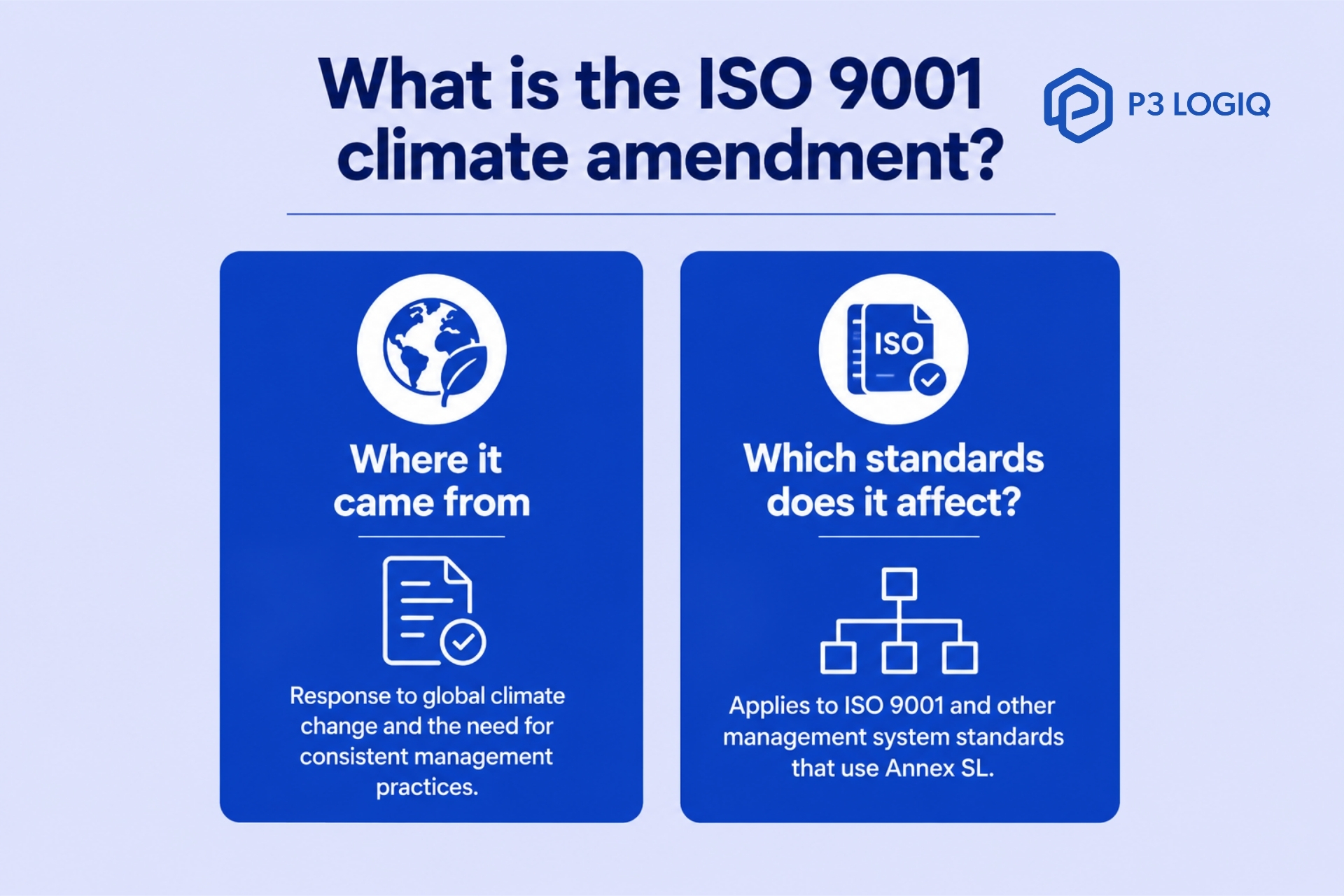
There is no separate standard officially called "ISO 9001:2026 Climate Amendment." The climate change requirement was introduced as a standalone amendment in 2024, and it will be carried into the 2026 revision. That's why you keep seeing both years mentioned together.
ISO published Amendment 1: Climate action changes (ISO 9001:2015/Amd 1:2024) back in February 2024. It added two short lines to the standard, one to Clause 4.1 and one to Clause 4.2.
In simple terms, the first line asks you to figure out whether climate change is something that could actually affect your business.
The second one asks you to check whether any of your stakeholders, like customers or suppliers, have climate-related expectations you need to be aware of.
That’s it. That's the entire amendment. No new sections, no restructuring, just two additions to clauses that already existed in your QMS.
The first requires your organization to determine whether climate change is a relevant issue for your QMS.
The second reminds you that your stakeholders, customers, suppliers, and regulators, may also have their own climate-related requirements that you need to account for.
It goes all the way back to 2021.
Back in 2021, ISO got together with members who were representing 165 countries. They made a public commitment to start weaving climate considerations into all their management system standards. That commitment eventually led to the 2024 amendment, which was basically ISO following through on what they promised and making climate change an official part of ISO 9001 for the first time.
This amendment applies to all ISO management system standards that organizations can be certified against. That includes ISO 9001, ISO 14001, ISO 45001, ISO 27001, and several others. You can find the full list in the IAF/ISO Joint Communiqué on Climate Change.
You might be curious to know what the change is that’s going to dictate your documentation if it has non-conformities or not. Check these out.
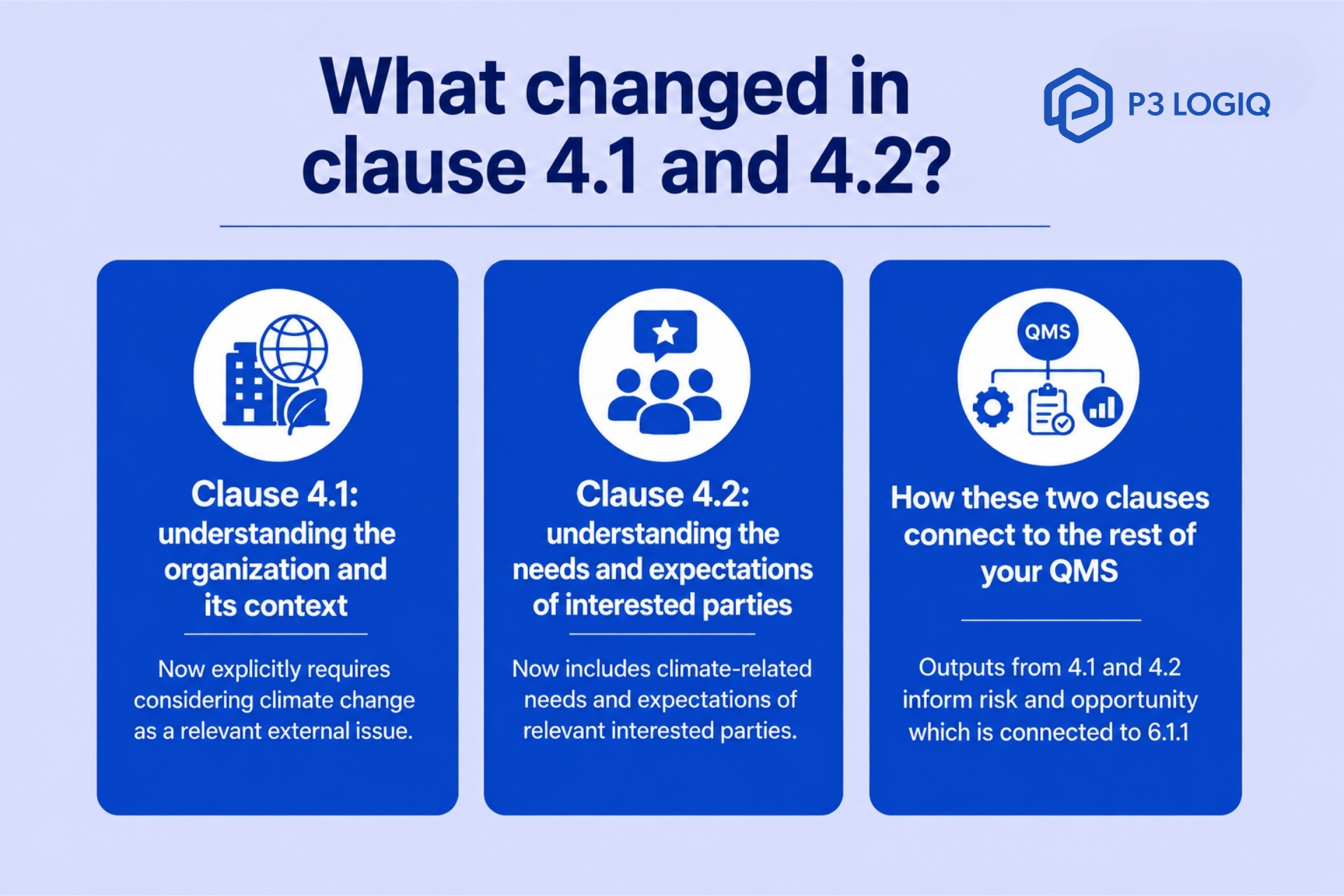
The climate change addition for Clause 4.1 is: "The organization shall determine whether climate change is a relevant issue."
That's it. One sentence. But here's the key part you got to notice: the word "shall" makes it mandatory.
That means no matter what, you will have to record your statement saying that climate change is either relevant or not relevant to your scope as a conclusion. Because auditors will see that you at least considered it as evidence.
Because if you leave that part blank in your context analysis, then guess what?
It will be considered a non-conformance.
So if your business is, say, a software company in a low-risk location with no physical supply chain exposure, you can document that climate change is not a relevant issue for your QMS. That's perfectly acceptable. You just need to show your thoughts about it. A solid ISO 9001 document control process makes recording this assessment straightforward.
The addition to Clause 4.2 states: "NOTE: Relevant interested parties can have requirements related to climate change."
This pertains to your stakeholders, including customers, suppliers, regulators, and anyone else with a vested interest in your operations. Organizations must identify stakeholders such as employees, regulators, customers, and suppliers who may impose climate-related expectations, such as net-zero commitments or emissions reporting.
This matters more than most businesses realize.
Say you make parts for a big retail chain. That retailer has promised their customers they'll reduce their carbon emissions to zero by a certain year. To hit that goal, they're now asking everyone they buy from, including you, to show that you're also thinking about your environmental impact. It's showing up in their supplier checklists and tender documents. So even if you never thought about climate change before, your biggest customer is now making it your problem.
This all makes sense, and it will feel relevant once you know this, so in Clause 4.3, it defines the scope of the management system and requires you to see what all internal and external issues your company has from 4.1. For 4.2, it is about the needs of interested parties.
Finally, we come to 6.1.1, which talks about risks and opportunities. It takes you back to 4.1 and 4.2 to check if anything identified becomes either a risk or an opportunity for your business.
See how all of these are interconnected, right?
So any climate-related issue you find goes directly into your risk management process. You can't treat it as a standalone checkbox. If you're still working through how to structure this in your system, the blog on ISO 9001 implementation challenges covers the risk and opportunity planning side in practical detail.
Luckily, it's just minor but crucial changes, not a complete revision, so no worries.
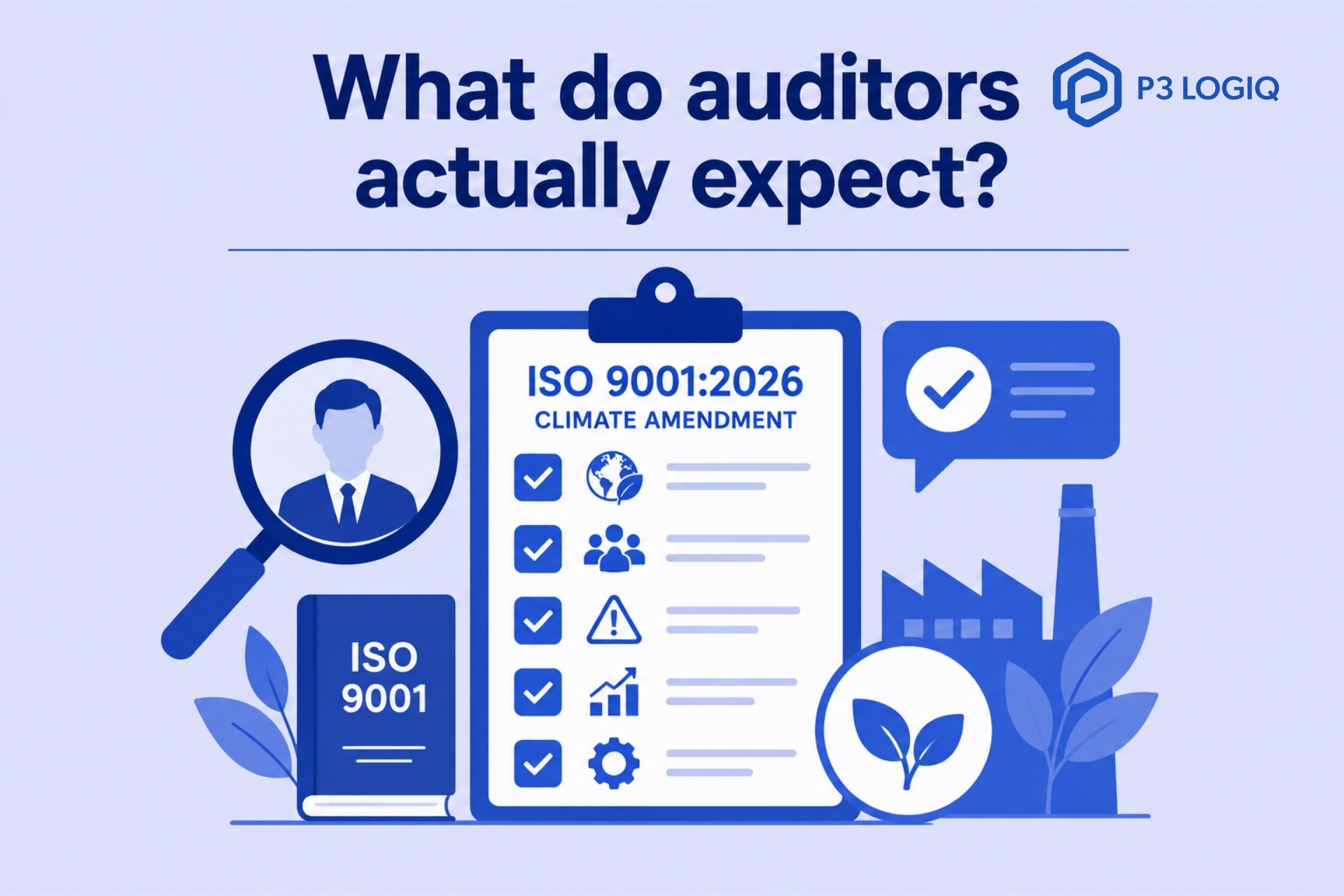
But know this: you will definitely need a system that should acknowledge these new requirements because the certification body (aka CB) will check for compliance relating to climate clauses.
“This is all fantastic, but when will the ISO:2026 release?”
ISO 9001:2026 is revealed to be released by September 2026, but do not panic because although it might be released at that time, you will have ample time to transition until September of 2029, which is 3 years after the release.
The climate amendment from 2024 is already mandatory and will be formally carried into the ISO 9001:2026 revision expected in September 2026. So while the full revision gives organizations until September 2029 to transition, the climate requirement isn't waiting for that. It applies to your QMS right now. So keep that in mind.
This is where a lot of businesses get nervous because of ISO 9001 implementation challenges, so let's be direct about it.
You do not have to be nervous; I’ve got you!
What you need to do is to make sure that climate change as a topic should be considered when you do your gap analysis. In case climate change seems to be a part of your issue, it needs to be addressed in the development and implementation of your management system.
So if we are talking about this in a practical sense, here is what you do.
In your next management review, you should have a documented discussion stating whether climate change may or may not affect your operations. Using a convenient audit management setup makes your process so much easier to track and maintain your documentation.
Some questions worth asking:
Are your logistics or supply routes exposed to extreme weather events?
Do your customers have carbon reduction targets that flow down to you?
Are there local regulations around emissions that apply to your industry?
If the answer to all of those is no, document that. If yes, factor it into your risk register.
The ISO 9001:2026 climate amendment is genuinely one of those things that sounds bigger than it is. Just two lines were added to the standard. One asks you to check if climate change is relevant to your business. The other reminds you that your stakeholders and other parties might have climate-related expectations you need to account for. That's basically the whole thing.
But the documentation piece is real. Auditors are already checking for it. And if your context analysis hasn't been updated since February 2024, that's the most urgent gap to close right now.
If you feel like you need help with getting your clauses right so that you get certified, we at P3 LogiQ have you covered.
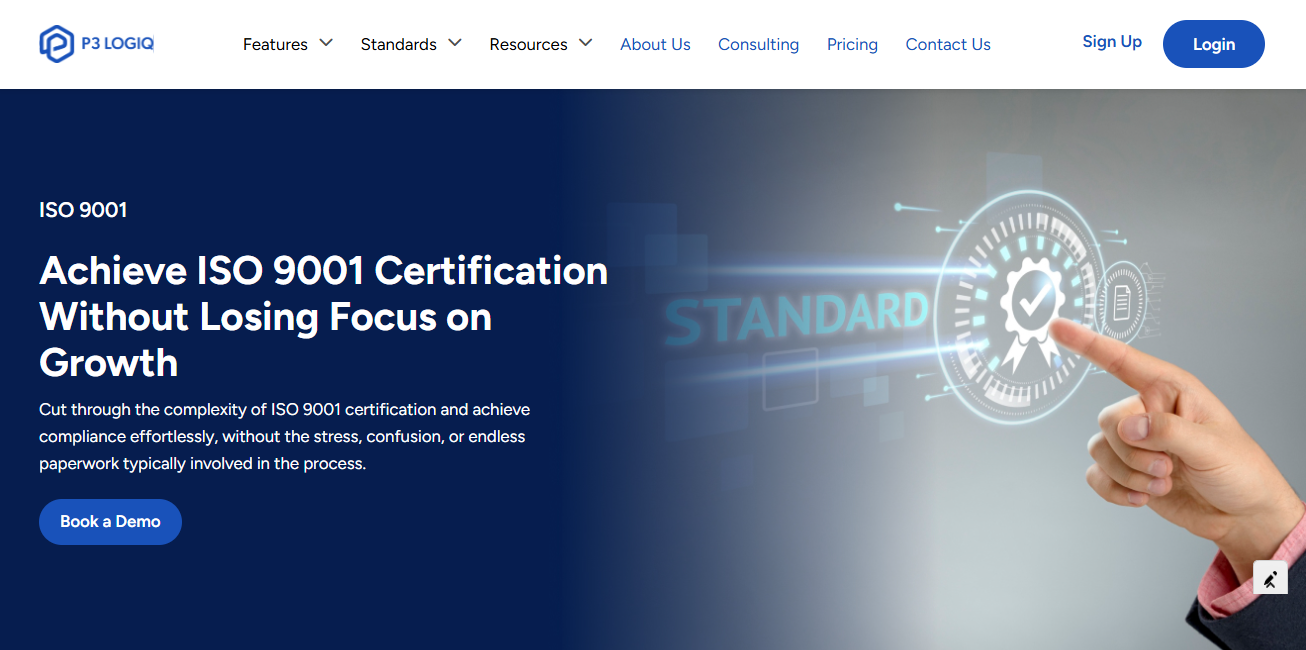
We make managing this straightforward. You can document your climate change assessment, maintain your context analysis, update your risk register, and keep everything audit-ready, all inside one platform built specifically for ISO compliance.
Book a demo now to see how we handle ISO 9001 compliance end-to-end, or sign up and start exploring the platform today.
2 lines. That’s all; it’s an addition of just two lines that was published in February 2024 thanks to the London Declaration. One for Clause 4.1 asking your company if climate change is a relevant problem for your QMS. The second line is for Clause 4.2, which is about the interested parties having requirements related to climate change.
ISO published this amendment in February 2024 and it kicked in straight away, no grace period, no transition window. Every certified organization was expected to be on board from day one, which honestly caught quite a few businesses off guard.
You don't. You do not need to stress about getting a new certificate or getting your certificate renewed because of the climate amendment, as confirmed by both ISO and IAF. But still, your QMS should acknowledge climate change, as CBs will check for it during the audits.
Valid question; chances are it’s not compulsory because chances are your business does not have to be relevant to the climate amendment due to your location. But still, you need to have in your documentation that you assessed it and reached that conclusion; auditors will check if you have at least considered the amendment as evidence. So be wary of that.
Clause 4.1 now includes the statement: "The organization shall determine whether climate change is a relevant issue." This is compulsory. You must see if climate change can or cannot affect your business when you write it in your QMS.
It just asks you to check whether the people connected to your business like your customers, suppliers, regulators, whoever, have any climate-related expectations that you need to account for. If they do, that needs to be reflected somewhere in your QMS.
Absolutely, this climate change amendment will definitely be there in the 2026 version, which will be available in September 2026. Also, it does not matter at what stage the revision may be, as the amendment is already mandatory regardless of where the revision stands.
Nope, not at all. ISO isn't asking you to go green overnight. It just wants you to think about whether climate change could affect your business and, if it does, factor that into your risk planning. No mandatory environmental targets, nothing like that.
Think of it this way: whatever you find in Clauses 4.1 and 4.2 doesn't just sit there. It feeds into Clause 6.1, where you actually decide what's a risk and what's an opportunity. So if bad weather could disrupt your supply chain, that goes straight into your risk planning.
It goes into your context analysis document, which you're probably already updating during management reviews anyway. Just write down whether climate change is relevant to your business, what you looked at, what you concluded, and what you're doing about it if anything. That's your audit evidence right there.



Businesses need document management systems (DMS) to ensure ISO and R2 compliance, improve efficiency, and stay audit-ready. The article highlights key features like version control, security, and automation while reviewing the top 5 DMS solutions. P3 LogiQ stands out for its compliance-focused automation and secure document tracking
Read More
Recycling businesses gain efficiency, compliance, and sustainability with RIOS certification. It streamlines quality management, environmental responsibility, and worker safety, helping companies avoid legal risks and boost credibility. P3 LogiQ simplifies the certification process with automation, document control, and compliance tracking, making operations smarter and safer.
Read More
Audit Management Software (AMS) automates compliance tracking, streamlines workflows, and reduces audit risks. Key features include automated scheduling, compliance checklists, CAPA tracking, vendor risk management, and integrations.
Read More
Learn how audit management systems simplify ISO and R2 compliance by automating audits, managing documentation, and minimizing compliance risks efficiently.
Read More
In 2025, many businesses still face challenges in compliance management due to outdated methods like spreadsheets and fragmented software. This inefficiency leads to missed deadlines, increased risk, and regulatory penalties. The blog emphasizes the importance of modern compliance tools that automate workflows, enhance risk management, and streamline regulatory processes to meet ISO and R2 standards.
Read More
The rise in e-waste and environmental concerns makes responsible electronics recycling essential. The R2 Certification sets a global standard for safe, sustainable, and data-secure recycling practices. Developed by Sustainable Electronics Recycling International (SERI), R2 helps businesses manage environmental risks, data security, worker safety, and legal compliance.
Read More
Businesses face increasing challenges in managing complex regulatory compliance. Manual methods such as spreadsheets and paperwork can lead to missed deadlines, inefficiencies, and costly penalties. Compliance management software offers a streamlined solution to reduce risks, automate processes, and improve operational efficiency.
Read More
Maintaining R2 Certification is crucial for businesses in the e-waste recycling industry, ensuring regulatory compliance, sustainability, and strong stakeholder trust. This guide outlines 10 best practices to help businesses simplify operations, reduce risks, and stay compliant.
Read More
Unlock the value of ISO risk management certification. Explore its impact on compliance, risk mitigation, and business expansion.
Read More
Explore the top 5 ISO risk management software tools for 2025, including document management solutions for streamlined compliance and increased efficiency.
Read More
Find the ideal document management software (DMS) for your business. Learn how to choose with expert tips, key features, and insightful guidance
Read More
Unlock the power of a Document Management System (DMS). Learn how it can revolutionize your business operations.
Read More






.png)


.png)




.jpg)





.jpg)
.jpg)












.jpg)



.png)

.png)
.png)





.png)

