.jpg)
I once visited a healthcare facility where the quality of care was good, but the administrative process varied depending on who was working that day. Registration, appointment scheduling, and billing followed different steps with different staff members. It wasn't a clinical problem, but it showed how much organizations rely on standardized processes to deliver a consistent experience.
That's what happens when an organization runs on fragmented knowledge instead of a system. ISO 9001 certification in healthcare exists to fix exactly that problem. It's the difference between a clinic that runs on "ask Sarah, she knows how we do it" and one that runs on a process so solid it doesn't matter who's at the desk that day.
For organizations looking to maintain consistent processes and simplify audits, ISO 9001 compliance software can help centralize documentation, track quality workflows, and keep teams aligned. If you're a healthcare administrator, hospital manager, quality manager, compliance officer, or clinic owner exploring ISO 9001 for healthcare, this guide explains what it is, how certification works, and why it matters in 2026.
Think about your favorite restaurant. You keep going back because you know exactly what you're getting. The service is consistent, the food doesn't randomly change quality, nothing feels like a gamble.
That's the entire idea behind ISO 9001 for healthcare. It's not a medical standard. Nobody's checking your surgical technique.
It's a "make your process so consistent that nothing falls through the cracks" standard. Healthcare providers that adopt ISO 9001 quality management practices build systems where patient intake, record-keeping, staff handoffs, and follow-up care work the same way every time, no matter who's on shift.
That consistency is what keeps small errors from snowballing into real harm.
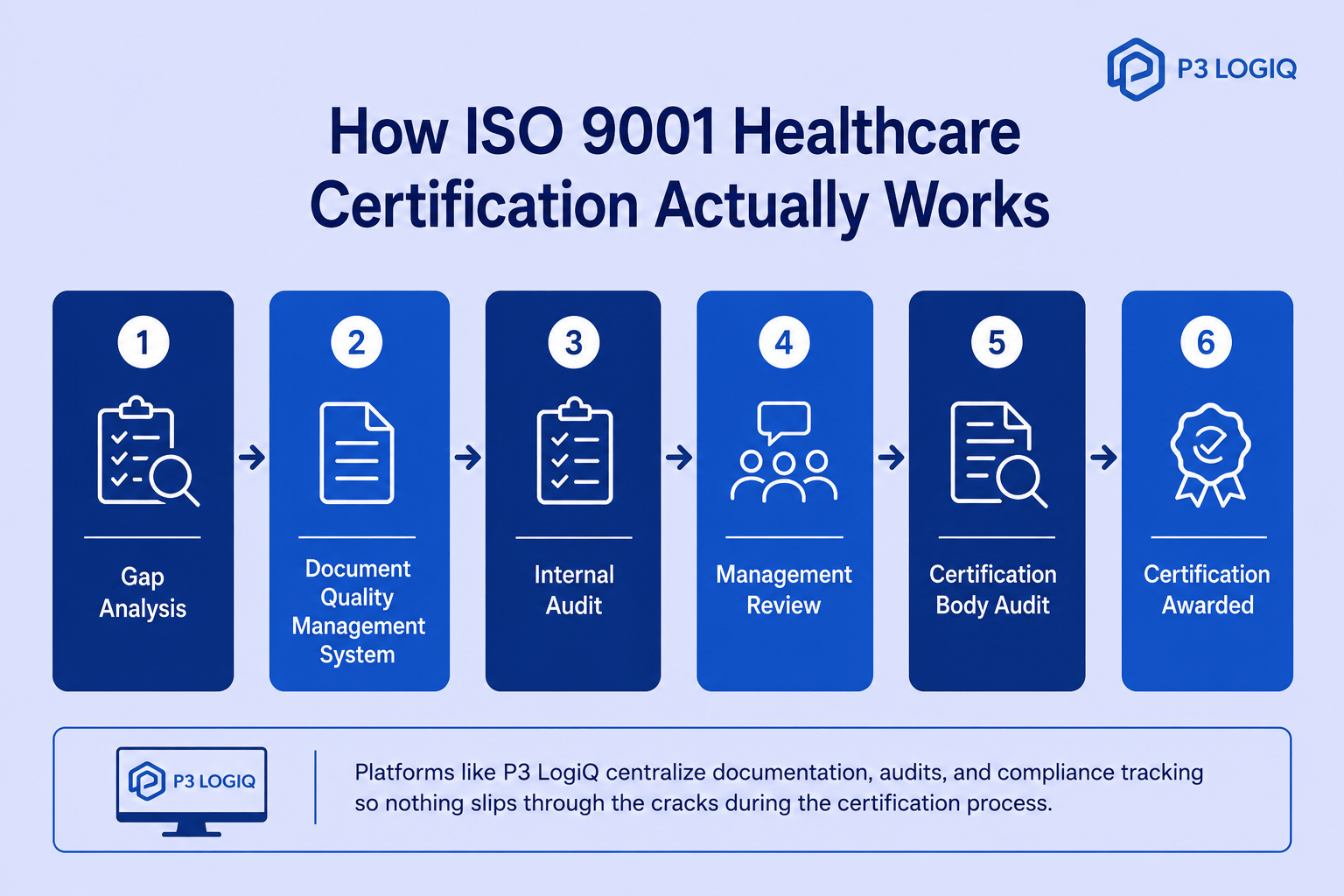
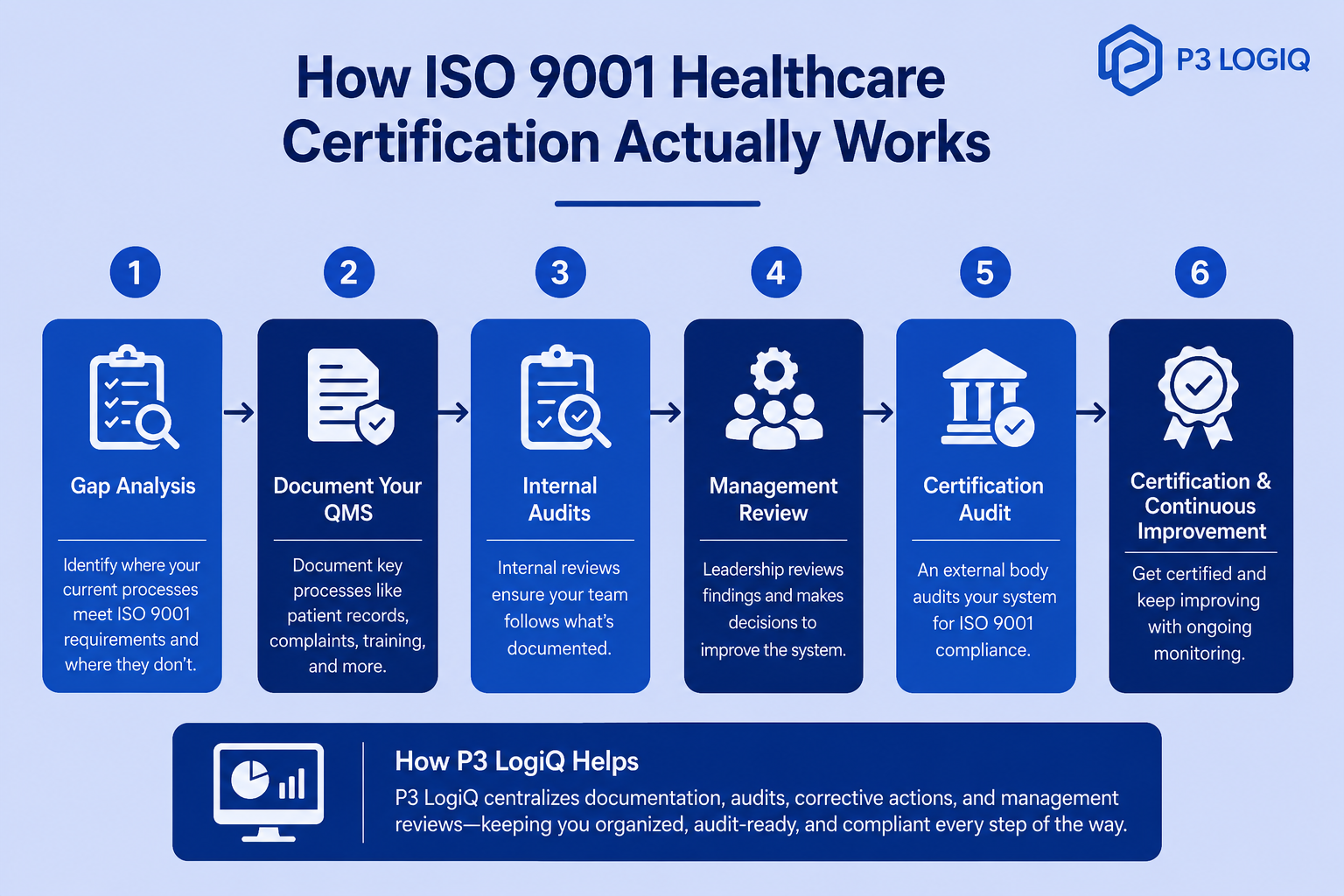
Getting ISO 9001 healthcare certification works a lot like training for a big exam you can't cram for. You don't just show up and pass. You build the habits months in advance, document them, get checked, fix the gaps, get checked again.
It usually starts with a gap analysis, where you compare your existing processes against ISO 9001 requirements to identify what's already in place and what needs improvement. This is an important step in the ISO 9001 certification process because it helps organizations address gaps before the certification audit.
From there, you document your quality management system. Things like how you handle patient records, how complaints get tracked, and how staff get trained on new procedures.
Internal audits come next. Someone inside your organization checks if you're actually following what you wrote down.
Then leadership reviews the findings before you bring in an outside certification body for the real audit. A lot of providers manage this whole process by hand in spreadsheets and shared drives, which gets messy fast once you're juggling multiple departments.
At P3 LogiQ, we built our platform to simplify the ISO 9001 certification process. We keep your documentation, audits, and compliance tracking in one place so nothing slips through the cracks during the certification audit.
Anyone who's tried to start a new gym routine knows the first two weeks are the hardest. Your body resists, you want to skip the early alarm, and it feels easier to go back to old habits.
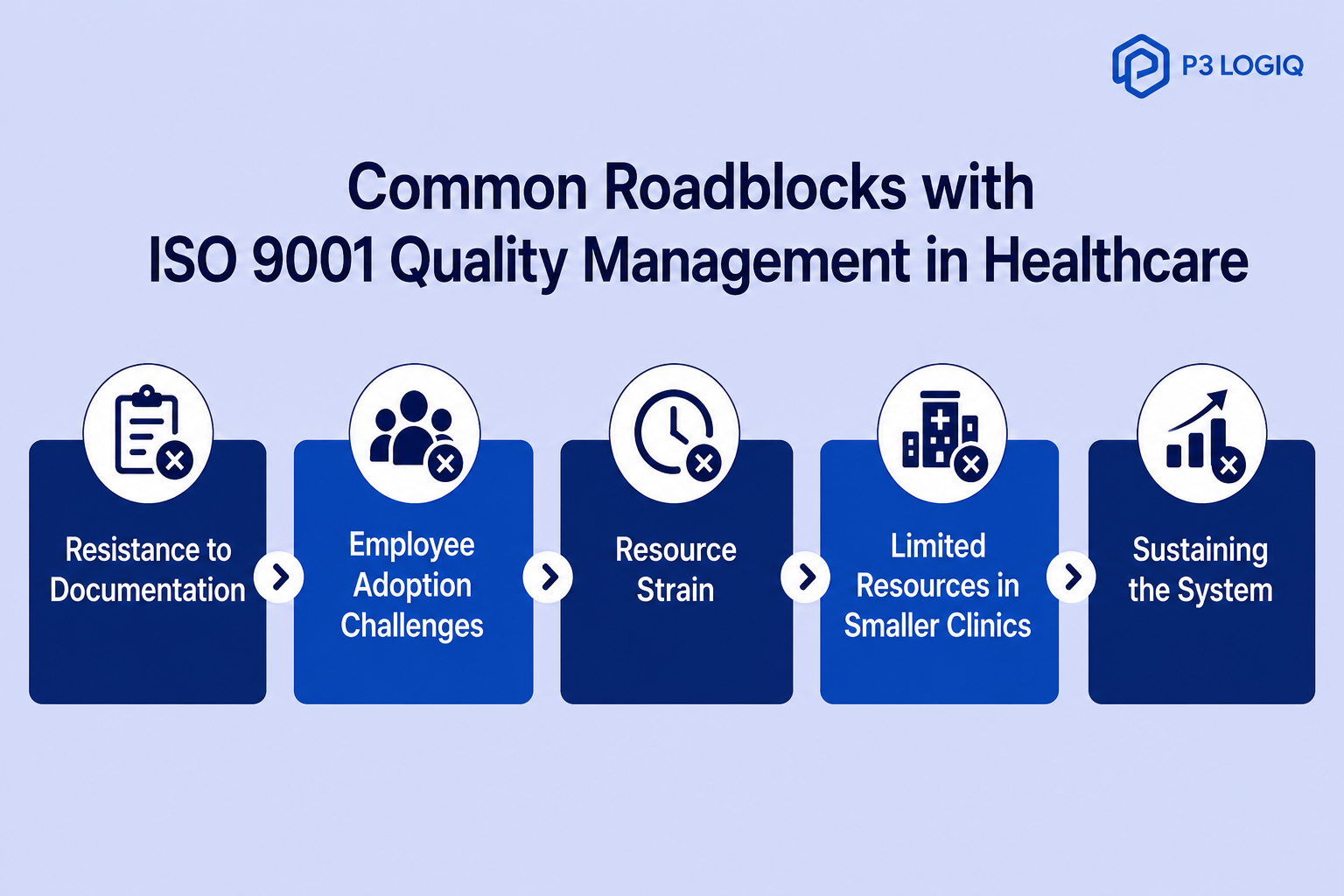
Rolling out ISO 9001 quality management in a healthcare setting works the same way. The standard itself isn't the hard part. Getting your team to actually live it is. Many organizations face ISO 9001 implementation challenges when introducing new processes, especially around documentation, employee adoption, and maintaining consistency.
The most common pushback sounds like "We already do this; why are we writing it down?" Staff who've worked the same way for years see documentation as busywork, not protection.
The fix isn't more paperwork. It's showing them how a written process saves them, like catching a new hire's mistake that nobody else would've noticed.
Resource strain is the other big one. Implementing ISO 9001 healthcare certification takes real time from people who are already stretched between patient care, internal audits, and management reviews.
Smaller clinics feel this hardest. They don't have a dedicated quality team to absorb the load.
And here's the part nobody warns you about: the real test isn't passing your first audit. It's still following the system six months later, after the initial push fades and old habits start creeping back in.
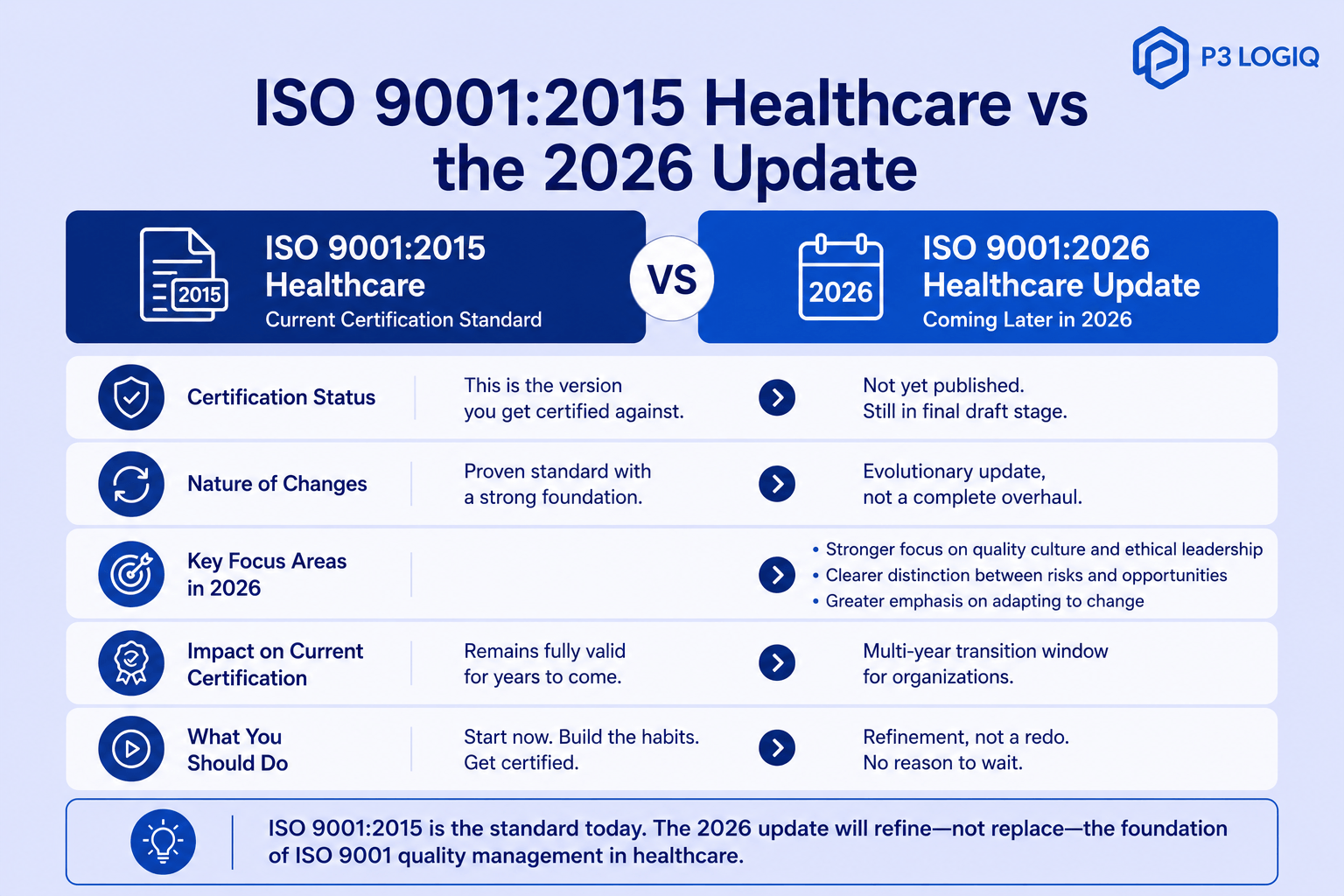
If you're researching this in 2026, you've probably seen both "ISO 9001:2015 healthcare" and "ISO 9001:2026 healthcare" floating around. You might be wondering which one you're actually chasing.
Here's the short answer: ISO 9001:2015 is still the version you get certified against today. The 2026 revision hasn't been published yet. It's still working through its final draft stage, with the official release expected sometime later this year.
So there's nothing new to certify against just yet.
When the update does land, don't expect a complete overhaul. Industry experts following the revision describe it as an evolutionary update, not a revolutionary one. The ISO 9001:2026 update focuses on refining existing requirements rather than replacing the foundation of the standard.
The changes worth knowing about: a sharper focus on quality culture and ethical behavior from leadership, a clearer split between managing risks and chasing opportunities, and more attention to how organizations respond to change.
The part that should actually ease your mind: your existing ISO 9001:2015 certification stays fully valid for years after the new version is published. Most healthcare organizations will have a multi-year window to transition.
If you're weighing whether to start now or wait for the new version, there's no real reason to wait. Get certified against the current standard. Build the habits. The 2026 update will be a refinement, not a redo.
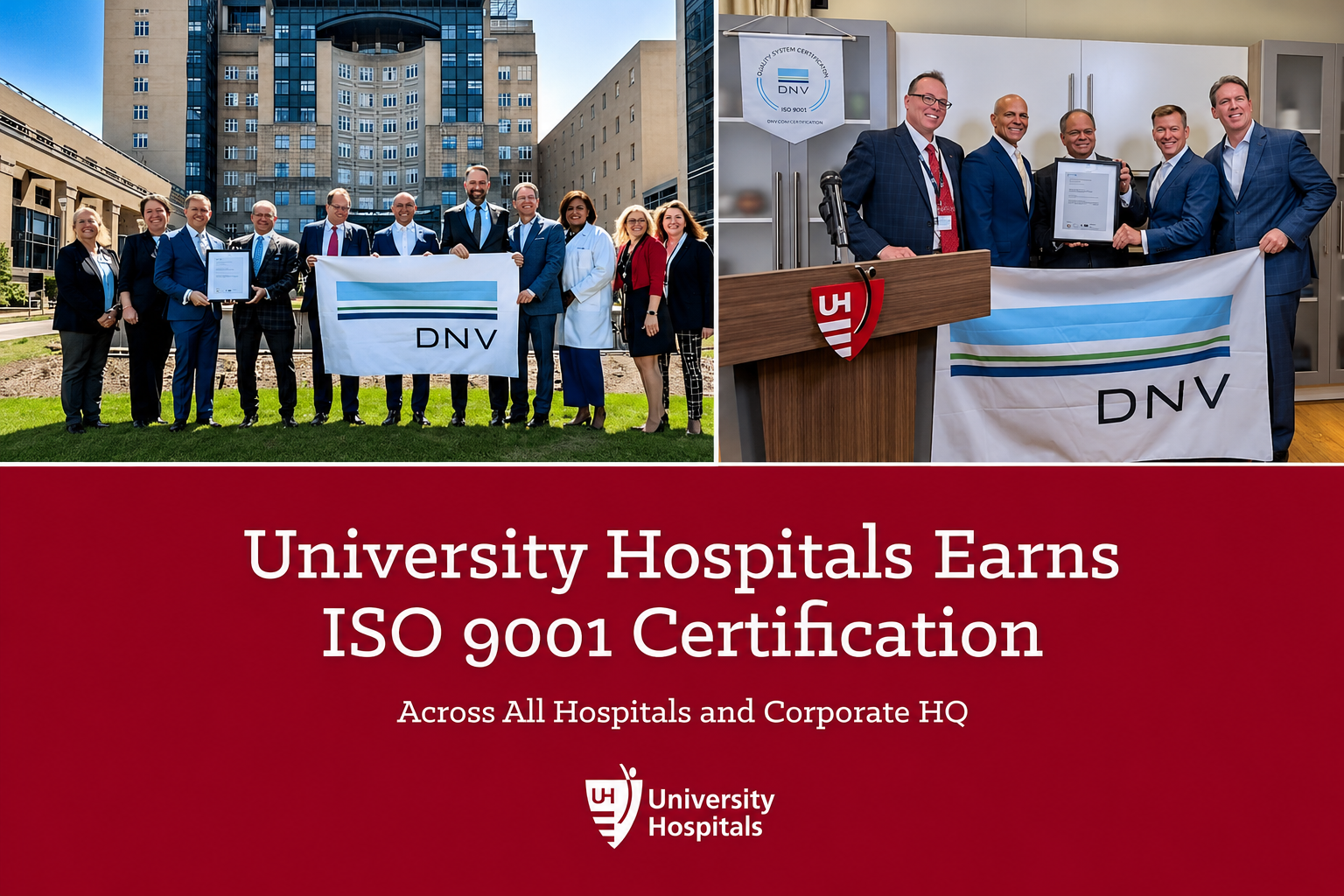
According to an April 2026 announcement from University Hospitals, the Cleveland-based system became the first health system in the nation to certify its entire corporate headquarters to ISO 9001. Every hospital in its network got certified too.
That's a major undertaking. University Hospitals spans 23 hospitals, including 5 joint ventures, more than 50 health centers and outpatient facilities, and over 200 physician offices across 16 counties in Northern Ohio. Getting a system that size aligned to one quality standard, top to bottom, doesn't happen by accident.
It happened because ISO 9001 helps organizations build consistent processes that can scale. That’s the real payoff.
It's not the certificate framed in the lobby. It's the reason a system that large can promise the same quality of care whether you're treated on a Monday morning or a Saturday night. The ISO 9001 business benefits become even more visible at scale, where consistent processes directly improve trust, efficiency, and operational reliability.
For smaller clinics, the same logic holds at a different scale. Patients trust you more, staff make fewer costly mistakes, and you stop relying on any one person's memory to keep things running.
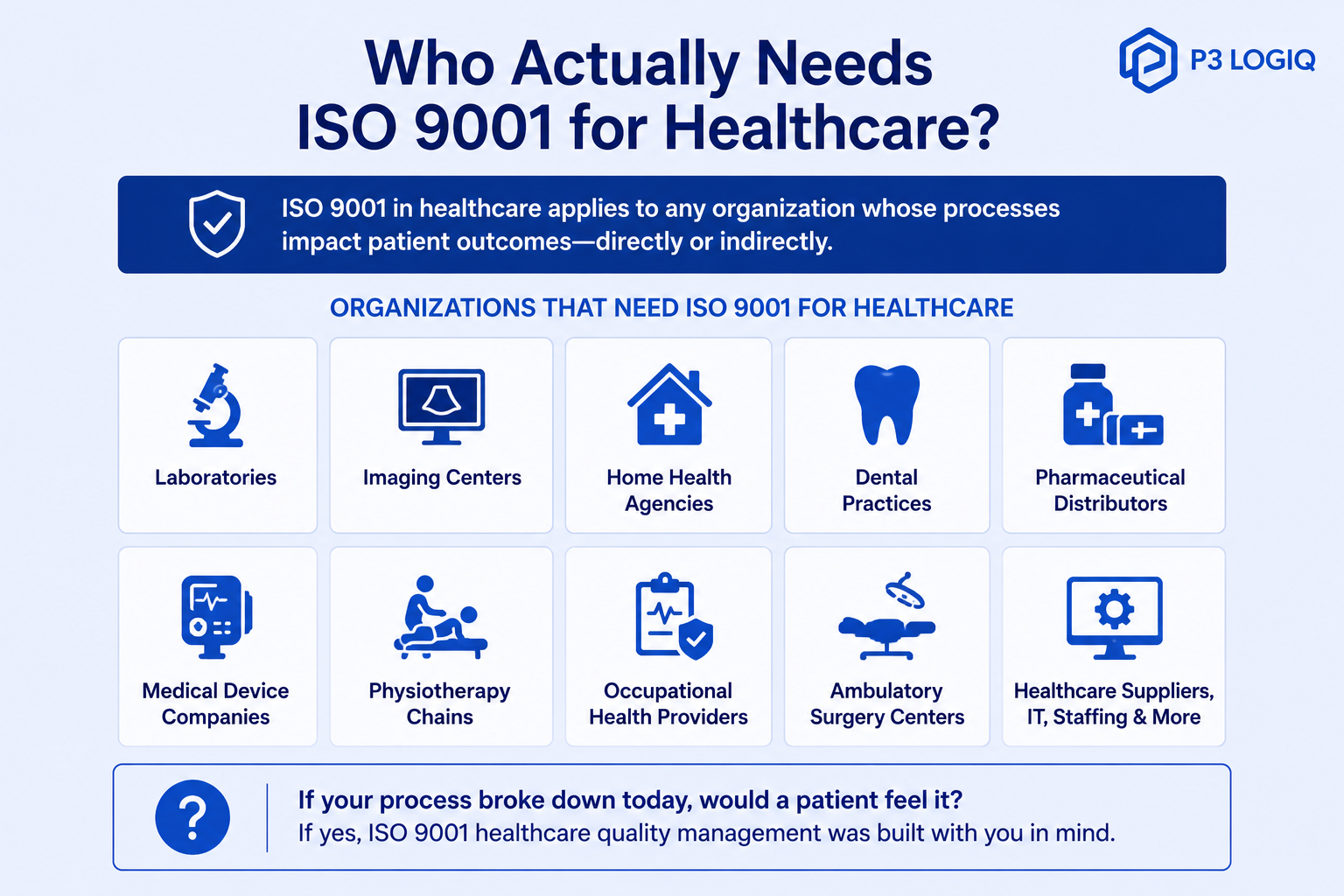
Most people hear "ISO 9001 in healthcare" and picture a giant hospital system with hundreds of staff and a dedicated compliance team. That's not the full picture. ISO 9001 for small businesses applies just as much to smaller clinics and service providers, since the standard is based on process consistency rather than organization size.
Labs, imaging centers, home health agencies, dental practices, and pharmaceutical distributors all qualify. So do medical device companies, physiotherapy chains, occupational health providers, and ambulatory surgery centers. If your work touches patient outcomes in any way, directly or indirectly, this standard applies to you.
The size of your organization doesn't matter as much as the consistency of your process. A two-room dental clinic with airtight documentation beats a 50-bed hospital running on gut instinct every single time.
And here's something most people miss. ISO 9001 for healthcare isn't just for providers who treat patients directly. If you supply equipment, manage medical records, run a healthcare staffing firm, or build software used in clinical settings, your organization also qualifies. The standard covers anyone whose processes can affect the quality of patient care downstream.
So before you assume this isn't for you, ask yourself one question: if your process broke down today, would a patient feel it? If the answer is yes, ISO 9001 healthcare quality management was built with you in mind.
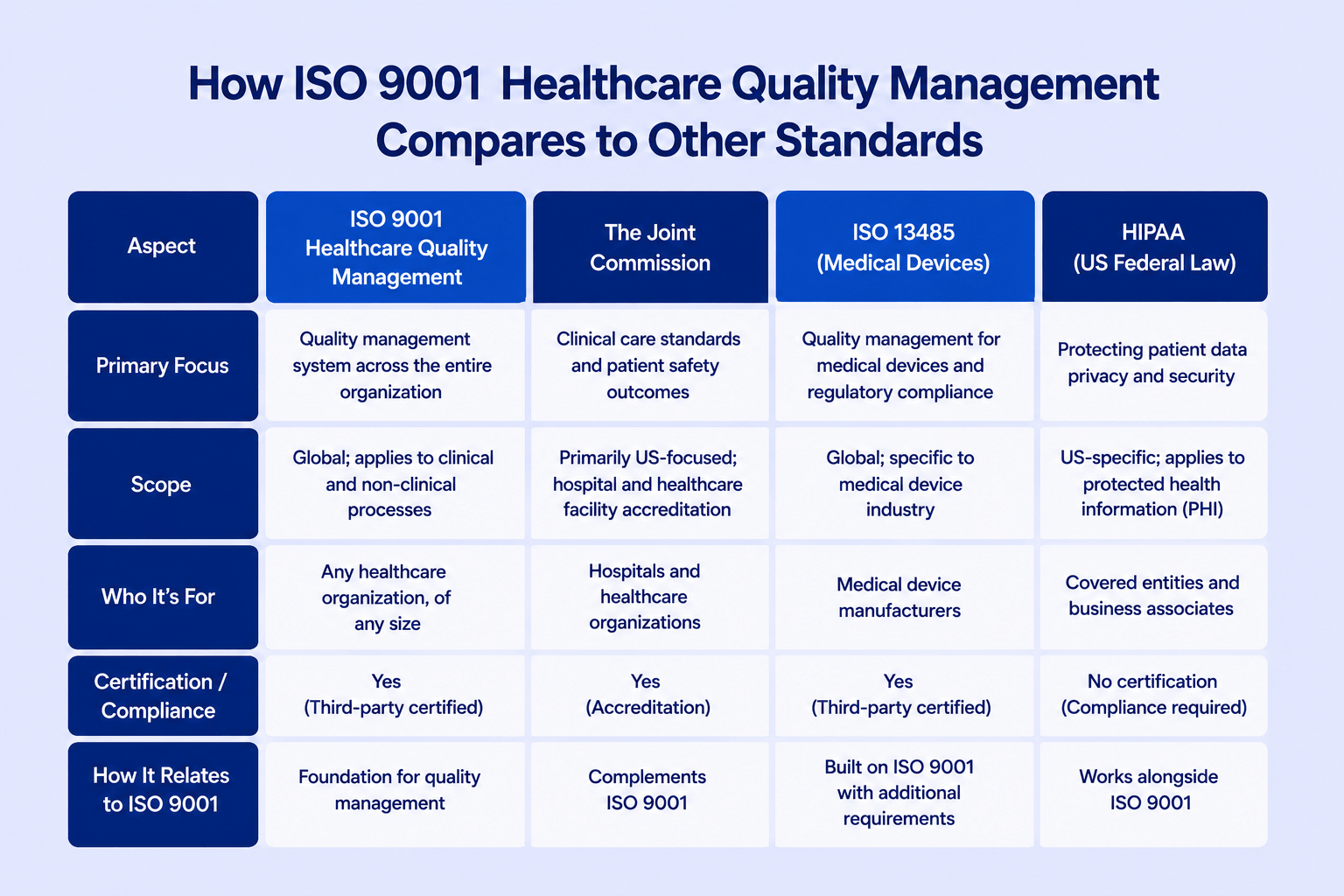
If you've spent any time researching quality in healthcare, you've probably come across The Joint Commission, ISO 13485, and maybe even HIPAA in the same breath as ISO 9001. They're not the same thing, and they're not interchangeable.
The Joint Commission focuses on healthcare accreditation, patient safety, and organizational performance, primarily for healthcare providers in the United States. It's heavily US-centric and evaluates whether hospitals meet specific accreditation criteria around clinical performance. ISO 9001 healthcare quality management is broader. It covers the entire operational system of an organization, clinical and non-clinical, and it applies globally.
Understanding ISO 9001 clauses helps clarify how this standard structures processes across different functions, unlike other healthcare-specific frameworks.
ISO 13485 is designed for organizations involved in the lifecycle of medical devices, not just manufacturers. It takes ISO 9001 as its foundation and layers on additional regulatory requirements tied to device safety and traceability. Organizations that operate across both healthcare services and medical devices may choose to implement both standards, depending on their business and regulatory requirements.
HIPAA is a different category entirely. It's a US federal law governing patient data privacy and security, not a quality management framework. You don't get certified to HIPAA the way you do to ISO 9001. You comply with it.
Think of ISO 9001 as the foundation. Other standards either build on it or sit alongside it, depending on what your organization does. If you're a hospital, ISO 9001 is typically your starting point. If you manufacture devices, you'll likely pursue both. If you're a data-heavy healthcare tech company, you'll deal with HIPAA on top of whichever quality standard fits your operations.
The key thing to understand is that these standards don't conflict with each other. Most mature healthcare organizations end up working within several of them at once. ISO 9001 just tends to be the one that ties everything together at the process level.
One of the mistakes most healthcare organizations make is treating ISO 9001 like a one-time project. You get the certificate, you frame it, and you move on. That's not how this works. ISO 9001 quality management in healthcare is an ongoing system, not a finish line.
Start by identifying one person who owns the process. Not a committee. One person. Without that, accountability gets diffused, and nothing moves. This is your quality management representative, and their job is to keep the whole system running before, during, and long after the certification audit.
From there, run your gap analysis. That's just a structured way of asking: where does our current process match what ISO 9001 requires, and where does it fall short? You'll almost always find the gaps aren't in clinical care. They're in documentation, handoffs, and how complaints get tracked.
Next, set a realistic timeline. Most healthcare organizations take 12 to 18 months from the decision to pursue certification to actually receiving it. Smaller clinics sometimes move faster. Larger systems with multiple departments take longer because aligning everyone to the same documented process takes real coordination.
Then comes the part where most teams quietly unravel. Managing all of this across email threads and shared drives is how things fall through the cracks. Documents get updated in one place and not another. Audit findings get logged but never resolved. Corrective actions sit in someone's inbox for weeks.
This is exactly where ISO 9001 certification audits become difficult to manage without a structured system in place.
P3 LogiQ keeps your documentation, internal audits, corrective actions, and management reviews in one place. Your team always knows exactly where things stand, right up to the day of your external audit. And after certification, it's what keeps the system alive instead of gathering dust.
Think of this as packing for a long trip. Forget one essential item, and you'll feel the impact later, usually at the worst possible moment.
Before pursuing ISO 9001 healthcare certification, your organization needs documented processes for the core activities that affect quality. Patient intake, record management, complaint handling, staff training, and incident reporting all need clear, written steps that any staff member can follow. A detailed ISO 9001 certification checklist can help teams identify these requirements and prepare before starting the certification process.
You also need measurable quality objectives. Auditors don't just want to see that you're maintaining standards. They want to see that you're actively working to improve them and that you can show the numbers to prove it.
Internal audits are non-negotiable. These are the checks your own team runs before an external auditor comes in. They exist to find your gaps before someone else does. If your internal audits rarely identify any findings, it may be worth reviewing whether they're being conducted with enough depth and objectivity.
Management reviews need to happen regularly, too. This isn't a formality. Leadership needs to sit down, look at the data, and make decisions based on what the quality management system is telling them.
Finally, corrective actions need to be tracked from identification all the way through to resolution. Finding a problem is only half the job. ISO 9001 quality management in healthcare requires you to investigate the root cause, fix it, and verify it doesn't come back. If you can honestly check each of these off, you're already in better shape than most organizations walking into their first certification audit.
Think about that healthcare facility where the quality of care was consistent, but registration, scheduling, and billing changed depending on who was working that day. That's exactly the kind of inconsistency ISO 9001 is designed to eliminate by replacing individual habits with standardized, repeatable processes.
ISO 9001 in healthcare is the fix for that, at every level of your organization. It's not about paperwork for the sake of it. It's about building something that doesn't depend on any one person's memory to keep running.
Whether you're managing a large hospital network or a small clinic, the principle remains the same. Consistent processes lead to consistent care.
But healthcare organizations already have enough on their plates. Managing audits, documentation, corrective actions, staff training, and quality records through disconnected systems only adds unnecessary complexity on top of an already demanding job.
That's why many providers are moving toward centralized compliance platforms like P3 LogiQ. By bringing document control, audit management, CAPA tracking, risk management, training records, and compliance workflows into a single system, teams spend less time chasing paperwork and more time focusing on patient care.
Whether you're preparing for your first ISO 9001 healthcare certification audit or looking to strengthen an existing quality management system, the right tools make the journey significantly easier.
Ready to see how it works? Book a demo with P3 LogiQ and discover how healthcare organizations streamline ISO 9001 compliance, improve visibility, and stay audit-ready throughout the year.
You can also sign up for P3 LogiQ to start building a more organized and efficient compliance management process today.
ISO 9001 in healthcare is a quality management system standard that helps hospitals, clinics, and other providers build consistent, repeatable processes across their operations. It covers patient intake, record-keeping, staff training, and complaint management, and applies across both clinical and non-clinical departments.
No, ISO 9001 for healthcare is not a legal requirement in the US. It's a voluntary certification that organizations pursue to improve quality, reduce operational errors, and build patient trust. That said, some insurers, government contracts, and hospital network partnerships increasingly prefer or require it from vendors and suppliers.
Most healthcare organizations take between 12 and 18 months to go from the decision to pursue ISO 9001 certification to receiving their certificate. The timeline depends on your organization's size, how many gaps your initial analysis uncovers, and how quickly your team can build and document new processes.
ISO 9001 is a general quality management standard that applies to any organization, including healthcare providers. ISO 13485 is designed specifically for medical device manufacturers and includes additional regulatory requirements. Many device companies use both. If you run a hospital or clinic, ISO 9001 is the more relevant starting point.
Costs vary depending on organization size, current process maturity, and the certification body you choose. Small clinics might spend between $5,000 and $15,000 total, including consulting, training, and audit fees. Larger hospital systems can spend significantly more, though the operational savings typically offset the investment over time.
Yes. ISO 9001 for healthcare scales to any organization size. Small clinics and single-specialty practices pursue it successfully all the time. The process is simpler because you have fewer departments and processes to document. The key is having one person who owns it and keeps the system running after certification.
ISO 9001 improves patient safety by reducing variation in how care processes are carried out. When staff follow the same documented steps every time, the risk of handoff errors, missed follow-ups, and inconsistent treatment drops. It also builds in a feedback loop so problems get caught before they escalate.
Yes. Compliance software can help manage ISO 9001 healthcare requirements by centralizing documentation, audits, corrective actions, risk management, and training records. P3 LogiQ provides structured workflows for ISO 9001 compliance, helping healthcare organizations improve visibility, maintain control, and reduce manual compliance efforts.
ISO 9001 certification is valid for three years. During that period, you'll go through annual surveillance audits to confirm you're still following the standard. At the end of the three-year cycle, you go through a full recertification audit. Staying compliant year-round is what makes recertification straightforward rather than stressful.
ISO 9001 and HIPAA are separate frameworks. ISO 9001 focuses on quality management processes, while HIPAA covers patient data privacy and security. That said, building strong documented processes through ISO 9001 healthcare certification can make HIPAA compliance easier to demonstrate, since both reward systematic, accountable operations over ad hoc ones.



Businesses need document management systems (DMS) to ensure ISO and R2 compliance, improve efficiency, and stay audit-ready. The article highlights key features like version control, security, and automation while reviewing the top 5 DMS solutions. P3 LogiQ stands out for its compliance-focused automation and secure document tracking
Read More
Recycling businesses gain efficiency, compliance, and sustainability with RIOS certification. It streamlines quality management, environmental responsibility, and worker safety, helping companies avoid legal risks and boost credibility. P3 LogiQ simplifies the certification process with automation, document control, and compliance tracking, making operations smarter and safer.
Read More
Audit Management Software (AMS) automates compliance tracking, streamlines workflows, and reduces audit risks. Key features include automated scheduling, compliance checklists, CAPA tracking, vendor risk management, and integrations.
Read More
Learn how audit management systems simplify ISO and R2 compliance by automating audits, managing documentation, and minimizing compliance risks efficiently.
Read More
In 2025, many businesses still face challenges in compliance management due to outdated methods like spreadsheets and fragmented software. This inefficiency leads to missed deadlines, increased risk, and regulatory penalties. The blog emphasizes the importance of modern compliance tools that automate workflows, enhance risk management, and streamline regulatory processes to meet ISO and R2 standards.
Read More
The rise in e-waste and environmental concerns makes responsible electronics recycling essential. The R2 Certification sets a global standard for safe, sustainable, and data-secure recycling practices. Developed by Sustainable Electronics Recycling International (SERI), R2 helps businesses manage environmental risks, data security, worker safety, and legal compliance.
Read More
Businesses face increasing challenges in managing complex regulatory compliance. Manual methods such as spreadsheets and paperwork can lead to missed deadlines, inefficiencies, and costly penalties. Compliance management software offers a streamlined solution to reduce risks, automate processes, and improve operational efficiency.
Read More
Maintaining R2 Certification is crucial for businesses in the e-waste recycling industry, ensuring regulatory compliance, sustainability, and strong stakeholder trust. This guide outlines 10 best practices to help businesses simplify operations, reduce risks, and stay compliant.
Read More
Unlock the value of ISO risk management certification. Explore its impact on compliance, risk mitigation, and business expansion.
Read More
Explore the top 5 ISO risk management software tools for 2025, including document management solutions for streamlined compliance and increased efficiency.
Read More
Find the ideal document management software (DMS) for your business. Learn how to choose with expert tips, key features, and insightful guidance
Read More
Unlock the power of a Document Management System (DMS). Learn how it can revolutionize your business operations.
Read More






.png)


.png)





.jpg)



.jpg)
.jpg)










.jpg)



.png)

.png)
.png)



.png)

