.jpg)
The logistics industry runs on reliability. A late shipment, a mislabeled pallet, or poor coordination between carriers can quickly damage customer trust. Even a small mistake can lead to delays, higher costs, and unhappy customers.
That is why ISO 9001 in logistics matters. It gives you a proven framework to keep quality consistent across every stage of the supply chain, from freight pickup to final delivery. Many logistics companies also use ISO 9001 compliance software to manage documentation, audits, and quality processes more efficiently.
If you run a trucking company, a third-party logistics (3PL) business, a freight brokerage, or a warehouse in the US, ISO 9001 certification can help you improve operations and show customers that your business follows an internationally recognized quality standard.
In this guide, I'll explain what ISO 9001 logistics quality management covers, how certification works, and why it continues to matter in 2026.
ISO 9001 is an international standard for Quality Management Systems (QMS). It helps organizations build processes that consistently meet customer expectations while complying with regulatory requirements.
For logistics companies, this means creating clear, repeatable processes across daily operations. The goal is to improve service quality, reduce errors, and support continual improvement through well-defined ISO 9001 requirements and procedures.
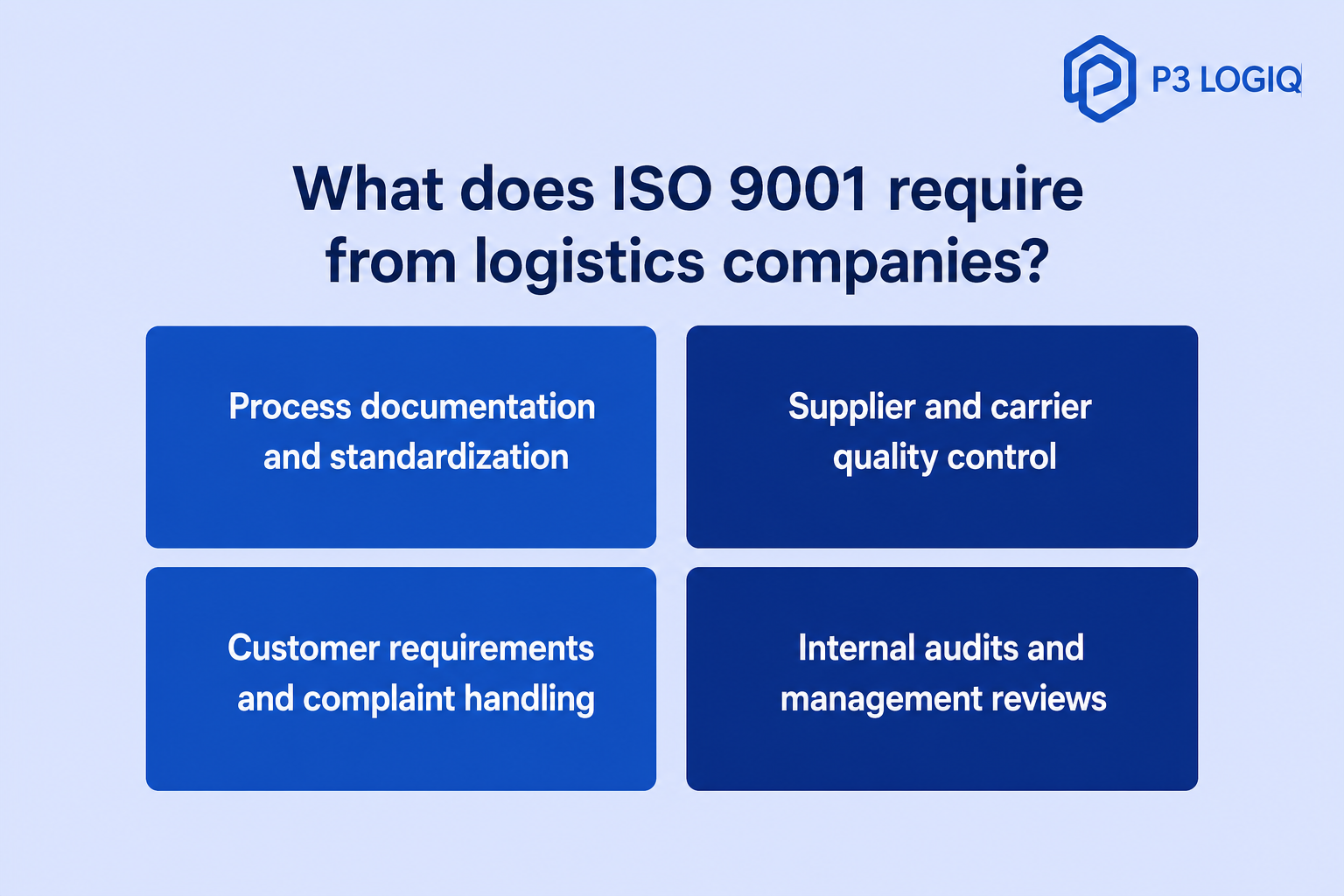
One of the core requirements of ISO 9001 quality management logistics is documenting important business processes. Instead of relying on verbal instructions or individual experience, your team follows clear and consistent procedures.
For a logistics company, this includes receiving goods, handling freight, selecting carriers, planning loads, managing inventory, and resolving customer complaints.
This becomes especially valuable when unexpected situations occur. If a driver is unavailable or a shipment is delayed, your team already knows the correct steps to follow.
If your business operates across multiple warehouses or works with carriers in different states, standardized processes help every location deliver the same level of service.
Your service quality depends on more than your own team. It also depends on the carriers, warehouse partners, freight brokers, and other suppliers you work with.
ISO 9001 logistics certification requires you to evaluate and monitor these external providers. The goal is not only to choose reliable partners but also to measure their performance over time. A guide to ISO 9001 compliance can help logistics companies understand how to maintain structured supplier evaluation processes, monitor performance, and meet ongoing quality requirements.
Many logistics companies track delivery performance, damaged shipments, customer complaints, and service reliability. This information helps you make better decisions when renewing contracts or selecting new partners.
A structured supplier management process can also reduce business risks. It gives you documented evidence that your partners meet quality and compliance expectations.
Understanding customer requirements is another key part of ISO 9001:2015 logistics. Before a shipment moves, you should clearly document delivery schedules, labeling instructions, handling requirements, and any customer-specific requests. An ISO 9001 checklist helps logistics companies verify that important quality processes, customer requirements, and compliance steps are properly documented and followed.
The standard also requires a formal process for managing complaints and nonconformities. If something goes wrong, you investigate the root cause instead of simply fixing the immediate problem.
Once the cause is identified, you implement corrective actions and verify that the issue does not happen again. This approach helps improve both customer satisfaction and long-term service quality.
Internal audits help you confirm that your Quality Management System is working as planned. They also identify areas where processes can be improved.
ISO 9001 requires audits to be carried out by someone who is independent of the work being reviewed. This helps ensure the findings remain objective.
Management reviews are equally important. Leadership reviews audit results, customer feedback, quality objectives, business risks, and improvement opportunities on a regular basis.
For growing logistics companies, these reviews provide valuable insights. They help leaders make informed decisions based on real performance data instead of assumptions.

The certification process usually starts with a gap assessment. This helps identify where your current processes already meet ISO 9001 requirements and where improvements are needed. Understanding the ISO 9001 certification process helps logistics companies prepare for each stage, from initial assessment and QMS implementation to audits and certification.
Next, you develop and implement your Quality Management System. This includes documenting procedures, defining responsibilities, setting quality objectives, and training employees.
Before certification, your organization performs internal audits and a management review. These activities confirm that the system is working effectively.
An accredited certification body then conducts an external audit. If your organization meets the requirements, you receive ISO 9001 logistics certification.
Certification does not end there. You will continue completing surveillance audits and improving your Quality Management System to maintain certification.

Customer expectations continue to rise. Businesses expect faster deliveries, better communication, and reliable service every time.
Supply chains are also becoming more connected and more complex. As a result, logistics companies need structured quality systems that can support growth without increasing operational risks.
Although ISO 9001:2015 remains the current certifiable standard, organizations are also preparing for the upcoming revision expected in 2026. Companies that already have a strong quality management system will find it much easier to adapt when the updated standard is introduced.
Many businesses are also adopting the best ISO 9001 software for quality management to simplify document control, audit management, corrective actions, and compliance tracking. Digital tools reduce manual work and make it easier to maintain certification over time.
ISO 9001 is more than a certification. It helps you build a stronger quality management system that improves consistency, reduces risks, and delivers better customer experiences across your logistics operations.
As supply chains become more complex, managing quality manually becomes harder. ISO 9001 compliance software simplifies documentation, audits, corrective actions, and compliance activities while helping your team stay audit-ready throughout the year.
P3 LogiQ is your centralized platform for ISO 9001 quality management. Manage documents, schedule audits, track nonconformities, monitor corrective actions, and maintain compliance with confidence.
Book a free demo to see how P3 LogiQ simplifies ISO 9001 certification for your logistics business. Or sign up today and take the first step toward a more efficient, compliant, and quality-driven logistics operation.
ISO 9001 in logistics means applying the international Quality Management System (QMS) standard to freight, trucking, warehousing, and 3PL operations. It helps logistics companies standardize processes such as freight handling, carrier selection, load planning, and complaint resolution to maintain consistent service quality.
ISO 9001 certification is not legally required for trucking companies, but many pursue it to demonstrate reliability to customers, improve internal processes, and stand out when bidding for contracts that require documented quality standards.
For 3PL and freight brokerage businesses, ISO 9001 requires documented processes for carrier selection, supplier evaluation, customer requirement handling, and nonconformity management. This helps companies manage service quality across multiple partners and locations.
ISO 9001 requires logistics companies to evaluate and monitor carriers, warehouse partners, and freight brokers on an ongoing basis. Companies can track factors such as delivery performance, damaged shipments, and customer complaints to make informed decisions about their partners.
The timeline depends on how developed your existing processes are. It typically involves a gap assessment, QMS implementation, employee training, internal audits, a management review, and a final external audit before certification is granted.
An ISO 9001 audit for a logistics business reviews process documentation, supplier and carrier evaluation records, customer complaint handling, corrective action processes, and evidence that internal audits and management reviews are being conducted as required.
ISO 9001 requires a formal process for managing complaints and nonconformities. Logistics companies must investigate the root cause of issues, implement corrective actions, and verify that similar problems do not happen again.
Yes. ISO 9001:2015 remains the current certifiable version of the standard for logistics companies in 2026. Organizations are preparing for a future revision, and having a strong QMS already in place can make the transition easier.
Yes. ISO 9001 promotes standardized processes across locations, helping logistics companies with multiple warehouses or carriers in different states maintain consistent service quality regardless of where a shipment is handled.
Yes. ISO 9001 compliance software can help logistics companies manage documentation, schedule audits, track corrective actions, and monitor supplier performance. This reduces manual work and makes it easier to stay audit-ready and maintain certification throughout the year.



Businesses need document management systems (DMS) to ensure ISO and R2 compliance, improve efficiency, and stay audit-ready. The article highlights key features like version control, security, and automation while reviewing the top 5 DMS solutions. P3 LogiQ stands out for its compliance-focused automation and secure document tracking
Read More
Recycling businesses gain efficiency, compliance, and sustainability with RIOS certification. It streamlines quality management, environmental responsibility, and worker safety, helping companies avoid legal risks and boost credibility. P3 LogiQ simplifies the certification process with automation, document control, and compliance tracking, making operations smarter and safer.
Read More
Audit Management Software (AMS) automates compliance tracking, streamlines workflows, and reduces audit risks. Key features include automated scheduling, compliance checklists, CAPA tracking, vendor risk management, and integrations.
Read More
Learn how audit management systems simplify ISO and R2 compliance by automating audits, managing documentation, and minimizing compliance risks efficiently.
Read More
In 2025, many businesses still face challenges in compliance management due to outdated methods like spreadsheets and fragmented software. This inefficiency leads to missed deadlines, increased risk, and regulatory penalties. The blog emphasizes the importance of modern compliance tools that automate workflows, enhance risk management, and streamline regulatory processes to meet ISO and R2 standards.
Read More
The rise in e-waste and environmental concerns makes responsible electronics recycling essential. The R2 Certification sets a global standard for safe, sustainable, and data-secure recycling practices. Developed by Sustainable Electronics Recycling International (SERI), R2 helps businesses manage environmental risks, data security, worker safety, and legal compliance.
Read More
Businesses face increasing challenges in managing complex regulatory compliance. Manual methods such as spreadsheets and paperwork can lead to missed deadlines, inefficiencies, and costly penalties. Compliance management software offers a streamlined solution to reduce risks, automate processes, and improve operational efficiency.
Read More
Maintaining R2 Certification is crucial for businesses in the e-waste recycling industry, ensuring regulatory compliance, sustainability, and strong stakeholder trust. This guide outlines 10 best practices to help businesses simplify operations, reduce risks, and stay compliant.
Read More
Unlock the value of ISO risk management certification. Explore its impact on compliance, risk mitigation, and business expansion.
Read More
Explore the top 5 ISO risk management software tools for 2025, including document management solutions for streamlined compliance and increased efficiency.
Read More
Find the ideal document management software (DMS) for your business. Learn how to choose with expert tips, key features, and insightful guidance
Read More
Unlock the power of a Document Management System (DMS). Learn how it can revolutionize your business operations.
Read More






.png)


.png)



.jpg)



.jpg)
.jpg)




.jpg)

.png)

.png)
.png)



.png)

