
You run an electronics recycling operation. You do the right things, or at least you think you do. You sort the equipment, handle the data drives carefully, and keep your workers safe.
You think you got yourself a new opportunity by meeting new clients for closing business deals, and all you saw was that you met some of the requirements they had until you saw something that was off at first. You noticed that the client had a requirement asking if you were R2 certified.
That question, right there, is a real problem. Not only might it cost you the contract. But because without a verified standard like R2, there's no way for anyone on the outside to know what actually happens inside your facility. Any company can say they recycle responsibly. Only R2 Standard has an independent third party come in and check.
R2 stands for Responsible Recycling. It’s known for adopting the certification around the world for electronics recycling and refurbishment by following the best practices for staying R2 certified.
It’s used for used electronics, and now we got the latest version, which is known as the R2v3, which helps to continue the reuse and recycling of the electronics.
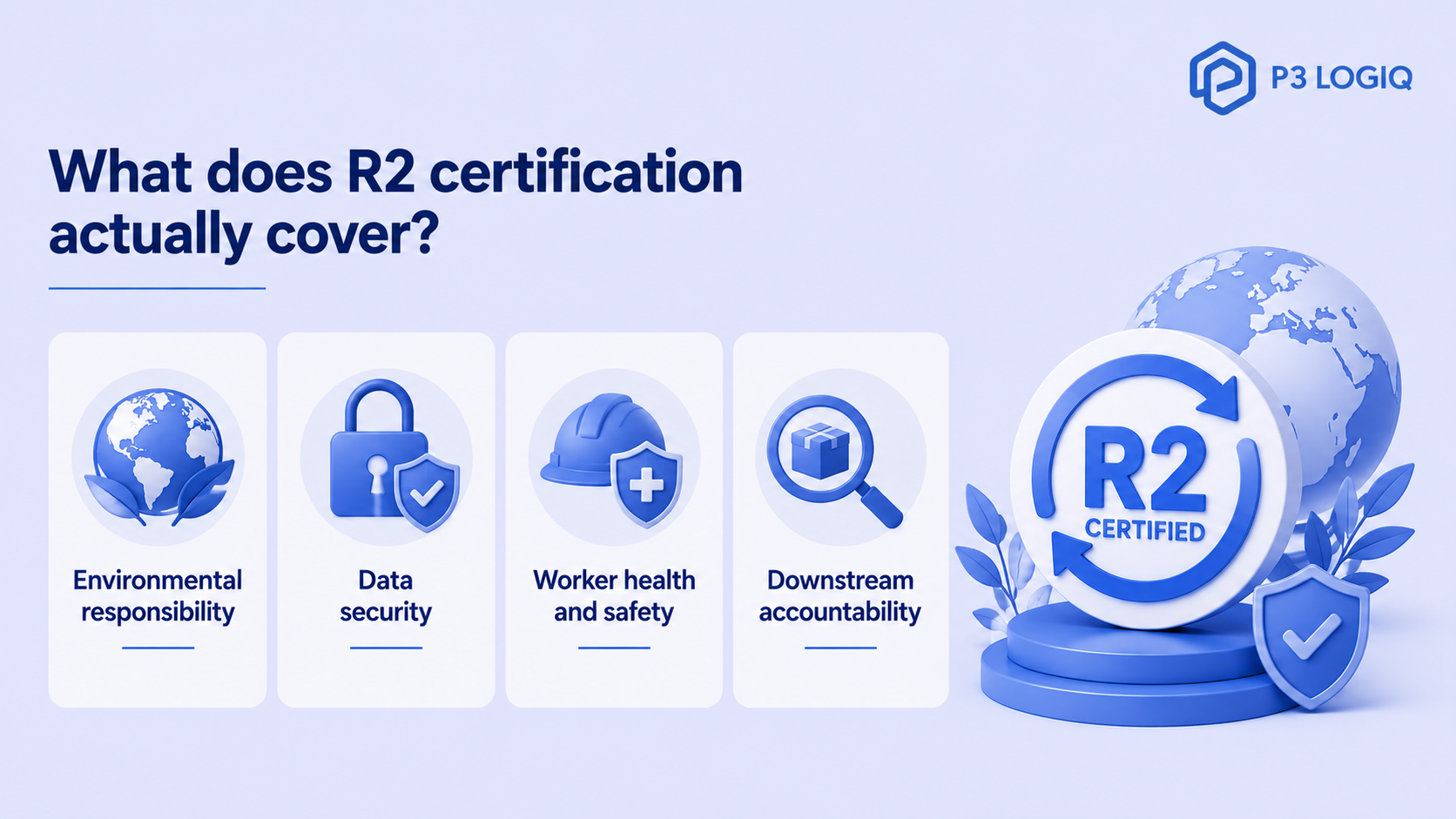
When your facility has this R2 certification, it basically tells your clients that your company has been audited against strict requirements covering environmental protection, worker safety, data security, and downstream accountability.
So where did all this actually come from?
As per SERI’s R2 story, the R2 Practices were released and repair and recycling facilities began to get certified. It began in 2008 to promote the practices of reuse and recycling.
And yes, R2 is also EPA-recognized. The Environmental Protection Agency formally backs it as the recommended benchmark for responsible electronics recycling.
The standard has gone through four versions since then. R2v1 came out in 2008 as the starting point. R2v2 followed in 2013 with tighter requirements. R2v3 landed in 2020 with a completely revamped structure. And then in 2024, R2v3.1 was introduced as the update to R2v3.
Every update got stricter. That's not a coincidence. The e-waste problem was growing faster than anyone expected, and both regulators and corporate buyers started demanding more accountability from recyclers. The standard had to keep up.
The R2 standard is developed in collaboration with a multi-stakeholder technical advisory committee. This committee includes representatives from e-waste recycling companies, customers like OEMs and data center operators, regulatory agencies, and public interest groups. The R2 standard is accredited by the American National Standards Institute (ANSI).
SERI, which stands for Sustainable Electronics Recycling International, is the non-profit body that owns and manages the R2 standard. They don't do the auditing themselves. Instead, they accredit independent third-party certification bodies to carry out the audits. This separation matters: it means the people checking your facility have no financial interest in whether you pass or fail.
What you need to know about SERI is that they own and manage the R2 Standard, and they are also a non-profit body. Just to be clear, they do not do any auditing by themselves. Instead, they task the independent third-party certification bodies (CBs) to carry out the audits.
Electronics recyclers should be certified by demonstrating to an auditor that they are following specific standards, basically saying, “Yes, I follow the procedure as per R2 standards, and I safely recycle and manage electronics”. This way, you will ensure that you manage unwanted and used electronics.
This was mentioned on the US EPA's certified electronics recyclers page.
This is where a lot of people get confused. They assume R2 is just about recycling properly. It's actually much more than that.
The R2 standard consists of ten clauses that include scope, hierarchy of responsible management strategies, legal compliance, data security, focus materials, reusable equipment, tracking throughput, environmental health and safety, management systems, and documentation and recordkeeping.
Each of those ten clauses has real requirements behind it. Here's what the main areas actually mean in practice:
The fact of the matter is that electronic waste is one of the fastest-growing waste streams; that means it makes up about 70% of toxic waste. The problem with e-waste is that it has harmful materials like mercury, lead, and so on, which can leak into the environment. This means it can cause health and environmental issues.
We don’t want that now, do we?
So for that reason, R2 requires you to have your processes documented, basically showing proof that you handle these materials on the regular. Not just having good intentions.
The R2 standard requires you to entirely wipe out the data and also document it as proof that you have done it properly. Your clients handing over old servers need proof that their data was wiped or destroyed, not just your word for it.
The people in your facility are handling equipment that can contain lead, cadmium, mercury, and other hazardous substances. With R2, you have to make sure that your safety procedures, proper protective equipment, training records, and a system for identifying and correcting safety risks are documented clearly.
What’s interesting about R2 is that it overlaps significantly with workplace safety standards you might already know, like ISO 45001 certification, which focuses on occupational health and safety management.
R2 Certification covers the primary facility and all of their downstream vendors, delivering the confidence to know that electronics will be responsibly reused or recycled at every step along the way. This is a big one. You can't just ship materials off to a cheaper processor and wash your hands of what happens next. R2 makes you responsible for your whole supply chain.
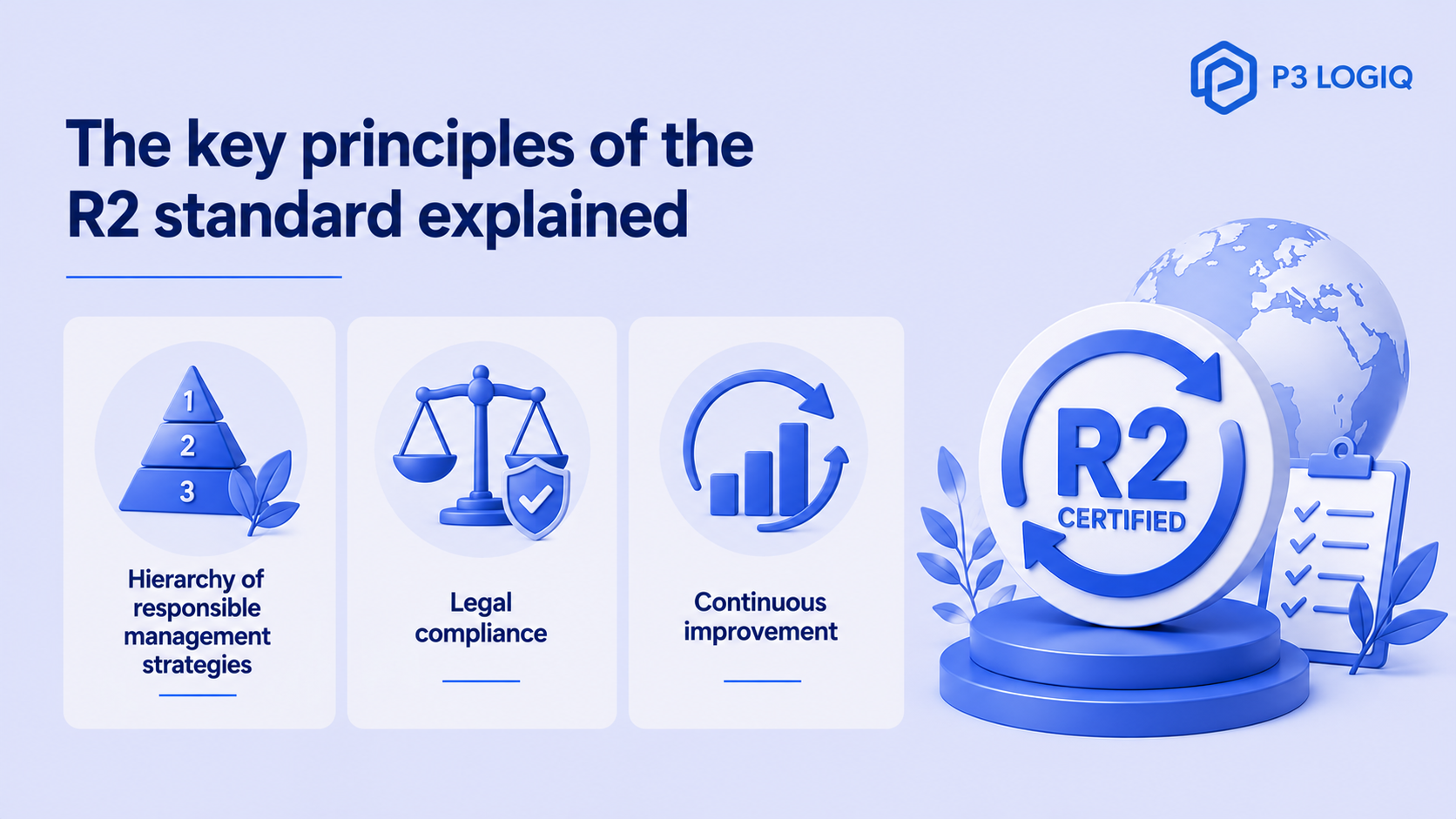
Understanding the principles behind R2 helps you understand why the requirements exist. They follow a clear logic.
R2 doesn't treat recycling as the end goal.
You’ll see that managers who partner with ITAD companies that are R2 certified can feel more confident that electronic equipment and components will be managed based on a hierarchy of responsible management strategies.
The idea is that a working device going back into use is better than a working device being shredded. Refurbishment and reuse come first, then responsible recycling, then disposal as a last resort.
This one sounds obvious but it's genuinely one of the harder requirements to get right. E-waste regulations change by country, state, and even municipality. R2v3 requires that your e-waste management complies with all applicable laws to reduce environmental impact and pollution. You need to know which regulations apply to your specific operation and actually prove you're following them.
R2 isn't a pass-once-and-forget certification. The R2 standard makes you focus on continuous improvement; that means it requires you to keep on evaluating to see if there are any issues so that you will have room to improve your practices and processes. This habit encourages you to adopt innovative solutions and technologies in e-waste management.
You need a stern management system that tracks your performance over time and responds when things aren't working. This is why compliance software that gives you real-time tracking across your R2 operations matters more than just filing paperwork once a year.
What's new in R2v3?
If you've been certified under an older version of R2 or you're researching the standard for the first time, R2v3 is what you need to know about now.
The R2v3 standard was released in July 2020 and is the second major revision of the R2 standard since 2013.
R2v3 recognizes the diversity in types of facilities, from collectors to ITAD companies to returns and recycling, and introduces requirements that address specific operations that require specialized skills and processes.
So the biggest change you can see in R2v3 is the modular framework.
It’s got a set of mandatory core standards alongside a range of “specialty process requirements." Even though the R2 facilities meet the same core requirements, there are additional appendices for certain facilities like data sanitization, downstream recycling chains, or test and repair.
Now see, there are different appendices that R2 covers; for example, for recyclers, it will be to certify Appendix E for material recovery.
For ITAD companies, it will be to certify to Appendix C, which is for test and repair; Appendix B, which is for data sanitization; etc.
This is why when you look up an R2 certified facility on the SERI website, you can see exactly what scope they're certified for, not just that they're certified.
When it comes to keeping your appendices organized, it’s best you understand how to keep your audit management systems simplified for ISO & R2, because this can save you a lot of time and confusion during your certification process.
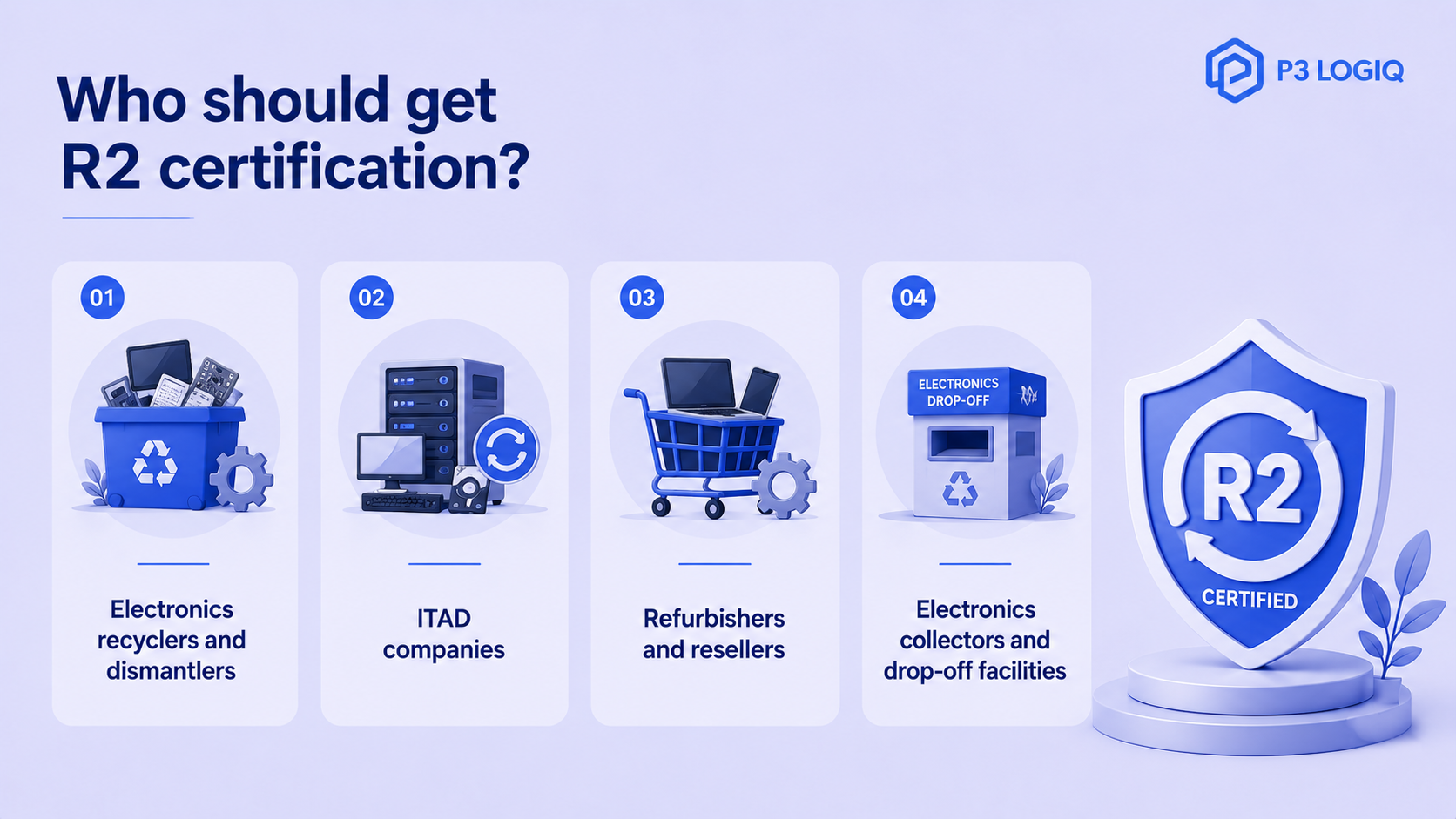
Good question, and honestly one that doesn't get asked enough.
If your facility handles used electronics, then R2 certification is for you.
Electronics recyclers and dismantlers are the most obvious fit. If your facility receives end-of-life electronics and processes them for material recovery, R2 was basically designed with you in mind.
ITAD companies (IT Asset Disposition) that handle data-bearing equipment like laptops, servers, and hard drives need R2 if they want to prove to clients that data security is being taken seriously, not just claimed.
Refurbishers and resellers who test, repair, and resell used electronics also fall under the R2 scope.
Electronics collectors and drop-off facilities that gather devices from consumers or businesses before passing them downstream also benefit from R2, since the standard holds them accountable for where those devices end up.
If you're handling used electronics in any capacity and your clients include large companies, government agencies, or healthcare organizations, the R2 license is something they're going to ask about before they sign anything. The question isn't really if you need it. It's when you're going to go get it.
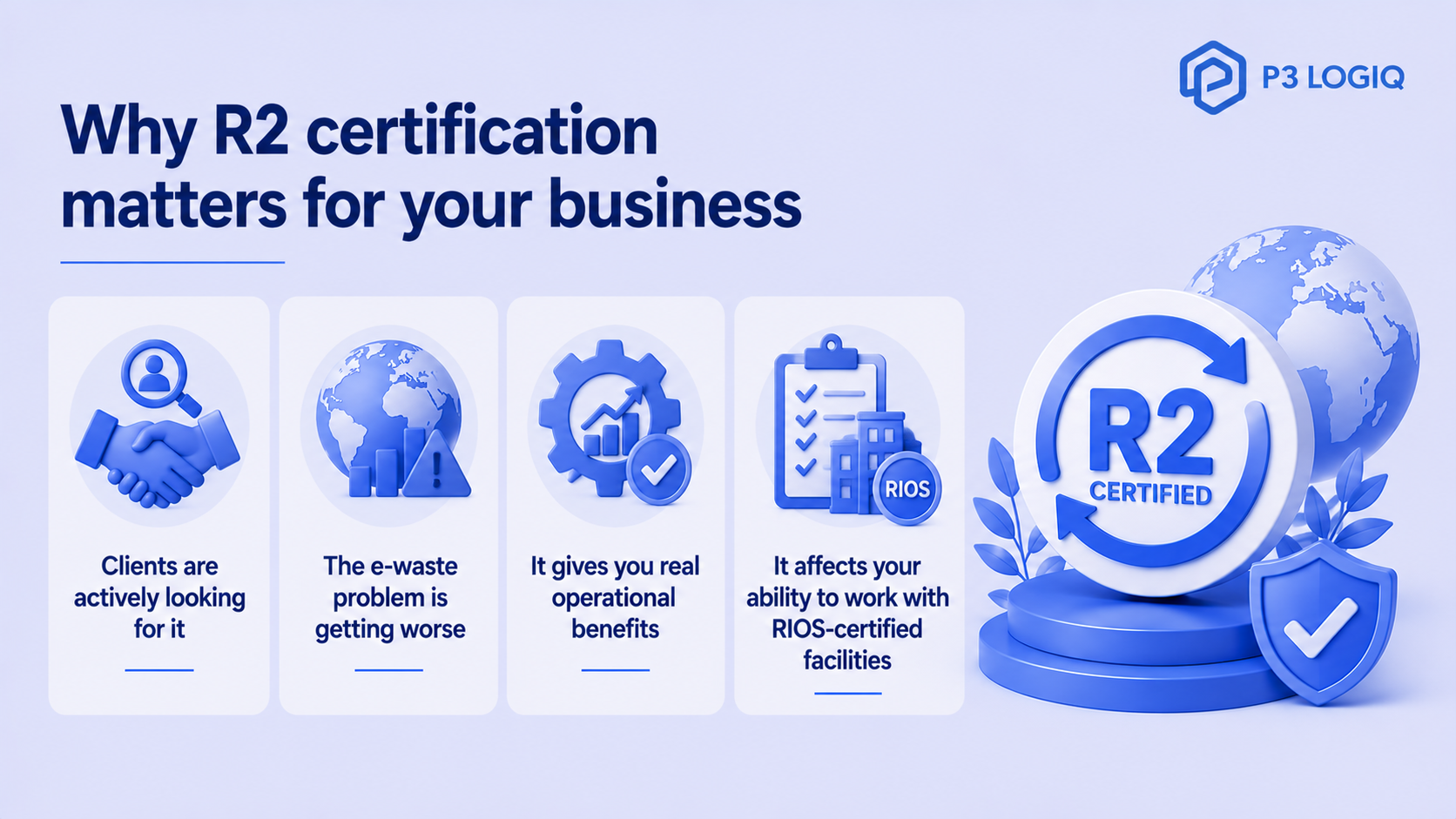
The honest answer is that R2 certification does two things at once. It makes your operation genuinely better, and it makes it easier to prove that to people who need to trust you. You know, such as for government tenders and whatnot.
Facilities that are R2 certified do their best in reducing risks and brand damage by making sure to go through audits, which are conducted by an accredited third-party CB.
The point of doing the audit is to make sure that these facilities are following the industry standards when it comes to data security, recycling best practices, and electronics sustainability.
When a company is disposing of 5,000 laptops, they're not just picking a vendor from a Google search. They're asking for certifications.
If you check out the 2024 Global E-waste Monitor report, you’ll find that in 2022, there were 62 million tons of e-waste generated, and out of that, only 22.3% were recycled.
So what happened to the rest?
The rest was either discarded or burned off.
You know what's concerning?
As per ScienceNews 2020 e-waste news, By 2030, it’s estimated that e-waste will reach 75 million metric tons annually worldwide! As that issue arises, the pressure on you as a recycler to follow the regulations will also increase.
To tackle all this, get yourself an R2 certification, and you’re golden. It puts you way ahead; you’ll already be following the requirements, and you’ll be prepared.
Trust me, the requirements that feel like extra paperwork usually end up improving your operation.
Tracking throughput helps you find inefficiencies.
Once you document safety procedures, you reduce the chances of accidents and liability.
Vendor due diligence protects you from problems your downstream partners create. These aren't just compliance checkboxes. They're how well-run recycling operations actually work.
If you're not familiar with RIOS, it's another important standard in the recycling industry that covers quality management, environmental management, and worker health and safety altogether. Many facilities pursue both R2 and RIOS. RIOS certification gives recycling businesses a competitive edge, you’ll be able to grasp the full picture of where the industry is heading.
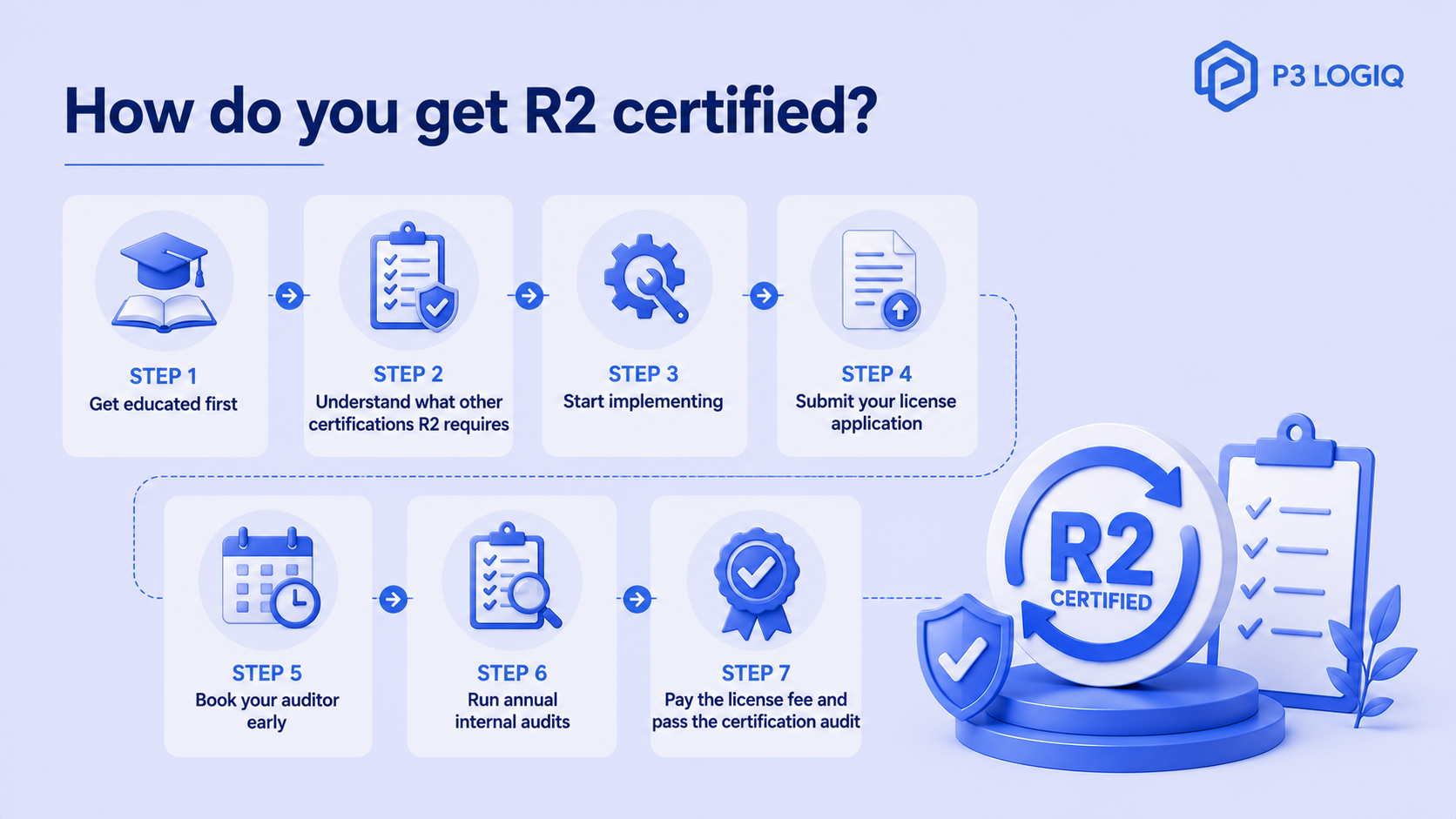
Here's the thing: a lot of businesses make this process way more complicated than it needs to be. Yes, it takes time. But the steps themselves are pretty straightforward once you know what they are.
SERI puts the whole certification timeline at 8 to 12 months for most companies. Some pull it off on their own. Most find it helpful to bring in a consultant, especially for the first time around. Either way, here's what the actual process looks like.
Before you do anything else, go to the R2 Knowledge Base on the SERI website. SERI has a free 90-minute intro webinar in the "Getting Certified" section that walks you through the R2 requirements, the steps, and what certification actually costs. Just start there. It'll save you a lot of confusion later.
You'll also want to download the R2v3 Standard document itself, the REC (Responsible Electronics Certification), and the R2v3 Code of Practices from the R2 Document Library. These are the actual requirements you'll be certified against. Read them properly.
This is something a lot of people don't realize upfront. R2 doesn't just ask you to meet its own requirements. It also requires you to hold other certifications alongside it.
Every R2 facility needs an Environmental, Health, and Safety (EH&S) management system certification.
You have two options here.
The first is ISO 14001 (environmental) combined with ISO 45001 (health and safety). Each standard costs around $150 USD to purchase, but keep in mind they typically require longer audit times, which can push your audit costs up.
The second option is the RIOS Standard, which combines environment, health, safety, and quality management into a single certification. RIOS has a $1,250 USD annual fee that decreases if you have multiple facilities. The upside is that auditing RIOS instead of multiple separate ISO standards can actually reduce your total audit time and cost.
If your facility does test and repair or brokering activities, you'll also need a quality management system certification. That means either ISO 9001 or RIOS (which already includes it if you went that route).
Good news: you can certify R2 and your EH&S certification during the same audit, which saves time and money.
This is where the actual work happens. Getting certified means documenting every process and procedure at your facility and weaving the R2 requirements into how you actually run things day to day.
Write down what you do. Build record systems to prove you're doing it. Make sure your team is trained and follows those documented processes consistently. Your auditor will expect real evidence, things like testing and data destruction records, material flow tracking, monitoring records, and proof of legality for any cross-border shipments.
Before your audit happens, you need to complete the online license application through SERI and pay the license application fee of $150. This step happens before your contract review with the certification body, so don't leave it until the last minute.
Schedule your audit with a SERI-approved certification body. This is important: Because CBs often book 4+ months ahead. If you wait until your documentation is "perfect" to reach out, you'll end up waiting a lot longer than you need to. Start that conversation early.
Before and after certification, you're required to conduct annual internal audits to assess your own conformance to R2 and any other required standards and to catch any gaps or corrective actions needed. Your internal auditors need to actually know the areas they're assessing. A lot of companies bring in a consultant for this too, and that's a completely normal approach.
Before your Stage 2 audit, you'll need to pay the annual SERI/R2 license fee of $2,500 USD. Then your CB conducts the registration audit, which comes in two stages: Stage 1 (documentation review) and Stage 2 (on-site facility audit).
After that, you'll need to pass an annual surveillance audit every year to keep your certification current.
On the cost side, SERI breaks it into three main things: the $2,500 annual R2 license, the $150 license application fee, any other required certifications (RIOS or ISO), and your audit fees.
Consulting costs are optional but worth factoring in if you're going through this for the first time.
The good news is that once you've built the documentation, the management system, and the habits around compliance, maintaining the certification year after year gets significantly easier than getting it the first time. That's especially true if you're using software that keeps your records organized in place and your audit trail clean throughout the year, rather than scrambling to pull everything together a few weeks before your auditor shows up.
As mentioned above, it can take you somewhere around 8 to 12 months. There is no specific time I can tell you because there are a lot of factors that play into this.
There’s a chance that a facility that already has strong documentation practices, trained staff, and a working management system might move through in 6 months or less.
A facility that's essentially starting from zero on all of those fronts could take longer, especially if significant process changes need to happen.
The size of your company as well as the branches that you have also makes a huge difference too.
The honest truth is that most of the time goes into preparation, not the actual audit. The audit itself is usually a few days. Getting your systems and documentation to the point where they'll hold up under scrutiny is where the months go.
Using software that tracks your compliance status in real time, rather than trying to manage it all on spreadsheets, removes a lot of the delay and confusion from that preparation phase. That's exactly what tools like P3 LogiQ's risk management module are built to help with.
People often ask about this. Both are recycling standards. Both are relevant to the e-waste industry.
They're not the same thing. I’ll explain the difference to you.
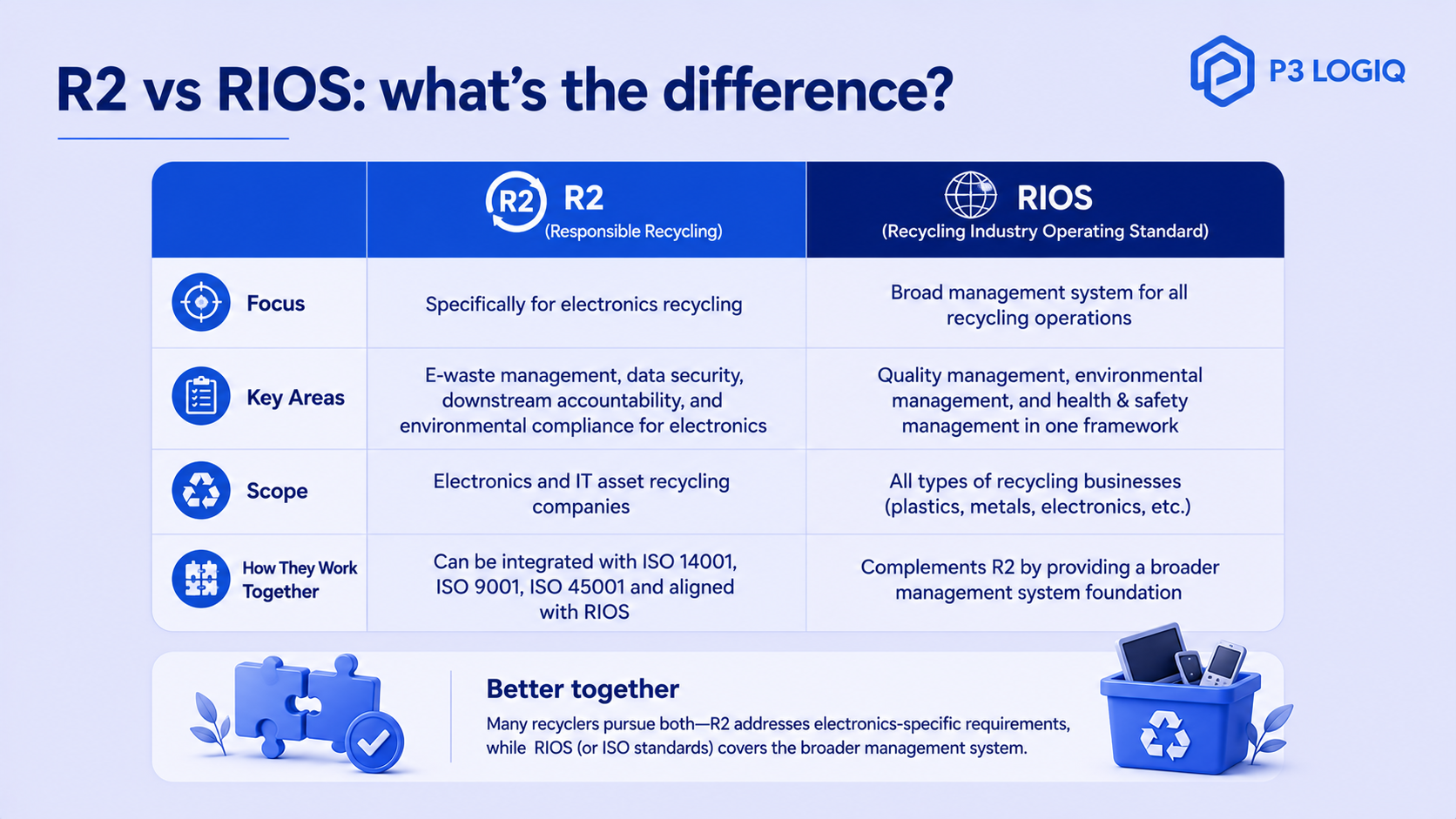
R2 is specifically towards electronics recycling. It focuses on things I mentioned such as e-waste management, data security, downstream accountability, and environmental compliance in the context of electronics.
RIOS is a broader integrated management system standard that focuses and combines quality management, environmental management, and health and safety management into one single framework. It's designed for recycling businesses across all material types, not just electronics.
What’s great is that there is compatibility; what I mean is with R2, you can integrate it with ISO 14001 certification for environmental management, ISO 9001 certification for quality management, ISO 45001 certification for occupational health and safety, and the R2v3 can be aligned with RIOS for quality, environmental, and health and safety management and so on.
Many electronics recyclers pursue both because they complement each other very well.
R2 handles the electronics-specific requirements, while RIOS or ISO standards cover the broader management system requirements. Understanding RIOS certification for workplace safety will give you a broader picture.
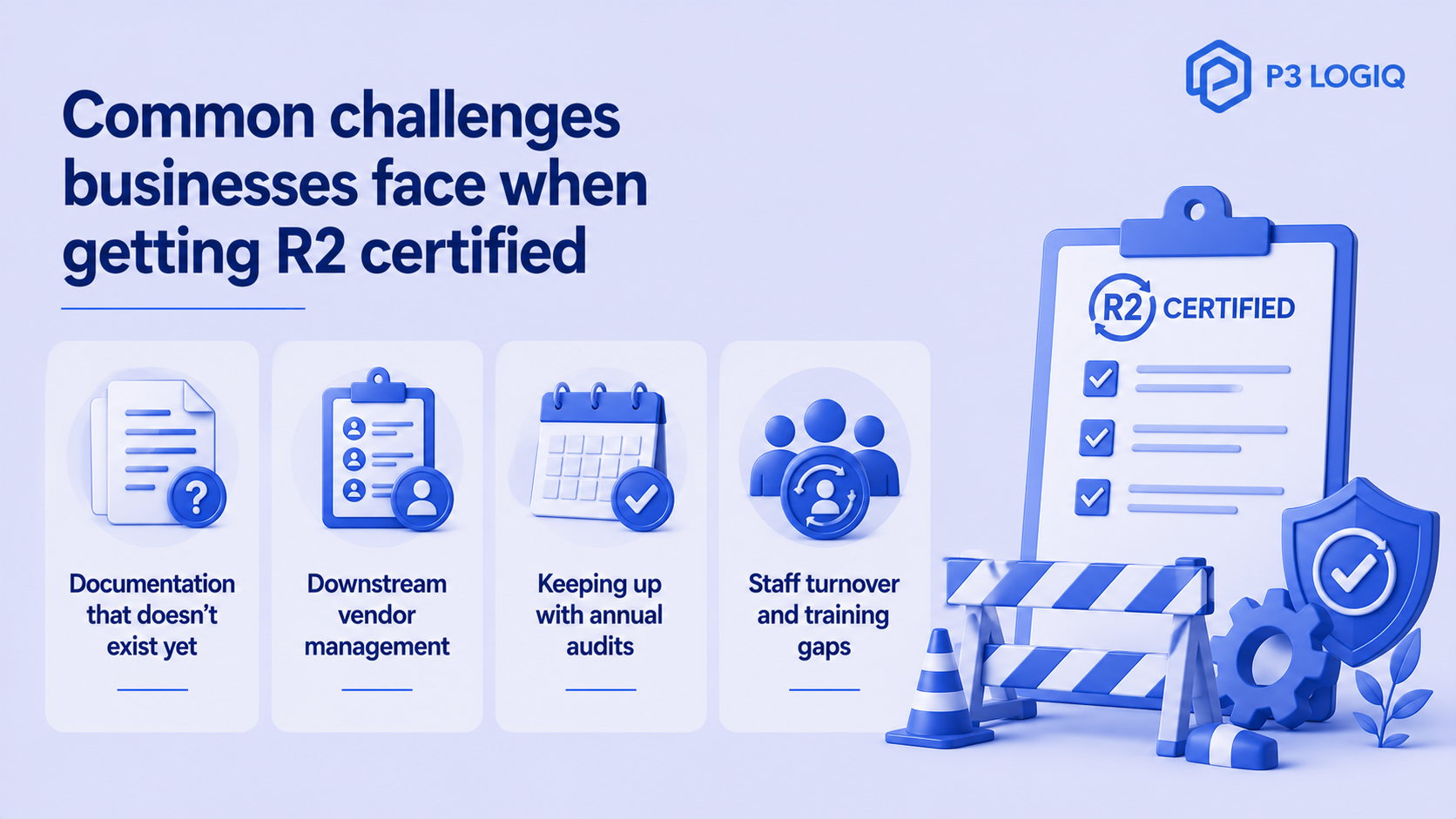
It would be dishonest of me to present R2 certification to you as a smooth, painless process. Most businesses run into at least a few of these:
R2 requires thorough documentation of your processes, your training, your vendor relationships, and your material flows. A lot of businesses have these processes in place but haven't written them down in a way that's auditable. Creating that documentation from scratch takes significant time and careful thought. If you have some of the best document management systems for R2 and ISO up your sleeve, it becomes a real asset for you here.
You might run a tight, compliant operation. But R2 holds you responsible for your downstream vendors too. Verifying their certifications, maintaining records of your due diligence, and having a plan for what you do if a vendor loses their certification are all things you need to manage. This is one of the areas where most first-time R2 applicants find they're underprepared.
Getting certified is one thing. Staying certified is another.
Your documentation, training, and operational practices need to stay current all year, not just in the weeks before an audit. Building best practices for staying R2 certified long-term into your routine is what separates facilities that maintain their certification easily from those that scramble every single year.
Your certification is only as strong as your team's knowledge.
When staff turn over, training records need updating fast. New employees need to be up to speed before they're working independently with regulated materials or data-bearing equipment. That can't live in a folder of old slides. It needs a real, ongoing system.
Documentation gaps are the #1 reason facilities fail R2 audits
P3 LogiQ keeps your records organized, up to date, and audit-ready so you never get caught off guard.
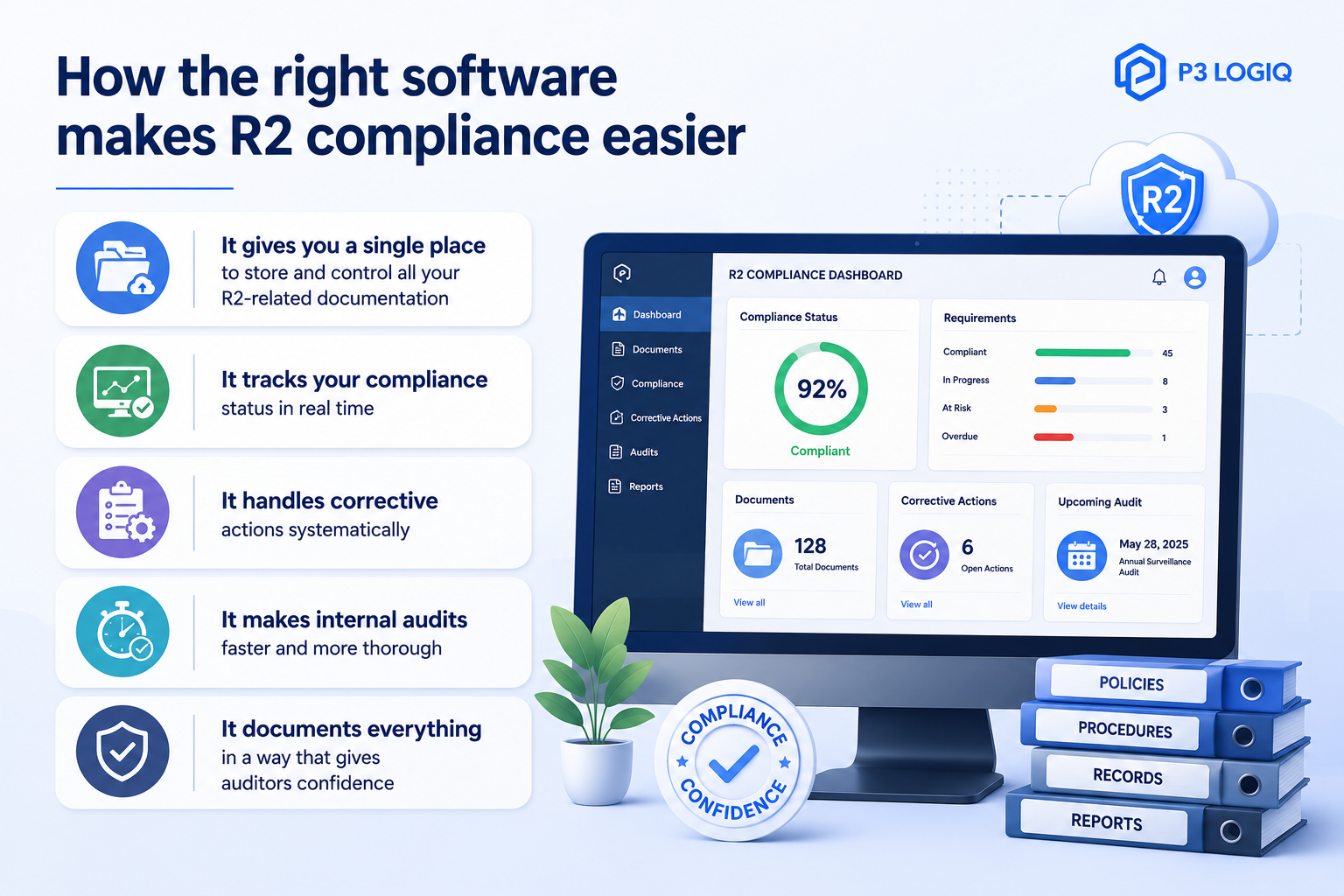
There's a reason so many R2-seeking facilities end up using compliance management software. Managing R2 manually is genuinely hard. The number of moving parts, documents, vendor records, audit trails, training logs, and corrective actions is too much to keep organized across spreadsheets without things falling apart.
What good compliance software actually does:
When an auditor asks for a specific record, you can find it in seconds rather than digging through folders for an hour.
You're not waiting for a quarterly review to find out you have a problem. You see issues as they emerge.
When something goes wrong, whether that's a nonconformance found in an internal audit, a supplier falling out of compliance, or a training record expiring, the system flags it, assigns it, and tracks it to resolution.
Running regular internal audits is one of the most effective ways to stay ready for external ones. When you use some of the top compliance management tools designed specifically for standards like R2, your internal audits actually catch things instead of just checking a box.
A clean, organized management system signals to an auditor that your operation is under control. A pile of disconnected spreadsheets sends the opposite signal.
The best options on the market are purpose-built for R2 and all. If you're not sure what to look for, the guide on choosing the right compliance management software for your business covers the key features and questions worth asking before you commit to a platform.
R2 certification isn't just a piece of paper you hang on the wall. You document it; you independently verify your commitment that your facility handles electronics responsibly at every stage, from intake to final destination.
For your clients, it's the proof they need to trust you with their data and their environmental responsibilities.
For your team, it's a structure that makes day-to-day operations safer and more organized.
For your business, it opens doors with buyers who ask the question before they sign anything.
From what I see, it’s a win-win-win situation for everyone!
But this process takes time and real effort. But businesses that go through it consistently report that the operational improvements alone make it worthwhile, separate from any client or marketing benefit.
If you want to see exactly how P3 LogiQ helps electronics recyclers and compliance-driven organizations achieve and maintain R2 certification without drowning in documentation.
You can book a demo with us for a walk through the platform. Or if you'd rather explore on your own first, you can sign up and see what our platform looks like from the inside.
R2 certification, short for Responsible Recycling, is a standard that is for electronics recycling facilities. It’s also recognized internationally as well. It verifies through independent third-party audits that a facility handles e-waste safely, protects data, keeps workers safe, and manages downstream vendors responsibly.
SERI-accredited third-party certification bodies issue the R2 certificate. You see, SERI develops and maintains the standard as a non-profit but doesn't audit anyone itself. It's independent auditors, approved by SERI, who go in, check your facility, and decide if you qualify.
Not legally, no. R2 certification is voluntary for you. But the US EPA has formally endorsed R2 as a recommended standard for electronics recyclers. Also, large companies and government buyers use it as a requirement before engaging in doing business. So you are missing out on not getting R2 certified.
Most facilities take 8 to 12 months to achieve R2 certification from the point they begin preparing. The timeline depends on how much existing documentation and process infrastructure is already in place. Facilities with strong compliance foundations tend to move faster.
Costs depend on your facility size, scope, and the CB. The fixed costs are the $2,500 annual R2 license and the $150 license application fee. You'll pay for any required companion certifications like RIOS or ISO, plus audit fees. Consulting is optional but common for first-timers.
A SERI-approved auditor reviews your documentation, policies, procedures, training records, and vendor compliance records in Stage 1. Stage 2 is an on-site inspection of your facility's actual operations. Any nonconformances found must be fixed before you receive certification. Annual surveillance audits are then required every year after that.
Yes, absolutely. R2 certification isn't just restricted to size or for the “big leagues." Smaller operations sometimes find documentation requirements tough without software support, but the certification is fully accessible to them. Costs and timelines are also generally more manageable at a smaller scope, which works in their favor.
R2 certification is valid for three years, but it's not a set-it-and-forget-it situation. You're required to pass annual surveillance audits every year within that period to keep your certification active. After three years, a full recertification audit is needed to renew it.
Head straight to the SERI website. They keep a searchable database of every currently certified facility, including the facility name, location, what scope they're certified for, and when the certificate expires. Always verify through SERI directly rather than just taking a vendor's word for it.
You can lose your R2 certification if you do not continue meeting the standard and renew on an annual basis. In case you have nonconformities that are serious, you will need to get it corrected ASAP within the timeframe or you can get your certification suspended by the CB.


Businesses need document management systems (DMS) to ensure ISO and R2 compliance, improve efficiency, and stay audit-ready. The article highlights key features like version control, security, and automation while reviewing the top 5 DMS solutions. P3 LogiQ stands out for its compliance-focused automation and secure document tracking
Read More
Recycling businesses gain efficiency, compliance, and sustainability with RIOS certification. It streamlines quality management, environmental responsibility, and worker safety, helping companies avoid legal risks and boost credibility. P3 LogiQ simplifies the certification process with automation, document control, and compliance tracking, making operations smarter and safer.
Read More
Audit Management Software (AMS) automates compliance tracking, streamlines workflows, and reduces audit risks. Key features include automated scheduling, compliance checklists, CAPA tracking, vendor risk management, and integrations.
Read More
Learn how audit management systems simplify ISO and R2 compliance by automating audits, managing documentation, and minimizing compliance risks efficiently.
Read More
In 2025, many businesses still face challenges in compliance management due to outdated methods like spreadsheets and fragmented software. This inefficiency leads to missed deadlines, increased risk, and regulatory penalties. The blog emphasizes the importance of modern compliance tools that automate workflows, enhance risk management, and streamline regulatory processes to meet ISO and R2 standards.
Read More
The rise in e-waste and environmental concerns makes responsible electronics recycling essential. The R2 Certification sets a global standard for safe, sustainable, and data-secure recycling practices. Developed by Sustainable Electronics Recycling International (SERI), R2 helps businesses manage environmental risks, data security, worker safety, and legal compliance.
Read More
Businesses face increasing challenges in managing complex regulatory compliance. Manual methods such as spreadsheets and paperwork can lead to missed deadlines, inefficiencies, and costly penalties. Compliance management software offers a streamlined solution to reduce risks, automate processes, and improve operational efficiency.
Read More
Maintaining R2 Certification is crucial for businesses in the e-waste recycling industry, ensuring regulatory compliance, sustainability, and strong stakeholder trust. This guide outlines 10 best practices to help businesses simplify operations, reduce risks, and stay compliant.
Read More
Unlock the value of ISO risk management certification. Explore its impact on compliance, risk mitigation, and business expansion.
Read More
Explore the top 5 ISO risk management software tools for 2025, including document management solutions for streamlined compliance and increased efficiency.
Read More
Find the ideal document management software (DMS) for your business. Learn how to choose with expert tips, key features, and insightful guidance
Read More
Unlock the power of a Document Management System (DMS). Learn how it can revolutionize your business operations.
Read More







.png)


.png)




.jpg)



.jpg)
.jpg)









.jpg)


.png)

.png)
.png)



.png)

