.jpg)
.png)
According to SERI’s first R2 Impact Measurement Report, R2 Certified facilities processed more than 657,000 metric tonnes of used electronics globally in 2024. The report highlights the growing scale of responsible electronics reuse, refurbishment, and recycling across the industry.
Behind every refurbished laptop, recycled circuit board, and recovered component is a detailed compliance trail. This is where R2 Certification becomes important.
Think of R2 Certification like a vehicle safety inspection. A car is not approved because the exterior looks polished. Inspectors check critical systems such as the engine control unit (ECU), braking system, suspension, airbags, and emissions controls to confirm the vehicle meets safety requirements.
R2 works in a similar way for electronics recyclers and ITAD companies. The certification looks beyond basic recycling claims. It checks whether organizations have proper controls for data destruction, environmental practices, worker safety, downstream vendor management, and material tracking.
As electronics volumes continue to grow, businesses need stronger visibility into their recycling processes. This makes understanding the actual cost of compliance more important.
The cost of R2 Certification is not limited to the certification audit alone. Organizations must also consider SERI licensing fees, audit expenses, documentation, employee training, process improvements, and ongoing compliance activities.
In this guide, we break down the complete R2 Certification cost in 2026, including major expenses, hidden costs, and factors that influence the overall investment.
We will also look at how R2 compliance software can help teams organize compliance records, track workflows, and maintain better visibility into their ongoing requirements.

When I look at how R2 certification projects typically unfold across the US recycling and IT asset disposition space, I consistently see the same cost structure patterns.
In 2026, R2 certification costs generally range between $15,000 and $50,000 USD for small to mid-sized facilities in the first year. Larger multi-site organizations or facilities with complex processing scopes may exceed $60,000 USD, depending on operational complexity, existing compliance maturity, and certification requirements.
Smaller electronics recyclers with simpler operations usually stay toward the lower end of this range. Larger IT asset disposition (ITAD) organizations with multiple facilities, complex downstream networks, and broader processing scopes tend to fall toward the higher end.
From a system perspective, the certification fee is only one part of the overall cost. Most organizations also account for gap assessments, documentation preparation, employee training, compliance system setup, process improvements, and ongoing maintenance.
Here is how the typical cost structure is usually distributed:
Note: Total annual R2 certification maintenance costs can be higher when including internal audits, employee training, documentation updates, compliance activities, and consulting support. Many organizations may spend approximately $12,000–$35,000 USD annually depending on facility size and operational complexity.
In most real-world cases, final cost depends heavily on how prepared an organization is before starting the R2 certification process. Facilities already running structured ISO-based systems such as ISO 9001 or ISO 14001 usually require fewer system adjustments compared to organizations building compliance frameworks from scratch.
When I break down R2 certification cost structures across different organizations in this space, I always map it back to how the system is built and maintained over time. It is never a single expense. It is a combination of structured cost categories tied to preparation, verification, and ongoing compliance.
The certification audit is one of the largest mandatory cost components in the process.
Accredited certification bodies such as SCS Global Services, NSF International, and TÜV Rheinland conduct the formal R2 certification audit in two stages:
During this process, auditors evaluate environmental controls, data security systems, downstream vendor management, and health and safety compliance across operations.
In practical terms, this is a full system verification where processes must be demonstrated with evidence, not just documented. Proper R2 audit preparation helps organizations identify gaps early and reduce unexpected compliance issues during certification.
Most organizations typically see audit costs in the range of $5,000 to $15,000 USD, depending on facility size, number of locations, and operational complexity. Multi-site or higher-risk operations generally require more audit effort due to expanded scope.
In many cases across the industry, organizations rely on external expertise to align their internal systems with R2 requirements.
This category typically includes:
Costs generally range from $8,000 to $35,000 USD for many small to mid-sized organizations, depending on operational complexity, existing management systems, documentation readiness, and the level of implementation support required. Larger multi-site programs may require higher consulting investment.
This is one of the most underestimated cost areas in R2 certification.
Even without external consulting or advisory support, organizations still invest significant internal resources to achieve compliance readiness. This includes:
In most facilities, this represents a real operational shift where internal capacity is redirected toward building and maintaining compliance systems.
Internal labor is also a significant part of the overall investment. Depending on facility size, organizations may spend approximately $5,000–$30,000+ USD in internal labor costs during initial certification preparation. This includes employee time spent on documentation, training, process updates, audit preparation, and compliance coordination.

When I work with recycling and IT asset disposition (ITAD) teams in the US, I always clarify one point early. The total R2 certification cost is not a single line item. It is a combination of audit, preparation, implementation, and ongoing compliance expenses that come together over time.
R2 is developed by Sustainable Electronics Recycling International (SERI) and is audited through accredited certification bodies such as SCS Global Services, NSF, and TÜV Rheinland. These organizations do not just “approve” a facility. They verify whether your operating system meets the requirements of the R2 Standard.
From a practical standpoint, here is what is typically included in the cost structure:
This is the primary external certification cost.
Accredited certification bodies such as SCS Global Services or NSF International conduct a two-stage audit process:
The auditors evaluate environmental controls, data security processes, downstream vendor management, and health and safety systems.
In practice, this is similar to an independent regulatory inspection where every process must be demonstrated, not just described.
Before certification, most organizations require a structured gap assessment.
This is where current operations are mapped against R2 requirements to identify missing controls or documentation. For many facilities, this step determines how much rework is needed before the formal audit.
I usually compare this to a DOT pre-inspection in logistics operations. It is a structured check before the official review.
This is often the most operationally intensive part of the process.
It typically includes:
In many US-based ITAD and recycling companies, internal teams are already running daily operations, so external support is commonly used to align existing processes with R2 requirements.
This category is often overlooked because it does not always appear as a direct invoice.
It includes internal labor and operational adjustments such as:
Even when no external consultant is involved, these internal efforts still represent a real cost in time and resources.
R2 requires employees to understand and consistently follow the procedures that apply to their role. Training is not a one-time activity. In most facilities, especially those operating multiple shifts, employees receive ongoing training to stay aligned with changing processes, safety requirements, and compliance expectations.
Training commonly covers:
Documentation forms the foundation of your R2 management system. During certification and surveillance audits, you need to demonstrate that policies, records, and operational evidence are accurate, up to date, and easy to retrieve.
This typically includes policies and procedures, environmental and safety records, downstream vendor agreements, asset tracking logs, and audit evidence.
Many organizations use compliance systems or structured software platforms to manage this.
At P3 LogiQ, we often see companies move away from spreadsheets into centralized compliance workflows. Choosing the top document management systems for R2 helps organizations maintain accurate records and stay audit-ready.
After initial certification, facilities are subject to ongoing surveillance audits conducted by certification bodies such as SCS Global Services, NSF, or similar accredited providers.
These audits confirm continued compliance with the R2 Standard and review any operational changes since the previous audit cycle.
SERI requires licensed participation in the R2 program. This includes application and annual licensing fees that are separate from certification body charges.
These fees support the administration of the R2 program and the maintenance of the standard framework.
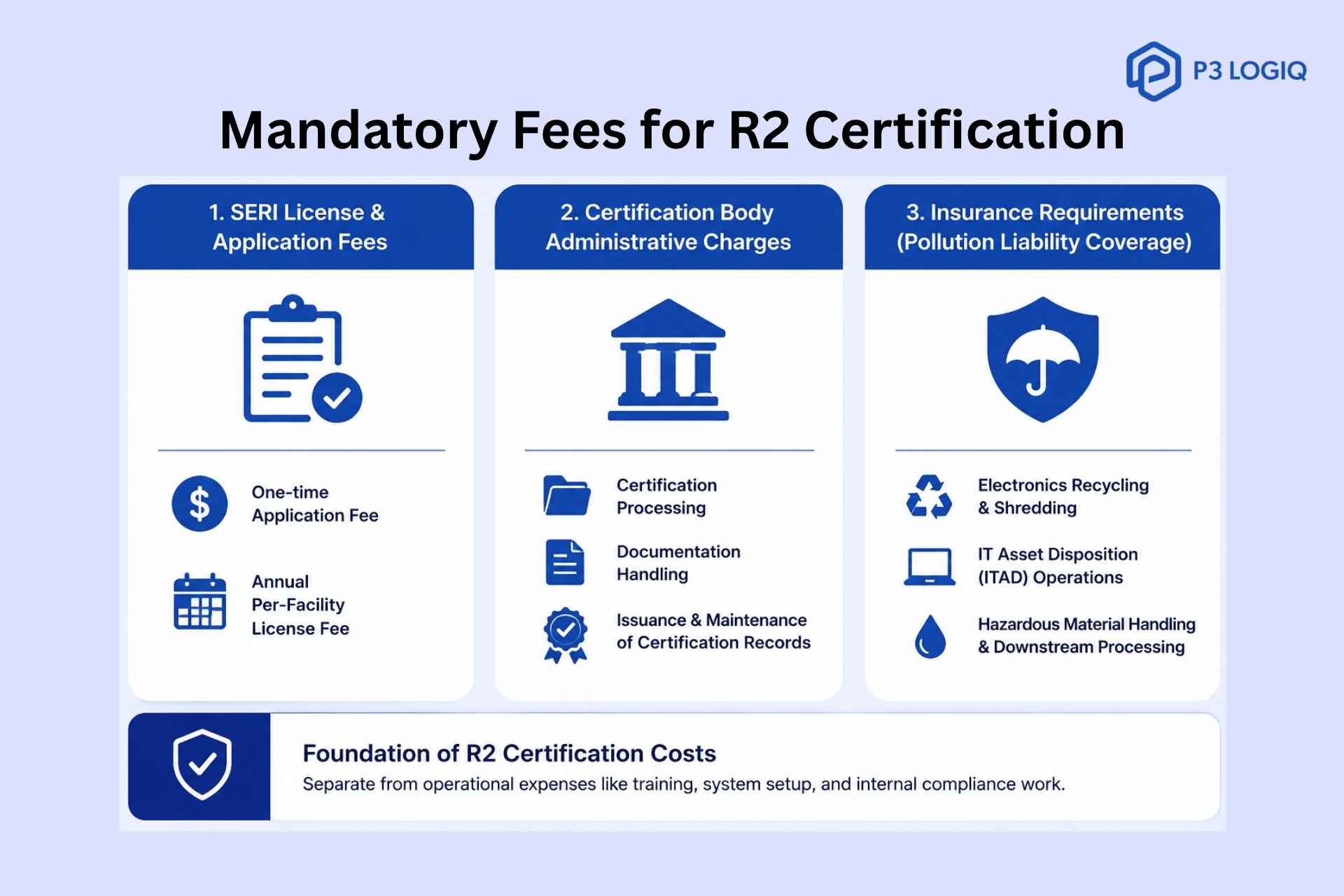
In every R2 certification setup across the US electronics recycling and ITAD industry, there is a baseline set of mandatory fees that sit outside operational or implementation costs. These are fixed program-level requirements defined under the R2 framework managed by Sustainable Electronics Recycling International (SERI).
These costs apply to every facility, regardless of size, maturity, or operational model.
Here is how I typically break them down:
Every facility entering the R2 program is required to hold an active SERI license. This is the formal entry point into the certification system.
It generally includes:
These fees are administrative in nature and support the governance and maintenance of the R2 standard across the industry.
In addition to SERI licensing fees, you'll also pay administrative charges to an accredited certification body, such as SCS Global Services, NSF International, or TÜV Rheinland. These fees are separate from the audit itself and cover activities such as certification processing, documentation handling, and the issuance and maintenance of certification records.
Many R2-certified facilities also maintain pollution liability insurance as part of their compliance program. This is especially important for organizations involved in electronics recycling, IT asset disposition (ITAD), hazardous material handling, or downstream processing.
Insurance costs vary based on your facility's size, operational risks, and the types of materials you process. While the exact cost differs for every organization, it's generally considered an essential part of maintaining R2 compliance.
These mandatory fees sit at the foundation of R2 certification costs, separate from operational expenses like training, system setup, and internal compliance work.
Keeping this layer distinct helps organizations clearly understand the baseline cost of entering and maintaining the R2 program, independent of how their internal systems are structured or scaled.

The certification body audit is one of the main expenses included in your R2 certification cost.
Unlike SERI licensing fees, audit pricing varies based on your facility size, number of locations, certification scope, and operational complexity. A small recycler with one facility will typically have a lower audit cost compared to a large IT asset disposition (ITAD) company managing multiple sites and complex processing activities.
For most small to mid-sized organizations, R2 certification audit fees generally range between $5,000 and $15,000 USD.
The final cost may include:
Larger facilities or organizations with multiple locations may have higher audit costs due to additional audit time and broader certification scope. Understanding audit management systems for R2 compliance can help organizations improve audit readiness and manage compliance records more effectively.
The main factors that affect audit pricing include:
Planning for these factors early helps you estimate your R2 certification investment more accurately.
Getting R2 certified requires more than completing an application and scheduling an audit. Organizations need to build processes, maintain documentation, train employees, and show evidence that their compliance system is working.
Some companies choose to work with external R2 consultants for implementation support, while others manage the process internally using their own teams and compliance tools.
The cost of implementation support can vary widely depending on the size of your operation, current processes, and the level of assistance required.
For many small to mid-sized organizations, R2 implementation support may range from $15,000 to $50,000 USD. Larger or multi-site operations may exceed this range.
This cost may include activities such as:
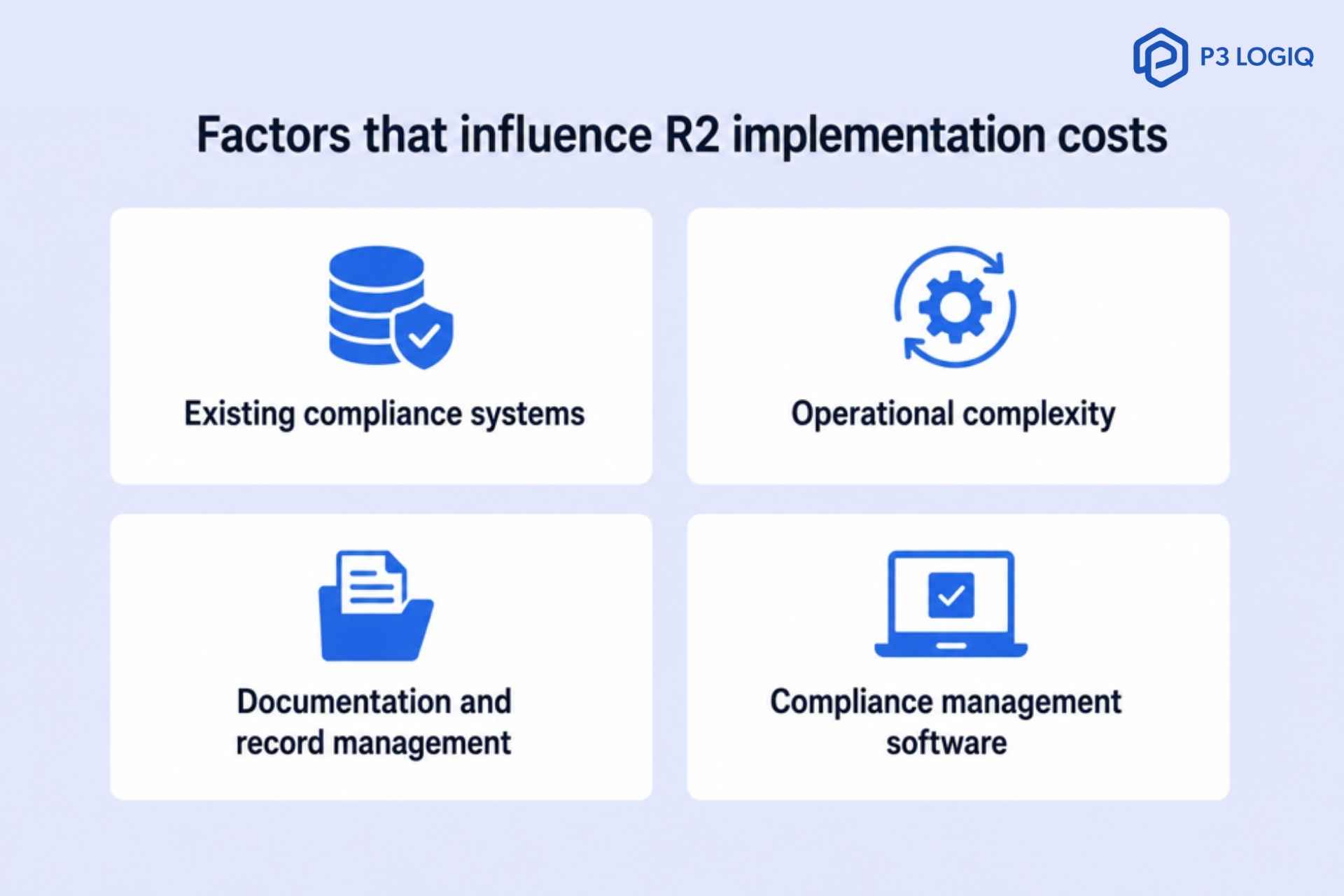
The amount you spend on implementation depends on where your organization starts.
Companies with structured management systems, such as ISO-based processes, may already have documentation and process controls in place, reducing the amount of additional work required.
A simple recycling operation usually requires fewer process changes compared to an ITAD company managing data destruction, refurbishment, multiple facilities, and downstream partners.
R2 requires organizations to maintain reliable records in areas such as material tracking, environmental controls, employee training, and downstream management.
Many organizations use compliance management software to organize these requirements, track actions, and maintain ongoing visibility across their R2 program. Choosing the right compliance software can help teams identify solutions that support compliance workflows, documentation, audits, and corrective actions in one centralized system.
Platforms like P3 LogiQ help teams manage compliance workflows, documentation, audits, and corrective actions in one centralized system.
Understanding implementation costs early helps you decide whether you need external support, internal resources, or a combination of both to achieve and maintain R2 certification.

Once your organization is ready for certification, the R2 audit process typically happens in two main stages.
Stage 1 focuses on reviewing your documented R2 system and checking whether your organization is prepared for the full certification audit.
During this stage, the auditor typically reviews areas such as:
The goal is to identify any major gaps before moving to the on-site evaluation.
Stage 2 is where the certification body evaluates how your R2 processes work in practice.
The auditor reviews your facility operations, records, and evidence to confirm that your documented processes are being followed.
This may include reviewing:
If any non-conformities are identified, your team will need to address them before certification can be granted.
A well-organized compliance system makes this process easier by helping teams maintain accurate records, track corrective actions, and keep important information accessible when needed. Understanding the features of effective audit management software can help organizations improve audit preparation, manage compliance activities, and stay ready for certification reviews.
For many electronics recyclers and IT asset disposition (ITAD) companies, R2 certification can be a valuable investment because it demonstrates responsible handling of electronic equipment, data security practices, and environmental controls.
The value of R2 certification goes beyond meeting a standard. It can help organizations:
Many organizations choose R2 certification because customers increasingly want proof that their electronics are being handled responsibly.
Think of R2 certification like a quality stamp for your recycling operations. It shows that your processes have been reviewed against an established industry standard and that you have systems in place to manage compliance.
The return on investment depends on your business goals, customer requirements, operational maturity, and how effectively you maintain your compliance program over time.

The cost of R2 certification can vary significantly depending on the size and complexity of your operation.
A small recycler and a large ITAD provider may follow the same R2 standard, but their certification investment will look very different.
Smaller recyclers usually have fewer employees, fewer locations, and simpler workflows. Their main costs often come from documentation, training, certification audits, and improving existing processes.
Medium-sized organizations often have more complex operations, additional processing activities, and larger teams. They may need stronger tracking systems and more structured compliance management.
Large ITAD companies or multi-location recyclers typically have higher costs because they manage more processes, facilities, employees, and downstream relationships.
Following the best practices for staying R2 certified helps organizations of all sizes maintain compliance, improve visibility into their requirements, and reduce manual tracking challenges.
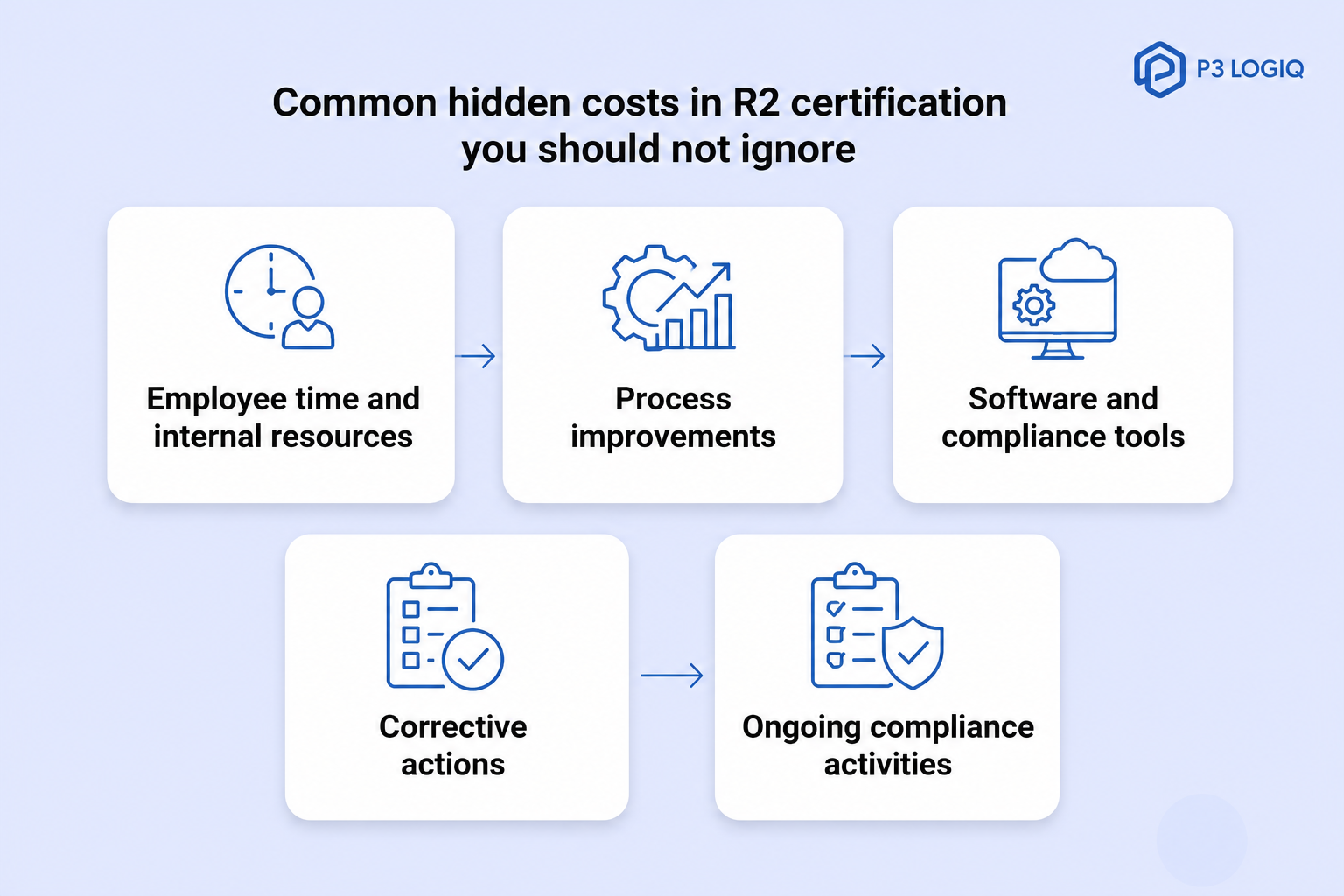
Many organizations focus only on audit fees when estimating R2 certification costs. However, several additional expenses can affect your total investment.
Common hidden costs may include:
Your team will need time to review requirements, update processes, maintain records, and support certification activities.
Some organizations discover they need improvements in areas such as documentation, tracking systems, data security controls, or operational procedures.
Managing R2 requirements through spreadsheets and disconnected files can become difficult as your program grows. Evaluating compliance management software features can help organizations identify tools that centralize documents, workflows, training records, and corrective actions.
If gaps are identified during the audit, addressing those issues may require additional time, resources, or process updates.
Maintaining R2 certification requires continuous monitoring, record-keeping, internal reviews, and process improvements.
Planning for these costs upfront helps you avoid unexpected expenses after starting the certification process.
Getting R2 certification involves more than just paying the audit fee. Your total R2 certification cost depends on several factors, including your facility size, operational complexity, certification scope, how prepared you are, implementation needs, and ongoing compliance requirements.
Your R2 certification budget may include certification body audit fees, SERI licensing costs, documentation, employee training, process improvements, and compliance management. Understanding these costs upfront can help you plan a more realistic budget and avoid unexpected expenses during the certification process.
The right compliance management system can also make ongoing R2 compliance much easier to manage. Instead of tracking requirements across spreadsheets, emails, and separate documents, organizations can use compliance management software to organize R2 activities, maintain records, track corrective actions, and keep their entire compliance program in one place.
At P3 LogiQ, we help organizations simplify compliance management by bringing documentation, workflows, corrective actions, audits, and other compliance activities into one platform. Whether you’re preparing for R2 certification or managing an existing compliance program, P3 LogiQ gives your team the tools and visibility to stay organized and keep compliance on track.
Ready to make your R2 certification process easier to manage?
Book a demo with us and see how a centralized compliance platform can help you manage R2 requirements more efficiently.
Sign up with us today and take control of your compliance workflows with a system built for modern organizations.
The average cost of R2 certification in 2026 usually ranges from $15,000 to $50,000 USD for the first year. The final investment depends on facility size, certification scope, audit fees, implementation needs, employee training, documentation requirements, and ongoing compliance maintenance activities.
The total R2 certification cost includes certification body audit fees, SERI licensing fees, implementation expenses, employee training, documentation updates, process improvements, compliance software, and ongoing maintenance activities. The exact cost varies based on your organization’s current processes, facility operations, and readiness level before certification.
R2 certification audit costs typically range between $5,000 and $15,000 USD for many small to medium-sized organizations. The final audit cost depends on factors such as facility size, number of locations, certification scope, employee count, operational complexity, and the amount of evidence requiring review. Larger or multi-site facilities may have higher audit costs due to additional audit time and broader certification requirements.
Yes, SERI charges licensing fees for facilities pursuing R2 certification. Organizations must pay an application fee and an annual license fee to maintain their R2 certification status. These fees are separate from certification body audit costs and any internal implementation expenses required to meet R2 requirements.
R2 certification cost depends on several factors, including facility size, number of locations, employee count, certification scope, operational complexity, existing compliance systems, and documentation readiness. Organizations with structured processes usually require fewer improvements compared to companies building their compliance framework from the beginning.
Maintaining R2 certification requires ongoing compliance costs like audits, training, and licensing. Annual maintenance expenses vary by facility resources. Expect surveillance audit fees between $3,000 and $8,000 USD. Total yearly maintenance activities, including internal reviews and consulting support, typically range from $12,000 to $35,000 USD.
R2 certification can be valuable for electronics recyclers and ITAD companies that want to demonstrate responsible recycling practices, strengthen customer trust, and improve operational controls. The return depends on business goals, customer requirements, compliance needs, and how effectively the organization manages its certification program.
Yes, small companies can pursue R2 certification by planning their investment carefully and understanding their specific requirements. Costs may be lower for smaller facilities with limited operations, fewer locations, and existing processes. Using structured compliance tools can also help simplify ongoing management and reduce administrative effort.
Compliance software can help organizations manage R2 requirements more efficiently by organizing documents, tracking corrective actions, maintaining records, and improving visibility into compliance activities. While software does not replace certification requirements, it can reduce manual work and help teams maintain a more organized compliance program.
The timeline for achieving R2 certification varies based on your organization’s readiness, operational complexity, and required improvements. Many companies spend several months preparing documentation, implementing processes, training employees, and completing audits before receiving certification from an approved certification body.



Businesses need document management systems (DMS) to ensure ISO and R2 compliance, improve efficiency, and stay audit-ready. The article highlights key features like version control, security, and automation while reviewing the top 5 DMS solutions. P3 LogiQ stands out for its compliance-focused automation and secure document tracking
Read More
Recycling businesses gain efficiency, compliance, and sustainability with RIOS certification. It streamlines quality management, environmental responsibility, and worker safety, helping companies avoid legal risks and boost credibility. P3 LogiQ simplifies the certification process with automation, document control, and compliance tracking, making operations smarter and safer.
Read More
Audit Management Software (AMS) automates compliance tracking, streamlines workflows, and reduces audit risks. Key features include automated scheduling, compliance checklists, CAPA tracking, vendor risk management, and integrations.
Read More
Learn how audit management systems simplify ISO and R2 compliance by automating audits, managing documentation, and minimizing compliance risks efficiently.
Read More
In 2025, many businesses still face challenges in compliance management due to outdated methods like spreadsheets and fragmented software. This inefficiency leads to missed deadlines, increased risk, and regulatory penalties. The blog emphasizes the importance of modern compliance tools that automate workflows, enhance risk management, and streamline regulatory processes to meet ISO and R2 standards.
Read More
The rise in e-waste and environmental concerns makes responsible electronics recycling essential. The R2 Certification sets a global standard for safe, sustainable, and data-secure recycling practices. Developed by Sustainable Electronics Recycling International (SERI), R2 helps businesses manage environmental risks, data security, worker safety, and legal compliance.
Read More
Businesses face increasing challenges in managing complex regulatory compliance. Manual methods such as spreadsheets and paperwork can lead to missed deadlines, inefficiencies, and costly penalties. Compliance management software offers a streamlined solution to reduce risks, automate processes, and improve operational efficiency.
Read More
Maintaining R2 Certification is crucial for businesses in the e-waste recycling industry, ensuring regulatory compliance, sustainability, and strong stakeholder trust. This guide outlines 10 best practices to help businesses simplify operations, reduce risks, and stay compliant.
Read More
Unlock the value of ISO risk management certification. Explore its impact on compliance, risk mitigation, and business expansion.
Read More
Explore the top 5 ISO risk management software tools for 2025, including document management solutions for streamlined compliance and increased efficiency.
Read More
Find the ideal document management software (DMS) for your business. Learn how to choose with expert tips, key features, and insightful guidance
Read More
Unlock the power of a Document Management System (DMS). Learn how it can revolutionize your business operations.
Read More









.png)



.jpg)



.jpg)
.jpg)









.jpg)


.png)

.png)
.png)



.png)

