.jpg)

Aerospace manufacturing leaves no room for quality failures. A single defect can disrupt production, delay deliveries, and damage customer trust. That's why ISO 9001 for aerospace provides a strong foundation for consistent quality, effective risk management, and controlled processes.
Many aerospace organizations also adopt AS9100 to meet industry-specific requirements. However, ISO 9001 remains the starting point for building a reliable quality management system.
The 9001 compliance software can help organizations manage documentation, processes, audits, and corrective actions more efficiently.
This blog explains the ISO 9001 requirements, certification process, key benefits, and implementation best practices for 2026.
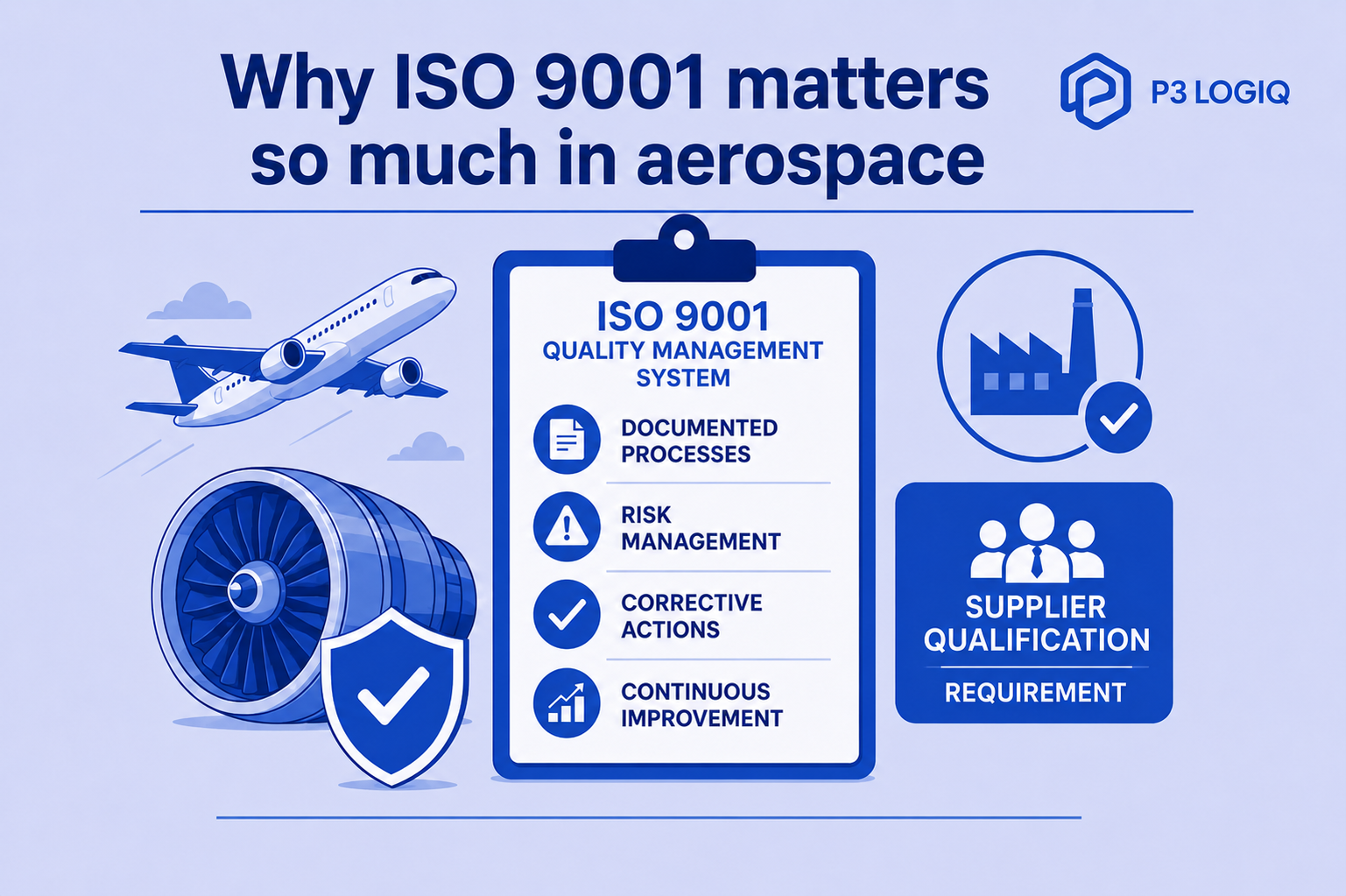
Aerospace parts don't get a second chance. A defect in a bracket or a wiring harness can show up thousands of feet in the air, and by then it's too late to fix. That's why the industry holds itself to a stricter standard than almost any other manufacturing sector.
ISO 9001 gives you the foundation: a documented, repeatable quality management system that aerospace companies can build on. It covers documented processes, risk management, corrective actions, and continuous improvement. Without this base, you can't even start talking to most aerospace primes about supplier qualification.
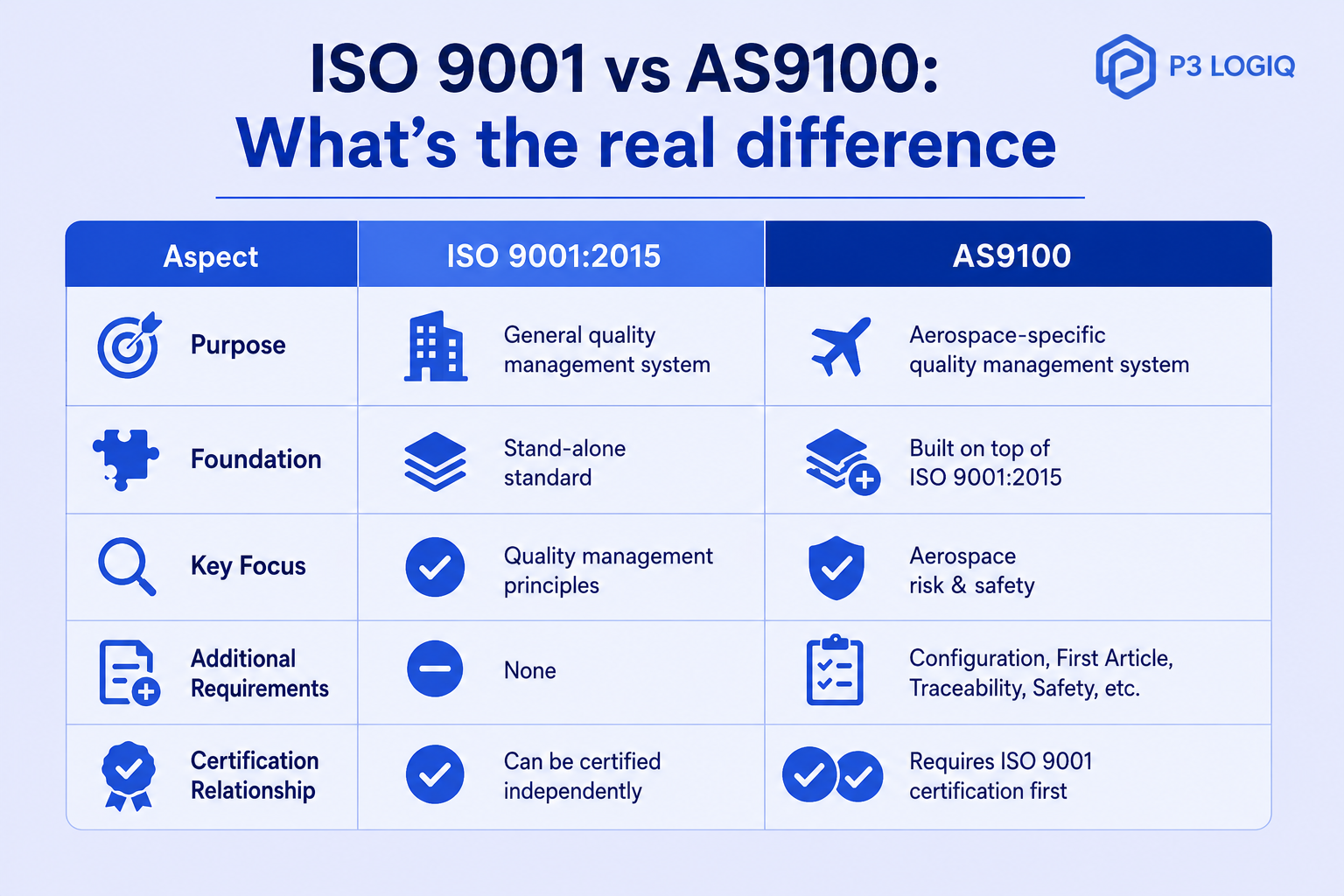
Here's where a lot of people get confused. AS9100 isn't a replacement for ISO 9001. It's built directly on top of it. Think of ISO 9001 as the base layer and AS9100 as the aerospace-specific add-on.
Every ISO 9001 clause in aerospace certification carries over into AS9100, plus extra requirements around:
So when your customer asks for "ISO 9001 aerospace certification",," they usually mean AS9100. But you can't get AS9100 without meeting every ISO 9001 requirement first. That's why understanding the base standard properly still matters, even in a niche like aerospace.

A quality management system that aerospace companies rely on needs to go beyond the standard ISO 9001 checklist. Here's what auditors and customers actually look for:
You need to show how you identify risks in design, production, and delivery, not just react to problems after they happen.
Every part needs a paper trail back to its raw material, supplier, and process history. If a defect shows up, you need to trace it fast and figure out what else it might affect.
Changes to design, tooling, or process need documented approval before they happen. No shortcuts, even for "minor" tweaks.
Your own suppliers need to meet aerospace-grade quality expectations too. Certification bodies will check how you flow down requirements to your supply chain.
Aerospace auditors care about training records, operator qualifications, and whether your team actually understands the procedures they're following, not just whether the documents exist.

Getting ISO 9001 aerospace requirements sorted out doesn't happen overnight. Here's a realistic timeline for most manufacturers:
Compare your current processes against ISO 9001 and AS9100 requirements. This usually takes two to four weeks and tells you exactly where you stand.
Build out your quality manual, procedures, and work instructions. Expect this phase to run eight to twelve weeks, depending on how mature your current system is.
Roll out the new processes across your floor and office. Train your team, run internal audits, and fix what breaks.
Your certification body reviews your documentation and readiness.
Auditors visit your facility, watch your processes in action, and interview your team.
If you pass, you get your certificate. If there are minor nonconformities, you'll get a short window to close them out.
Most companies take six to nine months from start to finish, longer if you're implementing a QMS from scratch. If you already run ISO 9001 in another sector and want a sense of what the audit day itself feels like, our post on ISO 9001 implementation has a practical walkthrough.

This isn't just a certificate for the wall. ISO 9001 benefits can help aerospace companies access supply chains, reduce quality issues, and build customer trust.
Boeing, Airbus, Lockheed Martin, and most defense contractors require AS9100 (built on ISO 9001) as a baseline for suppliers. No certificate, no contract.
Once you're certified, your customers trust your system instead of running their own full audit every time. That saves you time and money.
A strong quality management system makes it much easier to demonstrate compliance during FAA production certificate audits or DFARS-related reviews for defense work.
Companies that take this seriously see fewer scrap parts, fewer reworks, and fewer customer complaints. The system is designed to catch problems upstream, before they cost you real money.
In an industry built on trust, certification signals that you take quality as seriously as your customers do.
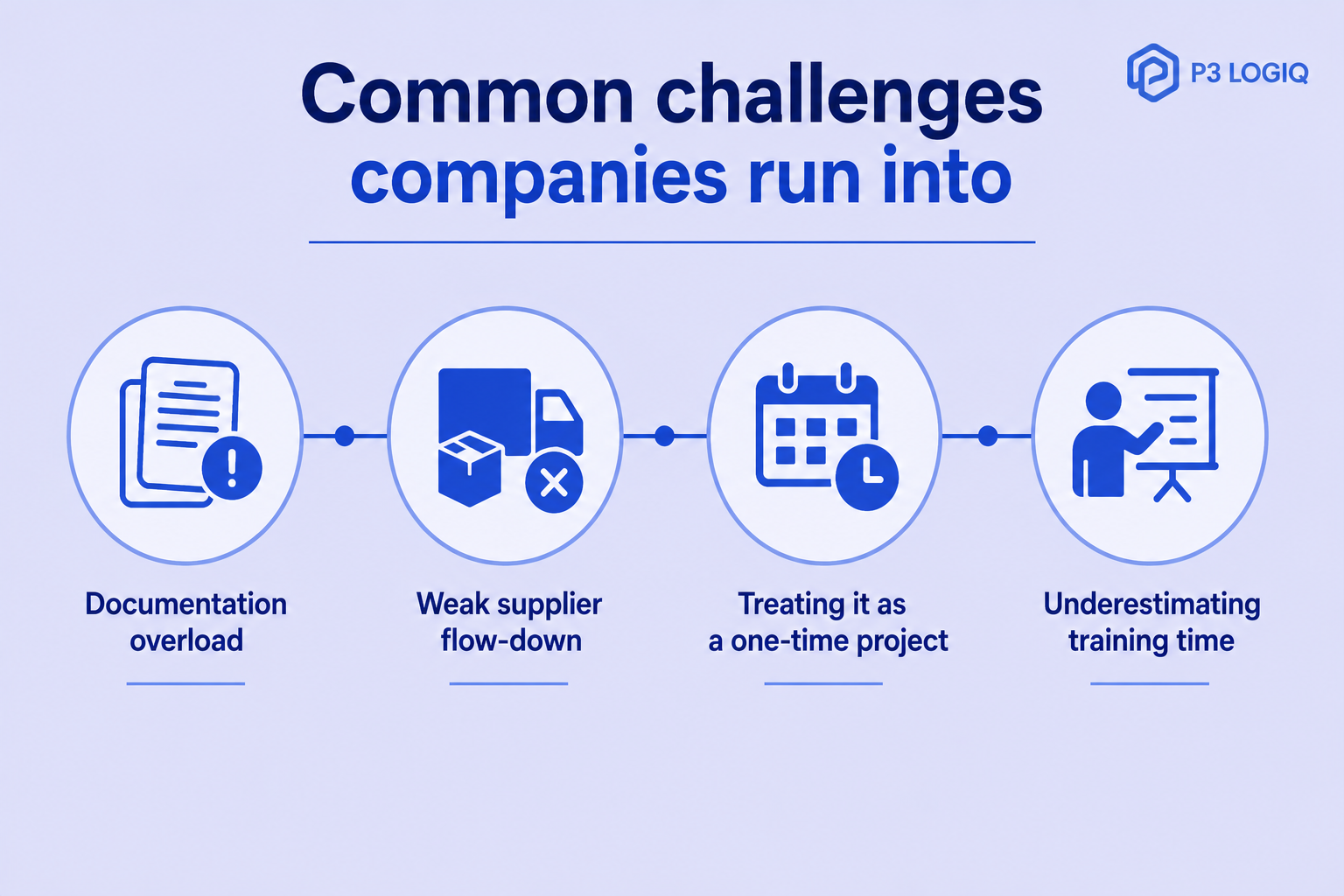
Even well-run manufacturers hit snags. The most common ones we see:
Aerospace supply chains keep tightening their requirements every year. More primes now expect suppliers to show digital traceability, real-time nonconformance tracking, and audit-ready records at any moment, not just when the certification body shows up.
The right process matters. But so do the right tools.
P3 LogiQ gives your team a cloud-based platform built for the demands of aerospace manufacturing. It brings document control, supplier management, corrective action tracking, and audit trails into one place. That means your quality management system isn't scattered across spreadsheets and email threads.
When your next surveillance audit arrives, your records are already organized and easy to access. Your team spends less time searching for documents, reduces compliance gaps, and stays audit-ready with confidence.
If you're planning your ISO 9001 aerospace certification journey in 2026, start with a gap analysis. Get your documentation in order early. Choose a system that scales with your supply chain instead of slowing it down.
Quality in aerospace isn't about perfection. It's about proving, every day, that you can identify and resolve issues before they leave your shop floor.
Ready to see what an audit-ready quality management system looks like? Book a demo to see how P3 LogiQ supports your aerospace supply chain, or sign up today to start building your certification-ready system.
Most aerospace primes require AS9100, which includes every ISO 9001 requirement plus aerospace-specific additions like configuration management and first article inspection. ISO 9001 alone rarely satisfies prime contractor requirements, so plan for both from the start.
Most companies need six to nine months from gap analysis to certification, depending on how mature their existing processes are. Companies building a quality management system from scratch should expect the process to take closer to a year.
Costs vary by company size and certification body, but expect to budget for gap analysis, documentation support, employee training, and audit fees. Smaller suppliers often spend less if they already run a basic quality system before starting certification.
Yes. Certificates run on a three-year cycle with annual surveillance audits in between. You need to keep your system running properly all year long, not just clean things up right before the auditor shows up on site.
Stage 1 reviews your documentation and checks whether your quality management system is ready for a full audit. Stage 2 happens on-site, where auditors watch your actual processes, interview your team, and verify records against real production activity.
Yes. Certification bodies don't require a minimum company size. Small suppliers can absolutely get certified, though they often need outside help building documentation and processes since they may not have a dedicated quality department in-house.
First article inspection verifies that your production process can consistently make a part that meets every design requirement. Aerospace customers require it before full production starts, since it catches process issues early instead of after a full batch ships.
Every part needs a documented history connecting it back to raw material, supplier, and every process step it went through. If a defect surfaces later, this traceability lets you quickly identify which other parts or batches might share the same issue.
It depends on your certification body and how your operations are structured. Some companies certify multiple sites under one certificate if processes are standardized, while others need separate certificates for facilities with different scopes of work.
You'll typically receive nonconformities with a set timeframe to fix them, often 30 to 90 days. Minor issues rarely threaten your certificate, but repeated or major nonconformities left unresolved can lead to suspension or loss of certification.



Businesses need document management systems (DMS) to ensure ISO and R2 compliance, improve efficiency, and stay audit-ready. The article highlights key features like version control, security, and automation while reviewing the top 5 DMS solutions. P3 LogiQ stands out for its compliance-focused automation and secure document tracking
Read More
Recycling businesses gain efficiency, compliance, and sustainability with RIOS certification. It streamlines quality management, environmental responsibility, and worker safety, helping companies avoid legal risks and boost credibility. P3 LogiQ simplifies the certification process with automation, document control, and compliance tracking, making operations smarter and safer.
Read More
Audit Management Software (AMS) automates compliance tracking, streamlines workflows, and reduces audit risks. Key features include automated scheduling, compliance checklists, CAPA tracking, vendor risk management, and integrations.
Read More
Learn how audit management systems simplify ISO and R2 compliance by automating audits, managing documentation, and minimizing compliance risks efficiently.
Read More
In 2025, many businesses still face challenges in compliance management due to outdated methods like spreadsheets and fragmented software. This inefficiency leads to missed deadlines, increased risk, and regulatory penalties. The blog emphasizes the importance of modern compliance tools that automate workflows, enhance risk management, and streamline regulatory processes to meet ISO and R2 standards.
Read More
The rise in e-waste and environmental concerns makes responsible electronics recycling essential. The R2 Certification sets a global standard for safe, sustainable, and data-secure recycling practices. Developed by Sustainable Electronics Recycling International (SERI), R2 helps businesses manage environmental risks, data security, worker safety, and legal compliance.
Read More
Businesses face increasing challenges in managing complex regulatory compliance. Manual methods such as spreadsheets and paperwork can lead to missed deadlines, inefficiencies, and costly penalties. Compliance management software offers a streamlined solution to reduce risks, automate processes, and improve operational efficiency.
Read More
Maintaining R2 Certification is crucial for businesses in the e-waste recycling industry, ensuring regulatory compliance, sustainability, and strong stakeholder trust. This guide outlines 10 best practices to help businesses simplify operations, reduce risks, and stay compliant.
Read More
Unlock the value of ISO risk management certification. Explore its impact on compliance, risk mitigation, and business expansion.
Read More
Explore the top 5 ISO risk management software tools for 2025, including document management solutions for streamlined compliance and increased efficiency.
Read More
Find the ideal document management software (DMS) for your business. Learn how to choose with expert tips, key features, and insightful guidance
Read More
Unlock the power of a Document Management System (DMS). Learn how it can revolutionize your business operations.
Read More








.png)


.png)





.jpg)





.jpg)
.jpg)












.jpg)



.png)

.png)
.png)





.png)

