
You're three weeks from handover. The client walks the site and finds cracked flooring in two units, misaligned door frames in four more, and concrete pours that don't match the spec on the approved drawings.
You call the subcontractor. They say the materials were fine. You call the materials supplier. They say the specs were followed. Nobody is pointing fingers at themselves, and you're now the one sitting across from a client who expected a finished building, not a list of explanations.
This kind of situation plays out on construction sites on a common basis. Not because the people involved are incompetent. It happens because nobody had a system that caught the problem early enough. The subcontractor performance wasn't being tracked in a way that flagged quality deviations before the work was signed off. The material approvals were verbal or buried in emails. The inspection checklist existed, but it wasn't consistent across sites.
The sad thing about rework is that in construction, rework is known to be a significant hidden cost. It accounts somewhere around 1% to 20% for total project costs. Some studies show around 4% to 10%.
Let’s do some calculations for a broader understanding of the consequences when it comes to rework.
Say you are working on a $5 million USD project; if we take the 10%, the rework cost will be $500,000 USD, all of that down the drain because you did not implement an ISO standard.
The deeper problem is that most construction companies know quality matters. They just don't have a documented, repeatable way to manage it across projects, sites, subcontractors, and teams. Every project manager ends up implementing their own version of quality control, and when that person leaves or is stretched across multiple sites, the entire system begins to deteriorate.
That's where ISO 9001 certification comes in.
You see, with the ISO 9001 software, it gives you a documented framework that works the same way whether you're on a residential development in Texas or a commercial build in Ohio.
And given how much rework is quietly draining construction budgets every year, understanding the key benefits of ISO 9001 is no longer just useful knowledge for quality managers. It's something every project director and operations head in construction should be familiar with.
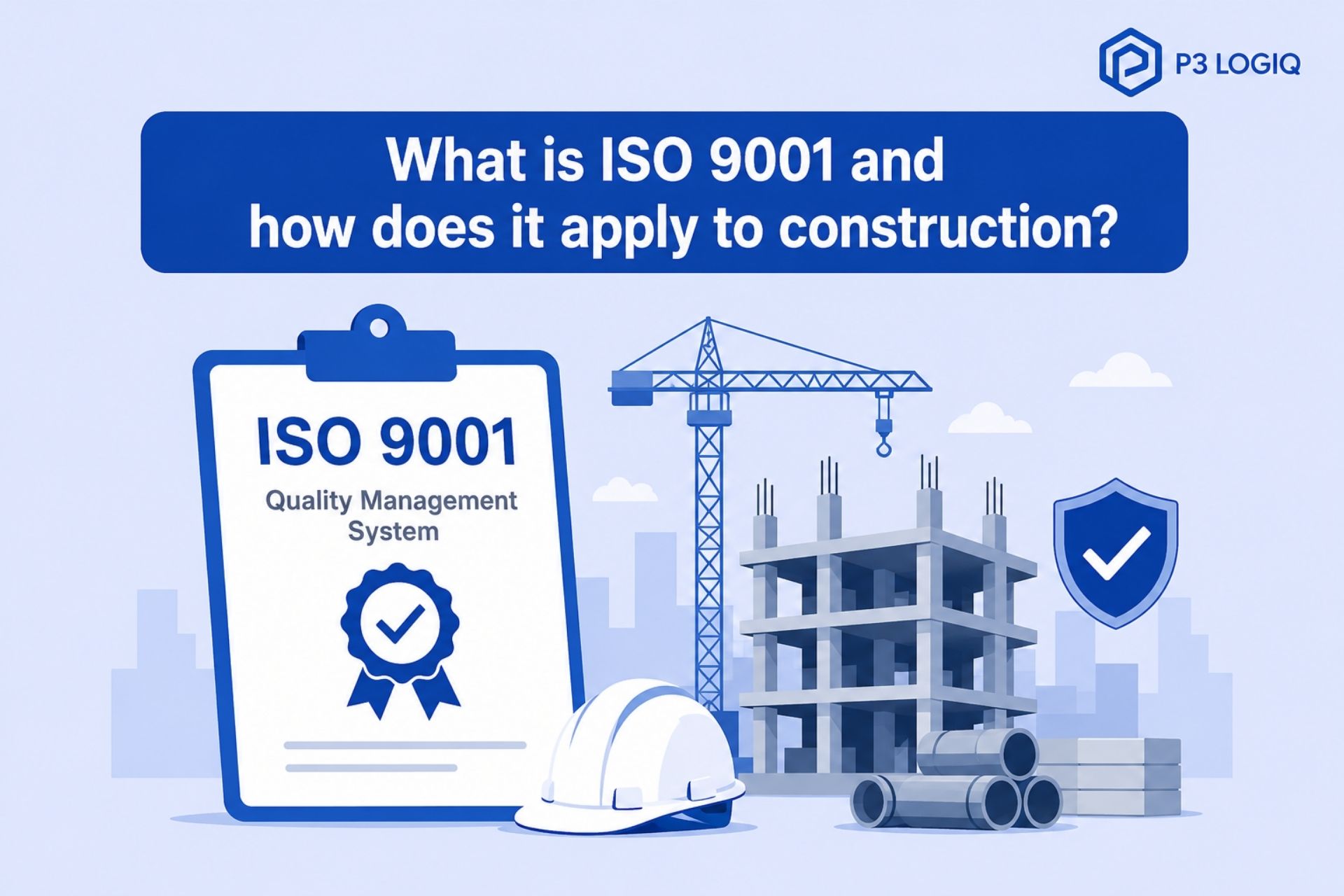
ISO 9001 is basically an international standard published by the International Organization for Standardization (ISO) that has certain requirements for your quality management system (QMS).
At its core, what it does for your business if implemented is you will be consistently delivering products and services that meet customer expectations and regulatory requirements.
In the context of construction, if you apply ISO 9001, it means you are building a QMS on how you plan projects, procure materials, manage subcontractors, handle inspections, deal with non-conformances, and review your processes over time.
It's not industry-specific in the way some certifications are, which is actually one of its strengths. The framework is flexible enough to apply to a general contractor building commercial offices and a specialized firm doing civil infrastructure work.
What makes it particularly relevant for construction is that the industry is project-based and involves multiple parties, long timelines, and physical outputs that have to meet exact specifications.
That itself creates a lot of places where quality can slip up. ISO 9001 gives you a structured way to control those points, from how you vet subcontractors before engaging them to how you document and close out non-conformances when something goes wrong on site.
Here’s something interesting you should know!
Here's a number that puts things in perspective. The 2024 ISO Survey counted 1,474,118 certified sites for ISO 9001:2015 worldwide, the highest it's ever been. It's the standard most of the world's quality-focused businesses have already adopted.
Construction and manufacturing are among the largest certified sectors, which tells you this isn't a niche standard. It's the industry baseline for organizations that are serious about quality.
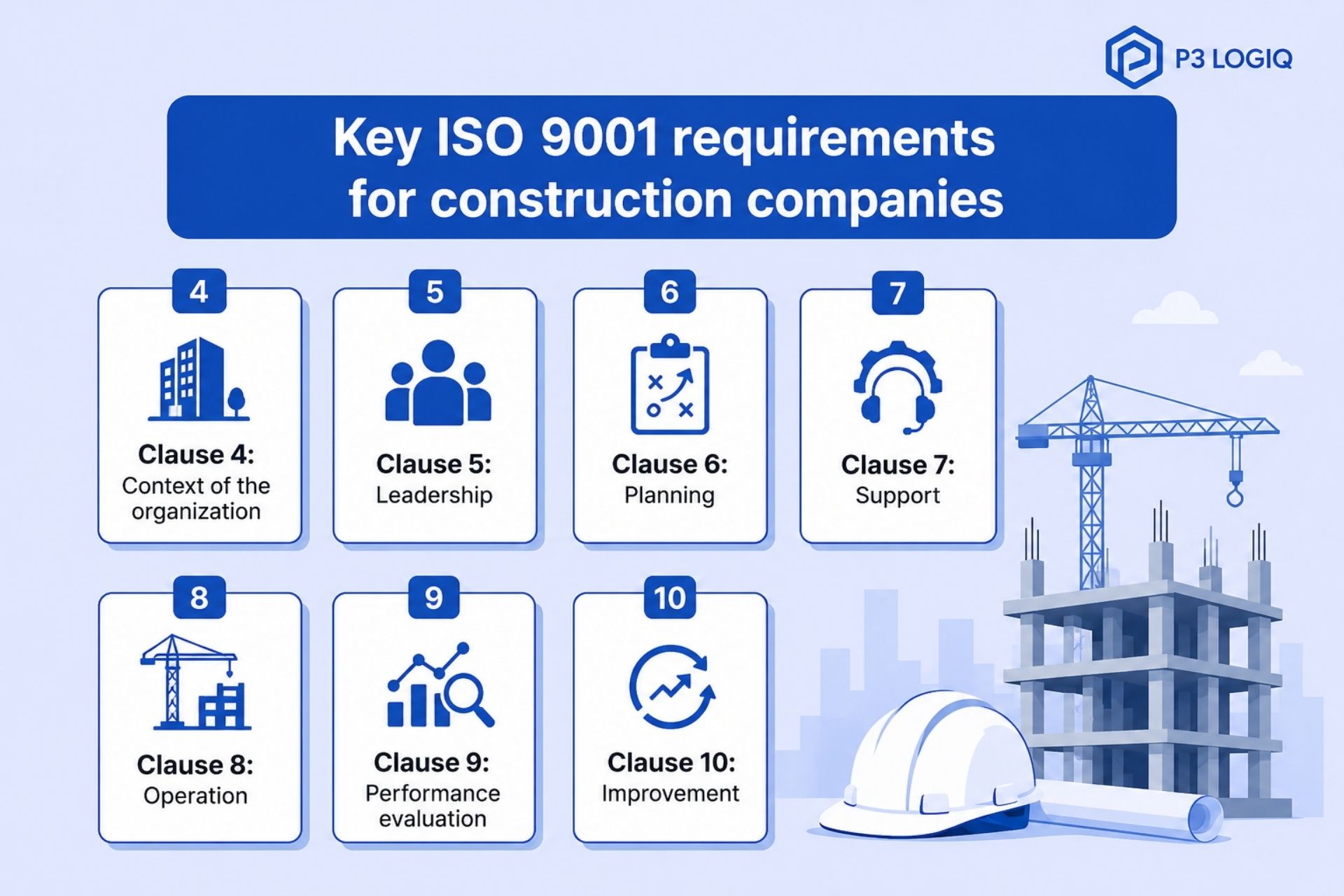
ISO 9001:2015 is structured around 10 clauses. In ISO 9001 clauses, The first three are introductory. The ones that matter for your QMS implementation are Clauses 4 through 10. Here's what each means in a construction context.
Simply put, the first 3 clauses talk about introductions.
What really matters are Clause 4 through Clause 10, because they are the main clauses that you will need to implement for your business.
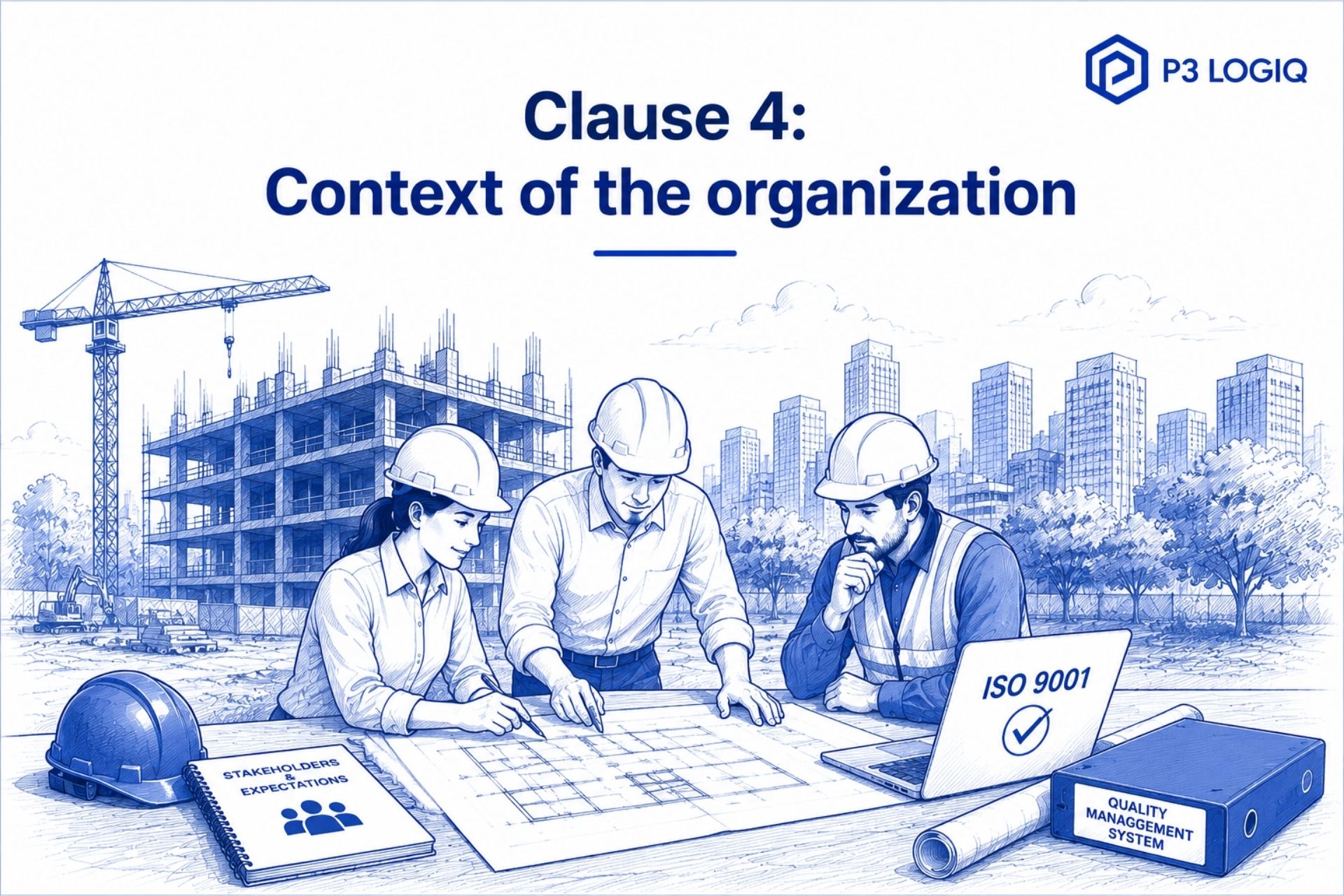
You need to define the internal and external issues of ISO 9001 that affect your ability to deliver quality.
Think about everything that affects how well you build. Your crew's skill levels. How reliable your subcontractors actually are. The regulations in whatever state or city you're working in. Where your materials come from and whether that supply chain holds up. What your client actually expects versus what they say they expect. All of that falls under this clause.
You also need to figure out who has a stake in your work and what they care about. Clients want their building done right and on time. Regulators want you following the rules. Your own employees want clear direction. Subcontractors want to know what's expected of them before they show up on site. Mapping this out sounds like a formality, but it's usually the first time a lot of companies sit down and actually write any of this stuff out loud.
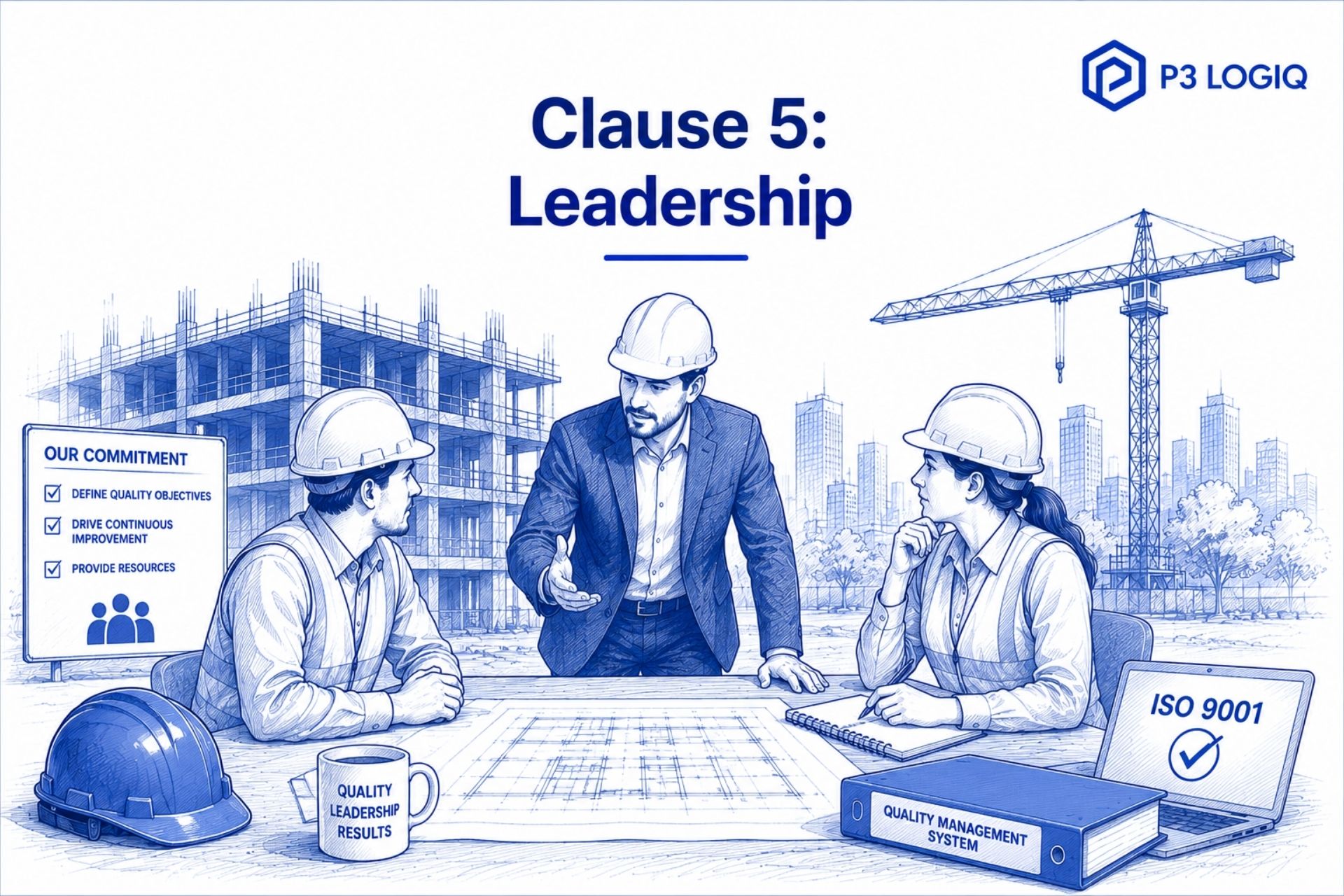
This one's simple but it trips a lot of companies up. The owner or senior leadership can't just sign a quality policy and walk away. They have to actually show up for it, ask about it in meetings, and make decisions that back it up.
This clause requires your leadership to define quality objectives, commit to the QMS, and make sure the right resources are in place.
For construction companies, this is often the difference between a QMS that actually changes how work is done and one that lives in a binder on a shelf.
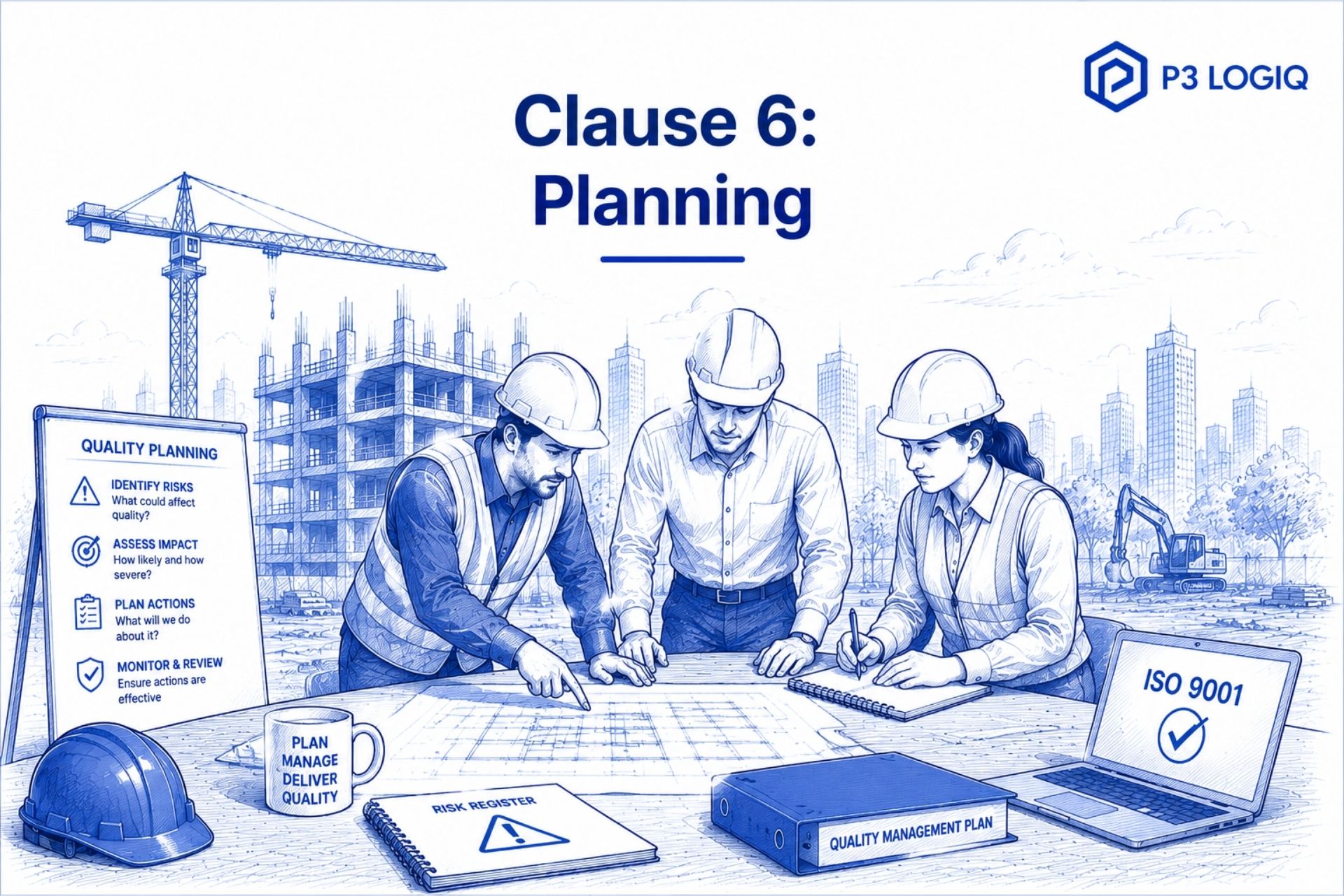
You have to identify risks and opportunities that could affect your quality outcomes, then plan actions to address them.
On a construction project, this is risk management applied to quality. Things like unreliable subcontractors, unusual site conditions, or new materials that haven't been used before all belong in this planning process.
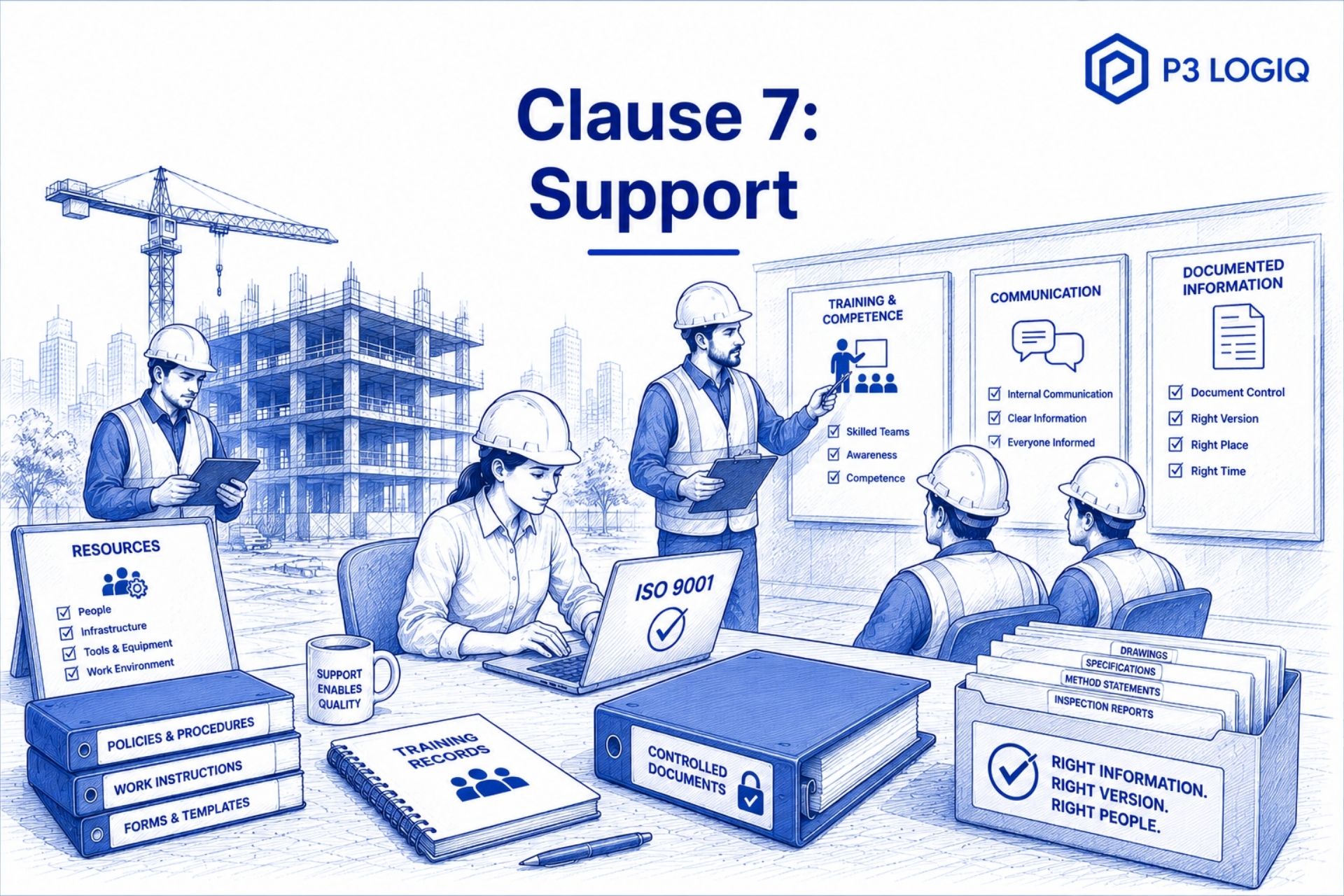
This covers resources, competence, awareness, communication, and documented information. In construction terms, it means making sure your teams are trained, your documents are controlled, and everyone on site knows what quality means for their specific role.
ISO 9001 document control is a requirement under this clause that many construction companies underestimate. Controlled documents aren't just about you having the right forms. They're about making sure the right version of every drawing, spec, and procedure is the one being used on site.
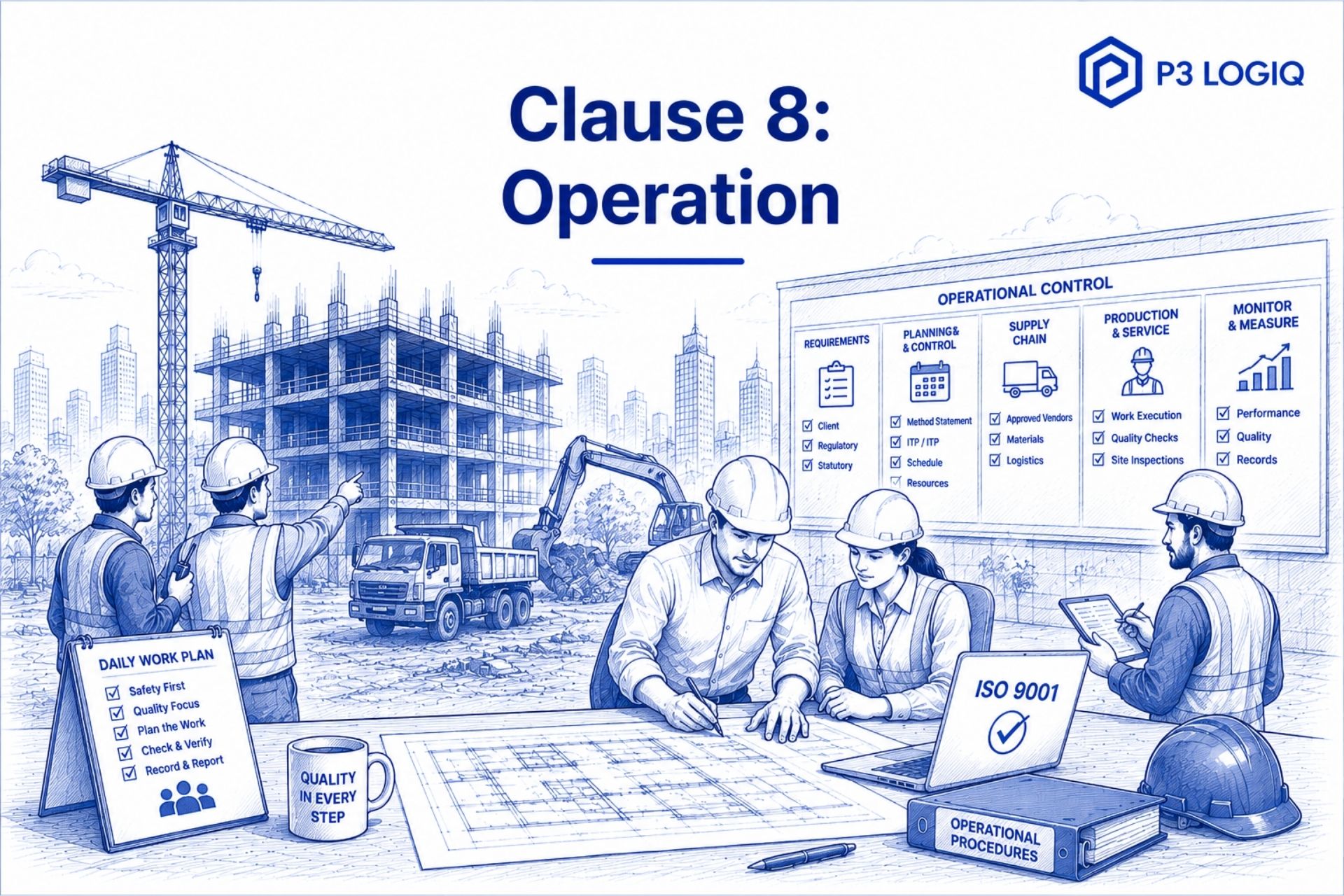
This is where most of the day-to-day construction work sits.
It covers planning and control of processes, requirements for products and services, design and development, control of externally provided products and services (your subcontractors and suppliers), production and service provision, release of products, and control of non-conforming outputs.
For construction, Clause 8 is the heart of your QMS. It defines how you check materials before they go into the ground, how you approve subcontractor work, how you document inspections, and what happens when something doesn't meet spec.
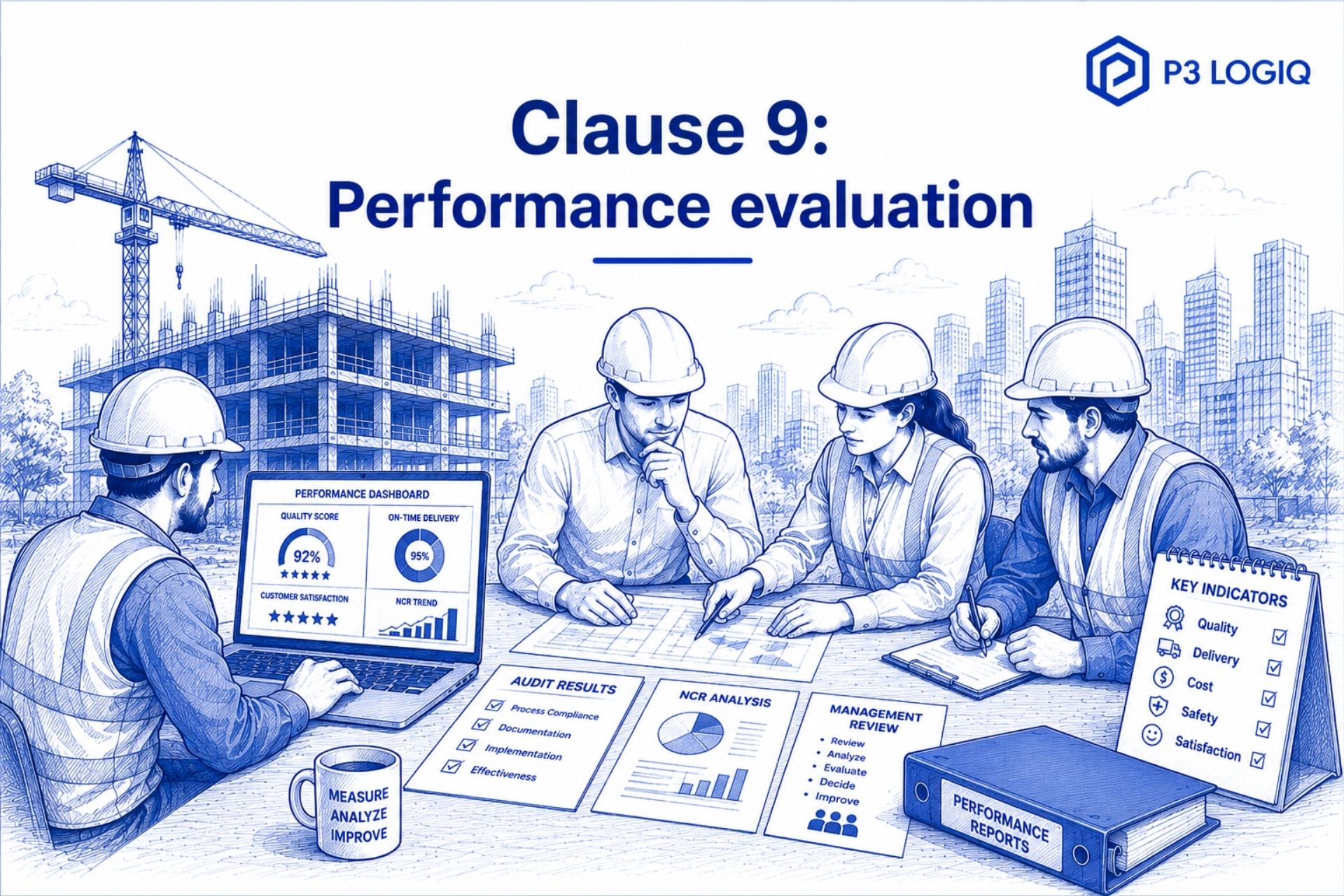
This is the check-in clause. You have to monitor, measure, analyze, and evaluate your QMS.
Internal audits, management reviews, keeping tabs on whether clients are actually happy.
For a construction company, it means sitting down regularly and looking at your numbers.
Checking out things like:
How many non-conformances came up this month?
What did inspections turn up?
And then actually doing something with that information instead of saving it in a folder nobody opens again.
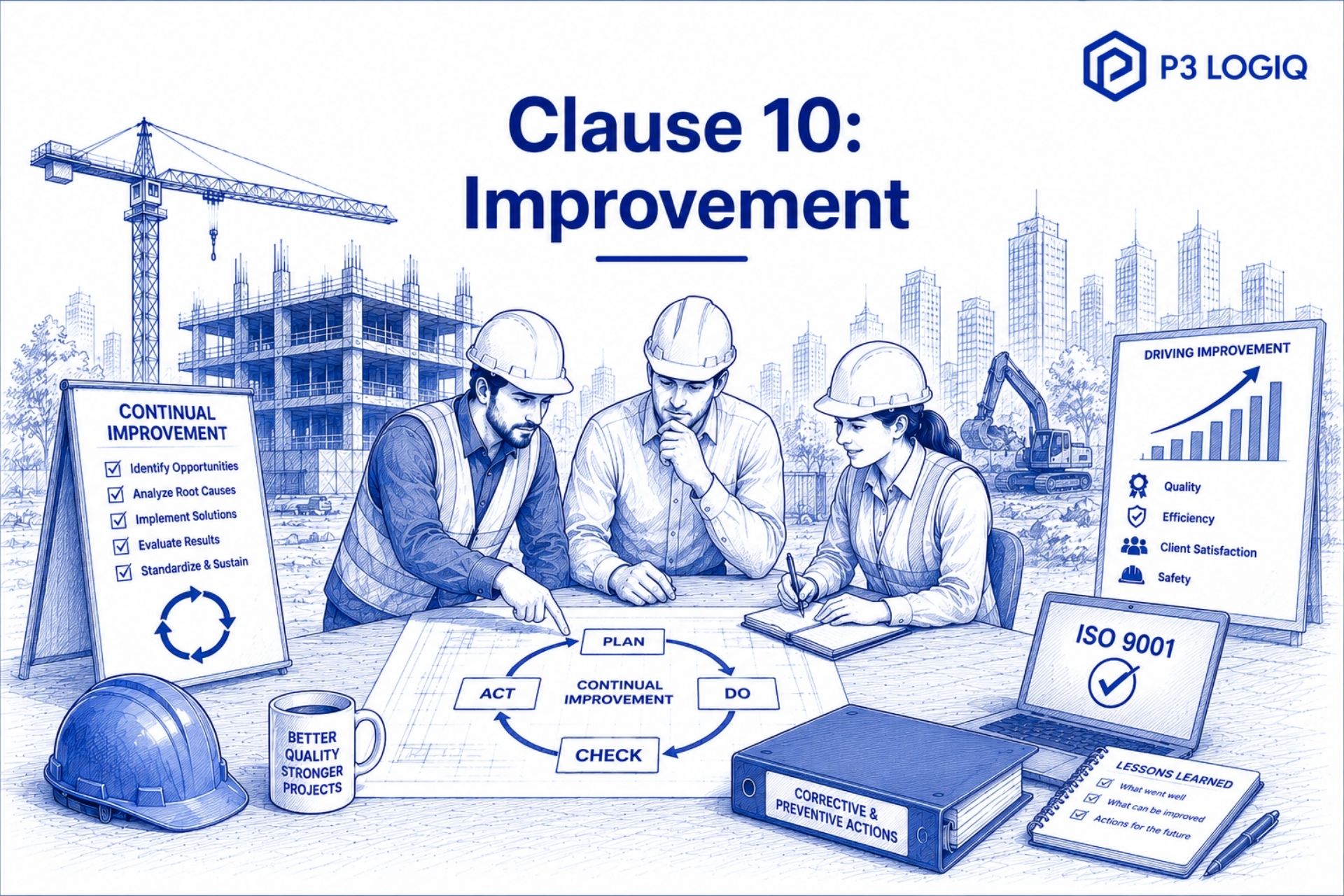
When things go wrong, you need a structured way to address them, find the root cause, and make sure they don't happen again. This is the corrective action process.
For construction companies that deal with defects, site issues, and subcontractor failures on a regular basis, having a formal corrective action system is one of the most practical outcomes of implementing ISO 9001.
Want to understand what a full ISO 9001 QMS looks like before you start?

These are some of the benefits of ISO 9001 your business will experience once you have implemented the standard, and it’s only going to get better.
Rework in construction is expensive not just because of the direct repair costs but because it delays handover, ties up site teams, and damages client relationships.
A QMS that catches non-conformances earlier in the process means fewer of those conversations with your clients.
Most construction companies rely heavily on subcontractors, and most quality failures can be traced back to subcontractor work that wasn't adequately defined, checked, or documented.
ISO 9001 requires you to have a formal process for evaluating, selecting, monitoring, and re-evaluating suppliers and subcontractors.
This doesn't mean more paperwork. It means a consistent process that every project manager follows, so you're not dependent on one person's judgment or memory when choosing who to bring onto a site.
Due to the demand for ISO certification, many clients are more willing to award tenders to ISO 9001-certified companies, knowing they adhere to consistent, high-quality standards. Government contracts and large commercial projects often use ISO 9001 certification as a qualifier, meaning uncertified companies don't even make it.
This is a direct business development benefit. Certification opens doors that weren't previously open. Imagine the opportunities your business can get once it gets ISO certified.
Construction projects usually have a lot of documentation.
Drawings, specs, inspection records, test results, material certificates, non-conformance reports and a lot more.
Construction generates a mountain of paper, even when it's all digital. ISO 9001 asks you to keep that mountain under control, so anyone who needs a document can actually find the right version of it without digging through five email threads.
When a client wants to review your quality records, or when a regulatory audit happens, having controlled documentation is the difference between a smooth process and a stressful scramble. So in this case, ISO 9001 compliance guide works will greatly help you after getting your initial certification.
If your company prioritizes quality management, you are guaranteed to have happy and loyal customers and good relationships with the clients.
The survey by ASQ (published by Number Analytics) says so.
In construction, where most business comes from repeat clients and referrals, that loyalty translates directly into revenue.
Clients who experience consistent quality on one project are far more likely to return for the next. ISO 9001 gives you the operational structure to deliver that consistency, even as your team grows or your project complexity increases.
Standardizing your processes doesn't just improve quality. It also removes duplication, reduces the time spent on rework, and makes it easier for you to onboard new site managers or project teams because your procedures are documented and consistent.
Impact of ISO 9001 Research published on ResearchGate further confirms that over the past 2 decades, once you implement ISO 9001, you get to notice that your costs get lowered, productivity increases, and stakeholders are satisfied in the construction area.
When your QMS is documented and working, your potential to scale becomes easier.
You can bring new sites online faster, onboard new project managers with less risk, and take on larger or more complex contracts because you have the documented systems to back it up.
There are some folks asking the questions like
“Does ISO 9001 for small businesses actually exist?”
Or
“Is it relevant to the type of my business?”
No matter the company size or type of construction work you have, the certification process stays the same.
First things first.
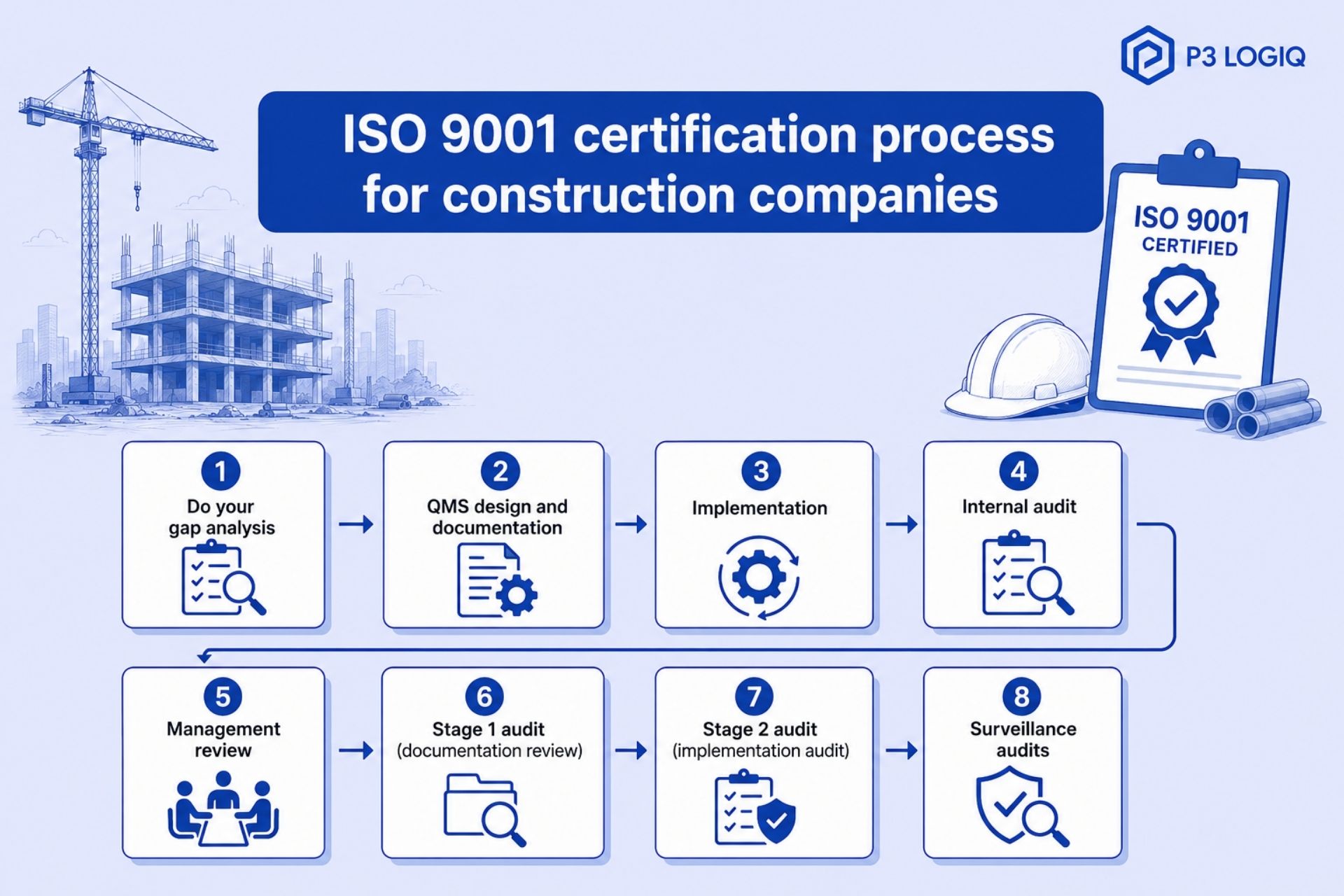
The purpose of gap analysis is to understand where you currently stand against ISO 9001 requirements.
It helps you compare your current work processes, documents and practices against each clause of the standard and helps you identify gaps.
See, most construction companies are missing the same things. Procedures that exist in someone's head but not on paper. No real system for checking subcontractors before bringing them on. And no formal way of dealing with things that go wrong other than a phone call and a fix. Once the gap analysis lays this out, you know exactly where to start.
Based on the gap analysis you made, you design your quality management system. This means writing your quality policy, setting quality objectives, documenting your key processes, and creating the documented information the standard requires.
For construction, this includes things like your project quality plan template, your subcontractor evaluation criteria, your inspection and test plan structure, your non-conformance procedure, and your document control process.
Now you actually put the system to work. This is where things get real, because it's not just about writing documents anymore. Your site teams need to know what's changed, why it matters to them, and how to actually do it on a Monday morning when the concrete truck is already there.
Training is a big part of this phase.
This is also where you start collecting the records your QMS requires, running internal audits, and identifying early non-conformances so you can address them before the certification audit.
Before the official auditor ever shows up, you run your own check first. Basically a dry run to see if your system is doing what it's supposed to and whether it actually lines up with what ISO 9001 expects.
Internal audit results need to be documented.
This step often surfaces issues that weren't visible during implementation. That's actually the point. Better to find them now than during the certification audit.
Your senior team reviews the overall performance of the QMS, including audit results, quality objectives progress, customer feedback, and any significant nonconformances. This review has to be documented and has to result in decisions and actions.
The external certification body (aka CB) reviews your QMS documentation to check that it meets ISO 9001 requirements.
They're not yet looking at whether your processes work in practice. Not yet, anyways.
They're checking whether you have the right structure in place.
Whatever comes up at this stage needs to be sorted out before you move on to Stage 2.
This is the one that happens on site.
The auditor walks around, talks to your people, checks your records, and watches how things actually run. Then they compare what they see to what your paperwork says. If everything lines up, you walk away with your ISO 9001 certificate. By navigating ISO 9001:2015 certification audits, you will know exactly what the auditor expects of your business.
Your certificate lasts three years, but it's not a "set it and forget it" situation.
The certification body checks in roughly once a year to make sure your system is still being used and not gathering dust.
After three years, you go through the whole certification process again.
Is your team still managing quality with spreadsheets and email threads?
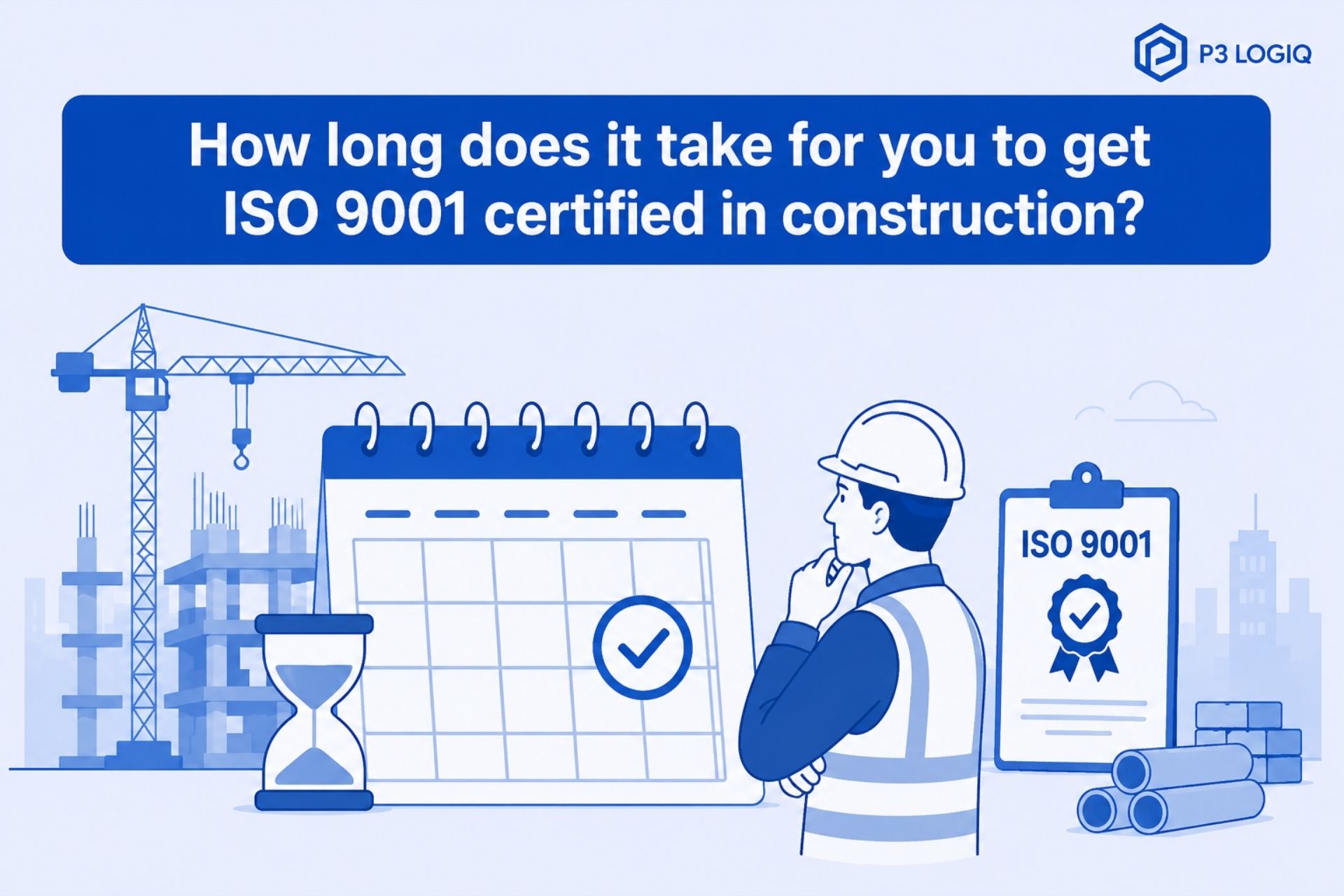
I wish I could give you a specific answer, but there's no single answer because it entirely depends on the size of your company, how many sites you operate, how complex your projects are, and how much of a QMS you already have in place.
Getting ISO 9001 certification is a process that typically takes a minimum of three to four months to complete.
But if you are a larger construction company with multiple sites, complex supply chains, and no existing QMS, the process can take significantly longer, often six to twelve months.
The most common reason companies take longer than expected is poor planning at the start. Deciding to pursue certification without assigning clear ownership, setting realistic milestones, or allocating time for proper implementation tends to extend the timeline significantly.
The factors that have the most impact on your timeline include the size of the gap identified during your gap analysis, how quickly your teams can be trained and adopt new processes, how fast your documentation can be developed and reviewed, and whether you have internal audit capability or need to develop it.
Ready to start your certification journey but not sure where to begin?
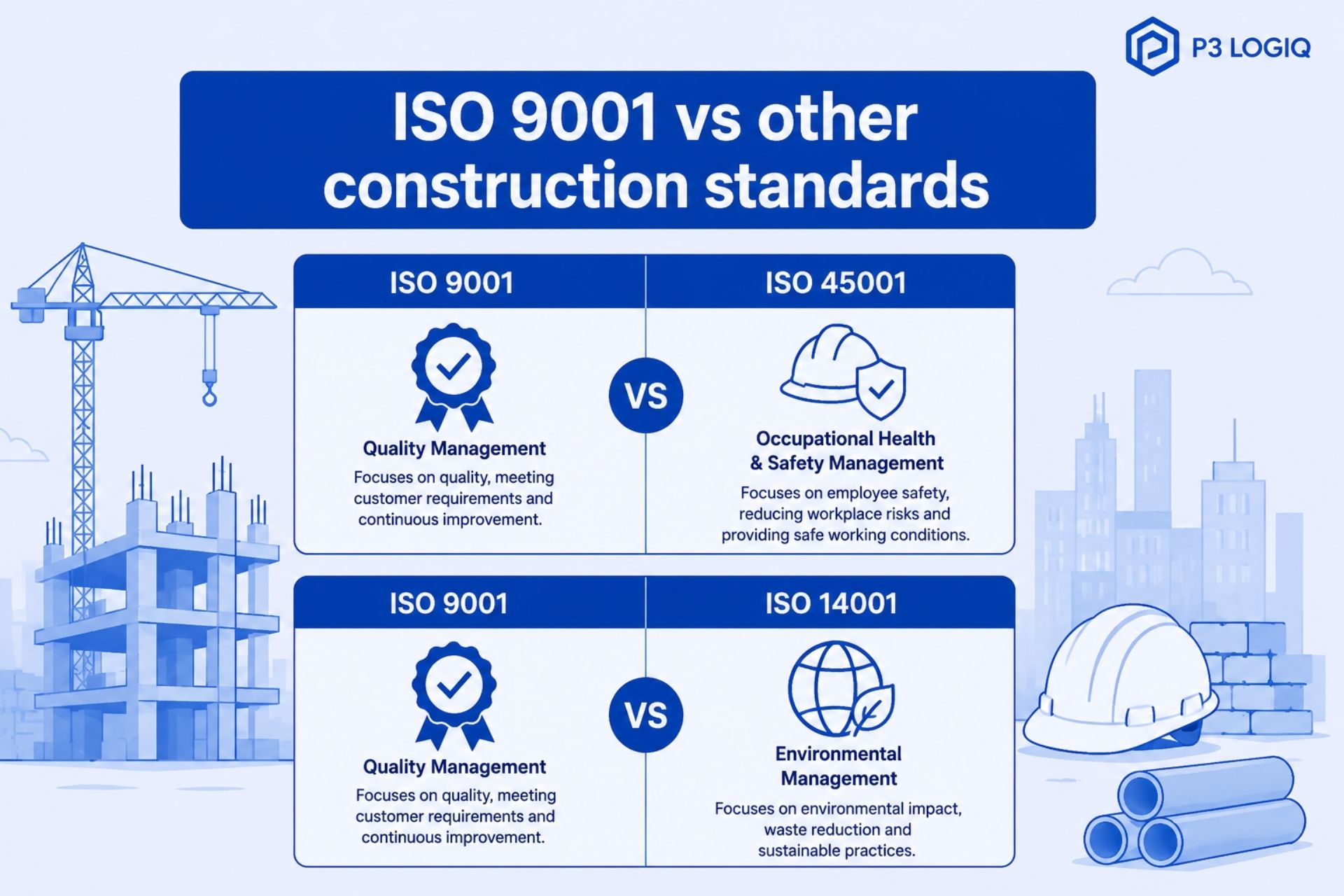
ISO 9001 is not the only certification relevant to construction companies, and understanding how it sits alongside others helps you plan your certification strategy.
We know that ISO 9001 covers quality management.
But ISO 9001 vs. ISO 45001 compared directly shows us that ISO 45001 covers occupational health and safety for your teams. Both are relevant in construction, but they highlight different areas. Many construction companies pursue both, especially when tendering for government or large commercial work where both are required.
ISO 14001 covers the environmental management aspect.
In construction, environmental compliance is basically becoming a tender requirement, particularly for projects near sensitive sites or in jurisdictions with strict environmental regulations. If you want to understand the full picture, the ISO 9001 vs ISO 14001 comparison is about how the two standards relate and where they overlap.
Many construction companies eventually go for all three, which reduces audit duplication and makes ongoing compliance more manageable.
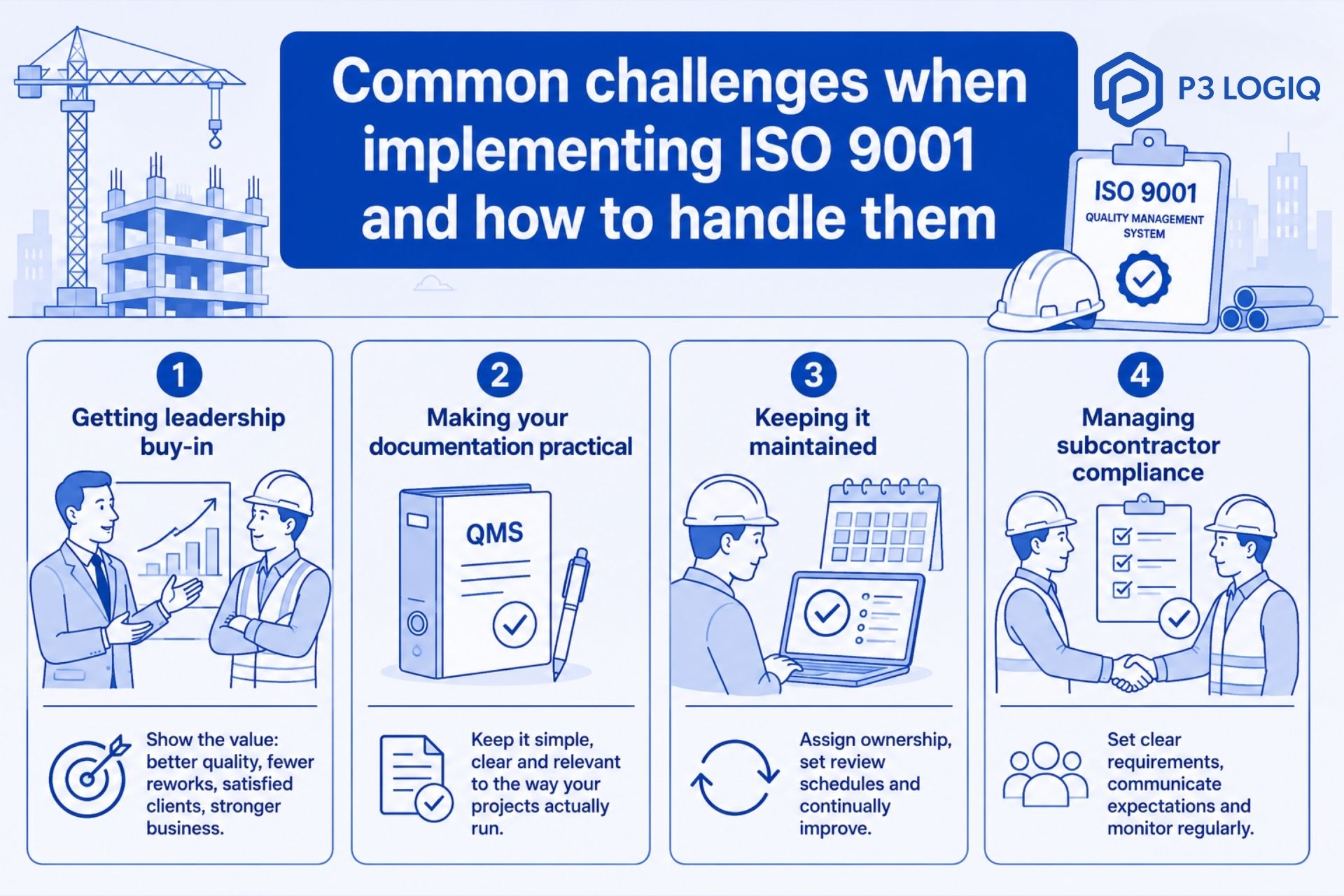
Now you know the requirements, the benefits, and the processes of getting ISO 9001 certified. You will also need to know the challenges of ISO 9001 so that you can be prepared for any setback.
If you are going to implement ISO 9001, then it is going to require you to have active leadership involvement. This means senior management time, resources for training, and willingness to make process changes. Companies that treat certification as a box-ticking exercise without genuine leadership commitment typically end up with a QMS that doesn't work in practice.
The way to address this is to connect the QMS to business outcomes that leadership already cares about, things like winning your tenders, reducing rework costs, and avoiding disputes with your clients.
Documentation is necessary, but there's a risk of creating overly complex procedures that nobody actually follows.
The best QMS documentation you can create is the one that is clear, concise, and written in a way that your site teams can use it without needing a quality manager to interpret it for them.
Getting certified is one thing. Keeping your QMS active and improving over time is another. Surveillance audits will check whether your QMS is still being used, and the most common finding at surveillance audits is that processes have drifted back to old habits.
The way to prevent this is to make the QMS part of how work is actually managed, not a parallel system that sits alongside normal operations. When project managers use your quality records in their day-to-day work rather than filling them in after the fact, you end up with a QMS that sustains itself.
Construction companies often find that the hardest part of their QMS to implement is the subcontractor management piece. Getting your subcontractors to provide the right documents, follow your inspection requirements, and close out non-conformances consistently is genuinely difficult.
The practical approach is to make your quality requirements part of the subcontract agreement from the start, so compliance is a contractual expectation rather than an afterthought.
Quality problems in construction rarely happen because people don't care. They actually happen because the systems aren't there to catch them early enough.
The subcontractor delivers work that doesn't match the spec, and nobody had a formal process for checking it before it was signed off. The material certificate was filed in three different places by three different people, and when the auditor asked for it, nobody could find it.
The inspection happened, but the record was never created.
ISO 9001 is the framework that closes those gaps. It doesn't tell you how to build. It tells you how to manage the quality of how you build in a way that's consistent, documented, and improvable over time.
If you are in the construction business that wants to reduce rework, manage subcontractors more effectively, win more tenders, and build a reputation that holds up under scrutiny, it's not a complicated decision.
P3 LogiQ makes the implementation side of this significantly more manageable. Instead of building your QMS in spreadsheets and shared drives, you get a purpose-built platform for document control, audit management, corrective actions, and compliance tracking, all in one place.
If you're ready to start, you can book a demo to see how we work for construction teams or sign up and explore the platform yourself.
ISO 9001 is not legally mandatory in most jurisdictions. But governments and large commercial projects use it as a baseline these days. Many clients treat it as a minimum requirement, which makes it effectively necessary for you to get those tenders.
Absolutely. ISO 9001 is meant to work for businesses of every size, including small construction companies. In fact, smaller teams often find the implementation process easier because there are fewer people, processes, and documents to manage. The standard scales with your business instead of adding unnecessary complexity.
Depends on your company size, how many sites you run, and whether you bring in a consultant. You'll have consultant fees, CB fees, and the time your team spends on it. Smaller and mid-size companies should plan for both the upfront cost and the yearly surveillance audit fees that follow.
Your certificate is good for three years, after that, the certification body checks in with surveillance audits roughly once a year during that time. At the end of three years, you go through the full process again to renew it.
Yes, it does. Clause 8.4 asks you to evaluate, select, monitor, and regularly review subcontractors and suppliers whose work affects your projects. The goal is to make sure everyone contributing to the build consistently meets your quality requirements, not just your own internal team.
A QMS is your company's playbook for quality. It's the policies, processes, and procedures that keep your work consistent, from how you plan a project and order materials to how you inspect work and handle defects when they show up.
Yes. Government tenders often list ISO 9001 as a requirement before they'll even look at your bid. Having it shows you have a documented system in place, which lowers the risk for public sector clients and can give you an edge during evaluation.
It's basically anything that doesn't meet spec. A material that's wrong, work that fails inspection, a subcontractor who skips a step they were supposed to follow. ISO 9001 wants these documented, looked into, and fixed so they don't happen again.
The ISO 9001 is the standard itself, the rulebook your system needs to meet. A quality manual is the document you write that explains how your company actually meets those rules. One's the requirement, the other's your answer to it.
Not necessarily. ISO 9001:2015 no longer requires every company to maintain a formal quality manual. What it does require is documented information that supports your quality management system. Many construction companies still keep a quality manual because it makes the system easier to understand and manage.


Businesses need document management systems (DMS) to ensure ISO and R2 compliance, improve efficiency, and stay audit-ready. The article highlights key features like version control, security, and automation while reviewing the top 5 DMS solutions. P3 LogiQ stands out for its compliance-focused automation and secure document tracking
Read More
Recycling businesses gain efficiency, compliance, and sustainability with RIOS certification. It streamlines quality management, environmental responsibility, and worker safety, helping companies avoid legal risks and boost credibility. P3 LogiQ simplifies the certification process with automation, document control, and compliance tracking, making operations smarter and safer.
Read More
Audit Management Software (AMS) automates compliance tracking, streamlines workflows, and reduces audit risks. Key features include automated scheduling, compliance checklists, CAPA tracking, vendor risk management, and integrations.
Read More
Learn how audit management systems simplify ISO and R2 compliance by automating audits, managing documentation, and minimizing compliance risks efficiently.
Read More
In 2025, many businesses still face challenges in compliance management due to outdated methods like spreadsheets and fragmented software. This inefficiency leads to missed deadlines, increased risk, and regulatory penalties. The blog emphasizes the importance of modern compliance tools that automate workflows, enhance risk management, and streamline regulatory processes to meet ISO and R2 standards.
Read More
The rise in e-waste and environmental concerns makes responsible electronics recycling essential. The R2 Certification sets a global standard for safe, sustainable, and data-secure recycling practices. Developed by Sustainable Electronics Recycling International (SERI), R2 helps businesses manage environmental risks, data security, worker safety, and legal compliance.
Read More
Businesses face increasing challenges in managing complex regulatory compliance. Manual methods such as spreadsheets and paperwork can lead to missed deadlines, inefficiencies, and costly penalties. Compliance management software offers a streamlined solution to reduce risks, automate processes, and improve operational efficiency.
Read More
Maintaining R2 Certification is crucial for businesses in the e-waste recycling industry, ensuring regulatory compliance, sustainability, and strong stakeholder trust. This guide outlines 10 best practices to help businesses simplify operations, reduce risks, and stay compliant.
Read More
Unlock the value of ISO risk management certification. Explore its impact on compliance, risk mitigation, and business expansion.
Read More
Explore the top 5 ISO risk management software tools for 2025, including document management solutions for streamlined compliance and increased efficiency.
Read More
Find the ideal document management software (DMS) for your business. Learn how to choose with expert tips, key features, and insightful guidance
Read More
Unlock the power of a Document Management System (DMS). Learn how it can revolutionize your business operations.
Read More








.png)


.png)





.jpg)



.jpg)
.jpg)










.jpg)



.png)

.png)
.png)





.png)

