
Think about the local supermarket, fashion store, or electronics shop you visit regularly. One of the biggest reasons you keep going back is that you know what to expect. The products are available, the staff is helpful, billing is smooth, and any issues are handled quickly.
But as a retail business grows, delivering that same experience every day becomes more challenging. Managing inventory, coordinating with suppliers, handling customer complaints, and maintaining consistent service across multiple stores or sales channels can quickly become complicated.
This is where ISO 9001 comes in. ISO 9001 is an internationally recognized Quality Management System (QMS) standard that helps businesses establish consistent processes and maintain quality across their operations.
Published and maintained by the International Organization for Standardization (ISO), the standard has been adopted by more than one million organizations across 189 countries, making it the most widely used quality management standard in the world.
You can simply understand the full scope of the standard directly on ISO, which outlines everything from its core requirements to how organizations of any size can apply it to their operations.
For retail businesses, it provides a structured framework to improve operational efficiency, enhance customer satisfaction, reduce errors, and support continuous improvement. By focusing on quality at every stage, retailers can create more reliable customer experiences while building a stronger and more resilient business.
The American Society for Quality (ASQ) offers a detailed breakdown of what ISO 9001 covers, including how its plan-do-check-act approach and risk-based thinking translate into practical steps your team can actually follow.
If you're wondering whether ISO 9001 certification is relevant for your retail business, this blog will walk you through its benefits, how it applies to retail operations, and the best practices to keep in mind when implementing it.
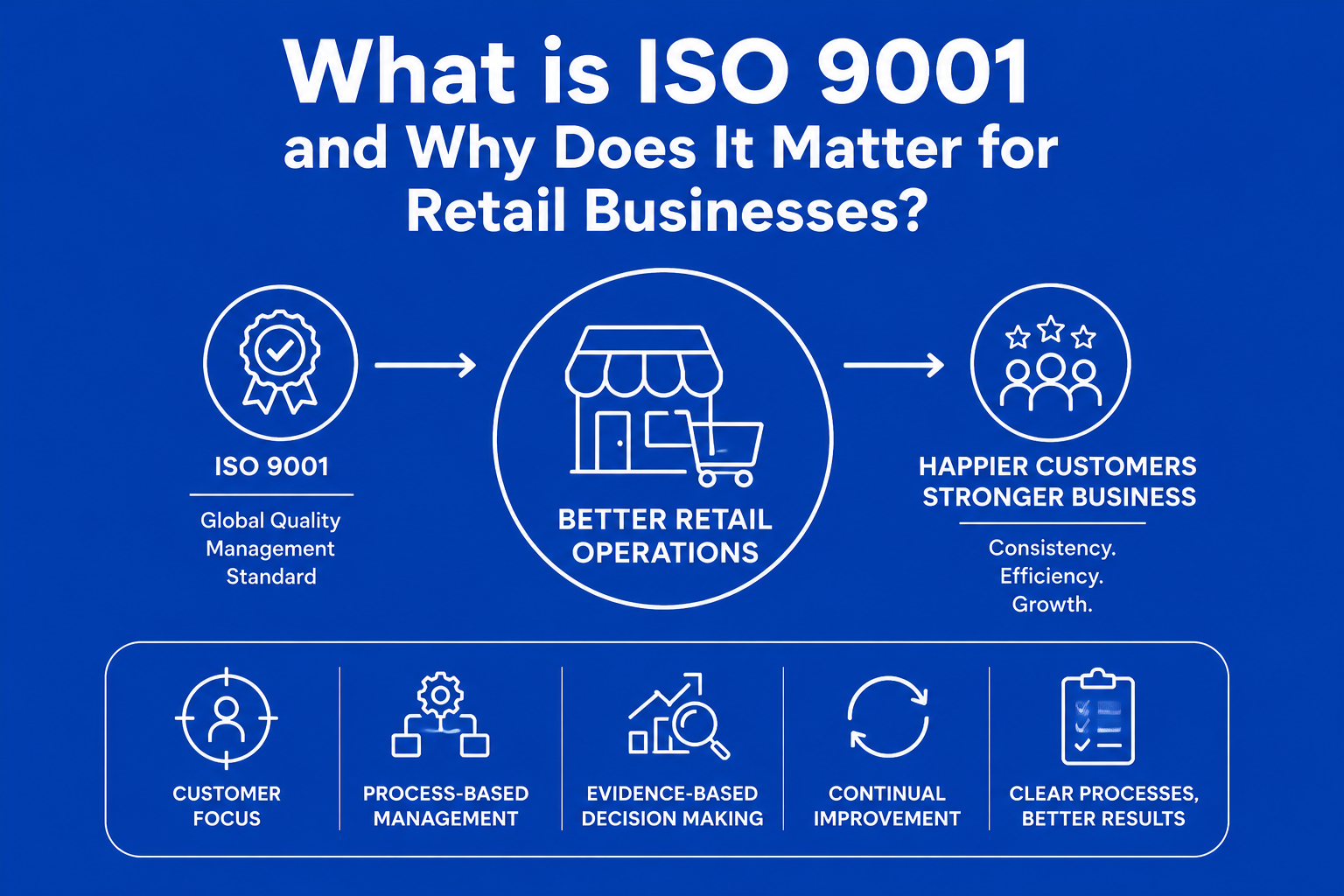
ISO 9001 gives your retail business a structured way to manage quality across your day-to-day operations. It is not only about the quality of the products you sell. It also covers the processes that shape how consistently you serve your customers.
In retail, customers expect the same level of service every time they interact with your business. ISO 9001 helps you create clear processes for areas such as inventory management, order handling, returns, customer complaints, and supplier management.
This becomes especially important when you operate across multiple stores, teams, or locations and need everyone to follow a consistent process.
For a retail business, quality also comes down to the experience you provide. A delayed order, incorrect product, poorly handled return, or unresolved complaint can all affect how customers see your business.
ISO 9001 helps you identify where these problems happen and put processes in place to reduce them.
Your processes need to keep up as your business changes. ISO 9001 encourages you to regularly review how things are working, identify recurring problems, and make improvements based on what you find.
This gives you a quality management system that can support your retail operations as they grow, rather than relying on different ways of working across teams or locations.

Implementing ISO 9001 is not just about earning a certification. It's about creating a retail operation that runs more smoothly, delivers a better customer experience, and is easier to manage as you grow. Here are some of the key benefits you can expect.
As a retailer, your success depends heavily on how customers feel after interacting with your business. If they can find the products they need, receive helpful service, and get their concerns resolved quickly, they are more likely to return.
ISO 9001 helps you put customers at the center of your processes. This means listening to their feedback, handling complaints properly, and improving the areas where their experience falls short.
However, maintaining that consistency is not always easy. Some common ISO 9001 implementation challenges, such as getting employees to follow the same processes, keeping teams properly trained, and managing quality across different stores or sales channels, can directly affect the experience you provide. Addressing these challenges early can help you deliver more consistent service and build stronger customer relationships over time.
If you manage multiple stores or sell through physical outlets, websites, and marketplaces, keeping the customer experience consistent can become difficult. Customers expect the same level of service wherever they interact with your brand.
This can become even harder as a smaller retail business starts to grow. Processes that were easy to manage with a small team may not work as well when you add new employees, locations, or sales channels. This is where ISO 9001 for small businesses helps by bringing more structure to everyday operations without losing sight of the customer experience.
With clear processes in place, your teams have a consistent way to handle orders, returns, customer service, and other day-to-day activities. As you grow, that consistency can make it easier to maintain the same quality standards across your retail operations.
When every store, platform, and team follows aligned quality standards, customers are more likely to experience the same reliability and service quality wherever they engage with your brand.
Few things frustrate customers more than finding out that a product is out of stock or unavailable after placing an order. At the same time, poor supplier performance can create disruptions throughout your business.
ISO 9001 encourages you to monitor supplier performance, define procurement processes, and regularly review inventory-related activities. This can help you improve stock availability, reduce errors, and build stronger relationships with suppliers.
Your employees play a major role in shaping the customer experience. When roles and responsibilities are unclear, mistakes and inconsistencies become more likely.
With ISO 9001, you can establish clear responsibilities, provide structured training, and ensure that everyone understands the processes they need to follow. This helps your team work more effectively while improving overall operational consistency.
Retail trends, customer expectations, and market conditions are constantly changing. What works today may not be enough tomorrow.
ISO 9001 promotes a culture of continuous improvement by encouraging you to regularly review performance, identify areas for improvement, and take corrective actions when needed. This helps your business stay agile and adapt to changing customer demands.
When customers, suppliers, or business partners see that your retail business follows internationally recognized quality management practices, it can strengthen their confidence in your business.
While certification alone does not guarantee success, it demonstrates your commitment to quality, consistency, and continuous improvement. In a competitive retail market, that commitment can help you stand out and build stronger long-term relationships with stakeholders.
As retailers explore certification, factors such as implementation timelines, process readiness, and ISO 9001 certification cost play a major role in decision-making.
The cost can vary depending on factors such as business size, number of locations, operational complexity, and certification scope.
While the investment is an important consideration, many businesses view it as a long-term step toward improving operational efficiency, reducing process gaps, and strengthening customer trust.

Successfully implementing ISO 9001 is not about changing everything overnight. The goal is to build processes that fit the way your retail business operates while creating a consistent experience for both your customers and employees. Here are some best practices to keep in mind.
Start by identifying the activities that have the biggest impact on your operations and customer experience. This may include inventory management, procurement, supplier coordination, customer service, returns, and complaint handling.
As you map and standardize these workflows, many retailers use the best ISO compliance software to centralize documentation, track process requirements, and improve visibility across teams. This can make it much easier to identify gaps and ensure everyone is working with the same standards.
When these processes are clearly documented, your team can follow consistent procedures more effectively and reduce unnecessary variations in how work gets done.
Your customers often provide the clearest indication of what's working and what needs attention. Pay close attention to reviews, complaints, surveys, and feedback received through your stores or online channels.
Instead of treating feedback as a one-time activity, use it to identify recurring issues and make meaningful improvements to your processes.
Even the best processes will not be effective if your team doesn't understand them. Make sure your employees know their responsibilities, understand quality expectations, and receive training whenever processes change.
Consistent training can help you reduce mistakes, improve service quality, and create a more reliable customer experience across your business.
To improve your operations, you first need to understand how they are performing. Track key metrics that are relevant to your retail business, such as customer satisfaction, stock availability, order accuracy, return rates, and complaint resolution times.
Regularly reviewing this data helps you identify trends, address issues early, and make more informed business decisions. In fact, one of the key benefits of ISO 9001 is its strong focus on performance monitoring and continuous improvement, helping retail businesses use data more effectively to strengthen operations and improve customer satisfaction.
Internal audits give you an opportunity to evaluate whether your processes are being followed as intended. They can help you identify gaps, uncover inefficiencies, and take corrective actions before they become larger problems.
Rather than viewing audits as a compliance exercise, think of them as a practical tool for maintaining quality and driving continuous improvement across your retail operations.
Managing ISO 9001 requirements can become challenging as your retail business grows. Documents need to be updated, audits must be tracked, corrective actions have to be completed on time, and quality processes need to remain consistent across locations. Handling all of this manually can quickly become time-consuming and difficult to manage.
P3 LogiQ helps you simplify ISO 9001 compliance by bringing your quality management activities into a single platform.

You can centralize important documents, maintain version control, and ensure your team always has access to the latest information. The platform also helps you track audits, manage corrective actions, and monitor compliance activities without relying on spreadsheets or scattered records.
Ready to see how it works?
Book a free demo or sign up with P3 LogiQ and discover how you can simplify ISO 9001 compliance, improve operational consistency, and build a stronger retail business with less administrative effort.
ISO 9001 is an internationally recognized Quality Management System (QMS) standard that helps retail businesses establish consistent processes, improve operational efficiency, and enhance customer satisfaction. It provides a framework for managing quality across different areas of the business.
No, ISO 9001 certification is not mandatory for most retail businesses. However, many retailers choose to implement it because it can help improve internal processes, strengthen customer trust, and demonstrate a commitment to quality management.
ISO 9001 encourages you to monitor customer feedback, address complaints systematically, and continuously improve your processes. This can help you deliver a more consistent shopping experience and respond more effectively to customer needs.
Yes. ISO 9001 can be implemented by retail businesses of all sizes, including small and medium-sized retailers. The standard is flexible and can be adapted to fit the size, complexity, and objectives of your business.
Yes. ISO 9001 can be applied to brick-and-mortar stores, eCommerce businesses, and retailers operating through multiple sales channels. The focus is on improving processes and maintaining consistent quality across operations.
ISO 9001 can help improve processes such as inventory management, supplier evaluation, procurement, customer service, employee training, complaint handling, and quality monitoring. The exact scope depends on your business operations.
The timeline varies depending on the size of your retail business, the maturity of your existing processes, and the resources available for implementation. Some businesses may be ready within a few months, while others may require a longer preparation period.
For businesses operating multiple locations, ISO 9001 can help standardize processes, improve operational consistency, reduce variations in service quality, and provide better visibility into performance across stores.
ISO 9001 encourages you to establish criteria for selecting, evaluating, and monitoring suppliers. This can help improve supplier performance, reduce supply chain disruptions, and support more consistent product quality.
P3 LogiQ helps you manage documents, track audits, monitor corrective actions, and standardize quality processes from a centralized platform. This can reduce administrative effort, improve visibility into compliance activities, and help you stay prepared for ISO 9001 certification and surveillance audits.


Businesses need document management systems (DMS) to ensure ISO and R2 compliance, improve efficiency, and stay audit-ready. The article highlights key features like version control, security, and automation while reviewing the top 5 DMS solutions. P3 LogiQ stands out for its compliance-focused automation and secure document tracking
Read More
Recycling businesses gain efficiency, compliance, and sustainability with RIOS certification. It streamlines quality management, environmental responsibility, and worker safety, helping companies avoid legal risks and boost credibility. P3 LogiQ simplifies the certification process with automation, document control, and compliance tracking, making operations smarter and safer.
Read More
Audit Management Software (AMS) automates compliance tracking, streamlines workflows, and reduces audit risks. Key features include automated scheduling, compliance checklists, CAPA tracking, vendor risk management, and integrations.
Read More
Learn how audit management systems simplify ISO and R2 compliance by automating audits, managing documentation, and minimizing compliance risks efficiently.
Read More
In 2025, many businesses still face challenges in compliance management due to outdated methods like spreadsheets and fragmented software. This inefficiency leads to missed deadlines, increased risk, and regulatory penalties. The blog emphasizes the importance of modern compliance tools that automate workflows, enhance risk management, and streamline regulatory processes to meet ISO and R2 standards.
Read More
The rise in e-waste and environmental concerns makes responsible electronics recycling essential. The R2 Certification sets a global standard for safe, sustainable, and data-secure recycling practices. Developed by Sustainable Electronics Recycling International (SERI), R2 helps businesses manage environmental risks, data security, worker safety, and legal compliance.
Read More
Businesses face increasing challenges in managing complex regulatory compliance. Manual methods such as spreadsheets and paperwork can lead to missed deadlines, inefficiencies, and costly penalties. Compliance management software offers a streamlined solution to reduce risks, automate processes, and improve operational efficiency.
Read More
Maintaining R2 Certification is crucial for businesses in the e-waste recycling industry, ensuring regulatory compliance, sustainability, and strong stakeholder trust. This guide outlines 10 best practices to help businesses simplify operations, reduce risks, and stay compliant.
Read More
Unlock the value of ISO risk management certification. Explore its impact on compliance, risk mitigation, and business expansion.
Read More
Explore the top 5 ISO risk management software tools for 2025, including document management solutions for streamlined compliance and increased efficiency.
Read More
Find the ideal document management software (DMS) for your business. Learn how to choose with expert tips, key features, and insightful guidance
Read More
Unlock the power of a Document Management System (DMS). Learn how it can revolutionize your business operations.
Read More






.png)


.png)



.jpg)



.jpg)
.jpg)




.jpg)


.png)

.png)
.png)


.png)

