.png)
What does it actually cost your business when a worker gets hurt on site? It's rarely just the injury.
A single incident can mean a stalled project, a spike in your insurance premium, an OSHA investigation, or, in some cases, getting quietly dropped from a prequalification list before you even know why.
In an industry where nearly two-thirds of worker deaths trace back to just four preventable hazards (falls, struck-by incidents, electrocutions, and caught-in/between accidents), frequently categorized as OSHA's Focus Four Hazards, the real question isn't whether safety matters. It's whether your current approach can actually catch these risks before they turn into a claim, a citation, or a lost bid.
This is where ISO 45001 comes in. It's the international standard built specifically to help construction firms manage risk with an actual system, not a binder that sits in a site trailer.
In this blog, I'll walk through what an ISO 45001 construction safety management system really requires, how ISO 45001 fits into your existing OSHA obligations, and what ISO 45001 certification cost looks like.
If you’ve spent any time researching workplace safety standards, you’ve probably come across a wall of acronyms and vague descriptions. Let’s break it down simply.
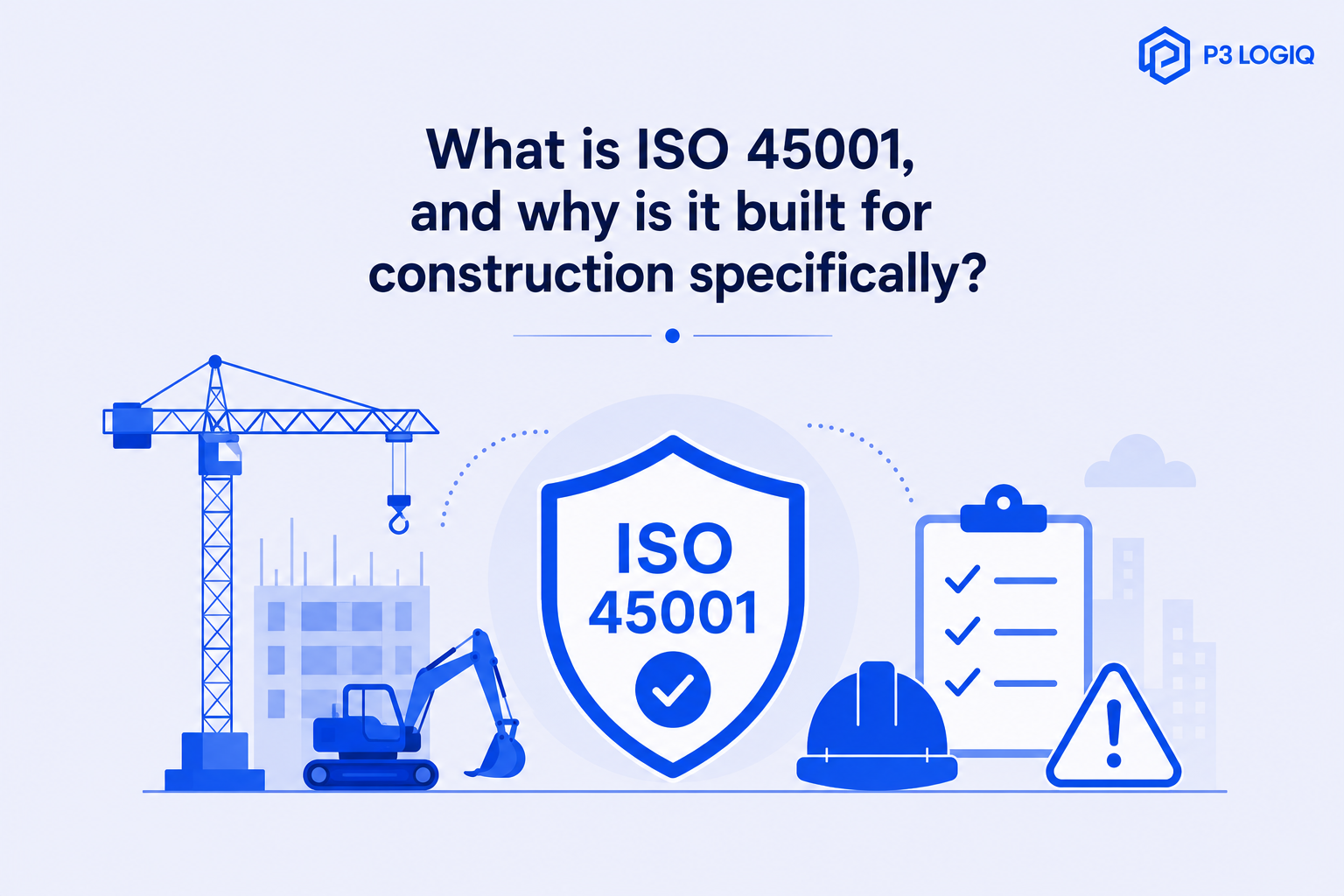
ISO 45001 is the international standard for occupational health and safety management systems. In simpler terms, it’s a structured way for a company to identify hazards, control risks, and continually improve its safety performance over time, rather than relying on whatever safety measures exist at a given site.
It was published in 2018 and has since become the global benchmark for how organizations manage worker safety, replacing the older OHSAS 18001 standard that many firms used before it.
Is ISO 45001 industry-specific?
No, it isn’t. The same standard applies to a software company and a steel fabrication plant. But the way it's applied varies completely depending on the work. For construction, that difference is significant, and it's important to understand before you assume this is just another generic compliance framework.
An ISO 45001 construction safety management system asks a company to do a few things consistently: identify hazards before they cause harm, involve workers in spotting and reporting risk, put controls in place that actually reduce that risk, and keep reviewing the whole system so it improves rather than stagnates.
It also requires leadership to own safety outcomes directly, rather than pushing responsibility down to a single safety officer with no real authority to make changes.
This is where the standard earns its relevance, specifically for the construction industry. A construction site isn't a fixed environment. It changes daily as work progresses, which means the hazards change too.
ISO 45001 is built to handle that kind of shifting risk profile, whether it's covering things like falls from height, struck-by incidents involving equipment or vehicles, electrocution risks from temporary power setups, excavation and trench collapses, or the coordination challenges that come from having multiple trades working the same space at once.
None of these are hypothetical. They're the same hazards behind most serious construction injuries every year, which is exactly why a systematic approach matters more here than in lower-risk industries.
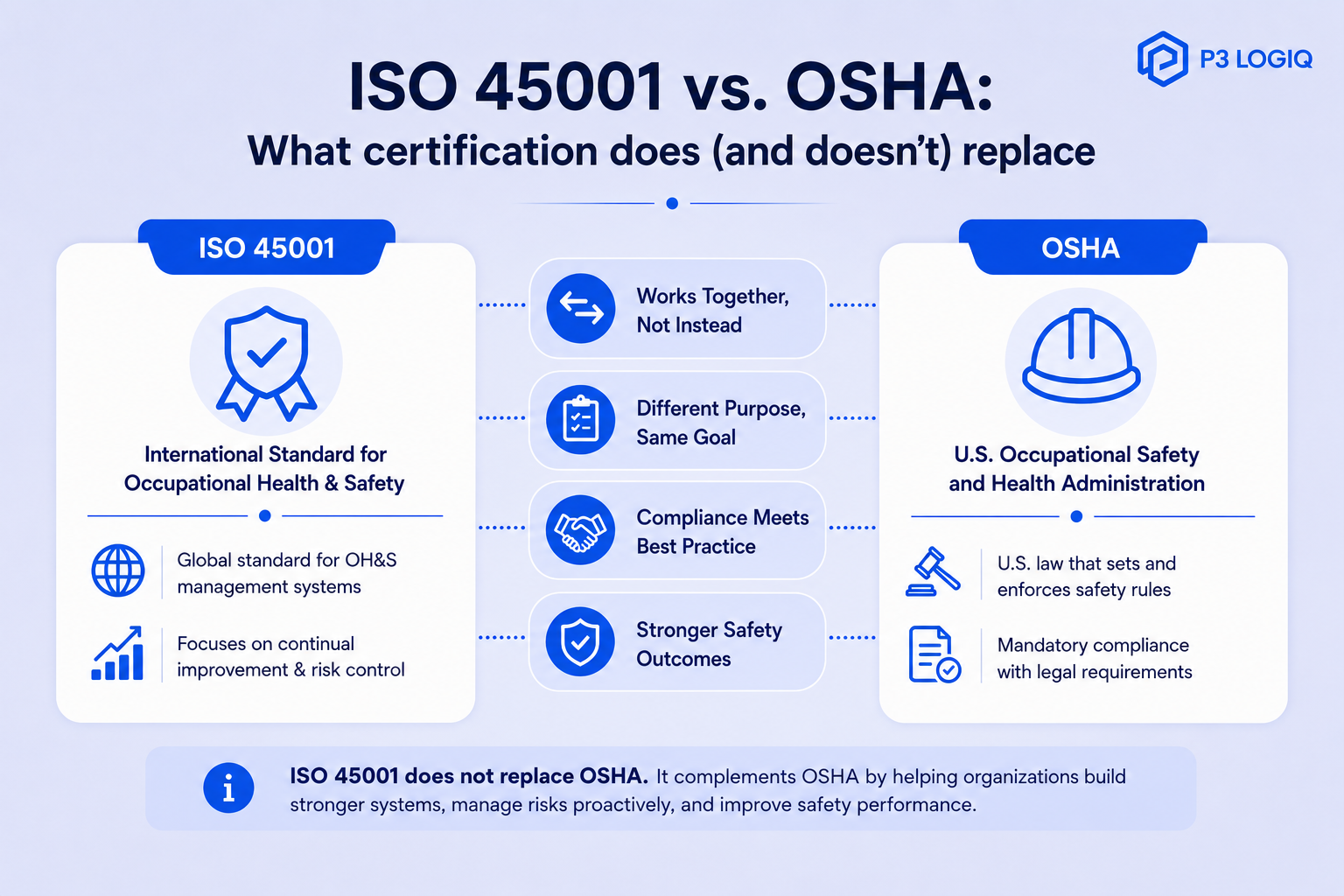
This is probably the first question on your mind, and it deserves a straight answer before we go any further. ISO 45001 does not replace OSHA. It doesn't exempt you from a single regulation, and no auditor, certification body, or piece of paper changes what OSHA can inspect you for. If you’re hoping this standard is some kind of shortcut around federal safety law, it isn't, and any blog that implies otherwise isn’t giving you the complete picture.
That said, the two aren't in competition either. They're solving different problems, and understanding that difference is what makes the rest of this guide actually useful.
OSHA is the law. It's a federal agency with the authority to set minimum safety requirements for every workplace in the country, inspect your sites, and issue citations or fines if you fall short. There's no opting out. If you run a construction business in the US, OSHA's rules apply to you whether you've heard of ISO 45001 or not.
ISO 45001 sits in a completely different category. It's a voluntary, internationally recognized standard that a company chooses to adopt. Nobody is going to fine you for not having it. What it gives you instead is a structured system for managing safety proactively, built around continuous improvement rather than a fixed list of rules to check off once a year.
Think of OSHA as the floor you're legally required to stand on and ISO 45001 as a framework for building something more solid on top of it.
Most firms pursuing an ISO 45001 construction safety management system are already trying to meet OSHA compliance requirements in practice. Certification doesn't undo that work. It just builds on it.
A solid OSHA compliance program gives you the raw material: hazard records, training logs, and incident history. ISO 45001 gives you the system to organize all of it, keep it current, and work on it, and that ongoing discipline is what ISO 45001 compliance actually looks like day to day, not just staying at the minimum required to pass an inspection.
The overlap is major too. Many of the things OSHA already expects from you come closely with what ISO 45001 asks for, just with more structure and more accountability built in. Treating the two as connected, rather than running them as separate programs, is generally what makes both work better in practice.
Your OSHA compliance strengthens because it's backed by an actual management system, and your ISO 45001 implementation becomes easier because you're not starting from scratch.
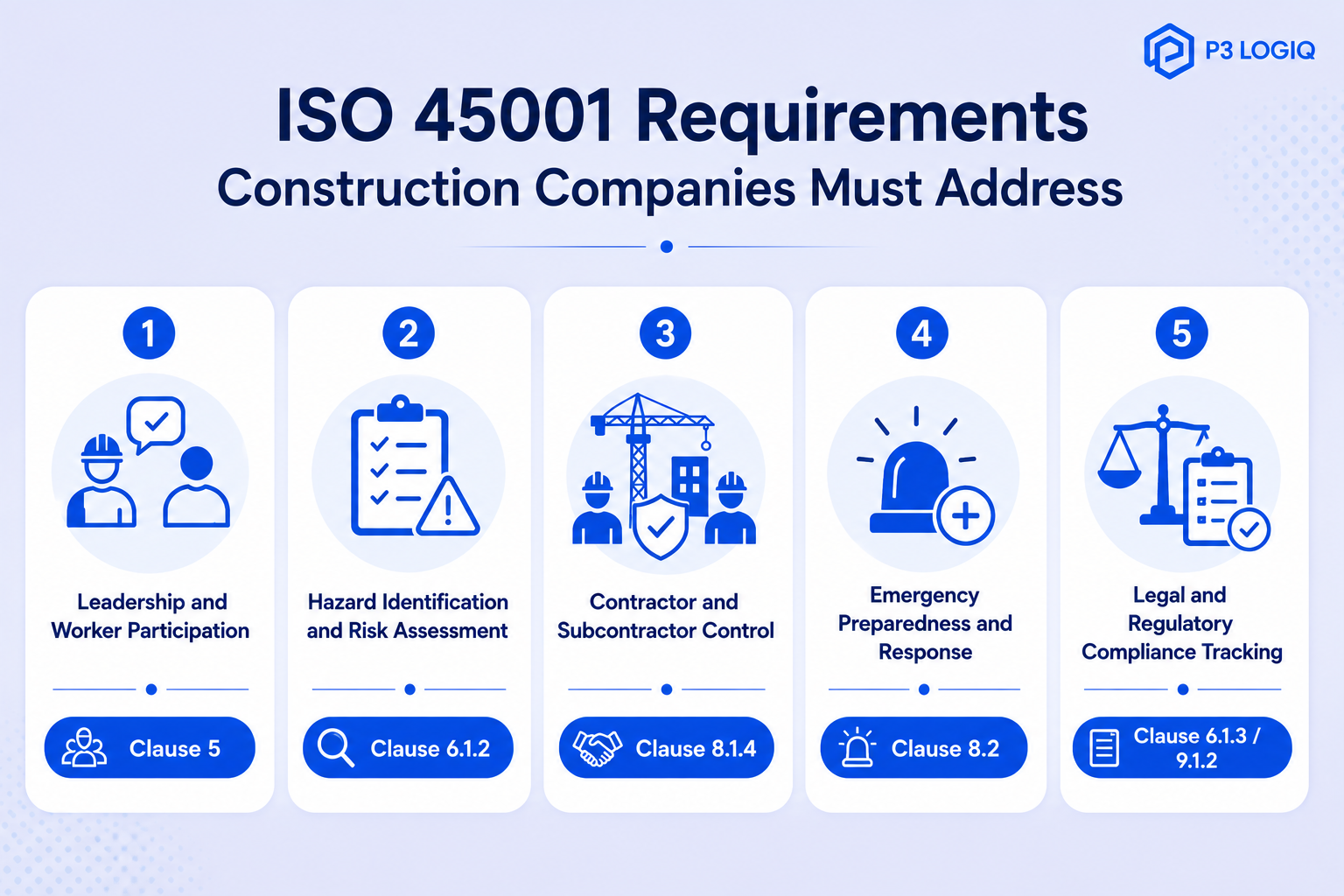
ISO 45001 isn't a vague philosophy about safety. It's a set of specific, auditable requirements, laid out across the ISO 45001 clauses, ten in total, each mapping to something concrete a construction firm actually deals with on site. Here's what the standard actually asks of you, broken down by what matters most for construction specifically.
This requirement is covered under Clause 5 of the standard and starts at the top. Ownership and senior management have to lead on safety actively, not just approve a policy and move on. That means providing resources, making sure safety is built into how projects actually run, and protecting workers who report hazards or refuse unsafe work from any pushback.
The other half of this clause is worker participation, and it's a bigger deal than it sounds. ISO 45001 doesn't just want workers informed. It wants them consulted and involved in decisions that affect their safety, whether that's through toolbox talks, safety committees, or a straightforward way to warn of hazards without red tape.
On a construction site, where the people closest to the risk are often the ones swinging the hammer or running the excavator, this input tends to catch problems that a policy written in an office never would.
Under Clause 6.1.2, your company has to proactively identify hazards before they cause harm, not just react after something goes wrong. For construction, this is where the standard earns its keep, because the hazard list is long and it doesn't sit still.
Falls from height, struck-by incidents, electrical risks from temporary power, excavation collapses, and the general chaos of multiple trades working in the same space all fall under this requirement.
The keyword is proactive. A risk assessment done once at the start of a project and never revisited doesn't meet the intent of this clause, especially on a site where conditions change week to week. ISO 45001 expects that assessment to stay current as the work itself changes.
This one's addressed under Clause 8.1.4, and it's arguably the requirement most specific to how construction actually operates. Almost no construction project runs with a single crew. You've got a general contractor, multiple subcontractors, and often temporary labor, all working under one roof with different levels of safety training and different safety cultures walking in the door.
Clause 8.1.4 requires your organization to manage that risk directly, making sure every party on site, not just your own employees, is working under a compatible standard of safety control.
That means accessing subcontractors before they're on-site, communicating your safety expectations clearly, and having a real process for catching gaps before they turn into incidents, rather than assuming everyone's on the same page by default.
Clause 8.2 requires a documented, tested plan for how your company responds when something goes wrong, whether that's a fall, a fire, a structural failure, or a medical emergency on site.
The standard doesn't just want a plan sitting in a binder. It expects that plan to be communicated to everyone on site, practiced, and updated based on what's actually learned from drills or real incidents.
For a construction site, this matters more than in most industries since emergencies here tend to develop fast, and the environment itself, scaffolding, heavy equipment, and multiple crews can complicate a response if it hasn't been thought through in advance.
Under Clause 6.1.3, your company has to determine every legal and regulatory requirement that applies to your OH&S system, and for construction, that list runs longer than most firms expect: federal OSHA standards, state-level safety regulations that can be stricter than federal ones, local building codes, and project-specific requirements tied to your jurisdiction.
Determining the requirements is only half the job. Clause 9.1.2 then requires you to periodically evaluate whether you're actually meeting them, not assume you are because nothing's gone wrong recently. For a firm running projects across multiple states or municipalities, this becomes one of the more demanding parts of the whole system and one of the easiest to let slip when it's tracked through scattered spreadsheets instead of a structured process.
Firms already running a quality system alongside this one often find that ISO 9001 starts to blur at the documentation level, where ISO 9001 vs ISO 45001 can help split this overlap apart.
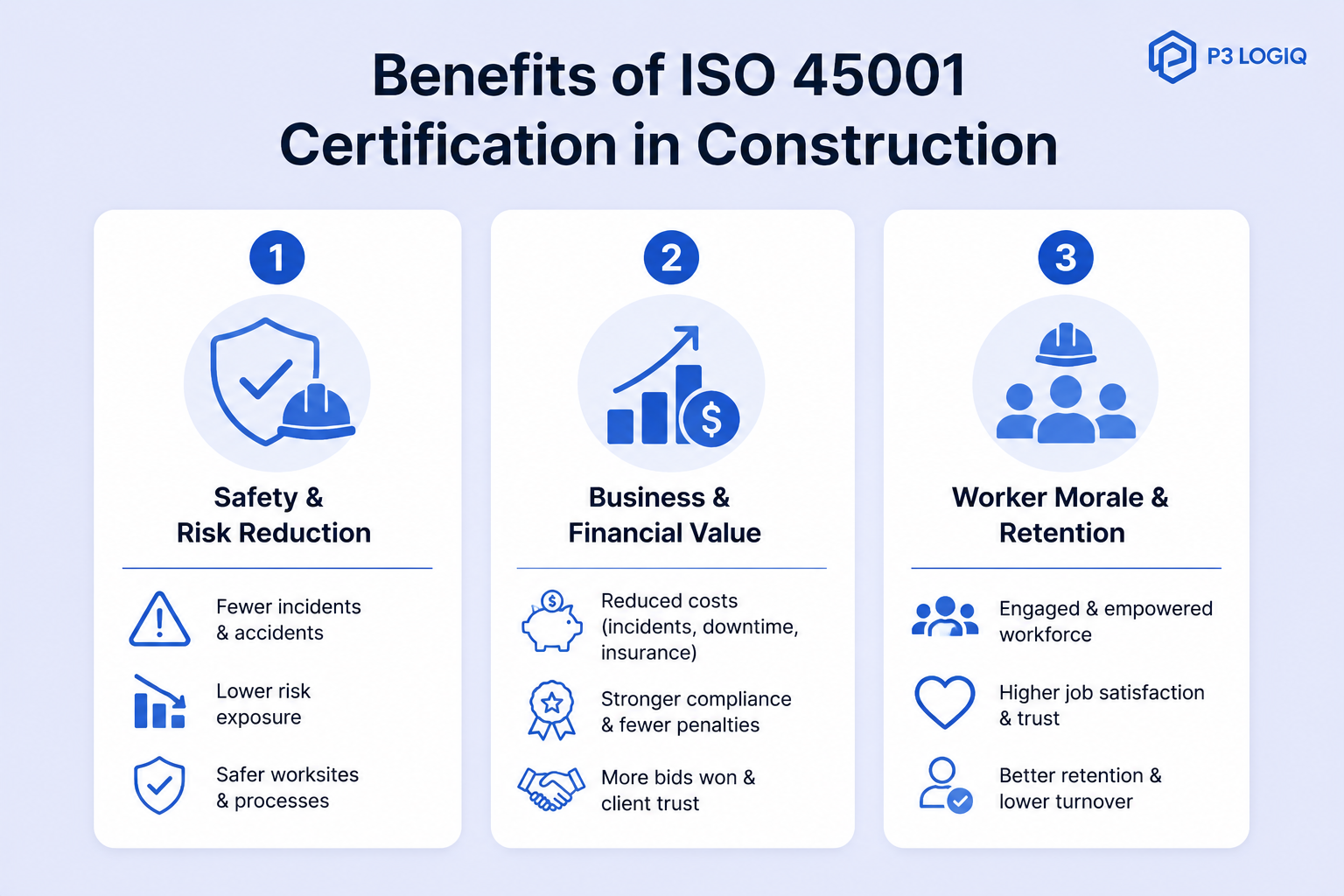
Certification takes real time and effort, so it's fair to ask what you actually get for it. The honest answer is that the benefits of ISO 45001 show up in three different places: fewer people getting hurt, real money on your books, and a workforce that sticks around. Here's how that breaks:
A systematic approach to hazard identification catches risks before they turn into injuries, which means fewer incidents on site and fewer opportunities for an OSHA citation in the first place.
Since ISO 45001 pushes you to document and control hazards proactively, you're also building a stronger paper trail that shows you're actively managing risk rather than reacting to it after something's already gone wrong.
No safety system eliminates every incident. What ISO 45001 changes is how your team responds when one happens. A tested, well-communicated emergency plan means the difference between a fast, controlled response and a chaotic one, and on a construction site, that gap can be the difference between a close call and a serious injury.
For a lot of construction firms, this is the benefit that actually moves the needle. General contractors and project owners increasingly vet subcontractors through prequalification platforms like ISNetworld, Avetta, and Veriforce before a bid is ever reviewed.
These platforms weigh your safety program heavily, and a certified OH&S management system gives you a documented, credible answer when they ask how safety is managed.
Referencing basic yet foundational frameworks like ISO standards compliance and certification helps clarify how core safety elements align with these prequalification requirements. Without it, you risk getting screened out before anyone even looks at your price.
Your Experience Modification Rate, or EMR, is a workers' comp multiplier based on your claims history. An EMR of 1.0 is average. Go above that, and your premiums climb, and worse, many prequalification platforms and GCs set EMR thresholds that can disqualify you from bidding entirely, regardless of your price or experience.
Since ISO 45001 is built to reduce incidents and claims over time, firms that implement it well tend to see their EMR trend down, which shows up directly on the bottom line.
OSHA's General Duty Clause requires every employer to keep the workplace free from recognized hazards, even when there's no specific standard covering that exact risk. It's a catch-all, and it applies to construction constantly.
A documented, actively managed OH&S system under ISO 45001 gives you real evidence that you took hazards seriously and acted on them, which matters if you ever need to defend your safety practices after an OSHA inspection or an incident investigation.
Construction has one of the highest turnover rates of any industry, and safety is a real part of why. Research backs up what most site supervisors already sense: workplaces with higher turnover tend to have more injuries, since newer workers are less familiar with site-specific hazards, and workers who stay longer build up safety awareness that a revolving crew never gets the chance to develop.
A strong, visible safety culture doesn't just prevent injuries. It gives workers a real reason to stay, which breaks a cycle that otherwise feeds on itself.
ISO 45001 requires more than informing workers about safety rules. It requires consulting them and involving them in decisions that affect their own safety.
That distinction matters. Understanding the differences between ISO 14001 vs ISO 45001 helps illustrate how managing internal worker risks compares to broader environmental compliance.
Workers who are asked for input, whether through toolbox talks, safety committees, or a straightforward way to flag hazards, tend to feel more ownership over the outcomes, and that sense of ownership is what turns a safety policy into an actual safety culture instead of a document that nobody reads.
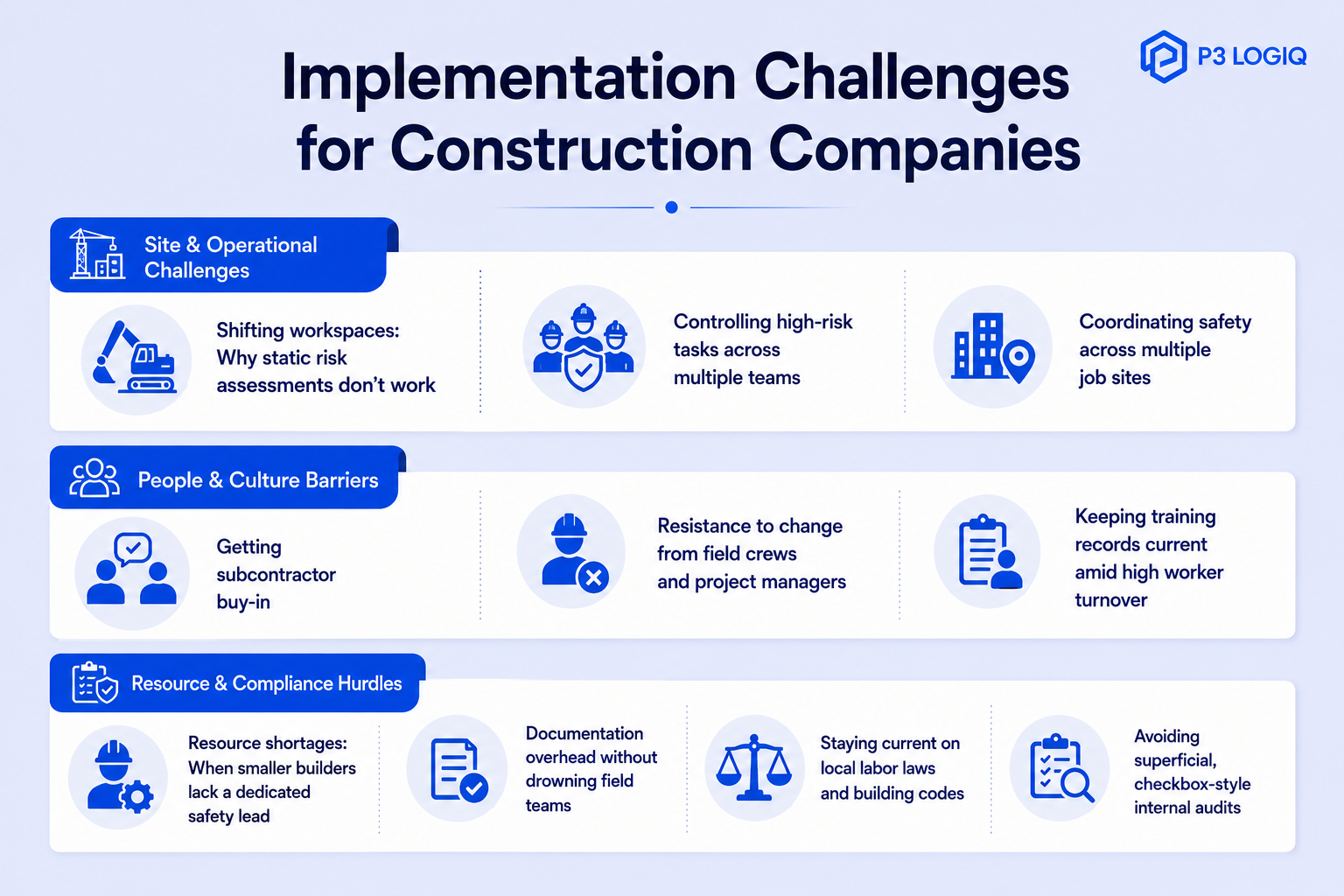
Implementing ISO 45001 well takes more than reading the standard and writing a policy. Most of the real difficulty does not show up on paper but in the field.
A construction site doesn't stay the same for long. What's a clear walkway in week one can be an excavation trench by week three.
A risk assessment done once at the start and never touched again stops reflecting the actual hazards on site quickly, which defeats the whole purpose of doing one. Managing these dynamic hazards often requires moving away from static spreadsheets and leveraging modern tools like best ISO 45001 software to track changing site conditions in real time.
Firms that treat risk assessment as a living process, not just a one-time form, tend to get far more out of ISO 45001 than firms that check the box and move on.
Falls, excavations, and heavy lifting each carry their own hierarchy of controls, and those controls need to be enforced consistently even when three different crews are working the same site at the same time.
Getting a framing crew, an electrical sub, and an excavation team all following the same safety hierarchy without stepping on each other is genuinely difficult, especially on tighter urban sites where space is already limited.
Most construction firms aren't running one project. They're running several, often in different cities or states, each with its own crew, site conditions, and local requirements.
Keeping a consistent safety standard across all of them, instead of safety quality varying by which superintendent happens to be running a given site, is one of the harder operational pieces of rolling out ISO 45001 at scale.
People & culture barriers
You can build the most thorough safety system in the industry and still have it fall apart the moment a subcontractor's crew shows up with different habits and no real reason to follow yours.
Getting subs to actually adopt your safety standards, rather than just nodding along during a pre-job briefing, takes clear expectations, real accountability, and follow-through, not just a signature on a contract.
This one's more human than procedural. Field crews and project managers under deadline pressure often see new safety protocols as friction that slows the job down, not protection that speeds it up. That resistance isn't unreasonable on its face.
It usually fades once people see that a well-run system prevents delays from incidents and rework, rather than causing them, but getting to that point takes time and visible proof, not just a memo.
Construction turnover is high, and every new hire needs safety training before they're fully up to speed on on-site hazards. When crews turn over constantly, training records can fall behind fast, and a training log that's out of date doesn't just create an audit problem. It means people are working around serious hazards without the training that's supposed to protect them.
Larger firms can often justify a full-time safety manager. Smaller builders frequently can't, and that's exactly why an ISO 45001 checklist for small businesses tends to look different in practice, which means implementation has to make sense to someone who's already stretched across estimating, scheduling, or operations.
That's not a reason to skip certification, but it is a real constraint worth planning around honestly, rather than assuming the workload will somehow sort itself out.
ISO 45001 does require real documentation, but there's a meaningful difference between documentation that supports the work and documentation that's just a pile of paperwork nobody reads.
Firms that implement this well build lightweight, practical records that field teams can actually keep up with. Firms that don't end up with a system that looks thorough on paper and gets ignored on site.
Labor laws and building codes don't stay fixed, and they vary by state and even by municipality. A firm running projects across multiple jurisdictions has to track changes in all of them, not just the ones near headquarters.
Falling behind here isn't just a compliance risk. It's an easy way to fail an ISO 45001 audit, since the standard expects you to actively track legal requirements.
Internal audits are supposed to catch real gaps before an external auditor does. Too often, they turn into a routine paperwork exercise; someone walks through a checklist, signs off, and nothing about actual field behavior gets examined.
That kind of audit gives a false sense of security and tends to surface problems for the first time during the real certification audit, which is the worst possible moment to discover them.
Getting certified isn't a single event. It's a sequence, and skipping steps or rushing through them tends to show up later, usually during the audit that actually matters. Here's the real order of operations.
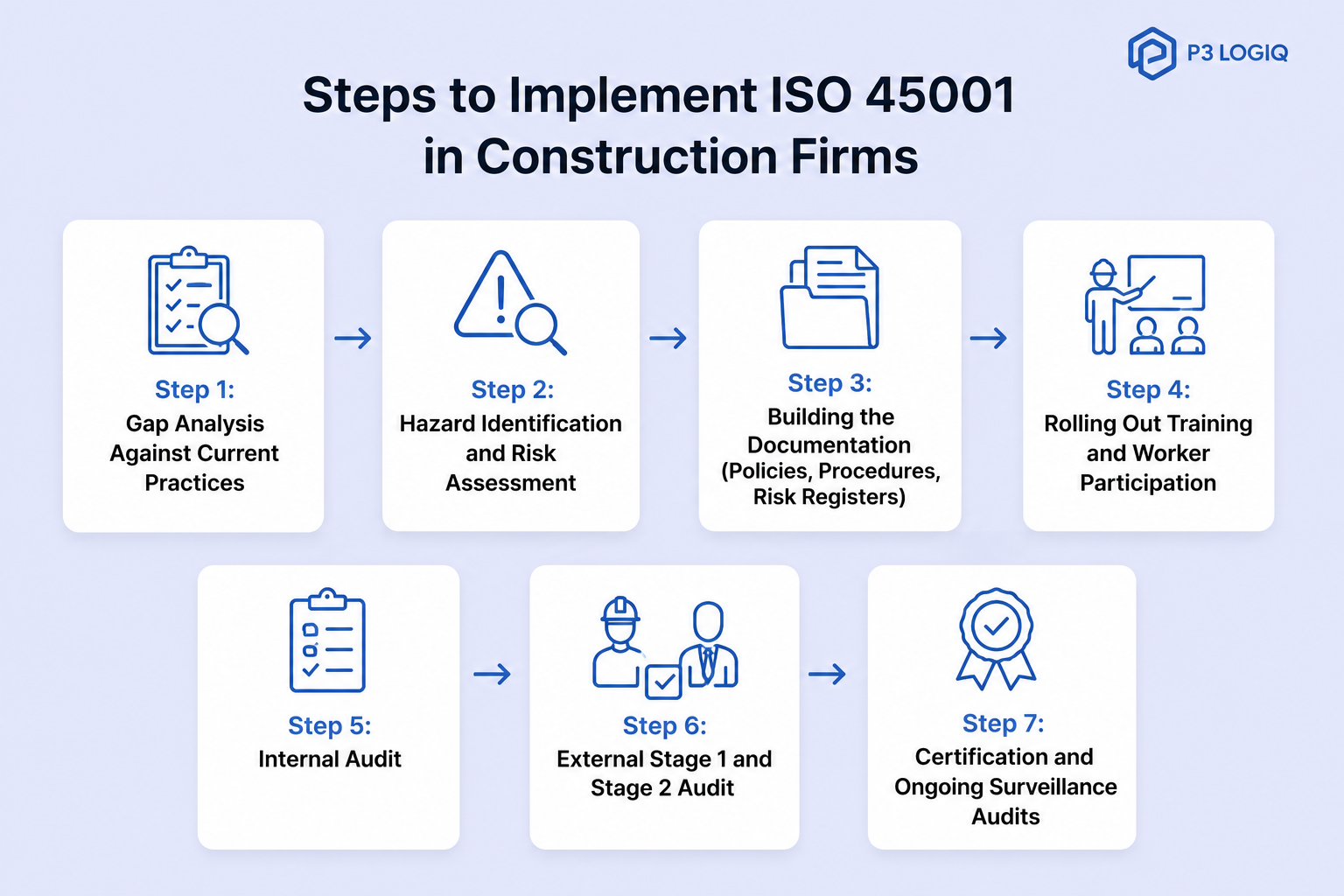
Before building anything new, you need an honest picture of where you stand. A gap analysis compares your current safety practices against what ISO 45001 actually requires, clause by clause, and tells you what's missing. Using structured software or an established baseline like how to get ISO 45001 certification helps clarify these clause requirements before mapping your existing workflows.
Most firms discover they're already doing more than they think in some areas and less than they assumed in others. This step sets the roadmap for everything that follows.
With the gaps mapped, the next step is building out a real hazard identification and risk assessment process specific to your work. For construction, this means systematically working through the actual risks on your sites, such as falls, excavation, electrical, and heavy equipment, rather than pulling a generic template off the internet and calling it done.
This is where the system gets written down: your OH&S policy, procedures for how hazards are managed, and risk registers that track what's been identified and how it's being controlled.
Good documentation here isn't about volume. It's about creating records that actually reflect how work gets done on your sites, since anything else falls apart the moment an auditor compares your paperwork to what's actually happening in the field.
A system nobody understands doesn't function. This step is about training your workforce on the new procedures and building real mechanisms for worker participation, toolbox talks, safety committees, and a straightforward way to report hazards so the system isn't just leadership's project.
This is also where resistance tends to surface and where getting genuine buy-in from field crews starts to matter more than it did on paper.
Before an external body ever sets foot on your site, you run your own internal audit against the ISO 45001 requirements. Done properly, this step catches real gaps while there's still time to fix them.
Done as a checkbox exercise, it gives you false confidence and pushes those same gaps straight into your certification audit, where they're far more costly to discover.
Certification happens through an accredited certification body, and it runs in two parts.
Stage 1 is a readiness review: the auditor checks your documentation and your scope and ckecks any obvious gaps before the real audit happens.
Stage 2 is the full on-site evaluation, where auditors interview your staff, observe actual site operations, and verify that what's documented matches what's really happening. This is the stage that determines whether you get certified.
Once certified, your certificate is valid for three years, but it's not a set-it-and-forget-it achievement. Your certification body will conduct annual surveillance audits during that cycle, shorter check-ins that sample parts of your system to confirm you're still operating it as intended, not just maintaining it for the day the auditor shows up.
At the end of the three-year cycle, a full recertification audit repeats the process to renew your certificate.
There's no single number here, and anyone who gives you one flat figure without asking about your company first is guessing. But the range is knowable, and it splits into three pieces worth understanding separately.
Every accredited certification body calculates audit time using the same international framework (IAF MD5), which means your price isn't arbitrary. It's driven by four things: how many employees you have, how many sites you're certifying, how high-risk your work is, and how complex your operations are.
Here's what that typically looks like over a full three-year certification cycle, covering the Stage 1 and Stage 2 audits plus annual surveillance:
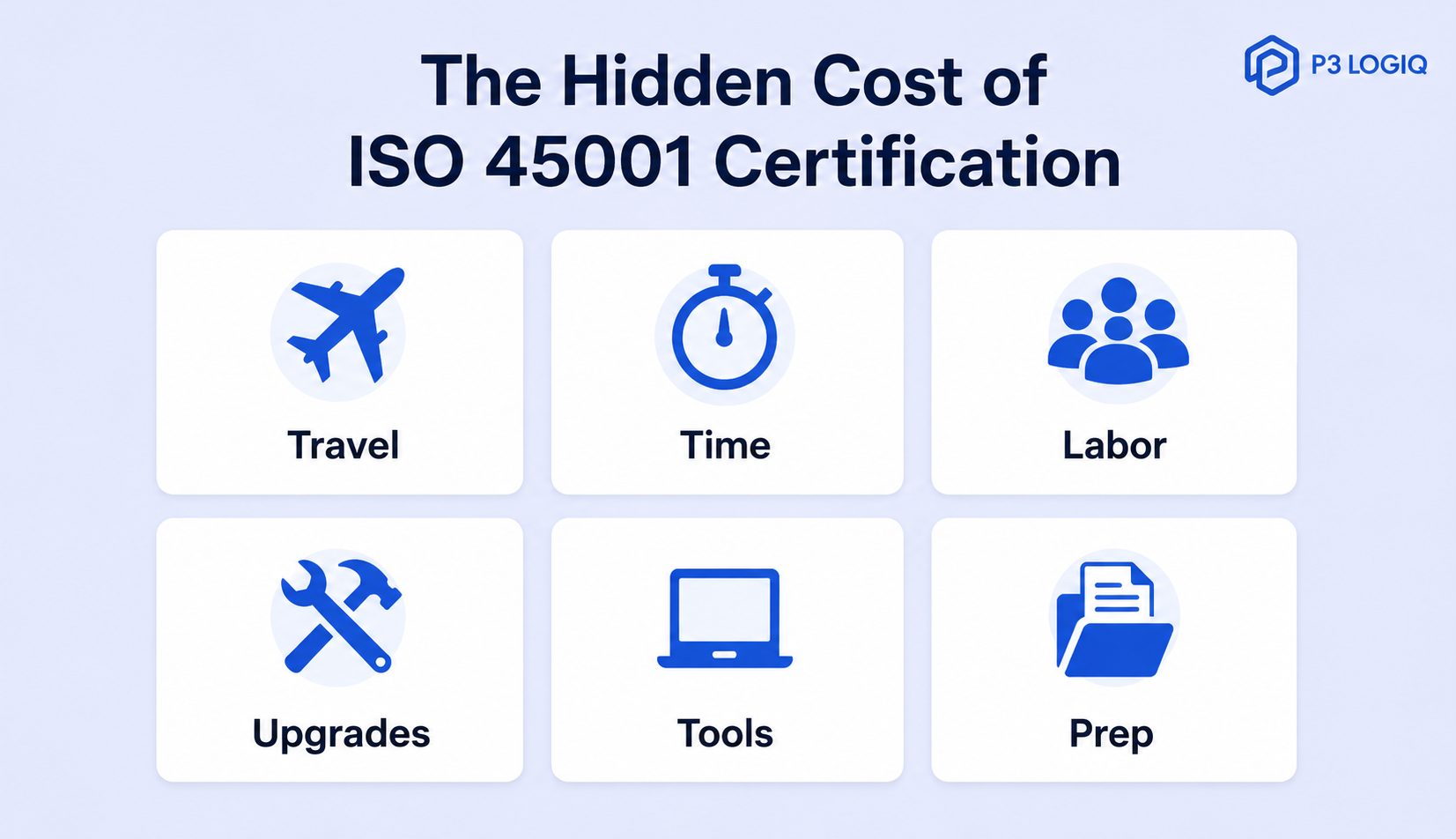
Certification body fees are only part of the number. What most firms underestimate is everything that has to happen before an auditor ever shows up.
This is where staff time, not audit invoices, tends to take the biggest chunk of the budget: hunting down the latest version of a document, chasing training records for a crew that turned over twice since the last update, or building out a risk register from scratch because nothing was tracked consistently before.
It's worth understanding why closing that gap pays off, not just what it costs. OSHA's own data shows that a structured, inspected safety program can produce a 9.4% drop in injury claims and an average 26% savings on workers' compensation costs over the following four years.
That's not a guarantee tied to ISO 45001 specifically, but it's a real, government-published data point for what a properly run safety system is worth financially, well beyond just staying out of trouble with an auditor.
This is exactly the gap compliance software like P3LogiQ is built to close. Instead of tracking documentation, risk registers, audits, and corrective actions across scattered spreadsheets and email threads, it centralizes all of it in one system built specifically for ISO compliance, including ISO 45001.
For a construction firm that's juggling multiple sites, subcontractors, and a workforce that turns over constantly, this isn't about replacing the certification body or skipping any of the real work. It's about spending less of your team's time on the manual tracking that takes hours every week, so more of your effort goes toward the parts of implementation that actually reduce risk on site.
Use this ISO 45001 checklist as a working reference, not a form to fill out once and forget. Each area below maps to a real clause in the standard, with a construction-specific action item to check yourself against.
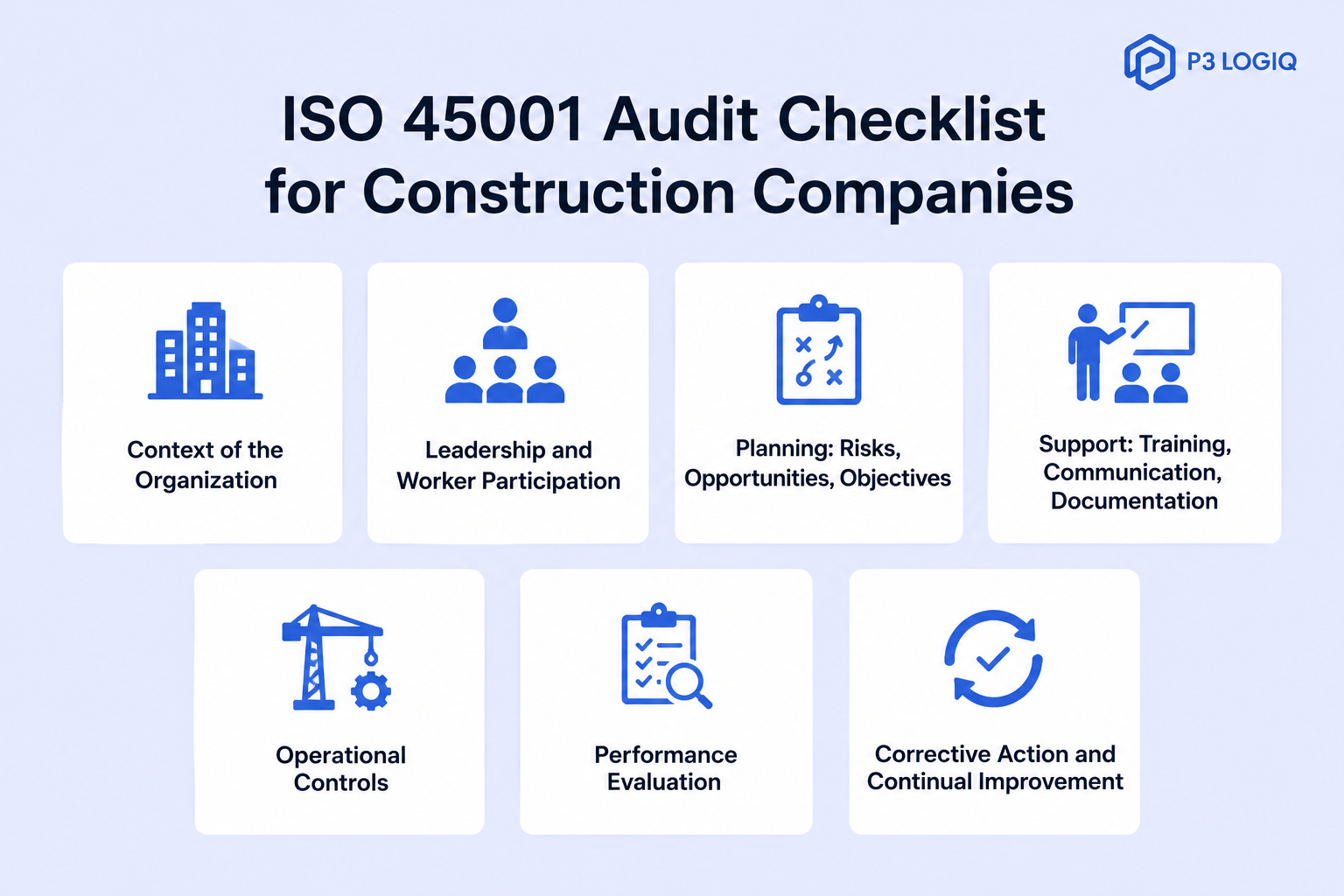
Does your documented scope actually cover every site type you run, not just the ones you had in mind when you wrote it?
Do your workers know how to report a hazard right now, without asking anyone first?
Was your highest-risk site's risk assessment updated this week or this quarter?
If a worker hired three weeks ago got hurt today, would their training record be current?
Before your last subcontractor started work, did anyone verify their safety practices, or just their price and schedule?
Did your last internal audit find anything, or did it just confirm everything looked fine?
Pick your last recorded near-miss accident. Was the root cause actually fixed or just noted?
This certification is all about staying up-to-date to keep relevance, and hence we think you should know about these changes and additions to it. Let’s discuss further:
In 2024, ISO 45001 was updated to require organizations to factor climate change into their hazard identification and risk assessment process. In plain terms, that means extreme heat, severe weather, and related environmental hazards now have to be treated as part of your formal OH&S planning, not as something separate from it.
This isn't an abstract addition. Extreme heat is already one of the more serious hazards on a construction site, and it's an active area of federal rulemaking right now, with OSHA working through a proposed heat illness prevention standard for outdoor and indoor workers.
A construction firm that's already accounting for climate-related risk under ISO 45001 is ahead of where that regulation is heading, not running to catch up once it's finalized.
Worth knowing before you invest heavily in documentation built entirely around the current version: ISO 45001-2027 is currently undergoing a scheduled five-year revision.
Early indications suggest the update will expand further into areas like mental health and psychosocial risk, alongside continuing to build on the climate-related requirements introduced in 2024.
That doesn't mean anything you implement now becomes obsolete. It means treating your OH&S system as something that evolves with the standard, not a document you finish once and file away, which is the same principle ISO 45001 asks of you in every other clause in this blog.
Getting an ISO 45001 construction safety management system in place comes down to one thing: catching risk before it turns into an injury, a lost bid, or a claim that follows you for years.
For any construction firm considering ISO 45001 for construction safety, especially one running multiple sites, managing subcontractors, and dealing with a workforce that doesn't always stay long enough to build up safety knowledge on its own, that kind of proactive process matters more than it does in lower-risk industries.
The business case holds up too. A lower experience modification rate means lower insurance premiums. Certification means you're not getting screened out of prequalification platforms like ISNetworld or Avetta before anyone's even reviewed your bid. And workers who trust how safety is handled on your sites tend to stay longer, which helps in an industry where turnover is a widely recognized, costly challenge.
None of this comes from writing a policy once and moving on. It comes from the kind of ongoing work this guide has walked through: hazard identification that stays current, training records that don't lag behind who's actually on site, and audits that catch real gaps instead of rubber-stamping what's already there.
The real test for any construction ISO 45001 program isn't whether your company can pass a single audit. It's whether you can build something that keeps catching risk long after the certificate's on the wall.
That's exactly what we built P3LogiQ for. We started this company to take the manual grind out of ISO compliance, so your team spends less time chasing paperwork and more time actually managing risk on site.
If you're ready to see what that looks like, we'd love to show you around. Book a demo, and we'll walk you through how it works for construction firms like yours. Or if you'd rather dive in yourself, sign up and start setting up your account today.
No. Certification doesn't replace or satisfy any OSHA requirement. OSHA compliance is legally mandatory, while ISO 45001 is voluntary and builds a management system on top of your existing compliance work. Getting certified doesn't exempt you from a single OSHA regulation.
Most small to mid-sized firms complete implementation and certification in six to twelve months, depending on how developed current safety practices already are. Firms starting with informal or undocumented processes typically need more time to build out the required documentation.
Certification body audit fees generally run $1,000 to $8,000 for small to mid-sized companies, plus $2,000 to $3,000 for annual surveillance audits. Add a consultant and expect $5,000 to $15,000 more. Total three-year costs typically fall between $10,000 and $50,000.
Yes. Many general contractors use prequalification platforms like ISNetworld, Avetta, and Veriforce to screen subcontractors before reviewing bids at all. A certified OH&S system, paired with a strong experience modification rate, is often what gets you past that screening stage.
Certification is usually held at the company level, so subs aren't automatically covered. But Clause 8.1.4 requires a certified GC to manage and verify that every subcontractor on site works under a compatible safety standard, certified or not.
Stage 1 is a readiness review, checking documentation and scope for gaps before the real assessment. Stage 2 is the full on-site audit, where auditors observe operations and interview staff to confirm that reality matches the paperwork. Stage 2 decides certification.
Yes. Certification runs on a three-year cycle, with annual surveillance audits confirming you're still operating the system as intended. At the end of the three years, a full recertification audit is required to renew your certificate and keep it valid.
For most small firms, yes, especially if you regularly bid on projects requiring prequalification or your EMR affects insurance costs. It takes real investment in time and documentation, but the payoff shows up in fewer incidents and better bid access.
It doesn't mean starting over. The certification body issues a list of nonconformities, and the firm generally gets 30 to 90 days to submit corrective evidence before a follow-up review. Unresolved major nonconformities can push certification back until the gaps are fully closed.
Yes, but scope matters. Multi-site certification is possible under a single certificate, and auditors typically sample a subset of sites each cycle rather than visiting every location. Adding a site type that wasn't part of the original scope usually requires an extension audit first.



Businesses need document management systems (DMS) to ensure ISO and R2 compliance, improve efficiency, and stay audit-ready. The article highlights key features like version control, security, and automation while reviewing the top 5 DMS solutions. P3 LogiQ stands out for its compliance-focused automation and secure document tracking
Read More
Recycling businesses gain efficiency, compliance, and sustainability with RIOS certification. It streamlines quality management, environmental responsibility, and worker safety, helping companies avoid legal risks and boost credibility. P3 LogiQ simplifies the certification process with automation, document control, and compliance tracking, making operations smarter and safer.
Read More
Audit Management Software (AMS) automates compliance tracking, streamlines workflows, and reduces audit risks. Key features include automated scheduling, compliance checklists, CAPA tracking, vendor risk management, and integrations.
Read More
Learn how audit management systems simplify ISO and R2 compliance by automating audits, managing documentation, and minimizing compliance risks efficiently.
Read More
In 2025, many businesses still face challenges in compliance management due to outdated methods like spreadsheets and fragmented software. This inefficiency leads to missed deadlines, increased risk, and regulatory penalties. The blog emphasizes the importance of modern compliance tools that automate workflows, enhance risk management, and streamline regulatory processes to meet ISO and R2 standards.
Read More
The rise in e-waste and environmental concerns makes responsible electronics recycling essential. The R2 Certification sets a global standard for safe, sustainable, and data-secure recycling practices. Developed by Sustainable Electronics Recycling International (SERI), R2 helps businesses manage environmental risks, data security, worker safety, and legal compliance.
Read More
Businesses face increasing challenges in managing complex regulatory compliance. Manual methods such as spreadsheets and paperwork can lead to missed deadlines, inefficiencies, and costly penalties. Compliance management software offers a streamlined solution to reduce risks, automate processes, and improve operational efficiency.
Read More
Maintaining R2 Certification is crucial for businesses in the e-waste recycling industry, ensuring regulatory compliance, sustainability, and strong stakeholder trust. This guide outlines 10 best practices to help businesses simplify operations, reduce risks, and stay compliant.
Read More
Unlock the value of ISO risk management certification. Explore its impact on compliance, risk mitigation, and business expansion.
Read More
Explore the top 5 ISO risk management software tools for 2025, including document management solutions for streamlined compliance and increased efficiency.
Read More
Find the ideal document management software (DMS) for your business. Learn how to choose with expert tips, key features, and insightful guidance
Read More
Unlock the power of a Document Management System (DMS). Learn how it can revolutionize your business operations.
Read More







.png)


.png)





.jpg)




.jpg)
.jpg)












.jpg)



.png)

.png)
.png)





.png)

