.png)

A machine operator loses two fingers after a safety guard is removed for a quick repair and never replaced. At another facility, a forklift hits a worker at a blind corner that was overlooked during the last safety inspection.
Incidents like these show why ISO 45001 compliance, the world’s leading standard for occupational health and safety (OH&S) management systems, is so important.
This blog covers everything manufacturers need to know about ISO 45001 certification in 2026: what the standard requires, how ISO 45001 clauses apply in the workplace, what certification costs, where companies commonly face problems during audits, and what the upcoming ISO 45001:2027 revision could mean for your business.
ISO 45001 is an international standard for managing workplace health and safety. It was published by the International Organization for Standardization in March 2018 and replaced OHSAS 18001, which had been widely used for many years.
The standard gives your business a clear way to identify workplace hazards, reduce risks, and prevent injuries, illnesses, and deaths.
ISO 45001 compliance is more than a checklist for passing an audit. It requires your business to create a proper safety system with clear policies, procedures, and responsibilities. These are required to be followed throughout the year by you. The goal is to make workplace safety part of everyday operations.
The standard uses a structure similar to ISO 9001 for quality management and ISO 14001 certification for environmental management. This means if you already use these standards, you can add workplace safety to your existing systems instead of building everything from scratch.
ISO 45001 certification is voluntary. However, more manufacturers are finding that it can help them meet customer requirements, pass supplier checks, and win new contracts.
Your factory faces more safety risks than an office or retail store. Every day, your workers may deal with moving machinery, forklifts, chemicals, confined spaces, loud noise, repetitive tasks, and rotating shifts.
A serious injury can affect more than your worker. It can lead to compensation claims, investigations, production delays, and legal problems.
ISO 45001 helps you identify these risks before they turn into accidents. It gives you a structured way to manage workplace safety and make it part of your everyday operations. And this where it really matters for manufacturers:
Identify hazards early and take steps to prevent such accidents.
Workplace injuries can result in medical expenses, compensation claims, legal fees, and lost production time.
Fewer accidents mean less disruption to your production lines and daily operations.
ISO 45001 certification can help you meet safety requirements when working with larger companies and industries.
Many customers may want to assess your health and safety practices before approving you as a supplier.
Certification demonstrates to workers, customers, insurers, and regulators that safety is built into how you operate.
In industries such as automotive, construction, energy, and defense, ISO 45001 certification can improve your chances of qualifying for new contracts.
The financial impact of workplace injuries can be significant for you. The NSC's Work Injury Costs Report reported that the total cost of work injuries in 2024 was $181.4 billion.
OSHA’s Business Case for Safety and Health article also estimates that employers in the U.S. spend more than $1 billion every week on direct workers' compensation costs for disabling workplace injuries.
For you, preventing an accident is not just about meeting a safety requirement. It can protect your workers, keep your operations running, and avoid costs that can quickly add up.

OHSAS 18001 was the one that was used for workplace safety management for more than 20 years before ISO 45001 replaced it. Organizations with OHSAS 18001 certification had until March 2021 to move to ISO 45001. It is no longer a recognized certification standard.
The change was significant enough for you to know the difference too. ISO 45001 changed how companies are expected to manage workplace safety.
With OHSAS 18001, workplace safety could be treated as the responsibility of the safety team. But ISO 45001 takes more of a broader approach.
Your senior management needs to take responsibility for safety.
Your employees should be involved in identifying problems and improving safety.
You are expected to look for potential problems before they cause an accident.
Safety requirements also extend to contractors and outsourced activities.
It is not just the job of one safety officer. Managers, supervisors, and workers all have a role to play.

ISO 45001 can help you improve workplace safety while also supporting smoother operations and stronger business relationships.
Identifying hazards and addressing risks before they cause accidents can help you create a safer workplace. The standard also gives you a clear process for reporting and investigating incidents.
ISO 45001 gives you a much clearer way to manage safety responsibilities, training, procedures, and records. This helps keep safety practices consistent across your plant.
Reviewing workplace hazards can help you spot problems in your processes. Fixing these issues can reduce disruptions and help your production run more smoothly.
Customers in industries such as automotive, construction, energy, and government supply chains may require suppliers to meet specific safety standards. ISO 45001 certification can help you meet these requirements.
Certification shows your customers that you have a structured approach to workplace safety. It can give them greater confidence in your company as a supplier.
Fewer workplace incidents can mean fewer compensation claims, investigations, legal costs, and production delays. Implementing strong ISO risk management software can help you automate safety protocols and prevent these problems.
Workers are more likely to value your workplace, as it takes safety seriously. Proper training, clear procedures, and opportunities to raise concerns can help create an even safer workplace for them.

There are plenty of misconceptions about ISO 45001, especially around who really needs it, what certification actually involves, and what really happens after you get certified.
Fact: Any organization can get ISO 45001 certification. It is used by manufacturers, logistics companies, healthcare organizations, offices, and many other types of businesses.
Fact: ISO 45001 helps you identify and reduce workplace risks, but it cannot guarantee that accidents will never happen. The goal is to prevent incidents and improve how safety risks are managed. And learning how to get ISO 45001 certification helps establish structured processes so teams can prevent incidents and manage risks proactively.
Fact: You need to keep your safety system running after certification. Regular audits, reviews, risk assessments, and improvements are all part of maintaining your certification.
Fact: ISO 45001 introduced important changes, including greater management involvement, stronger worker participation, and broader consideration of contractors and external activities.
Fact: Businesses of different sizes can get certified. The cost depends on factors such as your company size, number of sites, existing systems, and the complexity of your operations.
Fact: ISO 45001 does not require you to hire a dedicated safety manager. You need clearly defined responsibilities and competent people who can manage the required safety activities.

ISO 45001 is built from ten clauses. The first three are background and definitions. Auditors won’t test conformity against them directly. Clauses 4 to 10 hold the real requirements an auditor will actually be checking.
These clauses contribute only to introducing the standard and explaining key terms such as worker, hazard, risk, and incident. They provide the basic framework for you to understand the requirements that follow.
You need to understand the factors that can actually affect safety in your workplace, including your workers, processes, equipment, legal requirements, and contractors. You also define which sites and activities your safety system covers.
Referencing an internal ISO 45001 checklist helps ensure you properly define which sites and activities your safety system covers.
Your management team must take an active role in workplace safety. Workers must also have a chance to report hazards, raise concerns, and participate in safety decisions.
You need to identify workplace hazards, assess the risks they create, and decide how to control them. This clause also covers legal requirements and setting measurable safety objectives.
Your safety system needs the right people, resources, training, and communication. Workers should have the skills and knowledge needed to carry out their jobs safely.
This clause covers the safety controls you use during daily operations. Depending on your workplace, this can include machinery safety, lockout/tagout, confined spaces, hot work, contractors, procurement, and emergency procedures.
You need to regularly check whether your safety system is working. This includes monitoring safety performance, checking legal compliance, conducting internal audits, and reviewing results with management.
When something goes wrong, you need to investigate the cause, take corrective action, and check that the problem has been properly addressed. You should also continue looking for ways to improve workplace safety.
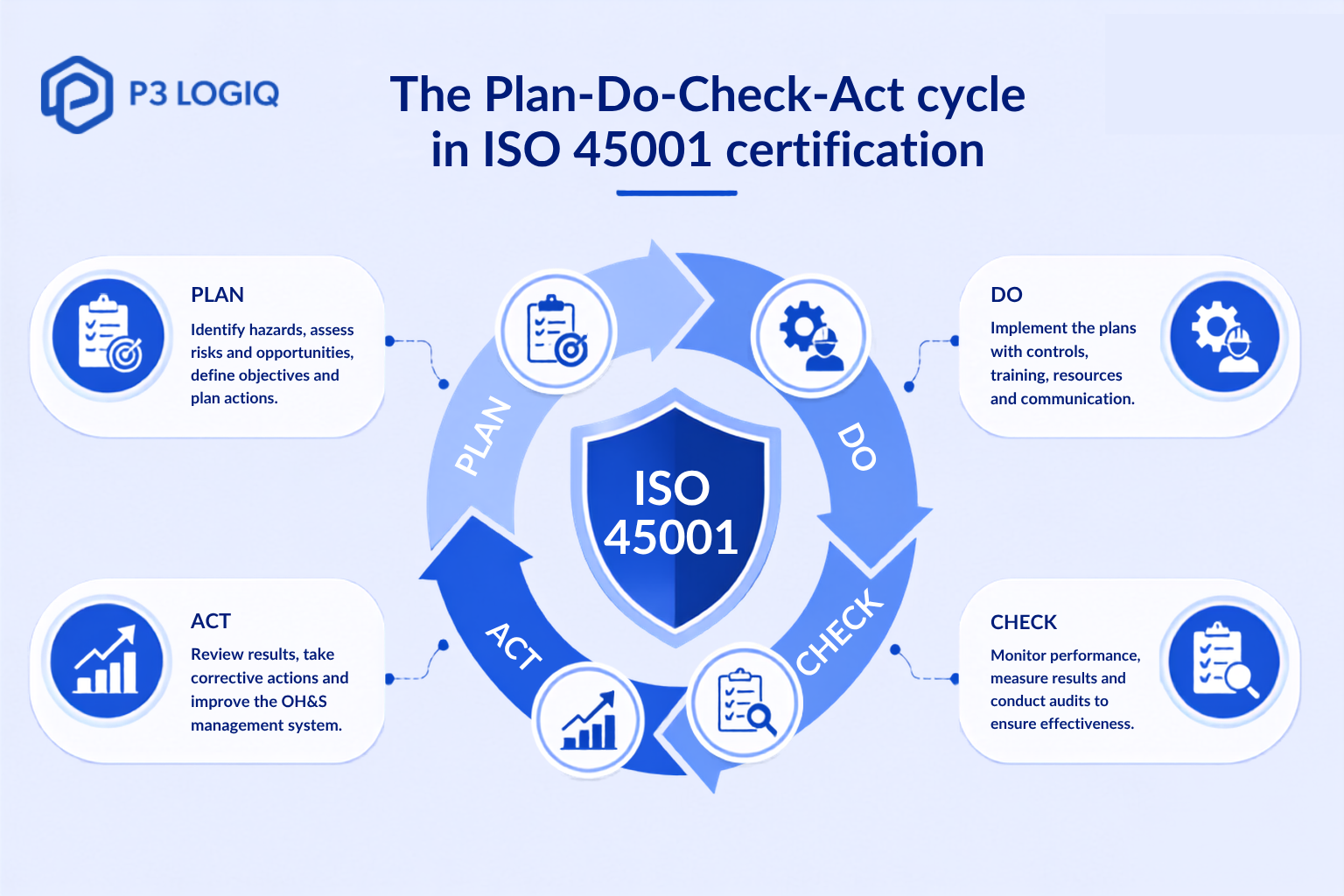
ISO 45001 follows the plan-do-check-act (PDCA) cycle. Each stage connects to specific clauses in the standard and helps you manage workplace safety as an ongoing process.
This is where you understand your workplace, identify safety risks, and decide what needs to be done.
This is where you put your safety plans into practice.
This is where you check whether your safety system is actually working.
This is where you fix problems and make improvements.
ISO 45001 goes beyond the factory gate. Clause 8.1.4 requires you to consider the safety risks linked to contractors, suppliers, and outsourced work. If a contractor's unsafe work puts your employees at risk, it becomes part of your safety responsibility too.
Follow these steps to ensure their safety:
If you outsource maintenance, cleaning, logistics, or other activities, those activities still need to be managed as part of your safety system.
A common mistake is focusing only on direct employees during safety checks. Contractors may be working on the same shop floor and facing many of the same risks, so they need to be included in your safety processes too.
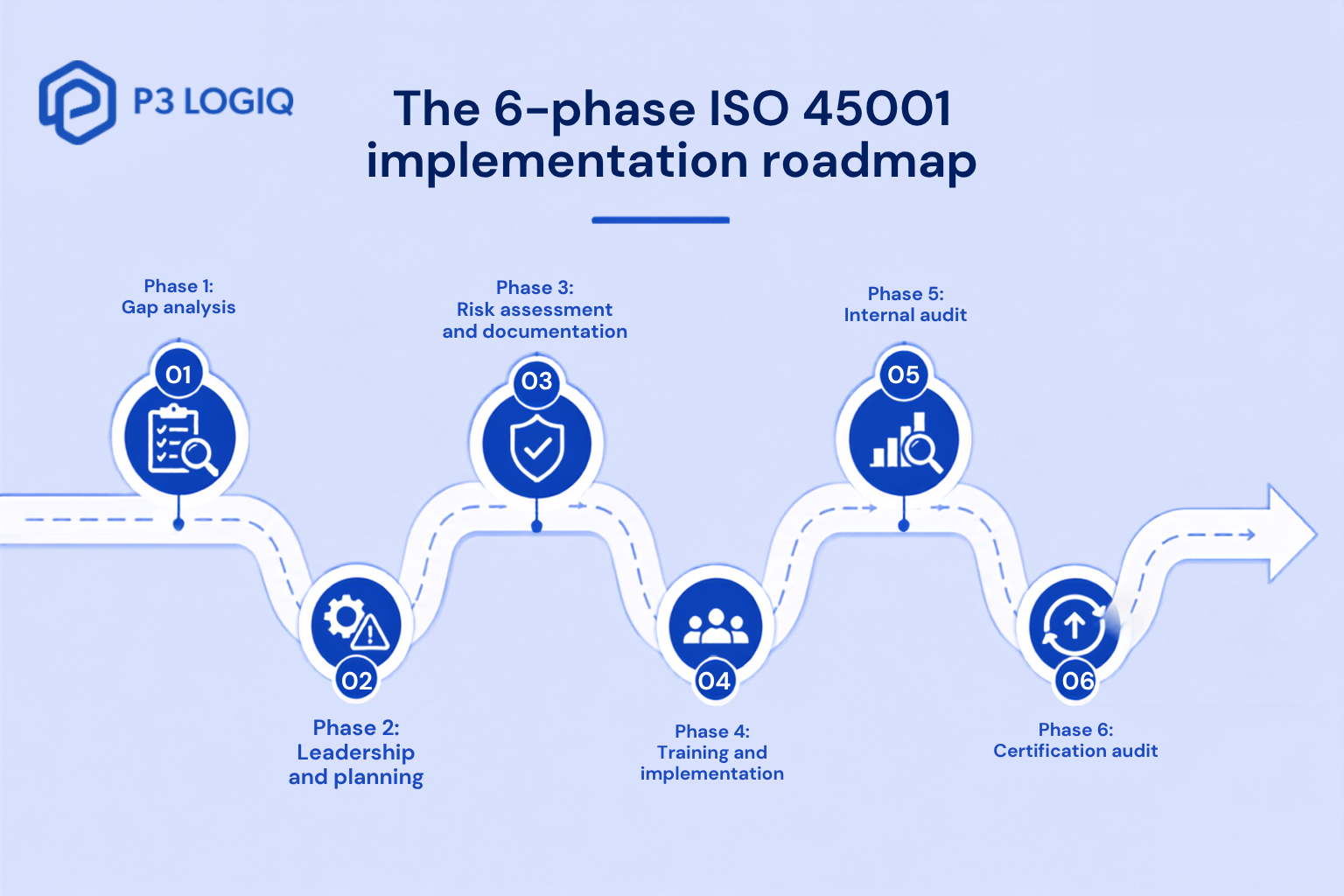
Getting ISO 45001 certification is easier when you break the process into clear steps. The exact timeline depends on your plant's size and existing safety practices, but a single-site manufacturer starting from scratch will usually need six months to a year.
Start by checking what you already have against ISO 45001 requirements. You may already have machine guards, PPE, safety training, inspections, or incident reporting in place. The gap analysis shows you what is missing and what needs to be improved.
Your management team needs to commit to the process, approve the OH&S policy, assign responsibilities, set a budget, and create a realistic timeline. Without management support, certification can easily become the responsibility of one person instead of the whole organization.
Identify hazards across your entire plant, including production, maintenance, storage, and loading areas. Assess the risks and put the necessary controls in place. You also need to prepare documents such as your legal requirements, safety objectives, and required procedures.
Put your new safety controls into practice and train workers on what has changed and what they need to do. This is also when you establish ways for workers to report concerns and participate in safety decisions.
Before the certification audit, conduct your own internal audit against ISO 45001. Finding and fixing nonconformities early is essential to control your total ISO 45001 certification cost and avoid extra audit fees. Ideally, the person conducting the audit should be properly trained and independent of the area being audited.
The external certification audit takes place in two stages:
If you pass Stage 2, you receive your ISO 45001 certification. Certification is generally valid for three years, with surveillance audits during that period.
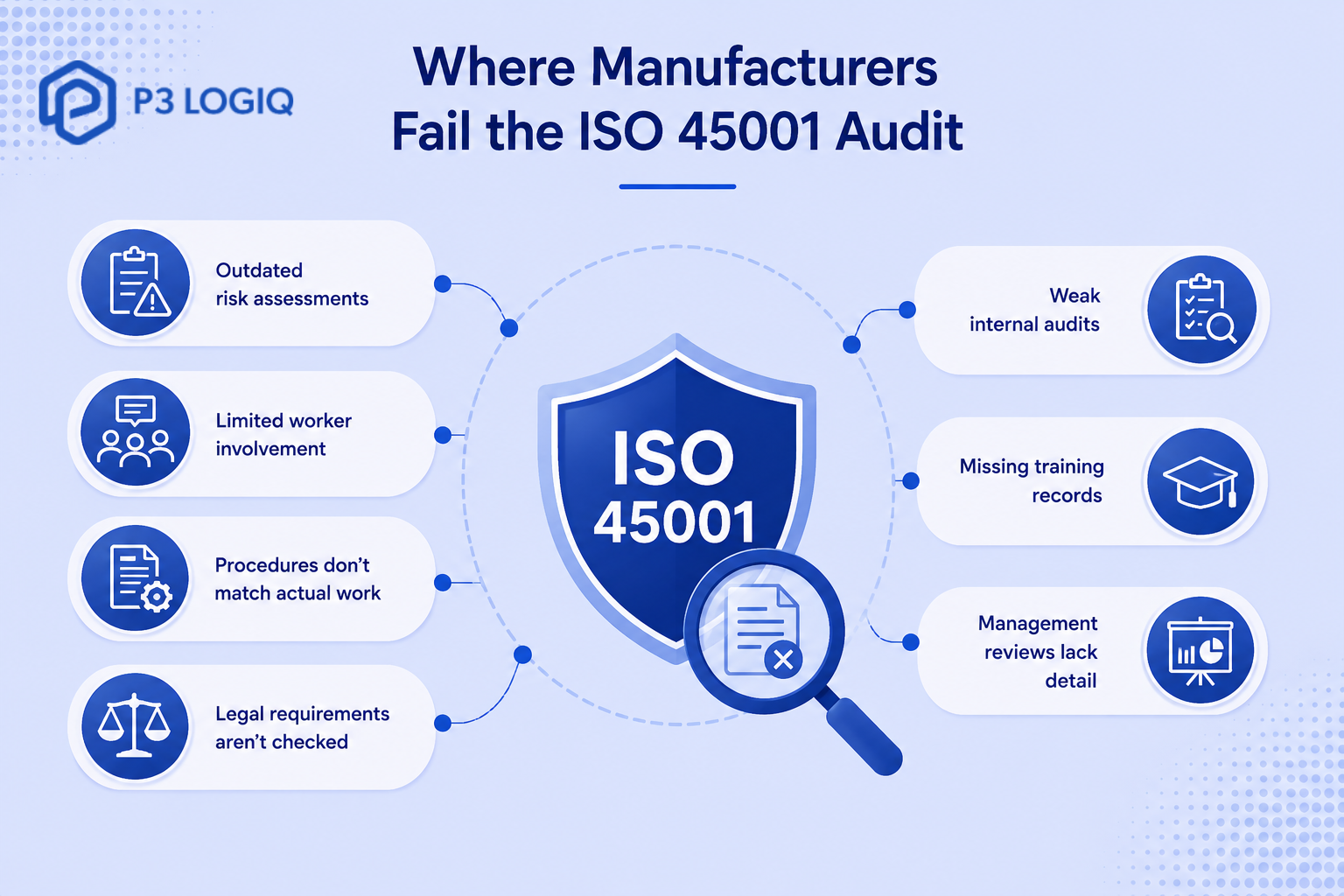
Usually, most ISO 45001 audit problems come down to a very simple issue: what you have written does not match what is actually happening at your plant. So here are some of the common areas where manufacturers run into trouble.
Your risk assessments should change when your workplace changes. New machinery, process changes, accidents, or near-misses may require you to review them.
A written policy saying that workers are consulted is not enough. Auditors may look for evidence such as safety meetings, worker feedback, and employee involvement in risk assessments.
Your documents should reflect what workers really do. If a procedure says one thing but workers aren’t actually following that process, an auditor can raise a finding.
Keeping a list of applicable health and safety laws is only part of the requirement. You also need to regularly check whether your plant is actually meeting those requirements and keep evidence of the review.
An internal audit should help you find problems before the certification audit. If you’re working across multiple standards, the approach that’s usually used for ISO 14001 certification can also inform how you review processes, records, and compliance, helping prevent rushed audits from leaving important gaps unnoticed.
You need evidence that workers have the training and skills required for their jobs. Expired or missing records are easy for auditors to spot.
Management reviews should look at real information such as incidents, audit results, safety objectives, and areas that need improvement. Treating the review as a paperwork exercise can leave important issues unresolved.
These problems are usually easy to prevent. A thorough internal audit, honest worker feedback, and regular reviews of your procedures can help you find and fix gaps before the external auditor does.
Getting certified is only the beginning. You need to keep following and reviewing your safety system throughout the three-year certification cycle.
Your initial certification audit checks whether your safety management system meets ISO 45001 requirements and is being properly implemented.
Your certification body conducts surveillance audits to check that your system is still working. These audits are smaller than the initial certification audit, but you still need to provide evidence that your safety processes are being followed.
At the end of the three-year cycle, you go through a full recertification audit. If you meet the requirements, your certification cycle continues.
The biggest mistake is treating certification as a one-time project. Once you’ve put your ISO 45001 system in place, you need to keep it working through regular risk assessments, worker involvement, corrective actions, internal audits, and management reviews. If you’re also working toward ISO 9001, understanding the differences between ISO 9001 and ISO 45001 can help you manage both systems without duplicating work.
Regularly reviewing incidents, near-misses, and safety performance helps you find problems early and stay ready for your next audit.

The cost of ISO 45001 certification depends on your company size, number of sites, existing safety systems, and the complexity of your operations. There is no fixed price really, so manufacturers of similar sizes can still receive different quotes.
In the U.S., certification can cost around $5,000 for a small, single-site manufacturer and $50,000 or more for a larger or more complex operation. This can include consulting, training, documentation, and certification audit fees. Multi-site companies usually pay more because each location adds to the audit time.
The biggest cost factors are:
For you, the value of a stronger safety system goes beyond simply preventing workplace injuries. When your safety processes are working well, you can reduce incidents, production downtime, compensation claims, and other avoidable costs.
Certification can also help you qualify for contracts with customers in industries such as automotive, construction, and defense, where ISO 45001 may be a supplier requirement.
Managing all of this manually can become difficult for when your safety system grows. Corrective actions can be missed, training records can become outdated, and important documents can be difficult to track across different files and spreadsheets.
Looking into ISO standards for the first time or streamlining compliance, P3 LogiQ helps manufacturers keep their ISO 45001 documentation, risk register, and corrective actions organized in one place.
This makes it easier to track what has been completed, what still needs attention, and how your safety system is performing throughout the year.
For many manufacturers, the cost of certification is small compared with the financial impact of a serious workplace incident or losing a contract because you do not meet a customer's certification requirements.
ISO 45001 is being updated for the first time since it was published in 2018. ISO's technical committee, ISO/TC 283, confirmed the revision in 2024, and the update is currently being developed and reviewed.
ISO 45001:2018 remains the current standard, with the revised version expected in 2027. The final publication date and requirements can still change.
The exact requirements are not final yet, but the revision is expected to give more attention to:
These changes are still being discussed, so you should not treat them as final ISO 45001 requirements yet.
You do not need to change your certification today. Instead, review dedicated ISO 45001:2027 update insights and use the upcoming revision as a reason to evaluate your existing safety practices. Also follow these actions:
You won’t know the exact transition period until ISO 45001:2027 is officially published. Based on how previous ISO management system updates have worked, you may get a transition window to move from the current standard to the revised one. For now, though, don’t rely on any specific deadline until ISO officially confirms it.
For now, ISO 45001:2018 remains the standard that you need to follow.
A safety system that only works because one supervisor remembers to check the guard, or one manager happens to keep good notes, isn't really a system. It's a habit, and habits can break the moment that person is out sick or moves on.
ISO 45001 helps close that gap by turning safety into a process the plant follows, rather than something that only lives in someone's head.
Risk registers, training sign-offs, corrective action logs, and contractor records often end up scattered across spreadsheets and emails, making it hard to know what’s current. That’s where certification efforts can lose its value because managing everything becomes such a hassle.
This is the gap P3 LogiQ is built to close.

It brings document control, audits, corrective actions, risk tracking, and training records into one place so your team can find what they need without digging through files, and an auditor can see the evidence without a scavenger hunt.
Whether you're just starting a gap analysis or you're already a few audits into an existing system, having that structure in place can make the rest of the process much easier.
Curious what it may look like in practice? Book a demo and see how manufacturers use P3 LogiQ to stay organized across sites and walk into audits prepared instead of scrambling.
Or skip ahead and sign up to start getting your ISO 45001 documentation and tracking in order now.
No, ISO 45001 certification is voluntary under the law. However, many customers, insurers, and supply chain partners may require it, especially in automotive, construction, energy, and defense. So, while certification is not legally mandatory, it can become important when you want to win contracts.
Most single-site manufacturers without an existing management system need about six months to a year. This usually covers gap analysis, planning, risk assessment, documentation, training, internal auditing, and the two-stage certification audit. Larger plants, multiple sites, and more complex operations may take longer.
ISO 45001 replaced OHSAS 18001 in 2018 and introduced important changes. It focuses more on preventing risks before incidents happen, requires stronger senior management involvement, gives workers a greater role in safety, and considers contractors and outsourced activities within the safety management system.
In the U.S., certification can cost around $5,000 for a small single-site manufacturer and $50,000 or more for larger operations. The final cost depends on employee numbers, site count, operational complexity, existing management systems, consulting needs, training requirements, and certification audit fees.
Yes, but the training should match each worker's responsibilities. Employees need awareness of workplace hazards, safety procedures, reporting methods, and emergency actions. Supervisors and safety-critical workers may need additional training in areas such as risk assessment, incident investigation, emergency response, and operational safety controls.
Yes. ISO 45001 can be used by manufacturers of any size, with no minimum employee requirement. Smaller companies may have a simpler implementation because they have fewer sites and shorter reporting lines. If you already have safety practices in place, you may mainly need to organize and document them.
ISO 45001 certification generally follows a three-year cycle. After the initial certification audit, your certification body conducts surveillance audits during the following years to check that your system remains effective. At the end of the cycle, you undergo a full recertification audit to continue your certification.
The certification audit has two stages. Stage 1 reviews your documents and checks whether your management system is ready. Stage 2 involves an on-site assessment, where the auditor reviews records, talks with workers, observes operations, and checks whether your safety procedures are actually being followed.
Yes. ISO 45001 requires you to consider health and safety risks associated with contractors, temporary workers, and outsourced activities. You should set safety requirements, communicate workplace hazards, and monitor relevant contractor activities. This helps ensure that workers outside your direct workforce are also covered by your safety arrangements.
ISO 45001:2027 is being developed, with publication expected in 2027. The revision is expected to give more attention to psychosocial risks, emergency preparedness, resilience, contractors, supply chains, and digitalization. However, the requirements are not final yet, and ISO 45001:2018 remains the current standard.


Businesses need document management systems (DMS) to ensure ISO and R2 compliance, improve efficiency, and stay audit-ready. The article highlights key features like version control, security, and automation while reviewing the top 5 DMS solutions. P3 LogiQ stands out for its compliance-focused automation and secure document tracking
Read More
Recycling businesses gain efficiency, compliance, and sustainability with RIOS certification. It streamlines quality management, environmental responsibility, and worker safety, helping companies avoid legal risks and boost credibility. P3 LogiQ simplifies the certification process with automation, document control, and compliance tracking, making operations smarter and safer.
Read More
Audit Management Software (AMS) automates compliance tracking, streamlines workflows, and reduces audit risks. Key features include automated scheduling, compliance checklists, CAPA tracking, vendor risk management, and integrations.
Read More
Learn how audit management systems simplify ISO and R2 compliance by automating audits, managing documentation, and minimizing compliance risks efficiently.
Read More
In 2025, many businesses still face challenges in compliance management due to outdated methods like spreadsheets and fragmented software. This inefficiency leads to missed deadlines, increased risk, and regulatory penalties. The blog emphasizes the importance of modern compliance tools that automate workflows, enhance risk management, and streamline regulatory processes to meet ISO and R2 standards.
Read More
The rise in e-waste and environmental concerns makes responsible electronics recycling essential. The R2 Certification sets a global standard for safe, sustainable, and data-secure recycling practices. Developed by Sustainable Electronics Recycling International (SERI), R2 helps businesses manage environmental risks, data security, worker safety, and legal compliance.
Read More
Businesses face increasing challenges in managing complex regulatory compliance. Manual methods such as spreadsheets and paperwork can lead to missed deadlines, inefficiencies, and costly penalties. Compliance management software offers a streamlined solution to reduce risks, automate processes, and improve operational efficiency.
Read More
Maintaining R2 Certification is crucial for businesses in the e-waste recycling industry, ensuring regulatory compliance, sustainability, and strong stakeholder trust. This guide outlines 10 best practices to help businesses simplify operations, reduce risks, and stay compliant.
Read More
Unlock the value of ISO risk management certification. Explore its impact on compliance, risk mitigation, and business expansion.
Read More
Explore the top 5 ISO risk management software tools for 2025, including document management solutions for streamlined compliance and increased efficiency.
Read More
Find the ideal document management software (DMS) for your business. Learn how to choose with expert tips, key features, and insightful guidance
Read More
Unlock the power of a Document Management System (DMS). Learn how it can revolutionize your business operations.
Read More







.png)


.png)



.jpg)



.jpg)
.jpg)








.jpg)



.png)

.png)
.png)



.png)

